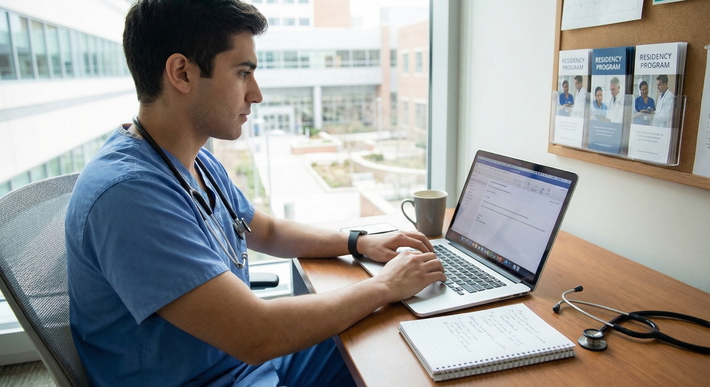
Residency interviews are high‑stakes, fast‑paced, and often blur together—both for you and for your interviewers. Thoughtful follow-up can set you apart as a professional, polished MD graduate residency candidate and reinforce your fit for a program. Done poorly, it can come across as generic, excessive, or even unprofessional.
This guide walks you step‑by‑step through effective thank you notes and post interview follow up strategies specifically for MD graduates coming from allopathic medical schools. You’ll learn what to send, when to send it, what to say—and when not to say anything at all.
Why Thank You Notes Still Matter in the Residency Match
Many applicants wonder whether a residency thank you note genuinely influences the allopathic medical school match process. While a single email rarely changes a rank list on its own, thoughtful follow‑up has several real benefits:
Professionalism and courtesy
- Programs expect physician colleagues to communicate clearly and courteously.
- A well‑crafted thank you email after interview signals maturity, respect, and attention to detail.
Reinforcing interest and fit
- Interview days are short, and each faculty member meets dozens of applicants.
- A good residency thank you note briefly reinforces how your goals align with their program, helping them remember you.
Clarifying or adding information
- You can clarify something you wish you’d answered differently.
- You can add one brief update (e.g., new publication, leadership role) if it’s truly significant.
Maintaining appropriate contact
- Structured, professional follow up prevents you from over‑emailing or sending emotional messages late in the season.
- It creates a simple, one‑time communication that closes the loop respectfully.
Leaving a positive last impression
- Your follow‑up is often the last thing a program sees from you before ranking.
- A clear, concise note supports a mental image of you as organized and easy to work with.
Thank you notes will not fix a weak application or override major red flags. However, they can elevate a strong or solid interview into a memorable one—and protect you from avoidable missteps.
Timing, Format, and Logistics: Getting the Basics Right
Before worrying about wording, it’s critical to get the logistics right. Poor timing or format can undermine even the best content.
When to Send Your Thank You Notes
For most MD graduate residency applicants, this timing works best:
- Ideal window: Within 24–48 hours after your interview day
- Acceptable window: Up to 3–4 days after the interview
- Too late: More than a week later (unless you were explicitly invited to send an update later)
Why this matters:
- You’re still fresh in the interviewers’ minds.
- The interview day details are still vivid for you, which helps you customize your notes.
- It feels timely and professional, not like a last‑minute box‑checking exercise.
Email vs. Handwritten Notes
In the era of ERAS and virtual interviews, email is strongly preferred for residency thank you notes:
Use Email Because:
- It’s fast (received within minutes).
- It’s easy to forward or save in the program’s file.
- It matches how residency selection committees typically communicate.
Handwritten notes may be appropriate if:
- The program is local, you interviewed in person, and the culture felt more traditional.
- You already have an ongoing relationship with the person (e.g., a mentor, research PI, or clerkship director who interviewed you).
If you do send a handwritten note, also send an email—handwritten mail can be delayed, misplaced, or never reach the person.
Who Should Receive a Thank You Email?
Use this general hierarchy:
- Your main faculty interviewers – Always send a thank you email after interview to each primary interviewer you spoke with one‑on‑one or in a small group.
- Program Director (PD) – Usually send at least one note to the PD, even if you had only a brief interaction.
- Associate/Assistant Program Directors – Reasonable to include if you had a meaningful conversation.
- Residents you met in a formal interview – Send notes to residents who actually interviewed you or spent significant dedicated time with you (e.g., 30‑minute session).
- Program Coordinator – A brief thank you for logistics and help is appropriate and appreciated, but not mandatory.
You don’t need to email every resident you met during socials or large group sessions. Focus on those with whom you had substantive, individualized conversation.

How to Write an Effective Residency Thank You Email
A strong thank you email after interview is brief, specific, and professional. Think of it as a highlight reel, not a second personal statement.
Key Principles for Content and Tone
- Keep it short: 150–250 words is usually enough.
- Be specific: Reference a particular topic, case, or program feature you discussed.
- Stay professional: Use formal language, correct titles, and polished writing.
- Avoid pressure: Do not ask about your ranking or imply a commitment from them.
- Be honest: Don’t claim the program is your “top choice” unless you mean it and understand the implications.
Basic Structure of a Residency Thank You Note
A simple structure that works well for MD graduate residency applicants:
- Subject Line
- Greeting with proper title
- Thank you for their time
- Specific reference to your conversation or the program
- Brief reinforcement of fit and interest
- Professional closing
Example Subject Lines
- “Thank you – [Your Name], [Specialty] Interview on [Date]”
- “Gratitude for our interview conversation – [Your Name]”
- “Thank you for the opportunity to interview at [Program Name]”
Sample Template for Faculty Interviewer
Feel free to adapt this template, but avoid copy‑pasting it verbatim for every interviewer.
Dear Dr. [Last Name],
Thank you very much for taking the time to speak with me during my [specialty] residency interview at [Program Name] on [date]. I appreciated the opportunity to learn more about your work in [specific area you discussed] and the program’s approach to [unique feature, e.g., resident autonomy, teaching, community care].
Our conversation about [specific topic, patient case, research interest, or training philosophy] especially resonated with me. As an MD graduate from [Your Medical School], I have particularly valued [related experience], and I was excited to see how strongly this is emphasized at [Program Name].
My interview day confirmed my enthusiasm for [Program Name] and reinforced my belief that it would be an excellent environment to grow as a clinician and educator. Thank you again for your time and for considering my application.
Sincerely,
[Your Full Name], MD
AAMC ID: [Number]
[Optional: Phone number]
Sample Template for Program Director
Dear Dr. [Last Name],
Thank you for the opportunity to interview at the [Program Name] [Specialty] Residency Program on [date]. I am grateful for the chance to learn more about the program’s curriculum, culture, and commitment to resident education.
I was particularly impressed by [specific detail: e.g., the emphasis on resident mentorship, the structure of the continuity clinic, the diversity of the patient population, or the program’s support for scholarly activity]. Speaking with you and the residents reinforced my sense that [Program Name] offers the balance of rigorous clinical training and supportive environment that I am seeking.
As an MD graduate trained at [Your Medical School], I am excited by the opportunity to contribute to a program that values [specific value: patient advocacy, teaching, research, QI, leadership]. My interview experience has made me even more enthusiastic about the possibility of joining your residency.
Thank you again for your time and for considering my candidacy.
Best regards,
[Your Full Name], MD
AAMC ID: [Number]
Sample Template for Resident Interviewer
Dear Dr. [Last Name] / Dear [First Name] (if they invited you to use it),
Thank you for taking the time to speak with me during my interview day at [Program Name]. I appreciated your candid perspective on the resident experience and your insights about [specific area: call schedule, teaching culture, fellowship placement, life in the city].
Hearing about your experiences with [specific rotation, elective, or aspect of the program] helped me better understand what day‑to‑day life is like for residents at [Program Name]. Your description of the camaraderie among residents and the support from faculty was especially meaningful to me as I look for a program with a strong sense of community.
I am very excited about the possibility of training at [Program Name] and would be honored to work alongside residents like you. Thank you again for sharing your experiences and for helping make the interview day so informative.
Sincerely,
[Your Full Name], MD
AAMC ID: [Number]
Strategic Follow-Up Beyond the Initial Thank You
Sending a thank you email after interview is just the first step. Many MD graduates aren’t sure how much additional post interview follow up is appropriate—or how it fits into the allopathic medical school match rules and norms.
Types of Acceptable Follow-Up
Initial Thank You Note
- Sent within 24–48 hours
- Content as described above
One Targeted Update or Clarification (Optional)
- Send only if you have a meaningful new achievement or clarification, such as:
- New first‑author publication accepted
- Significant new leadership role
- Major award or honor
- Rank‑defining change in your interests (e.g., genuine geographic or program focus)
- Keep it brief and attach updated CV if relevant.
- Send only if you have a meaningful new achievement or clarification, such as:
Post‑Interview Interest/Intention Communication
- Some applicants send one additional note later in the season (often January/early February) to express continued interest.
- This should respect NRMP communication guidelines (more on this below).
What NOT to Do in Follow-Up
Avoid these common pitfalls:
- Multiple emails to the same person without substantive reason.
- Asking how you will be ranked or implying that they should rank you highly.
- Pressuring statements, e.g., “I will only rank you #1 if you tell me I will match there.”
- Mass emails that sound generic and could apply to any program.
- Negative comments about other programs or your own medical school.
When in doubt, err on the side of less follow‑up, but higher quality.

NRMP Rules, Ethics, and “Love Letters”: What You Can and Cannot Say
Post interview follow up is constrained by NRMP rules and professional ethics. As an MD graduate, you’re already familiar with professionalism standards; this is where they’re tested.
What NRMP Prohibits
The NRMP Match Participation Agreement forbids:
- Programs requiring or soliciting statements about ranking intentions.
- Applicants and programs making binding commitments outside the Match.
- Any behavior that misrepresents your intentions or coerces the other party.
While non‑binding “preference signals” (e.g., “You are my top choice”) are not strictly prohibited, they can be ethically gray if misused.
Communicating Genuine Interest Ethically
You may express your level of interest, but:
- Be truthful: Do not tell more than one program they are your #1 if that’s not true.
- Be clear but measured: Avoid language that could be interpreted as a binding contract.
Examples of reasonable, ethical statements:
- “Your program remains one of my very top choices, and I would be thrilled to match there.”
- “After completing all my interviews, [Program Name] stands out as my top choice, and I plan to rank it accordingly.” (Use this only if accurate, and only for one program.)
- “I continue to feel that [Program Name] is an excellent fit for my training goals.”
Example: Post-Interview Interest Email (Optional, Later in the Season)
Dear Dr. [Last Name],
I hope you are doing well. I wanted to thank you again for the opportunity to interview at the [Program Name] [Specialty] Residency and to let you know that my interest in your program has only grown since our interview day.
After reflecting on my interviews, I continue to feel that [Program Name] offers the combination of strong clinical training, mentorship, and [specific program feature, such as research support or commitment to underserved care] that I am seeking in a residency. As I prepare my rank list, your program stands out as a particularly strong fit with my goals as an MD graduate pursuing [specific interest, e.g., academic medicine, primary care, subspecialty training].
Thank you again for your time and for considering my application.
Sincerely,
[Your Full Name], MD
AAMC ID: [Number]
Use this kind of message sparingly—typically once per program, and only for a few programs where you have a genuine, strong interest.
Practical Tips, Examples, and Common Pitfalls for MD Graduates
Customizing Notes Efficiently Across Many Programs
Many MD graduate residency applicants apply broadly and interview at 12–20+ programs. Personalized notes for each interviewer can feel overwhelming, but there are strategies:
Take notes immediately after each interview day
- Jot down:
- Names and titles of interviewers
- Key discussion points
- Unique aspects of the program
- Any personal or professional connection
- Use a simple template or spreadsheet for consistency.
- Jot down:
Create a flexible base template
- Draft one or two core thank you email structures for each role (PD, faculty, residents).
- Customize 2–4 lines for each person (conversation topics, specific interests).
Batch your work
- Set aside 1–2 hours the evening after your interview (or the next morning) to write all your thank yous for that program.
- This helps keep details fresh and prevents backlog.
Examples of Good vs. Weak Thank You Notes
Weak / Generic:
Dear Dr. Smith,
Thank you for interviewing me. I enjoyed learning about your program. I hope to match at [Program Name].
Sincerely,
[Name]
Problems: No specifics, no personalization, sounds copy‑pasted, adds no value.
Stronger / Specific:
Dear Dr. Smith,
Thank you very much for taking the time to speak with me during my interview at [Program Name] on December 5. I especially appreciated our discussion about teaching on the inpatient wards and your approach to involving residents in bedside teaching with students.
As an MD graduate who enjoyed serving as a peer tutor and sub‑intern mentor at [Medical School], I resonated with your emphasis on developing residents as educators. Our conversation reinforced my belief that [Program Name] would be an excellent environment to grow as both a clinician and teacher.
Thank you again for your time and for considering my application.
Sincerely,
[Name], MD
Handling Special Situations
If You Think the Interview Went Poorly
Resist the urge to write a long, defensive email. Instead:
- Send a standard, professional thank you that focuses on what you learned and your interest.
- Only briefly clarify a misunderstanding if it was truly significant and objective (e.g., you misspoke about a date, mis‑stated a publication detail).
Example:
I also wanted to clarify one point from our conversation: when discussing my research experience, I misstated the year of our data collection. The study actually ran from 2022–2023, not 2021–2022. I apologize for the confusion.
Then move on. Do not apologize excessively or rehash your entire interview.
If You’ve Changed Your Specialty Intentions
Occasionally, an MD graduate might be interviewing in two specialties or rethinking their plans. In your thank you notes:
- Maintain your professional presentation in the specialty you interviewed for.
- Do not mention active pursuit of another specialty in these emails.
- If you truly decide to withdraw from that specialty, follow program instructions for withdrawal (through ERAS or direct program contact) rather than using thank you emails for that purpose.
If You Forget to Send a Thank You
If you realize this within a week:
- It’s reasonable to send a slightly delayed note, briefly acknowledging the delay without over‑apologizing.
I apologize for the delay in sending this note; I remain very grateful for the opportunity to interview at [Program Name] on [date]…
If it’s been several weeks or more:
- Skip the thank you and, if needed, send a concise interest/update email later in the season instead.
Frequently Asked Questions (FAQ)
1. Are thank you emails required for residency interviews?
They are not required, and some programs explicitly state that thank you emails are unnecessary. However, in most cases, a concise, professional residency thank you note is still appropriate and can leave a positive impression. If a program specifically says “please do not send thank you emails,” follow their instructions and do not send one.
2. Can a thank you email after interview change my position on the rank list?
A single email rarely causes a dramatic change, but it can:
- Help interviewers remember you more clearly.
- Reinforce a positive impression.
- Demonstrate professionalism and communication skills.
In borderline cases or tie‑break situations, a well‑crafted note may contribute to how a committee feels about your candidacy. Still, your interview performance, letters, academic record, and overall application weigh much more heavily in allopathic medical school match decisions.
3. Should I tell a program they are my number one choice?
You may tell one program they are your number one if:
- It is completely true.
- You understand this is a significant professional communication.
- You do not tell multiple programs the same thing.
If you’re uncomfortable making that commitment, you can use softer but still honest language, such as “one of my top choices” or “a program where I would be truly excited to train.”
4. How many post interview follow up messages are appropriate per program?
For most MD graduate residency applicants, a reasonable maximum per program is:
- 1 thank you email per interviewer (sent within 24–48 hours).
- At most 1 additional follow‑up or interest/update email later in the season (only if you have a meaningful update or strong, specific interest).
Beyond that, additional messages usually don’t help and may be seen as excessive.
Thoughtful, well‑timed thank you notes and measured post interview follow up won’t guarantee a match, but they can sharpen your professional image and reinforce your fit at programs where you genuinely hope to train. As an MD graduate entering this next phase, approach these communications with the same care, clarity, and integrity you bring to patient care—you’ll stand out for the right reasons.