
What do you actually think happens to your position on a residency program’s rank list the moment you hit “send” on that perfectly crafted thank-you email?
The uncomfortable truth: thank-you emails almost never move rank lists
Let me be blunt: in the vast majority of programs, your thank-you email does not change your rank position in any meaningful way.
That is not what you’ve been told by older residents, Reddit threads, or the anxious group chat. You’ve probably heard some version of, “It can’t hurt and might help bump you up.” Sounds nice. Also mostly false.
Here’s what the data and real-world practice show:
- The NRMP’s Program Director Survey (historically and pre-2022 thank-you-ban discussions) consistently shows that post-interview communication is way down the list of factors that affect ranking. Things that dominate: interview performance, letters, MSPE, grades, perceived fit.
- Many large academic programs finalize or nearly finalize rank lists the same day or week of your interview. Some literally lock them at the end of the interview day while everyone’s memory is fresh.
- A nontrivial number of programs have explicit policies: “We do not consider post-interview communication when creating our rank list.”
Does that mean thank-you emails are useless? No. But you need to understand what they actually do, and stop pretending they’re secret rank steroids.
Let’s separate three different questions that get conflated:
- Do thank-you emails change your actual numeric position on the list?
- Can any post-interview communication ever affect outcomes?
- Should you send them anyway?
The answers: rarely, sometimes, and yes—but not for the reasons you think.
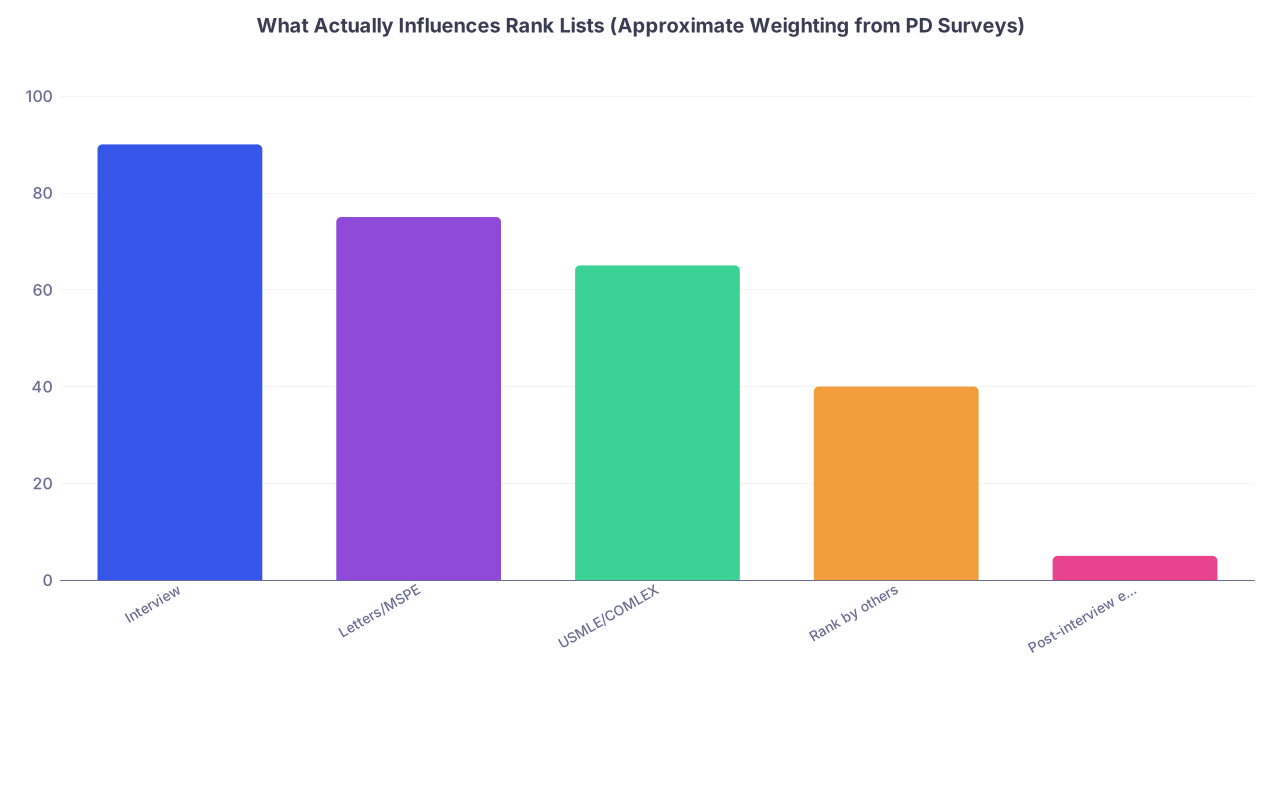
| Category | Value |
|---|---|
| Interview | 90 |
| Letters/MSPE | 75 |
| USMLE/COMLEX | 65 |
| Rank by others | 40 |
| Post-interview emails | 5 |
How rank lists are really made (and where emails fit in)
Here’s the piece almost nobody explains clearly. Most applicants imagine some mysterious, fluid process that continues for weeks where every tiny “signal” nudges you up or down. That makes you think a strong thank-you note could be the magic push.
Reality is a lot more structured—and less romantic.
At many programs (especially medium to large ones), the process looks something like this:
- Interviewers score you on a rubric the day of your interview. This may be a composite of “fit,” clinical readiness, communication, red flags, and sometimes test scores, research, etc.
- Those scores get aggregated into tiers or a preliminary rank order list.
- The Clinical Competency Committee / Selection Committee meets and goes through the list. People argue. Strong advocates speak up. The group adjusts some positions. They identify “do not rank” applicants. They may flag “must rank” candidates.
- The list gets refined over a few sessions and then essentially locked.
Notice what’s missing: “Check thank-you email folder and reshuffle top 40.”
At smaller community programs or places where the PD really runs the show, the process may be less formal. Still, they are not sitting there with two nearly identical candidates and saying, “Well, this one wrote a better thank-you paragraph, so bump them up three spots.”
Do they read them? Usually yes. Do they appreciate them as human beings? Often. Do they systematically re-score you because of them? Almost never.
But I heard of someone whose email “saved” them
I’ve heard the stories too:
- The candidate who sent a heartfelt email clarifying a perceived red flag.
- The applicant who followed up to show real understanding of a niche track (physician-scientist, global health, etc.).
- The person who wrote a very personal note to a PD who actually cared and remembered.
These stories fall into two categories:
- Exception cases where the email addressed something substantive the committee was worried about (professionalism issue, location concern, specialty switch explanation).
- Stories where the applicant got in and retroactively credited their thank-you email—when in reality they were already high on the list.
Humans love causality. “I sent a powerful message and then I matched there” feels better than “I interviewed well and was already ranked highly.” Residency is no exception.
The rare situations where an email can matter
Now let me contradict myself (slightly). There are narrow, specific situations where your post-interview communication can have real impact. But it’s not the typical generic thank-you.
1. Clarifying serious concerns
If your interview had a landmine—Step failure, leave of absence, disciplinary notation, failed remediation—and you handled it awkwardly, a concise, thoughtful follow-up can sometimes improve how they view that issue.
Not: “Sorry again for that.”
More: “I realized I did a poor job explaining X. Here’s the concise version of what happened, what I learned, and how my performance since then reflects that growth.”
This doesn’t catapult you from rank #60 to #5. But it can bump you from “maybe don’t rank” to “okay to keep on the list.” That’s a meaningful shift.
2. Correcting misunderstandings about your goals or geography
Programs are obsessed with “will this person actually come here?” Especially mid-tier or geographically less desirable places.
If you live on the coasts but interview in the Midwest and your interview answers made you sound noncommittal, a follow-up clarifying that you and your partner have family nearby or you’re genuinely open to staying long-term can address a silent doubt that was pushing you downward.
Again: this is about substance, not flattery.
3. When the PD explicitly invites continued communication
Some PDs tell you clearly on interview day:
- “If this is your top choice, I want to know.”
- “If you have any questions or want to express your interest, email me directly.”
In those rare cases, failing to follow up can hurt you relative to similarly ranked applicants who did. But even then, the effect is usually within a narrow band. Think “tie-breaker between two very similar candidates,” not “dramatic rank leap.”
4. At very small or very personality-driven programs
There are programs—small community sites, niche subspecialty-heavy departments—where the PD legitimately “goes with their gut” and keeps mental notes about who seems genuinely engaged.
If you’re one of 3–5 people they really remember, a well-written, specific note can reinforce that impression right before they finalize ranks. This is the least predictable but most plausible setting where your email can matter a bit more.
Still, if you interviewed poorly, no email fixes that. It might turn a strong interview into a slightly stronger position, not salvage a disaster.
What thank-you emails are actually good for
If they’re not magic rank boosters, what’s the point?
They’re actually useful for three things, just not the three you’re obsessing over.
1. Professionalism and reputation
Your career is longer than this match cycle. PDs talk. Faculty move. You may cross paths with these attendings in fellowship interviews, conferences, or job searches.
A short, respectful thank-you tells them you know how to close a professional interaction properly. That matters in medicine, which is still hilariously old-school about etiquette.
You’re not being graded on a rubric for this, but you’re building a pattern: good email tone, timely responses, clarity. That stuff sticks.
2. Keeping doors open outside the match
You’d be surprised how often this happens:
- A program doesn’t rank you high enough and you don’t match there.
- A year later, they have an unexpected PGY-2 spot.
- The PD vaguely remembers, “That applicant from last year who stayed in touch / was very professional…”
- They reach out.
Or you’re applying for fellowship, and an attending you interviewed with is now on that selection committee or knows someone there. The way you communicated previously can quietly help you.
That’s not speculation; I’ve seen it. The candidate who wrote thoughtful thank-you notes, then later needed a nonstandard opportunity, got a warmer response.
3. Getting useful information (if you’re smart about it)
You can use thank-you emails to ask pointed, non-Googleable questions:
- “How have your graduates placed into heme/onc fellowships in the last few years?”
- “You mentioned changes to night float—how has that affected resident wellness boards scores or attrition?”
- “You spoke about expanding a global health track. What would concrete resident involvement look like in the next 2–3 years?”
You’re not sucking up. You’re gathering decision-critical intel while strengthening a relationship. That’s a better use of that email than copy-pasted “Thank you for your time, I appreciated learning about your program.”
The myth of “love letters” and “this is my #1” emails
Let’s address the worst offender: the belief that telling a program “You are my number one” will dramatically boost your rank position.
Programs know applicants lie. They’ve all had the experience of:
- Applicant: “You’re my top choice. I will rank you #1.”
- Match Day: Applicant matched elsewhere, obviously having told at least one other place the exact same thing.
Most PDs now treat these pledges as background noise.
Here’s what usually happens in reality when you send a “You’re my #1” email:
- If you were already ranked highly: they nod, feel mildly pleased, maybe move you up one or two spots if they’re sentimental. But the marginal effect is small.
- If you were mid-list: they’re unlikely to overhaul their carefully debated rank list just because of a single message. They might nudge you slightly if there was already debate.
- If you were low or borderline: no email overcomes significant concerns, poor interview, or weak application.
Worse, some programs are explicitly uncomfortable with “I will rank you #1” statements because of NRMP communication guidelines. They do not want to encourage match violations. A few will actively ignore or even dislike overly aggressive messaging.
If you feel compelled to send a “high interest” message, keep it honest and restrained:
- It’s fine to say: “Your program is among my very top choices, and I can genuinely see myself thriving there.”
- It’s fine to say (if absolutely true): “I intend to rank your program first.”
- It’s not fine to make that promise to multiple programs. That’s not strategy; that’s just lying.

How to write a thank-you that’s not a waste of time
If you’re going to send them—and you probably should—do it right and do it efficiently. You have limited time and finite sanity.
Who to email
Priority order:
- Program Director
- Associate/Assistant PD you had substantial interaction with
- Key faculty or residents with whom you had in-depth conversations or interviews
You do not need to email every single resident from the social. That’s how you burn out.
Timing
Within 24–72 hours of the interview is fine. Don’t obsess. This is not a transplant organ with a half-life.
Content
Three short paragraphs is enough:
One line of thanks + specific reference
“Thank you for taking the time to speak with me on Monday. I especially appreciated learning about your approach to X.”One line that shows you actually listened
“Our discussion about Y made it clear that your program truly prioritizes Z, which aligns with my interest in A/B.”One line of forward-looking interest or question
“This conversation reinforced my strong interest in your program, and I’d be excited to train there.”
Optional: add one thoughtful, answerable question if you genuinely have one.
No thesaurus. No flowery nonsense. No attachment of your personal statement. This is not your last shot on goal; it’s a brief professional courtesy that might yield some information and goodwill.
| Aspect | More Effective | Less Effective |
|---|---|---|
| Length | 3–6 concise sentences | Long multi-paragraph essays |
| Specificity | References concrete details discussed | Generic “I enjoyed learning about…” |
| Tone | Professional, calm | Overly emotional or desperate |
| Goal | Courtesy + clarity + info | Manipulate rank list |
| Frequency | One email per relevant person | Multiple follow-ups, repeated nudges |
What actually moves your rank list position
If you’re still hoping to game the system with email, focus on the wrong lever and you’ll stay anxious and ineffective.
Here’s what consistently moves you up or down far more than any thank-you note:
- How you treated the program coordinator and residents. They absolutely talk about you. Poor behavior can drop you off the list entirely.
- Your consistency. If your personal statement says you love underserved medicine, but you light up talking only about private practice and money, people notice.
- Red flags. Subtle or obvious. Making off-color jokes. Talking over people. Being weirdly negative about your school or other programs. That sticks more than a thousand “thank you’s.”
- How well you actually performed on interview day. Articulate but authentic beats memorized talking points 100% of the time.
If you want to influence outcomes late in the game, you’d get more benefit from preparing for interviews and understanding programs deeply than from workshopping thank-you drafts.
FAQ: Thank-You Emails and Rank Lists
1. Do programs get annoyed if I don’t send thank-you emails?
Most do not punish you for silence, especially at large academic centers where they’re drowning in messages. But in small, relationship-heavy programs, sending nothing can subtly hurt compared to peers who closed the loop professionally. It won’t tank you, but it’s a missed low-effort professionalism signal.
2. Is it ever okay to send a second follow-up after my initial thank-you?
Usually no. Unless you have a genuine update that matters (new Step 2 score, new publication accepted, couples match change) and it’s clearly relevant to how they might view your file. A second email saying “Just wanted to reiterate my strong interest” screams anxiety, not maturity.
3. Should I handwrite physical thank-you cards instead of emailing?
No. This is not 1995. Physical cards are slow, easily lost, and often end up sitting in someone’s mailbox after rank meetings are done. Email is the professional norm. Handwritten notes are optional at very small, extremely personal programs—but they’re not magic.
4. Can a bad or unprofessional thank-you email hurt my rank?
Yes. This is one of the few reliable effects. Rambling, oversharing, flirting, pushy “I expect to match here” language, or passive-aggressive comments about other programs can confirm concerns about your judgment. If you can’t write a normal, adult, businesslike email, it can reinforce doubts and nudge you down or off the list.
5. If thank-you emails don’t matter much, why does everyone obsess about them?
Because they’re controllable. After the interview, everything feels out of your hands, and humans hate that. So you fixate on the one remaining lever that feels active: sending words into the void. The system rewards pre-interview work and on-the-day performance far more than post-interview rituals, but that’s harder to emotionally accept than “maybe this email will fix it.”
Key points: thank-you emails almost never meaningfully move your rank position, but they do matter for professionalism, relationships, and a few edge cases where you clarify real concerns. Send short, specific, honest messages, then stop obsessing and go back to what actually counts: how you interviewed and how well your application tells your story.