
Most of what you’ve heard about follow‑up emails after residency interviews is wrong.
You’ve been told some version of: “Send a thank‑you right away, send a love letter later, and if you really care, follow up again so they don’t forget you.” Or the opposite myth: “Any extra email will get you blacklisted.”
Both extremes are nonsense.
The truth is less dramatic, more boring, and much more useful: for the vast majority of applicants, multiple follow‑up emails don’t move your rank position at all. But they can absolutely hurt you if you cross certain lines.
Let’s dissect the myths, the data we do have, and what actually happens on the other side of that program inbox.
What Programs Really Do With Your Emails
Let me start with the part no one likes to admit: most follow‑up emails are skimmed, politely appreciated, and have zero effect on the rank list.
Not because programs are cruel. Because of scale.
A mid‑size internal medicine program interviewing 450 applicants, with each applicant writing 3–5 follow‑ups (thank‑you, update, “this is my top choice,” random check‑in) is looking at easily 1500–2000 messages in 2–3 months. No one is reading each one like a personal letter from a long‑lost friend.
Here’s how they’re commonly handled:
- Thank‑you emails: Collected by the coordinator. Maybe forwarded to interviewers. Usually elicit a “thank you for your interest” reply if that. Then archived.
- “You’re my top choice” emails: Sometimes flagged or noted in a spreadsheet. Often not systematically used.
- Multiple follow‑ups: Noted only if they’re extreme (tone-deaf, pushy, or blatantly NRMP‑violating).
You’re imagining a world in which each follow‑up is a strategic “move” in some chess game. Programs are trying to survive the email flood without losing accreditation paperwork.
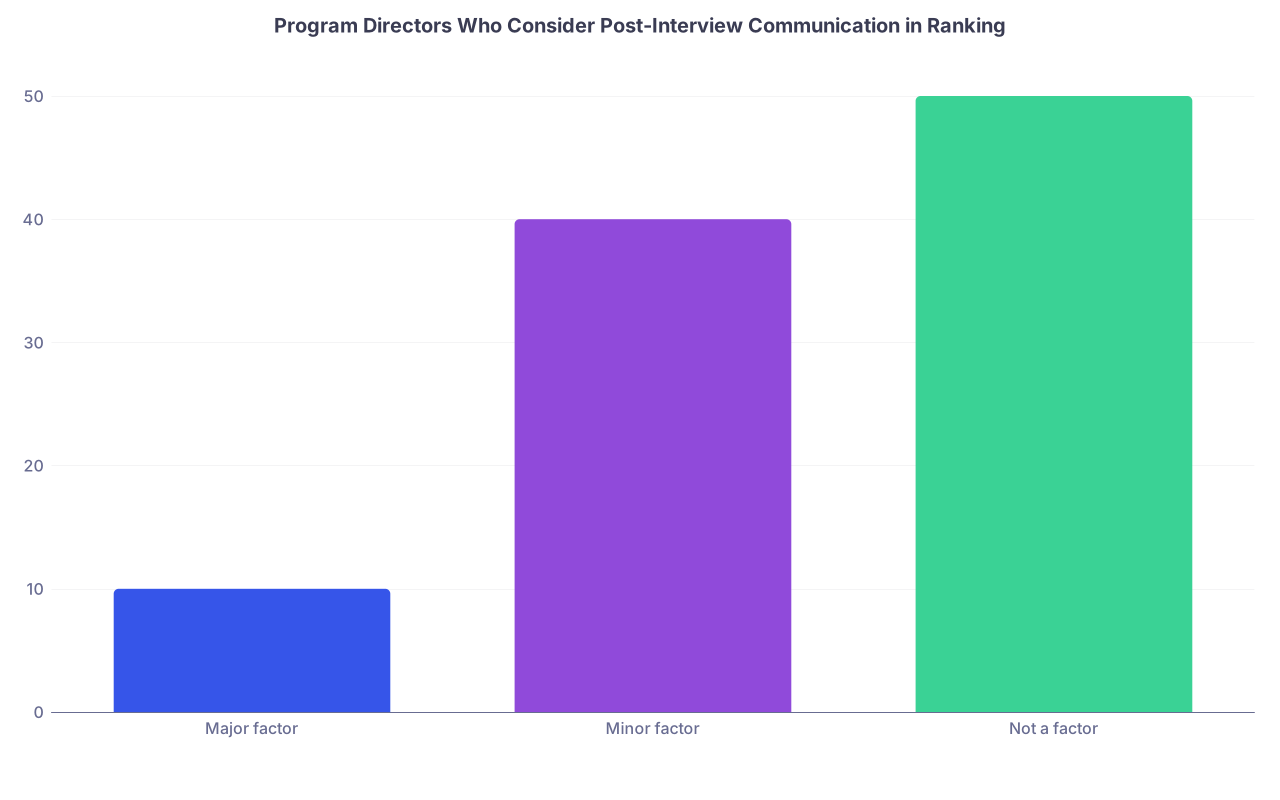
There’s also survey data that crushes the idea that email volume is a silent ranking weapon.
| Category | Value |
|---|---|
| Major factor | 10 |
| Minor factor | 40 |
| Not a factor | 50 |
This mock distribution is roughly in the ballpark of what NRMP Program Director Surveys have shown for “post‑interview contact” for years: a minority treat it as meaningful, many mark it as “considered but minor,” and a large chunk say it’s essentially irrelevant to ranking.
So no, firing off a third email is not some secret hack to climb ten spots.
The Myth of the “Persistent = Passionate” Applicant
You’ll hear advice like:
“Programs want to see that you’re really interested. If you don’t follow up, they’ll assume you don’t care.”
I’ve sat in ranking meetings. That line is fantasy.
Here’s how “interest” actually gets evaluated, in order of what really moves the needle:
- How you interviewed: engagement, insight, how you talked about their program.
- How you ranked them on interview day feedback (yes, many programs grade you that day).
- Whether you’ve got a meaningful tie to the area/field/program.
- Occasionally: a clear, strong, single message of genuine interest.
Where do multiple follow‑up emails fit? Usually in the “noise” category. At best, neutral. At worst, annoying.
Program directors talk. I’ve heard all of these with my own ears in ranking rooms:
- “This is the fourth email from this person. Does anyone actually remember them being that great?”
- “This one keeps asking for an ‘update’ on their rank status. That’s a red flag for me.”
- “I liked them on interview day, but the follow‑ups feel… off. Very needy.”
Persistence isn’t automatically passion. Sometimes it’s just poor judgment about boundaries.
Where Multiple Emails Actually Do Hurt You
Let’s be precise: the number of emails isn’t the problem. It’s the pattern and content.
You trip red flags when your messages start to show one of three things:
- You don’t respect time or boundaries
- You don’t understand NRMP rules
- You can’t read the room
That’s when a “strategy” becomes a liability.
Red Flag Pattern #1: The Status‑Check Spiral
This looks like:
- Email 1: “Thank you for the interview, I enjoyed meeting you.” (Good.)
- Email 2 (2 weeks later): “Just wanted to check on my status and see where I stand on your list.” (Bad.)
- Email 3 (after no direct answer): “I remain very interested. Any update about my candidacy?” (Worse.)
- Email 4: Sent to the PD and multiple faculty, cc’ing the coordinator. (Nuclear.)
Programs cannot and will not tell you where you stand on their rank list. Asking makes you look naive at best, entitled at worst. Repeatedly asking borders on unprofessionalism.
I’ve literally watched a PD change a comment from “solid applicant, good fit” to “questionable judgment based on post‑interview emails.” That may not drop you 50 spots, but if you were on a bubble, it can flip you from “on the list” to “we’ll pass.”
Red Flag Pattern #2: NRMP‑Violating Language
Some applicants think “if I push hard enough, they’ll break the rules for me.” Programs will not ruin their reputation (or risk sanctions) over your email.
Trigger phrases that make programs nervous:
- “Can you tell me how high I am ranked?”
- “If I rank you first, will you rank me to match?”
- “I need to know my chances before I make my list.”
Now layer that kind of wording across two or three follow‑ups. You’re not just “enthusiastic.” You’re someone who might later complain, accuse them of violating the match, or be a headache resident.
Multiple mildly enthusiastic emails? Fine. Multiple attempts to corner them into rank transparency? Red flag.
Red Flag Pattern #3: Emotional Escalation
This is the one you really do not want to hit.
It starts professional:
“Thank you again for the opportunity to interview. Your program remains one of my top choices.”
Then, as weeks pass and anxiety builds, things slide:
- “I was really disappointed not to hear anything after my last email.”
- “I’m confused why I have not received a response. This is my dream program.”
- “I feel like my strong interest is not being reciprocated. I hope this will not unfairly affect my candidacy.”
You think you’re “advocating for yourself.” On the receiving end, you look volatile.
Once a PD labels someone as “emotionally high‑maintenance before they even start,” that impression is hard to shake.
So What Does Help? The Evidence‑Backed Approach
Here’s the part the advice blogs rarely say: a single, well‑written follow‑up can matter more than five mediocre ones.
Not because it guarantees you jump up the list. But because it can lock in a positive impression that’s already there.
Look at how low‑impact email frequency is compared to things that actually move rank decisions:
| Factor | Impact Level |
|---|---|
| Interview performance | Very High |
| Letters of recommendation | High |
| Clinical grades / MSPE | High |
| Program “fit” from faculty discussion | High |
| Single clear post‑interview interest email | Low–Moderate |
| Multiple follow‑up emails | Neutral–Negative |
Notice the catch: single clear interest email: Low–Moderate. Multiple emails: Neutral to Negative.
Here’s what a sane, evidence‑aligned strategy looks like.
1. One Thank‑You, Done Right
You can send individual thank‑you emails or one consolidated note via the coordinator. Either way, keep it:
- Short (5–7 sentences)
- Specific (one or two concrete things you liked)
- Sane (no declarations of undying loyalty 2 hours after the interview)
The goal isn’t to game the system. It’s to close the loop like a professional adult.
Something like:
“Thank you for the opportunity to interview at [Program]. I especially appreciated our discussion about [specific clinic, rotation, or aspect]. The residents’ enthusiasm and the program’s emphasis on [X] confirm my strong interest. I’m grateful for your time and consideration.”
That’s enough.
2. One True “Interest” or “Rank” Email (If You Mean It)
If you genuinely have a program as your first choice, a single clear note can help slightly in tie‑break scenarios. Sometimes.
Not three variations. One.
Sent once you’ve formed your rank list, not 24 hours after your interview when you’re still high on adrenaline.
This is as aggressive as you should go:
“I want to thank you again for the opportunity to interview at [Program]. After completing my interviews, I can say that [Program] is my top choice, and I will be ranking it first. The combination of [specifics] and the residents I met convinced me this is where I’d most like to train. Thank you again for your consideration.”
That’s it. Do not follow with, “Did you get my email confirming you’re my #1?” If they saw one, they saw it. If they didn’t care, they still don’t.
When More Than One Email Is Reasonable
All multiple emails aren’t evil. The context matters.
There are a few legitimate reasons to send more than one message to a program:
A needed clarification or update
For example: you matched into a couples match, published a major paper you discussed at the interview, or had a significant, relevant achievement.A logistics or admin issue
Wrong ERAS document, missing USMLE transcript, schedule question.A genuine error or apology
You sent something to the wrong person, attached the wrong file, or mis‑addressed a PD. One short correction email is appropriate.
The key: each email has a clear, distinct purpose. Not just “still here, still love you, please don’t forget me.”
Here’s what a reasonable multi‑email pattern might look like for a competitive but not unhinged applicant to a single program:

| Step | Description |
|---|---|
| Step 1 | Interview Day |
| Step 2 | Thank-you within 3 days |
| Step 3 | Optional: single top choice email in Feb |
| Step 4 | Send 1 brief update with new info |
| Step 5 | Major update later? |
You’ll notice what’s missing: January “just checking in,” February “still very interested,” March “please respond.”
The Hidden Risk: How You’ll Be Remembered
Here’s the part no one selling “secret strategies” will admit: a small fraction of applicants are actually remembered for their emails.
And that’s usually bad news.
Coordinators will say things like: “Oh, that’s the one who emailed us four times asking if we’d move their interview because of a vacation.” Or, “That’s the person who wrote a 900‑word manifesto about why they deserve to be ranked high.”
You don’t want to be a story.
You want to be “that solid interview from December who seemed thoughtful, prepared, and normal.” A simple thank‑you and maybe one genuine interest email can reinforce that impression. Four follow‑ups can erase it.
Multiple neutrally‑worded emails probably won’t sink you. But they also won’t rescue a mediocre interview. You’re taking communication risk with almost no upside.
So, Strategy or Red Flag?
Let me answer the title question cleanly.
Are multiple follow‑up emails a smart strategy? For almost everyone: no. The incremental benefit after one good thank‑you and, maybe, one honest interest email is close to zero.
Can multiple follow‑ups become a red flag? Yes. When they slip into pressure, boundary‑pushing, rule‑testing, or emotional over‑sharing, they absolutely can.
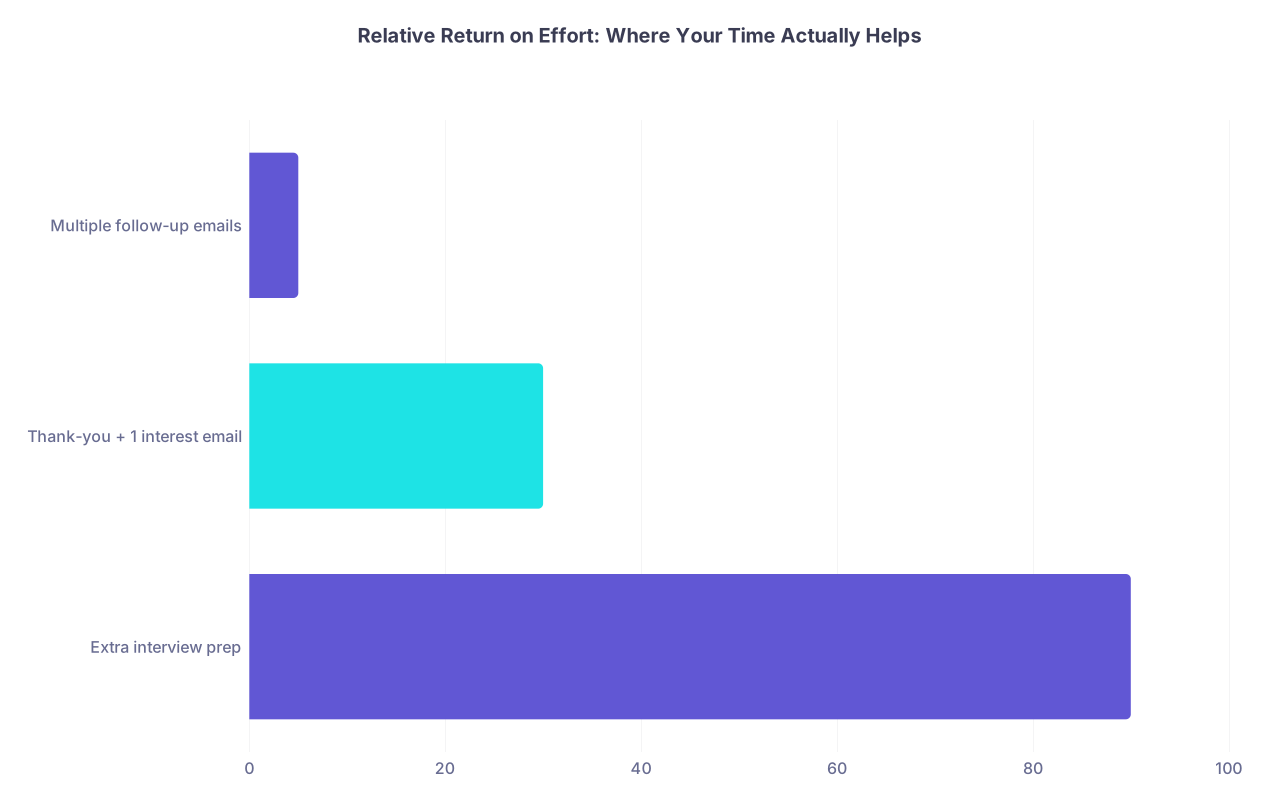
Use your energy where the data says it counts: interviewing well, getting strong letters, crafting a rational rank list. Not in turning a program’s inbox into your personal campaign platform.
| Category | Value |
|---|---|
| Extra interview prep | 90 |
| Thank-you + 1 interest email | 30 |
| Multiple follow-up emails | 5 |
That’s the real story: a sharp curve of diminishing returns.
Key Takeaways
- One concise thank‑you and, if genuine, one honest “top choice” email are enough; anything beyond that is almost never helpful.
- Multiple follow‑ups become a red flag when they push for rank information, show poor boundaries, or escalate emotionally—those can and do hurt you.
- Your time is far better spent improving what actually moves rank decisions—your interview performance, letters, and rank list—than trying to game the process through repeated emails.