
The Match Algorithm and Post-Interview Emails: What They Don’t Change
What exactly do you think that perfectly crafted post‑interview email is going to do to a Nobel Prize–winning algorithm that has placed hundreds of thousands of doctors over decades?
Let’s be blunt: the residency Match algorithm is not your program director’s inbox. And most of the folk wisdom about “sending the right follow‑up” is based on stories, superstition, and survivor bias—not on how the NRMP algorithm or program behavior actually work.
You’re being sold a fantasy: that if you write the magical thank‑you note, hint at ranking them highly, or “signal strong interest,” the algorithm will somehow bend in your favor.
It won’t.
Let’s separate what the algorithm does from what post‑interview communication might do—and more importantly, what it absolutely does not change.
The Match Algorithm: What It Actually Optimizes (Hint: Not Email Poetry)
At a basic level, the NRMP uses a variant of the Gale–Shapley “deferred acceptance” algorithm. This thing has a Nobel Prize behind it. It was designed to prioritize applicant preferences, assuming programs and applicants both submit honest rank lists.
Here’s the key: the algorithm only cares about two inputs.
- Your rank list.
- The program’s rank list.
That’s it. Not your thank‑you email. Not your “this is my top choice” hint. Not the number of times you “reaffirm your interest.”
Here’s how it actually plays out, stripped of the mythology:
- The algorithm tries to place you into the highest program on your list that has you high enough on their list to fit into their available spots.
- If you do not fit into your top choice program (because they filled with people they ranked higher), the algorithm tries your next one. And so on.
- This continues across all applicants simultaneously—iteratively—until there are no more changes possible.
You are not “fighting” for a spot with your emails. You are fighting with where you sit on a private list that’s already written and submitted when the algorithm runs.
Most people fundamentally misunderstand this:
The Match is not a negotiation at run time. It’s an execution of existing rank lists.
Your email might influence where you fall on someone’s list before they certify it.
Once that list is in? Game over. Algorithm does the rest. No “in‑the‑moment” judgment calls, no mid‑Match swaps, no secret backdoor wheeling and dealing.
Where Emails Could Matter (A Little) vs Where They Don’t
I’m not going to claim follow‑up emails are completely meaningless. They’re not. But their effect is wildly overstated compared to what actually moves rank list positions: your interview performance, letters, scores, perceived fit, and institutional politics.
Let’s dissect it.
Where emails might move the needle (slightly)
In the real world, programs don’t rank you based on a single number. They sit in a conference room with a spreadsheet and some coffee and argue about you.
I’ve watched this. Your name comes up alongside a few others in your “band” or “tier” of applicants. Nobody is debating between you and the superstar with 260+ Step 2 and first‑author NEJM. They’re debating between you and three other solid but similar candidates for position #14 vs #18 on the rank list.
In that kind of borderline discussion, a few soft factors can break ties:
- Someone on the committee remembers you as genuinely enthusiastic.
- A faculty member says, “They emailed after the interview and seemed really committed to us.”
- You sent a thoughtful—but not desperate—note that signaled you understand the program’s strengths and would likely come if ranked high.
That’s where a professional follow‑up email can help: as a tie‑breaker within a tier where you’re already competitive.
But notice what this implies:
- If you’re already clearly at the top of the list, your email does nothing. You’re already ranked high.
- If you’re clearly at the bottom or basically screened out, your email still does nothing. You’re not getting pulled out of the basement by a “thank you for your time.”
Emails are not resurrection tools. They’re tie‑breakers at best.
Where emails absolutely do not matter
There are some fantasies that refuse to die. Let’s kill them.
Post‑interview emails do not:
- Override a weak interview. An awkward, incoherent, or arrogant interview will not be fixed by a polished note.
- Replace signals that programs actually track (like standardized signaling systems in some specialties). Those are coded and quantified; your email is not.
- Make the algorithm give you “extra weight.” The algorithm doesn’t know your name, your story, or your email thread. It sees rank positions.
- Turn a mid‑tier applicant into a top‑tier one. Committees rank on overall application strength and perceived fit. Email is not a primary axis.
If an attending told you, “Send this and they have to rank you higher,” they either don’t understand the algorithm or they’re telling you a comforting story.
NRMP Rules vs Program Reality: The Games People Still Play
Now let’s talk about the other half of the mess: post‑interview communication and NRMP Match rules.
The NRMP is actually very clear:
Programs and applicants may express interest, but they cannot solicit or require statements about ranking intentions, nor make any guarantees or commitments.
And yet, every year:
- Applicants send “I will rank you #1” emails to multiple programs.
- Programs hint—sometimes strongly—about how “excited” they are about you and how “great of a fit” you are, sometimes even implying you’ll be ranked to match.
Everyone pretends not to violate the rules while routinely stepping over the line.
Key point: almost all of this does more to increase your anxiety than to improve your chances.
The match algorithm doesn’t care that:
- A PD wrote, “We look forward to working with you next year.”
- A chief resident said, “We fight hard for our favorites; you’re definitely in that group.”
- You told three programs they’re your “top choice.”
Once rank lists are certified, none of those words matter.
Most of the psychological manipulation around post‑interview communication preys on one simple misunderstanding: people think commitment language changes the algorithm. It doesn’t. The only thing that matters is where they place your name and where you place theirs.
What Programs Actually Use Post-Interview Emails For
Let’s get even more unromantic.
From the program side, post‑interview emails are often used for three low‑glamour purposes:
Mild signal of commitment
If two otherwise similar applicants are on the bubble, and one has repeatedly communicated genuine interest while the other has ghosted, the frequent communicator might get nudged up a couple of spots. Might. Not guaranteed.Vibes and professionalism check
Wildly inappropriate messages, boundary‑crossing, or obvious dishonesty get noticed. A desperate three‑paragraph email sent at 2 a.m. declaring eternal loyalty? You’d be surprised how often that gets screenshotted and passed around.Political cover
Sometimes faculty want you higher and will cite your messages as supporting evidence: “They reached out, they love our research, they said we’re top choice.” It gives them narrative justification to push you up a bit in committee.
But nobody is reranking their entire list because you wrote: “Thank you again for the opportunity to interview. I was very impressed by your program’s commitment to resident wellness.”
That line appears in 70% of emails. You’re not clever. You’re standard.
What The Data Actually Suggests: Matching vs “Showing Interest”
The hard part: there’s no randomized controlled trial of “post‑interview email vs no email” on Match outcomes. This isn’t Step scores; it’s fuzzy.
But we do have:
- NRMP Program Director Surveys.
- Self‑reported program behaviors.
- And the very obvious fact that the Match algorithm itself doesn’t use any communication as an input.
The Program Director Survey consistently shows that the major rank list drivers are:
- Interview performance.
- Letters of recommendation.
- USMLE/COMLEX scores (where still relevant).
- Clerkship grades.
- Perceived fit and professionalism.
“Post-interview communication” shows up much lower, often bundled into generic “perceived interest” or “other” categories. Often not even quantified.
So what does that mean in practical terms?
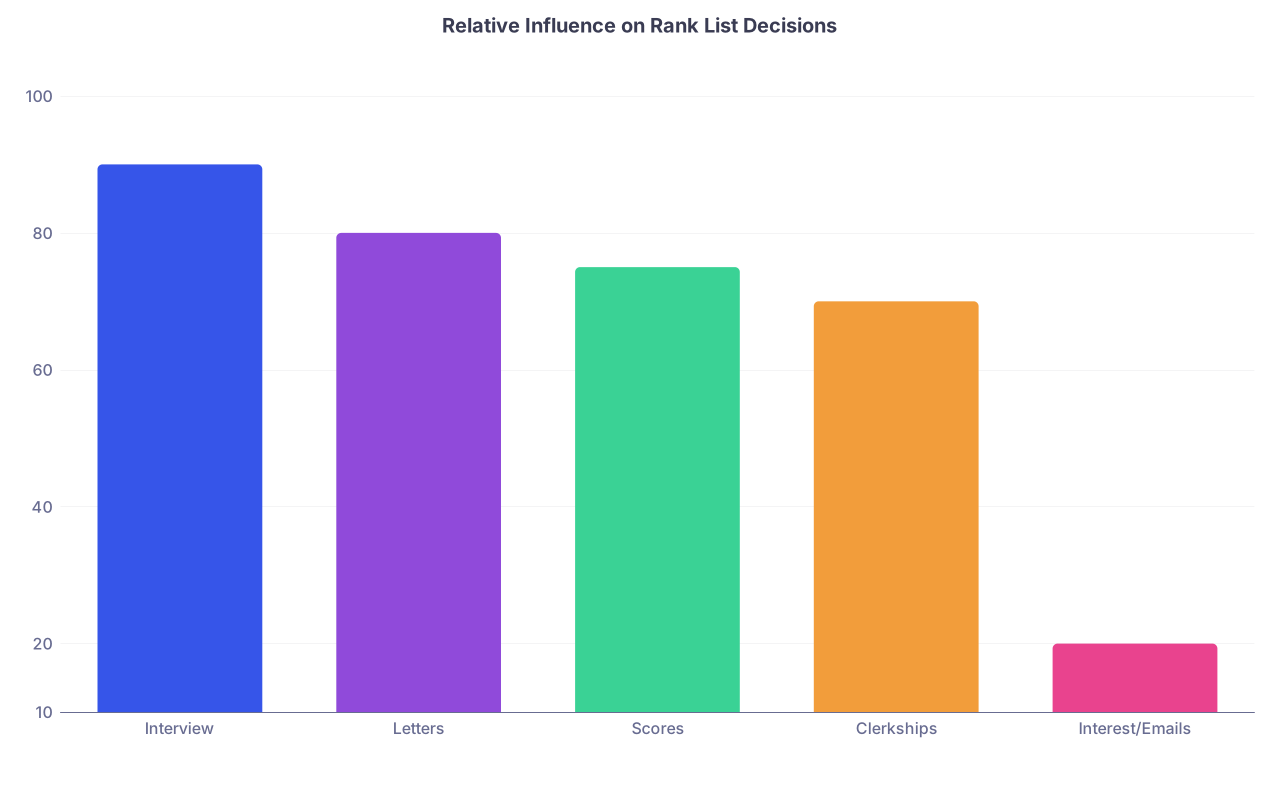
| Category | Value |
|---|---|
| Interview | 90 |
| Letters | 80 |
| Scores | 75 |
| Clerkships | 70 |
| Interest/Emails | 20 |
No, these aren’t exact NRMP percentages. They’re a realistic order‑of‑magnitude mental model based on survey trends: email interest is an order of magnitude less important than how you actually performed.
If you’re obsessing for hours over the perfect wording of a thank‑you while barely preparing for interviews, you’re fighting the wrong battle.
What Actually Doesn’t Change With Emails: Four Hard Truths
Let’s zoom out. There are several things email cannot and will not change, no matter how clever you are.
1. The program’s capacity and institutional priorities
You’re not emailing your way past:
- A hard cap of 12 categorical spots.
- The chair’s decision to heavily favor home students.
- The program’s new obsession with applicants who have PhDs or heavy research.
Those are baked into the way the rank list is built. You are not rebalancing a department’s priorities with one paragraph of gratitude.
2. Geographic and personal bias
Programs tend—statistically—to rank higher:
- Students from their own school or region.
- Applicants with strong geographic ties.
- Personal connections (mentors, prior rotators, etc.).
Your email does not outweigh the email the PD’s own dean sends saying, “This student is outstanding; we’d love to see them match with you.”
3. A clearly weak or mismatched application
If they thought you were a poor fit, that you lacked maturity, or that your application was significantly weaker than most of the pool, you’re not getting re‑categorized because you said you liked their noon conference setup.
You cannot patch a fatally weak candidacy with communication strategy.
4. The basic mechanics of the algorithm itself
Once both lists are certified, your email is dead. It’s a relic. The algorithm isn’t adaptive. It doesn’t check inboxes in the background. It doesn’t ask, “But wait, did they send a follow‑up?”
The entire machine operates on ordinal rank positions. Not vibes.
How To Follow Up Without Losing Your Mind (Or Your Dignity)
Now that we’ve stripped the magic out, let’s talk about what a rational, evidence‑aligned strategy actually looks like.
You follow up because:
- It’s professional.
- It keeps you on people’s radar in a normal, non‑annoying way.
- It can help at the margins in close calls.
You do not follow up because you think you’re hacking the algorithm.
Basic structure that’s enough
For most programs, one short, clear email to your interviewers or the PD after the interview is plenty.
Something like this:
- Thank them for their time.
- Mention 1–2 specific things you appreciated or resonated with.
- Reiterate genuine interest in the program.
- That’s it.
If a program is truly your top choice and your specialty’s culture accepts that kind of statement, sending one carefully worded message later in the season stating you plan to rank them highly is fine—as long as it’s honest and not copy‑pasted to ten places.
Do not send serial “Just checking in!” emails. Do not send emotional essays about your life story in January because you’re panicking. That does not read as “committed.” It reads as unstable.
The One Thing You Control That Actually Matters: Your Rank List
Here’s the real punchline: the algorithm is designed to favor your honest preferences. That’s not marketing language. That’s how the math works.
Most applicants still try to game it:
- Ranking places where they “think they have a better shot” higher, even if they prefer somewhere else.
- Panicking because a program never replied to their email and dropping them on the list.
- Over‑weighting vague PD language “we really liked you” as if that’s a binding contract.
Stop doing that.
The single most powerful thing you control in this whole process is your certified rank list, ordered in the true order of where you want to train, assuming they’d all take you.
The algorithm will try—mathematically—to get you your highest possible choice, given where programs rank you.
Post‑interview emails don’t override that. They just exist in the noisy, anxiety‑driven gray space before the lists are set.

| Step | Description |
|---|---|
| Step 1 | Application & Interview |
| Step 2 | Program Evaluation |
| Step 3 | Program Rank List |
| Step 4 | Applicant Preferences |
| Step 5 | Applicant Rank List |
| Step 6 | NRMP Match Algorithm |
| Step 7 | Match Outcome |
| Step 8 | Post-Interview Emails |
Notice where emails actually touch the process: at best, a tiny nudge in “Program Evaluation.” They never talk directly to the algorithm.
Quick Reality Check: What They Don’t Change
Strip away the noise and you’re left with this:
- The Match algorithm does not read your emails. It only reads rank lists.
- Post‑interview emails might tweak your position slightly inside a tier, but they will not transform a weak application into a strong one or override institutional priorities.
- The most powerful move you can make is still the most boring: interview well, be normal in your follow‑ups, and rank programs in your actual order of preference—then let the algorithm do what it was built to do.