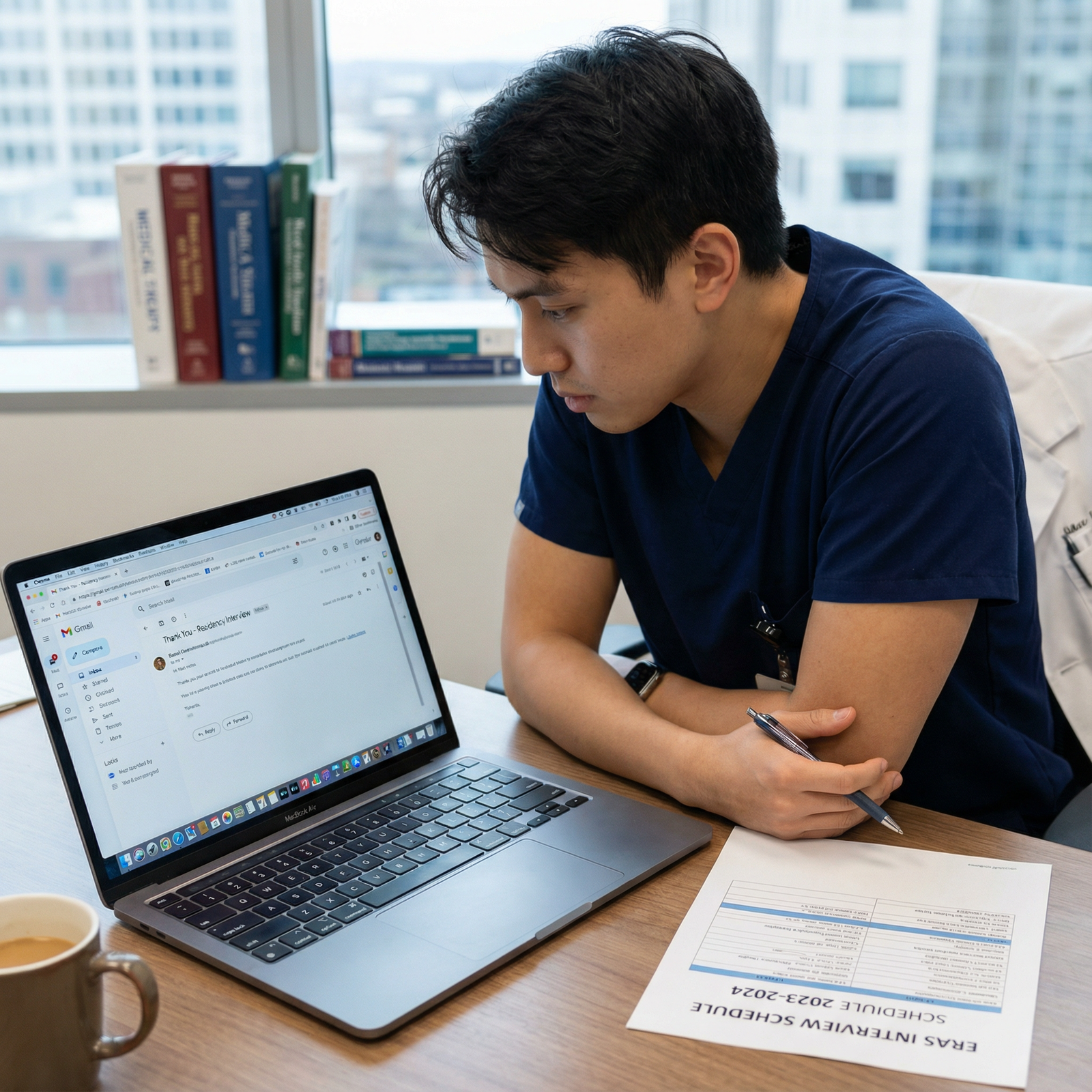
22% of program directors in one NRMP survey said they read every single post-interview email; the rest skim or ignore most of them.
So you obsessing over whether to send a group thank-you email vs. individualized notes? For most PDs, that’s background noise. But there are situations where a group email is fine—and others where it makes you look lazy or clueless.
Let’s cut through the folklore and the Reddit-anxiety and look at what actually matters.
What PDs Actually Do With Your Thank-You Emails
Let me be blunt: thank-you emails almost never move you up or down a rank list.
Multiple NRMP Program Director Surveys over the years show the same thing: post‑interview communication ranks way below things like:
- USMLE/COMLEX scores
- MSPE and clerkship grades
- Interview performance
- Letters of recommendation
- perceived “fit”
Thank-you notes (format, timing, whether you used “sincerely” or “best”) barely register.
Most PDs I’ve worked with fall into one of three camps:
- Never read them. Filters set. Folder named “Thanks.” Zero effect.
- Skim only if there’s content. They look for information (continued interest, clarification, update). Polite boilerplate? They forget it in 10 seconds.
- Read and remember only extremes. Truly thoughtful, specific note? Maybe remembered. Mass-CC’d disaster with obvious copy‑paste errors? Also remembered. For the wrong reasons.
So the real question isn’t “Will a group email ruin my shot?”
It’s: “Is there any reason to send a group email instead of targeted, minimal, non‑annoying follow-up?”
Sometimes, yes. But not often.
Myth #1: “Group Thank-You Emails Are Always Unprofessional”
No. That’s too simple—and wrong.
There are scenarios where a group email is perfectly acceptable, and even expected. But there are also situations where a group blast to every person you met screams:
- “I didn’t pay attention to who interviewed me.”
- “I’m treating this like a form letter chore.”
- “I don’t understand hierarchy or roles.”
The nuance matters.
When a Group Email Is Acceptable (and Often Best)
Here’s where a group email is totally fine—and often smarter than spamming 6–10 people individually.
- To the residency coordinator / program office
They’re the ones who handled your schedule, logistics, links, parking, food, etc. A short group thank-you to the main program email (often something like [email protected]) and/or the coordinator is not just acceptable, it’s appreciated.
That email might look like:
Subject: Thank you for the interview day – [Your Name]
Dear [Program Coordinator Name] and Team,
Thank you for organizing such a smooth and informative interview day on [date]. I appreciated the clear communication, detailed schedule, and the chance to learn more about [Program Name].
Best regards,
[Your Name], MD Candidate, [School]
Group email here = totally fine.
- When the program explicitly tells you to
Some programs say during orientation: “You do not need to send thank-you emails, but if you feel compelled, please send one note to the program email, not to individual interviewers.”
That’s not a suggestion. That’s policy. Ignoring it and sending 7 individual emails “just to be safe” makes you look either tone-deaf or unable to follow basic instructions.
- To a panel that interviewed you together
If you had a true group interview—three faculty together in one 60‑minute block—it’s acceptable to send a single email addressed to all three:
Dear Drs. Smith, Patel, and Nguyen,
Thank you for the opportunity to speak with you on [date]. I enjoyed discussing [X] and appreciated your insights on [Y].
Sincerely,
[You]
That’s not lazy. That’s rational.
- To a group of residents who all joined a single, casual session
The fourth‑year who tries to hunt down every PGY‑1 from the noon resident Zoom to send nearly identical “thank you for answering my questions” emails? That’s overkill.
A group email to the resident liaison or the main program email, thanking “the residents” collectively for their honesty and time, is completely reasonable.
Myth #2: “Individual Emails to Every Interviewer Are Mandatory”
This one is pushed heavily by some med schools and advising offices, often from people who have never sat on a rank meeting.
No, you’re not required to send a hyper-personalized thank-you note to every single interviewer to be ranked favorably.
Here’s what actually matters:
- You don’t annoy busy faculty with obvious copy‑paste spam.
- You don’t violate program policies about post‑interview communication.
- You don’t send anything that could be construed as an attempt to negotiate or pressure (“I will rank you #1 if…” before the allowed period, etc., depending on specialty norms).
Individual emails can be useful when:
- You had a genuinely meaningful connection with someone (shared research interest, specific mentorship conversation, same hometown, etc.).
- You want to add a short, substantive update that matters to that interviewer’s domain (research PI you talked to, chief resident who asked about leadership, etc.).
But “I talked to five faculty, therefore five generic thank-you notes must be sent or I’ll go unmatched”? That’s fiction.
The Real Risk: Sloppy Group Emails
Group emails aren’t “unacceptable.” Sloppy ones are.
The fastest way to make a not‑great impression is to send a group email that:
- Uses “To:” instead of “Bcc:” with 15 addresses
- Misspells someone’s name or the program name
- References the wrong specialty or hospital (yes, this happens every year)
- Sounds like an obvious mail merge gone wrong
I’ve seen this gem:
Dear [Program Name],
I really enjoyed learning more about your Internal Medicine program at [Wrong Hospital Name]…
That one got read. And laughed at. And remembered—in the worst way.
If you’re going to send a group note to multiple interviewers (which is rarely necessary), the minimum bar:
- Put the recipients in Bcc, not all visible in the To/CC line.
- Get every single name, title, and program name correct.
- Keep it short and nonspecific enough that no one feels like you mixed them up.
But again: group emails to multiple interviewers at once are usually unnecessary. Group emails should mainly target the organizing entity (coordinator, program office, resident group), not the whole faculty list.
What the Data and PD Behavior Actually Suggest
Let’s look at what we do know from surveys and real program behavior.
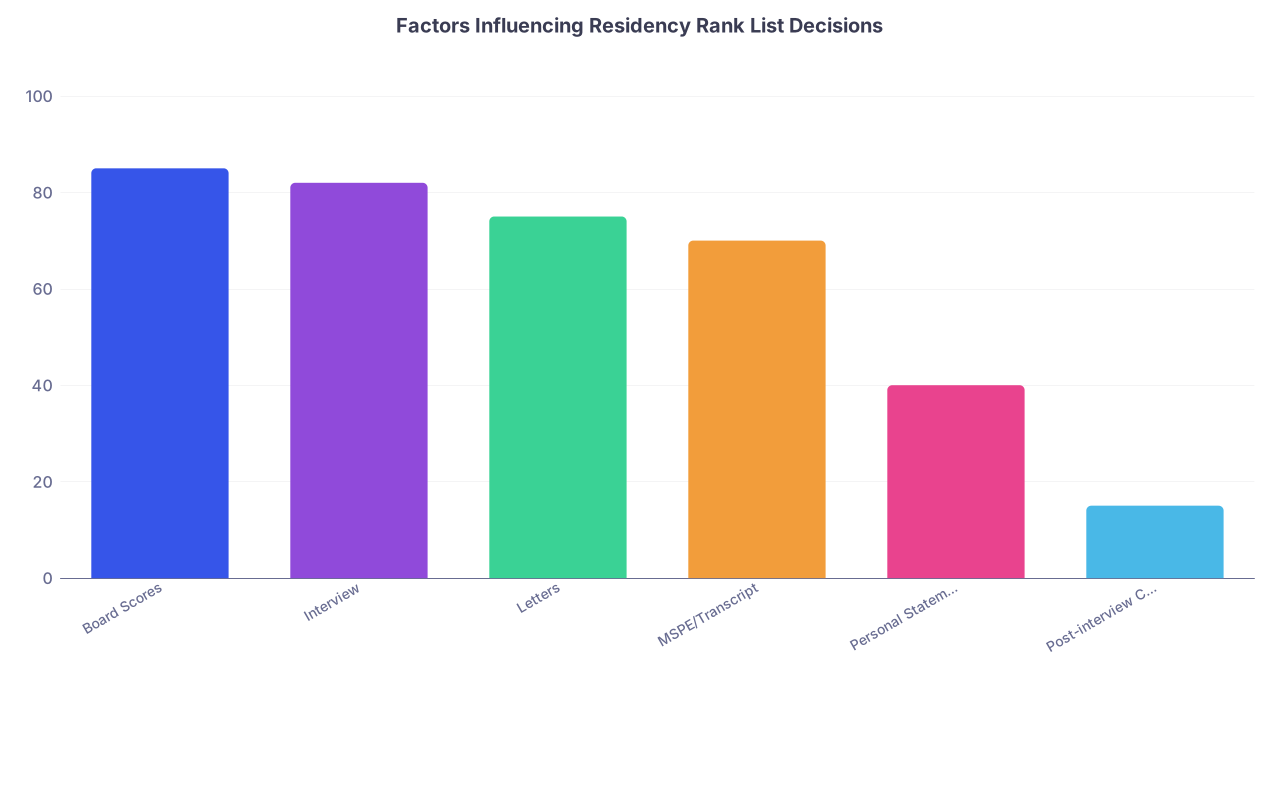
| Category | Value |
|---|---|
| Board Scores | 85 |
| Interview | 82 |
| Letters | 75 |
| MSPE/Transcript | 70 |
| Personal Statement | 40 |
| Post-interview Communication | 15 |
Those numbers mirror the general pattern from NRMP PD surveys across specialties:
- Board scores, interview performance, LORs, and academic record are heavy hitters.
- Personal statements and “interest” materials are middle of the pack.
- Post‑interview communication (including thank-you emails) consistently lands near the bottom.
So your risk profile looks like this:
- Sending no thank-you emails at all: Almost always neutral. Very few PDs penalize this.
- Sending one brief, professional note to the program office/coordinator: Slight upside in perceived professionalism, no real downside.
- Sending targeted notes to 1–2 key people where you had real substance: Small possible upside if they advocate for you.
- Blasting generic thank-you templates to everyone, with minor errors: Small but real downside if you annoy someone or look careless.
In other words: aim for low‑effort, low‑risk, not high‑effort, no‑benefit.
A Practical Playbook: How to Follow Up Without Overdoing It
Here’s a sane, evidence‑aligned approach that won’t eat your life.

| Step | Description |
|---|---|
| Step 1 | Interview Day Done |
| Step 2 | Send nothing |
| Step 3 | Email coordinator/program |
| Step 4 | Send brief note to coordinator |
| Step 5 | 1-2 targeted brief emails |
| Step 6 | Stop. You are done. |
| Step 7 | Program policy given? |
| Step 8 | Meaningful 1:1 convo? |
Step 1: Check Their Stated Policy
Some programs are explicit:
- “No post-interview communication is expected or necessary.” → Respect it.
- “Please direct all communication to the program email; no individual thank-yous are needed.” → Do that. One group email at most.
This is the easiest step. Don’t outsmart yourself.
Step 2: Default to One Coordinator/Program Email
Unless clearly told otherwise, send one short email to:
- the program coordinator, or
- the main residency program email
Goal: express basic professionalism, not seduce them with prose.
Something like:
Subject: Thank you for the interview – [Your Name]
Dear [Coordinator Name],
Thank you for organizing the interview day on [date]. I appreciated the opportunity to meet the faculty and residents and to learn more about [Program Name].
Best regards,
[Your Name]
That’s it. You’re done for 90% of programs.
Step 3: Decide If Anyone Merits an Individual Follow-Up
Ask yourself:
- Did I have a genuinely specific, memorable exchange?
- Is this person someone who might influence my advocacy (PD, APD, key faculty in my interest area, chief)?
- Do I have a concrete update or follow-up that actually matters?
If all three are “no,” skip it.
If “yes,” send a brief, targeted note. No life story, no ranking promises yet.
Dear Dr. [X],
Thank you for taking the time to speak with me on [date]. I especially enjoyed our conversation about [specific topic]. Our discussion reinforced my interest in [specific area] and how it’s supported at [Program Name].
Sincerely,
[You]
One or two of these per program. Not five to seven.
Are Group Emails Ever Actively Better Than Individual Ones?
Sometimes. The situations where a group approach actually wins:
| Scenario | Best Approach |
|---|---|
| Program bans individual follow-up | Single group email or none |
| Logistics & scheduling appreciation | Group email to coordinator/program |
| Joint panel faculty interview | One email to all panel members |
| Casual resident-only Zoom | Group thanks via coordinator |
| Deep 1:1 mentorship-style conversation | Individual email |
There’s also another angle: your own time and burnout.
Most applicants interview at 12–20 programs. Some more. If you feel compelled to send 8–10 individualized emails per program, you’ll spend dozens of hours on messages that almost nobody reads closely.
Use that time to:
- Sleep
- Fix your rank list
- Actually read program materials you handwaved the first time
Group emails, used selectively, protect your time and sanity with zero real downside.
A Realistic “Worst Case Scenario”
You’re probably imagining this: you send a group thank-you email, some PD reads it, is offended by the lack of personalization, and drops you 20 spots on the rank list.
That’s not how rank meetings work.
More realistic scenario:
- Your thank-you email (group or individual) is briefly seen.
- PD thinks “polite, standard” and moves on.
- You’re ranked based on your application, interview, institutional needs, and random politics.
- Your follow-up email is forgotten entirely by February.
The tiny sliver of programs that care deeply about thank-yous usually tell you so or heavily hint at it in their communications. And even there, they care far more about tone, professionalism, and not being weird than whether you used “To:” or “Bcc:”.
Key Myths vs. Reality
Let’s put the main misconceptions side by side.
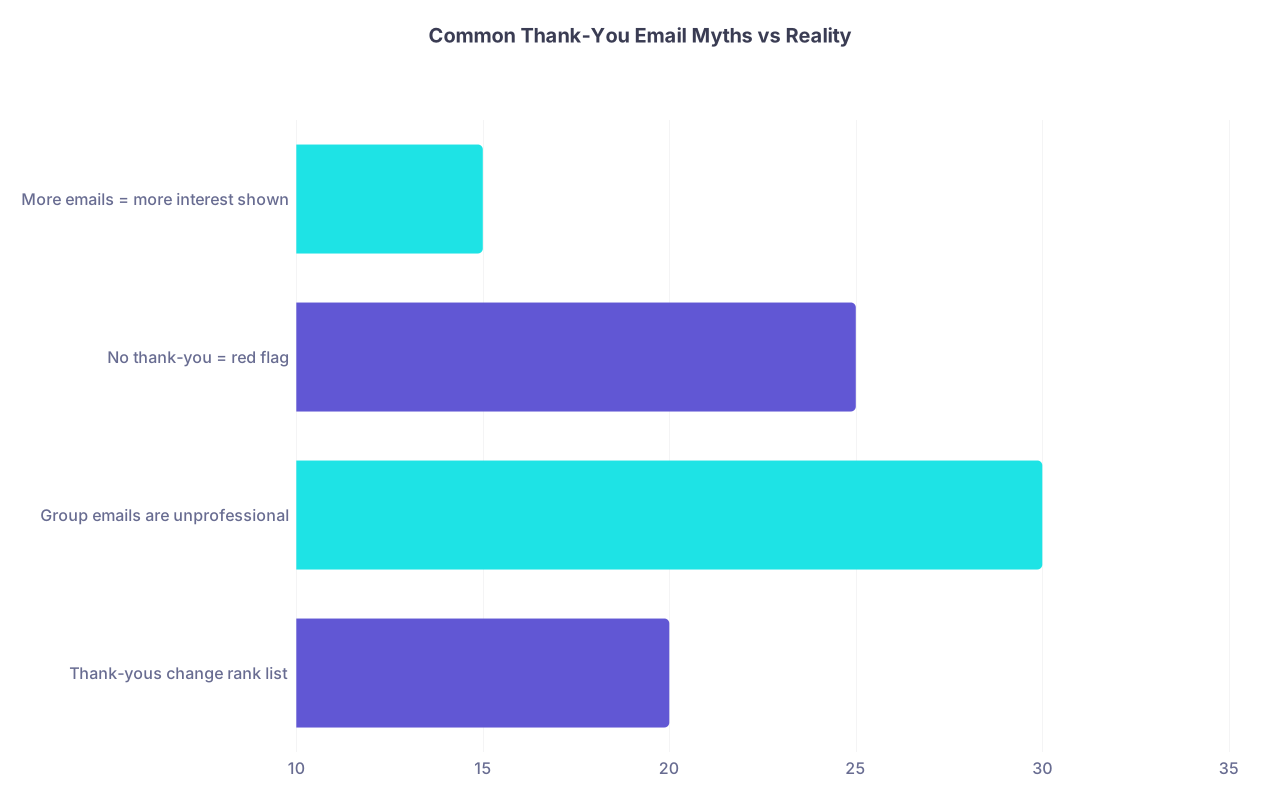
| Category | Value |
|---|---|
| Thank-yous change rank list | 20 |
| Group emails are unprofessional | 30 |
| No thank-you = red flag | 25 |
| More emails = more interest shown | 15 |
Think of those values as “how true applicants think these are” out of 100. Reality is much lower across the board.
Reality:
- Thank-you notes rarely influence rank order.
- Group emails are fine in the right context.
- No thank-you at all is almost never fatal.
- More emails typically just means “more noise,” not “more interest.”
FAQ (Exactly 3 Questions)
1. If I send a group email to my interview panel, do I list them in To: or Bcc:?
If it was a true, single panel interview and they were all in the room together, it’s fine to list them all in the To: line, addressed as “Dear Drs. A, B, and C.” For anything broader than that (multiple separate interviewers, residents, or staff mixed together), use Bcc: or, better yet, email the coordinator/program office only.
2. Will not sending any thank-you notes hurt my chances at competitive programs?
Almost never. A few old-school PDs may appreciate a note, but they generally won’t punish you for not sending one, especially in specialties where official guidance discourages post-interview communication. Your interview performance, letters, and application quality carry exponentially more weight than any thank-you etiquette.
3. Can I reuse the same thank-you template for multiple programs?
Yes—with caution. Using a simple, generic structure is fine. But you must change every program name, coordinator name, and any details you mention. Double-check each email before sending. The only thing worse than a generic note is a generic note addressed to the wrong program.
If you remember nothing else:
- Thank-you emails—group or individual—rarely move your rank.
- A single, clean note to the coordinator/program beats spamming everyone.
- The only truly bad follow-up is the sloppy, misaddressed, obviously copy‑pasted one.