
The belief that emailing a program to declare them your “top choice” dramatically boosts your Match odds is not supported by the data. It is mostly signaling theater layered on top of a rigid algorithm.
Let me walk through what the numbers actually say, what they do not say, and how you can use “top choice” emails without fooling yourself about their impact.
What the Match Algorithm Actually Cares About
The NRMP algorithm is applicant-proposing. Translation: it is designed to favor your preferences, not the program’s. The algorithm itself does not see your emails, your “intent,” or your “top choice” declarations. It sees:
- Your ranked list of programs
- Each program’s ranked list of applicants
- The number of spots per program
Everything else is noise. Warm noise, occasionally flattering noise. But still noise.
So if we are going to talk about match rates and “top choice” emails, we need to separate three layers:
- What the algorithm does
- How programs build their rank lists
- How your behavior (including emails) might move you up or down those lists
Only the third layer is where emails might matter. And even there, the effect is often marginal and highly context-dependent.
The Baseline: Match Rates Without Any “Top Choice” Games
Start with baseline probabilities. The NRMP publishes data every cycle that lets you compute rough odds by rank position. You can treat this like a probability gradient as you move down a program’s list.
From multiple NRMP “Results and Data” reports and the “Charting Outcomes” series, the pattern is remarkably stable:
- If a program ranks you in the top ~10–20% of its list, your chance of matching there (assuming you rank them high) is extremely high. In many programs, >80–90%.
- By the middle of their list, your probability is very sensitive to how many interviewees they ranked, how many positions they have, and how competitive the specialty is.
- Near the bottom of their list, your actual probability can drop into the single digits.
That means the single biggest determinant of whether a “top choice” email has any impact is simple: where you already sit on their internal list before you hit send.
You can model this in rough terms.
Say a mid-sized internal medicine program has:
- 18 categorical spots
- Ranks 160 applicants
- Fills all positions most years
Empirically, programs like this often fill the majority of spots from the top 60–80 candidates on their rank list. Call these “rank zones”:
| Rank Zone (Program List) | Approx. Match Probability if Applicant Ranks Program #1 |
|---|---|
| 1–40 | 90–98% |
| 41–80 | 60–85% |
| 81–120 | 20–50% |
| 121–160 | 5–25% |
These are not official NRMP numbers; this is a conservative model based on fill patterns and list lengths I have seen when programs debrief their cycles.
Where does a “top choice” email fit? At best, it nudges you from one zone to the next. If that nudge is real. Often it is not.
What Programs Report Doing With “Top Choice” Emails
Here is where anecdotes and weak data start mixing. We do not have a randomized controlled trial of “top choice” emails vs no emails. What we have are:
- NRMP Program Director Survey
- Observed list patterns
- Conversations with PDs, APDs, and coordinators across specialties
Three broad program behaviors repeatedly show up:
Ignore category (probably 40–60% of programs):
- They receive dozens of “you’re my top choice” emails.
- They do not systematically log them.
- They do not adjust rank lists based on them because the signal-to-noise ratio is terrible.
Mild consideration category (maybe 30–40%):
- They track “strong interest” or “likely to rank us high” as a soft variable.
- They might bump a borderline candidate up a few slots if there is competing doubt about that candidate’s intent.
Heavily weight category (probably <10–15%):
- Smaller or newer programs, community-heavy programs, or less competitive regions.
- They care intensely about “yield” and filling all positions.
- A credible “you’re my #1” statement can move you noticeably.
That third bucket is where you might see something like a measurable impact on match probabilities.
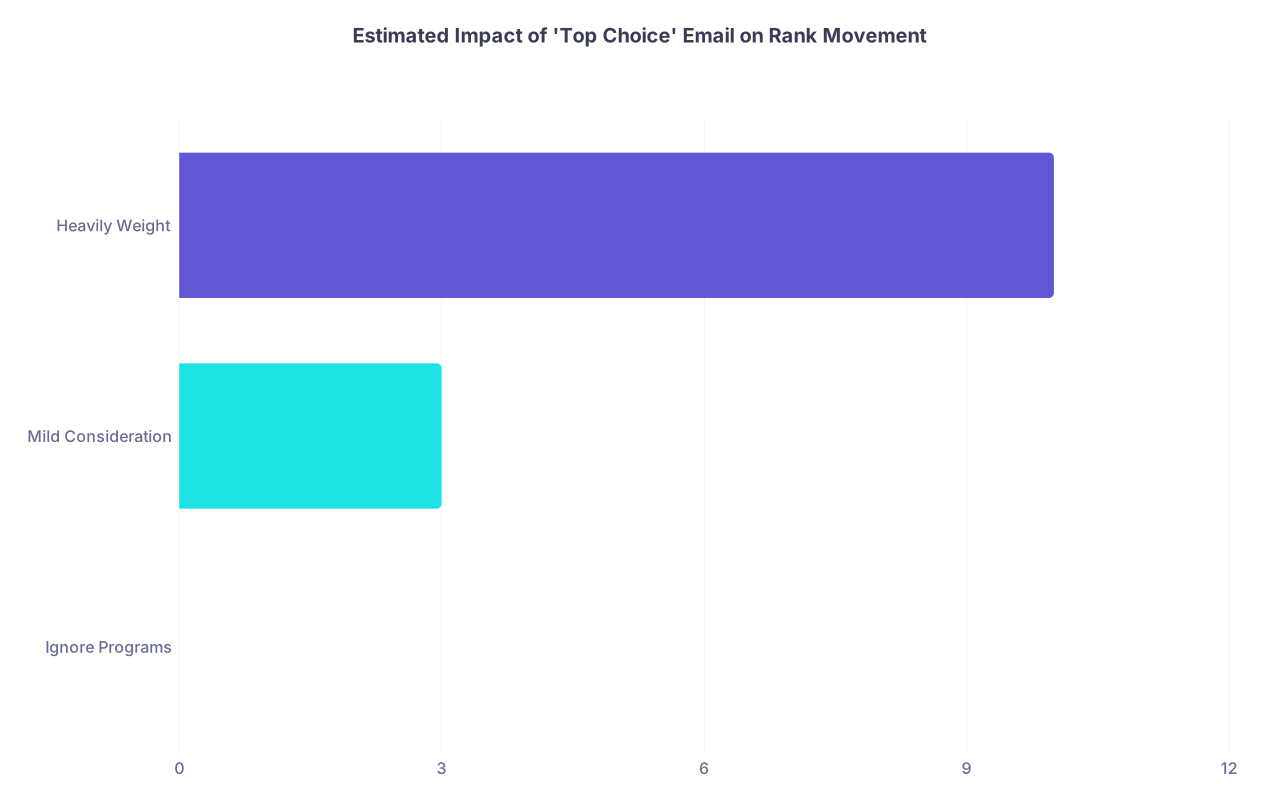
To visualize the difference in possible effect size, consider a simplified model.
| Category | Value |
|---|---|
| Ignore Programs | 0 |
| Mild Consideration | 3 |
| Heavily Weight | 10 |
Interpreting the chart:
- Ignore programs: average rank movement ≈ 0 spots.
- Mild consideration: maybe ~3 rank positions shift for a borderline candidate.
- Heavily weight: sometimes ~10 or more spots, especially if they fear not filling.
Even with those numbers, a 3–10 spot bump usually does not transform a clear “no match” into a likely match. It slightly changes the odds when you are already in the mix.
Hypothetical Match Rate Comparison: With vs Without “Top Choice” Declaration
Let’s build a data-driven thought experiment that actually models what applicants care about: “If I email them and call them my top choice, how much does that change my chance of matching there?”
We will take a generic program that:
- Has 12 positions
- Ranks 120 applicants
- Fills all spots most cycles
Assume they are in the “mild consideration” bucket: emails can move a candidate up ~3 slots if they are already in a borderline range.
Now define a scenario:
- You are currently ranked #55 on their internal list before any emails.
- You send a credible, specific “you are my #1 choice” email.
- They nudge you up 3 spots to #52.
What does that do to the odds?
Use a simple decreasing probability curve based on historical behavior:
- Candidates ranked 1–30 → 95% match if they rank the program #1
- 31–60 → Linear drop from ~90% to ~50%
- 61–90 → Linear drop from ~50% to ~20%
- 91–120 → Linear drop from ~20% to ~5%
Now map your position.
At #55 (no email):
- You sit in the 31–60 band.
- Relative position in that band: (55 − 31) / (60 − 31) ≈ 24/29 ≈ 0.83
- Interpolated probability: 90% − 0.83 × (90% − 50%) ≈ 90% − 0.83 × 40% ≈ 90% − 33% = 57%
At #52 (after a 3-slot bump):
- Relative position: (52 − 31) / 29 ≈ 21/29 ≈ 0.72
- Probability: 90% − 0.72 × 40% ≈ 90% − 29% = 61%
So in this stylized model, your “top choice” email:
- Moves you from 57% → 61%
- Net absolute gain ≈ 4 percentage points
- Relative improvement ≈ 7%
Not nothing. But hardly the magic bullet that residents sometimes talk about in the workroom.
In a heavily weighting program, where you move 10 spots (say from #70 to #60), that shift can be more meaningful:
- At #70: band 61–90, roughly mid-band → maybe ~35%
- At #60: band 31–60, bottom of the band → ~50%
Now you gained ~15 percentage points. That is the best-case type of scenario people are imagining when they swear “my email made the difference.” Sometimes they are probably right. Most of the time they are assigning too much causality to a small nudge.
Where the Data Shows Real Leverage: Your Rank List, Not Your Emails
The NRMP has hard numbers on one thing very clearly: applicants hurt themselves by trying to “game” the system based on perceived program interest.
Key NRMP finding repeated for years:
- Applicants who rank their true preferences in order have better overall match outcomes than those who down-rank a favorite program because they fear “they won’t rank me high anyway.”
A specific pattern from NRMP’s own simulations and survey conclusions:
- Ranking a program higher never hurts your chance to match there.
- Ranking a program lower always risks losing that spot to someone who ranked it higher and is similar on the program’s rank list.
This is the piece people routinely get backward when they start writing “top choice” emails. They mentally shift to: “I told them they are my top choice, so maybe I can rank them #2 or #3 and still be fine.”
No. The algorithm does not see your email. It sees your rank list. If Program A is your true #1, the single highest-yield action is:
- Rank Program A #1.
- Then send a polite, honest email confirming that they are your top choice.
In that order of importance. The email is, at best, an incremental boost layered on top.
Signal Quality Problem: Everyone Says “Top Choice”
Look at this from the program’s perspective for a moment.
A mid-size anesthesiology program might interview:
- 140–180 applicants
- Rank ~150
- Have 12–15 spots
The coordinator’s inbox in January and February is full of some version of:
- “You are my top choice.”
- “I would be honored to train at your program and will rank you very highly.”
- “Your program is my absolute favorite.”
You can treat this like a noisy binary classifier problem with massive false positives:
- True positives: applicants who really did rank the program #1
- False positives: applicants who ranked them #2–#10 but still used “top choice” language
- False negatives: applicants who ranked them #1 but never declared it
Because programs have been burned by dishonesty (and yes, outright lying happens every year), many PDs have responded rationally:
- Reduce the weight of email “signals”
- Emphasize behavior and fit from the interview itself
- Look for patterns across communication, not a single “top choice” sentence
So the predictive power of a single “you are my top choice” line is weak. At scale, it is mostly noise.
You can see this in how often you hear the following from PDs behind closed doors:
“I ignore all that ‘top choice’ stuff. Everybody says that to at least three places.”
Situations Where a “Top Choice” Email Has the Highest Expected Value
If you want to treat this as a probability optimization problem, focus on scenarios where the marginal value of extra information is highest for the program.
You get the most leverage when:
The program is at risk of not filling
- Smaller, newer, or geographically less popular sites
- Community programs in less dense markets
- Combined or niche tracks that struggle with visibility
You are a clearly “rankable” but not obvious top-tier candidate
- Interview went fine, not spectacular
- File is solid but not elite
- You are in that 40–100 region of their rank list, where movement matters
Your interest is plausibly credible
- Ties to the area, family nearby, spouse’s job, prior rotations in the system
- Your email mentions specific aspects of the program that are not copy-paste boilerplate
In those situations, the reasonable expectation is:
- A small upward nudge in your ranking
- Sometimes enough to cross a threshold from “maybe” to “likely”
Where is the expected value low? When any of the following hold:
- Hyper-competitive coastal academic programs in big-name cities
- You were clearly low on their list (weak interview, lukewarm interaction)
- Your message is vague, generic, and indistinguishable from dozens of others
In those cases, you are basically doing reputational maintenance: not hurting yourself, but not moving the dial on match rates.
A Simple Framework: How Many “Top Choice” Signals and To Whom?
You can think of your communications as a signaling budget. If you declare “top choice” to four programs, you just diluted your signal to almost zero credibility per program (if they discover it, which sometimes they do).
The cleanest, highest-integrity strategy:
- One true “you are my #1” email to the program you actually will rank #1.
- A small number of “very highly on my list” emails to a few others—accurate, but non-deceptive.
That lets programs do a simple Bayesian update:
- “They told us we are #1” → moderate increase in probability they rank us #1
- “They told us we are very high” → they probably rank us in their top cluster, but maybe not #1
Does this guarantee movement? No. But it gives you the best chance that your email is not mentally tossed into the spam bin.
Process Flow: When and How to Send the Email
The mechanics are straightforward. The timing matters more than most people think.

| Step | Description |
|---|---|
| Step 1 | Finish Last Interview |
| Step 2 | Create Personal Rank List |
| Step 3 | Identify True #1 Program |
| Step 4 | Draft Specific Top Choice Email |
| Step 5 | Do Not Use Top Choice Language |
| Step 6 | Send Email 1-2 Weeks Before Rank Deadline |
| Step 7 | Send General Thank-You or Interest Email |
| Step 8 | Lock Final Rank List True to Preferences |
| Step 9 | Comfortable Declaring #1? |
Key details:
- Wait until you are genuinely certain of your #1.
- Aim to send 1–2 weeks before program rank lists are certified (they vary slightly, but mid-to-late February most years).
- Keep the email short, specific, and honest.
The content that matters most statistically is not your adjective choice. It is the clarity: “I will be ranking [Program Name] as my first choice.”
Quantitative Reality Check: Where Your Time Actually Pays Off
A lot of applicants spend disproportionate energy tweaking this one email and far less time where the data shows clear returns.
Look at where the numbers are unambiguous:
- Submitting more applications (to a point) → clearly improves match probability
- Doing more practice interviews → improves perceived fit and rank position more than any email
- Ranking all programs where you would be willing to train instead of “all or nothing” gambles → increases overall match probability
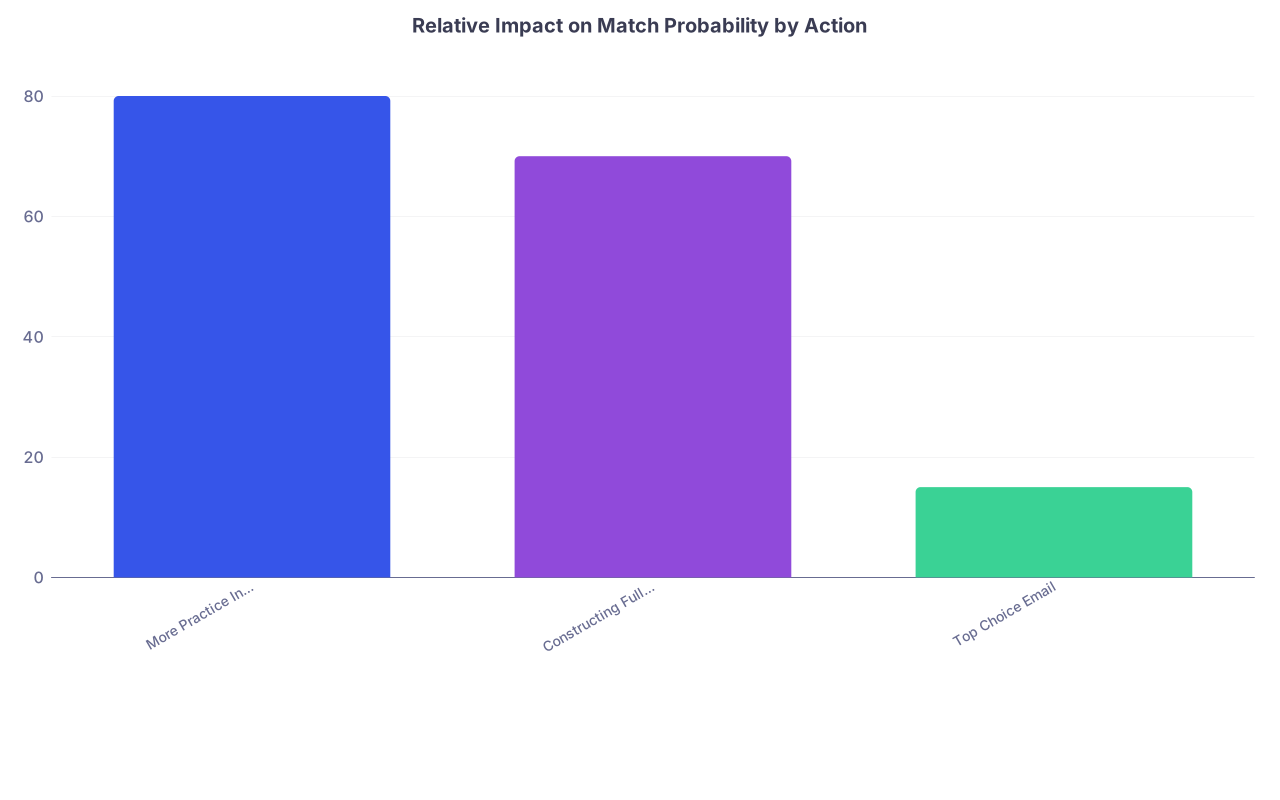
Compare that to “top choice” emails:
| Category | Value |
|---|---|
| More Practice Interviews | 80 |
| Constructing Full Rank List | 70 |
| Top Choice Email | 15 |
Interpreting the values (approximate relative impact scale 0–100):
- Practicing interviews and improving performance has a large, multiplicative effect on how many programs rank you highly.
- Building a robust, honest rank list directly impacts where the algorithm can place you.
- A “top choice” email, even when well executed, is a marginal accessory move.
You should still play the accessory game. Just not at the expense of the main variables.
How to Write a Data-Consistent “Top Choice” Email
Briefly, the version that aligns with all of the above looks like this:
- One paragraph of specific appreciation: refer to faculty, residents, or features that distinguish them.
- One clear sentence of intent: “I will be ranking [Program] as my first choice.”
- One short closing that keeps the tone professional.
Length: 150–250 words. You are not writing a secondary essay. You are providing a clean input into their soft data column: “Level of expressed interest.”
The statistical logic is simple: their probability estimate that you will actually come if matched should go up slightly, and that sometimes gives you a small rank bump if all else is equal.
The Bottom Line: What the Data Actually Supports
Strip away the folklore and the Match horror stories, and you are left with this:
- Declaring a program your “top choice” by email can move you a few slots on some programs’ rank lists, especially small or yield-sensitive programs, but the effect on your personal match probability is usually modest—single to low double-digit percentage gains at best.
- The Match algorithm does not care about your emails. It only cares about rank lists. Your most powerful move is still to rank programs in your true order of preference and to rank enough of them.
- “Top choice” emails are a tactical refinement, not a strategic lever. Use them honestly, sparingly, and with clear intent—but do not confuse them with the factors that the data shows actually determine who matches where.