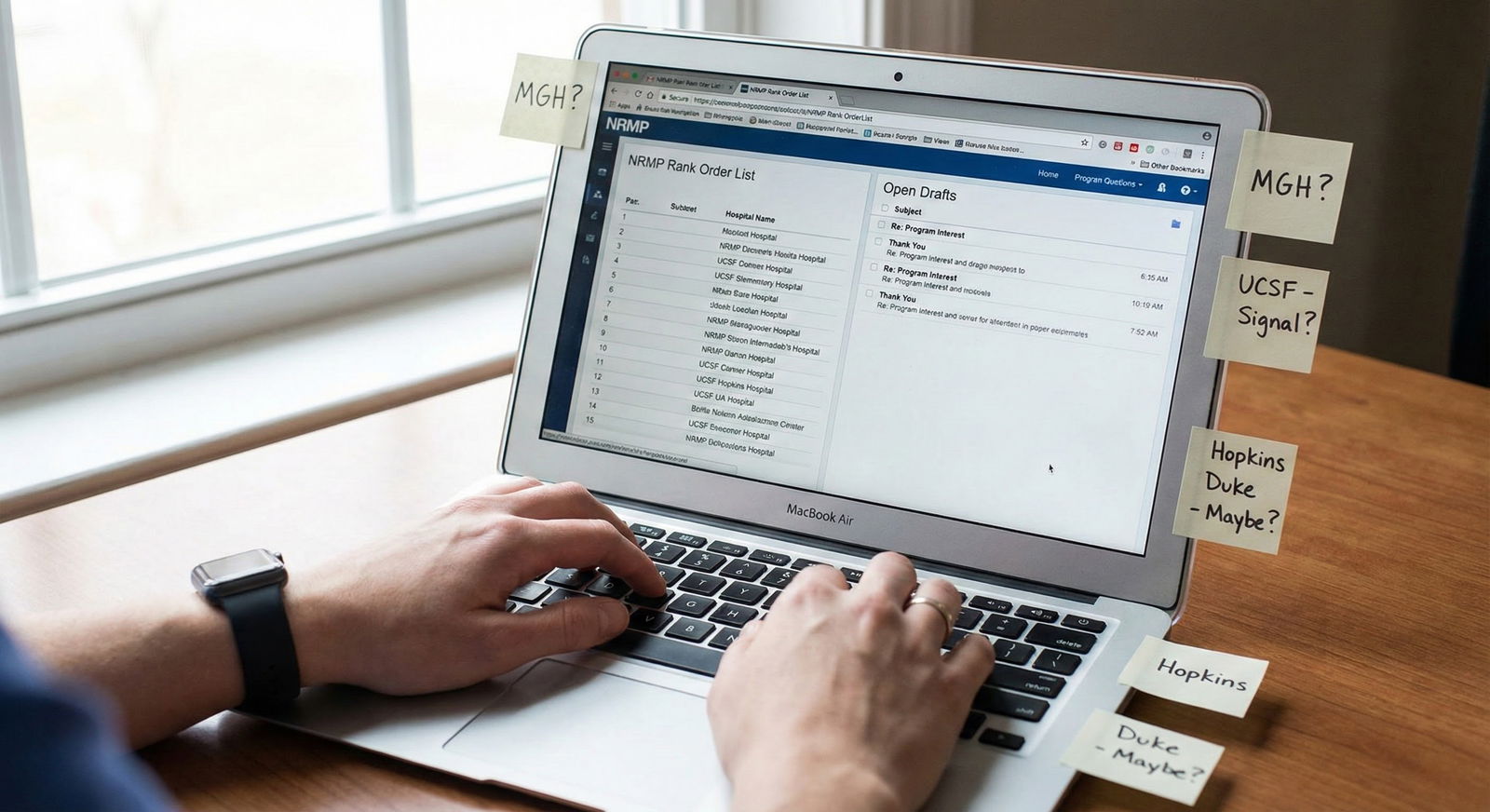
The reflex to keep emailing programs after interviews is how people accidentally annoy program directors.
Here’s the blunt truth: in most cases, you should not follow up again if you already sent a thank-you and got no reply. But there are a few smart exceptions—very specific ones—where a second touch makes sense.
Let’s sort out which situation you’re actually in, and what to do about it.
The Core Answer: Should You Follow Up Again?
You probably want a simple rule. Here it is.
If:
- You had the interview,
- You sent a reasonable thank-you email (or two at most, to different interviewers/program leadership),
- And you got silence…
Then:
- Do NOT send another “just following up” or “reaffirming my interest” email.
- Do NOT ask if they received your thank-you.
- Do NOT nudge them to respond.
Residency programs are not ghosting you; they’re just busy and often deliberately non-committal.
Most programs:
- Don’t reply to thank-you emails at all.
- Have policies restricting post-interview communication.
- Are paranoid about anything that could look like favoritism or “improper” signaling.
So your “no reply” is not a sign of disinterest. It’s normal.
Where people get into trouble is when they:
- Send a thank-you the night of the interview…
- Then a “just checking that you got this” a few days later…
- Then a “still very interested” two weeks later…
That doesn’t make you look enthusiastic. It makes you look high-maintenance.
When a Second Email Is Actually Reasonable
There are a few narrow lanes where a second message makes sense. Use these, and only these.
1. You Have a Major New Update
This is the one rock-solid reason to email again.
Good reasons:
- You matched into AOA, Gold Humanism, or similar honor.
- You got a new first-author publication or major presentation.
- You passed Step 2 CK after they interviewed you and that result might matter.
- You accepted or completed a meaningful leadership role (chief of something, new QI project, etc.).
In that case, send a concise “update + reaffirmed interest” email to the program coordinator or PD. One time. That’s it.
Template you can steal:
Subject: Application Update – [Your Name], [AAMC ID or Specialty]
Dear Dr. [Last Name] / Dear Program Leadership,
I wanted to share a brief update on my application. Since interviewing with [Program Name] on [date], I [describe update in one sentence: e.g., “was elected to AOA” / “had a manuscript accepted as first author in [Journal]” / “received my Step 2 CK score of ___”].
My interview day at [Program Name] reinforced my strong interest in your program, particularly [one specific detail you genuinely liked].
Thank you again for the opportunity to interview and for your time.
Best regards,
[Your Name]
[School, AAMC ID, contact info]
That’s not “following up on my thank-you.” It’s adding real information.
2. You Need to Correct Something Important
Another valid reason: fixing a problem.
Examples:
- You realized you gave incorrect information during the interview (score, publication status, visa status).
- Your ERAS had a significant error that affects your candidacy.
- You accidentally attached the wrong document (e.g., wrong personal statement) and it might matter.
Then yes, send a brief, clean correction. Don’t over-explain or sound panicked.
3. You Truly Didn’t Thank Key People the First Time
If you:
- Thanked only the PD,
- But completely forgot the APD or a faculty interviewer who clearly spent 45 minutes with you,
You can send a short thank-you to the overlooked person(s), even if some time has passed. Do not mention you already thanked someone else. Just send a straightforward note.
But this is still not “following up because they didn’t respond.” It’s finishing something you missed.
4. Program-Specific Invitation to Reach Out
Some programs explicitly say:
- “Feel free to reach out with questions.”
- Or they answer your first email warmly and invite future questions.
If they explicitly open that door, you can step through it—once or twice, not weekly.
Ask a real question:
- Clarify curriculum,
- Ask about a track,
- Clarify call schedule logistics if it genuinely matters to your rank list.
Still: do not ask, “Where do I stand?” or “Am I ranked to match?” That’s how you get a generic “we follow NRMP rules” reply and feel worse.
When You Should Stop Emailing Completely
Let’s call out the dead zones clearly. You do not send more emails when:
- Your first thank-you was standard (1–2 short paragraphs, sent within 24–72 hours).
- You got either:
- No reply at all, or
- A generic “Thank you, we enjoyed meeting you.”
- You have no meaningful update. Just “still very interested.”
In those situations, a second email:
- Won’t move you up the rank list.
- Might annoy someone.
- Definitely increases your anxiety as you wait for a reply that probably won’t come.
Especially do not send:
- “I know you’re busy, just wanted to bump this email.”
- “I didn’t hear back, so I wanted to check in again.”
- “I’m still thinking about [Program Name] daily and wanted to reiterate my interest.”
That all sounds needy on their end. Harsh, but true.
How Programs Actually See Thank-You and Follow-Up Emails
Let me pull back the curtain on what I’ve seen and heard from PDs and residents in multiple specialties.
Typical reality:
- Most PDs skim thank-you emails quickly, often on their phone.
- Many don’t reply at all, and feel no guilt about that.
- Some programs have their coordinator filter and log emails; they may not even go directly to the PD.
- Rank list decisions are usually based on:
- Interview performance
- Application content
- Internal discussion
- Sometimes post-interview signals—but not “I emailed twice instead of once.”
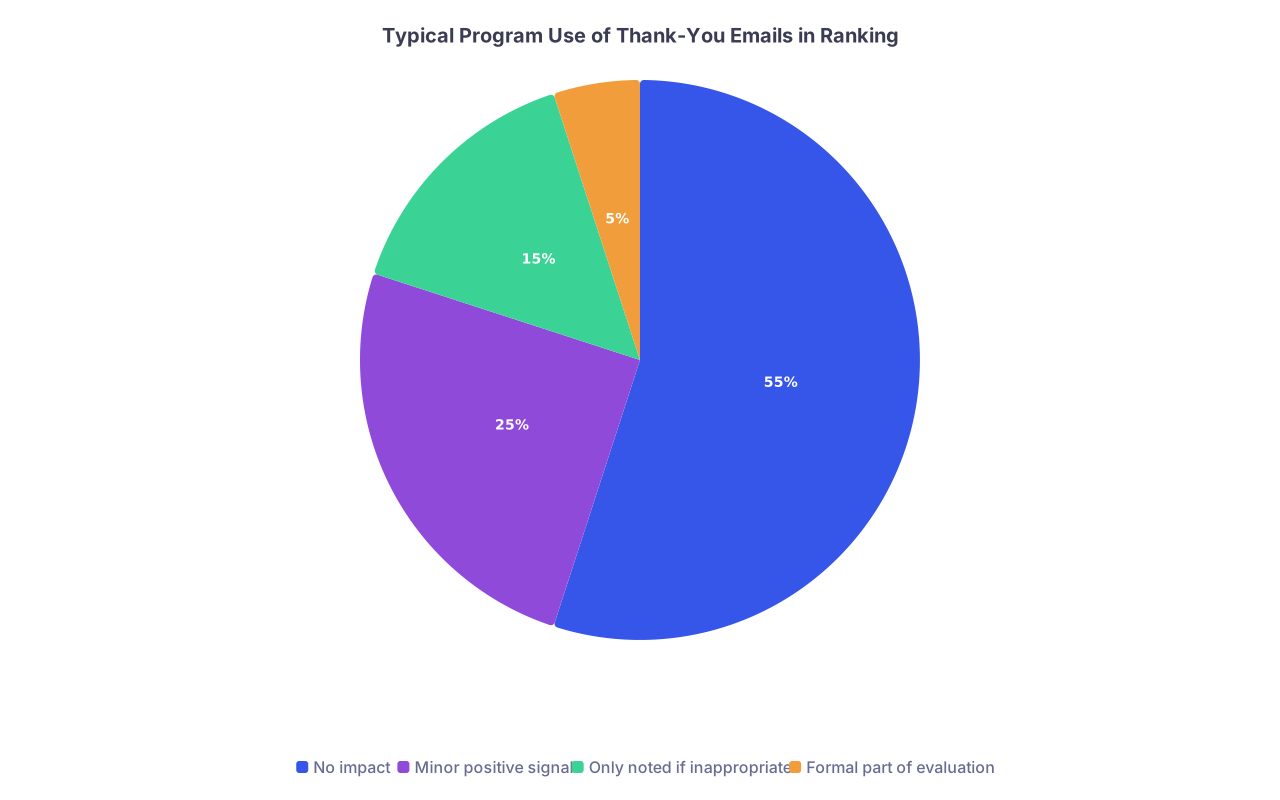
| Category | Value |
|---|---|
| No impact | 55 |
| Minor positive signal | 25 |
| Only noted if inappropriate | 15 |
| Formal part of evaluation | 5 |
Yes, some PDs glance at thank-yous as a tiny positive signal of professionalism. But almost no one is saying, “This applicant emailed again, looks extra committed, bump them up three spots.”
What does hurt?
- Overly long, emotional messages.
- Repeated follow-ups that feel like pressure.
- Anything that looks like fishing for ranking information (“Will I be ranked to match?”).
How Many Thank-You Emails Are “Enough”?
Quick framework so you stop overthinking this.
Use this as a rough ceiling, not a target:
| Situation | Max Reasonable Emails |
|---|---|
| Single-site interview day | 2–3 total (PD/APD + key interviewers) |
| Multi-interviewer day (4–6 faculty) | 3–4 max (pick the most relevant) |
| Post-interview update (major change) | 1 additional email |
| No updates, no replies | 0 more emails |
You do not need to email every single resident you met on the tour, every faculty at the social, and the PD plus APD plus coordinator plus chief. That’s overkill.
Pick:
- PD (always, unless they explicitly say not to),
- 1–2 interviewers you had the best conversations with,
- Maybe the coordinator if they went above and beyond for logistics.
Send those within 1–3 days. Then stop unless you have that legit update.
Special Case: Telling a Program They’re Your #1
People obsess over this.
Should you tell a program they’re your top choice? Sometimes yes. But do it once, thoughtfully, and only if it’s 100% true.
Key rules:
- Only one program gets the “You are my true #1” message.
- Use clear but not groveling language: “I intend to rank [Program Name] as my first choice.”
- Send it later in the season, closer to rank list submission, not immediately after the interview.
- Don’t then send follow-ups begging for acknowledgment.
You still don’t chase if they don’t respond. They read it. That’s the goal.
Here’s how to say it cleanly:
Dear Dr. [Last Name],
I wanted to thank you again for the opportunity to interview at [Program Name]. After completing my interviews, I’ve reflected carefully on my priorities and training goals.
I’ve decided to rank [Program Name] as my first choice. The combination of [specific reasons: e.g., strong clinical training, supportive culture, particular track] aligns best with the kind of resident and future [specialty] physician I hope to become.
Thank you again for your time and consideration.
Sincerely,
[Your Name]
Then stop. No second “just confirming you saw this” email.
If You’re Still Tempted to Follow Up Again
Let me be blunt: the urge to follow up again is usually about your anxiety, not their process.
Before you send anything, run through this quick decision filter:

| Step | Description |
|---|---|
| Step 1 | Already sent thank-you? |
| Step 2 | Send 1 normal thank-you |
| Step 3 | New major update or correction? |
| Step 4 | Do NOT email again |
| Step 5 | Send 1 concise update email |
| Step 6 | Stop emailing |
If the only justification you can come up with is:
- “I just want them to know I care,” or
- “I feel like I should be doing something,”
Don’t send it. Rank them where they deserve to be. Trust your impression. Let the process work.
FAQ: Follow-Up After Residency Interview
1. Is it bad if I never got a reply to any thank-you email?
No. Completely normal. Many programs don’t respond to any thank-yous. Silence does not mean you’re ranked low or rejected. It just means they’re busy and/or have a policy.
2. How long after the interview is it still okay to send a thank-you?
Ideal: within 24–72 hours. If it’s been a week or two and you forgot, you can still send a short note. Don’t apologize excessively or act weirdly self-conscious—just thank them and keep it moving. But don’t use lateness as an excuse to send multiple follow-ups later.
3. Should I email the program coordinator if the PD didn’t respond?
No, not just to get a response. The coordinator is not there to validate your thank-you. You email the coordinator for logistics, serious updates, or if they were a huge help during the process and you want to thank them directly. Not to circumvent an unresponsive PD.
4. Can repeated follow-ups ever improve my chances?
Realistically, no. One good thank-you and, if applicable, one meaningful update are enough. After that, extra emails don’t meaningfully help and can hurt if they’re pushy, emotional, or frequent.
5. What if another applicant told the program they’re ranking them #1—should I email too?
Only if they really are your first choice. Do not get dragged into an arms race of “I’m #1-ing you” just because others are. Programs can smell desperation and insincerity. Give one honest “you’re my top choice” message if it’s true. Otherwise, rank sincerely and move on.
6. What’s the best way to calm the anxiety of waiting without over-emailing programs?
Redirect the energy. Make and refine your rank list, talk things out with mentors or co-applicants you trust, finalize backup plans (research year, preliminary options if relevant), and step away from your inbox. Over-focusing on whether to send “one more email” is just feeding anxiety without changing your outcome.
Key takeaways:
- One thank-you per key person + one real update (if you have one) is enough. No reply is normal.
- Don’t send “just following up” or “still very interested” emails with no new substance—they don’t help and can hurt.
- Put your energy into an honest rank list and your future, not chasing responses that were never going to come.