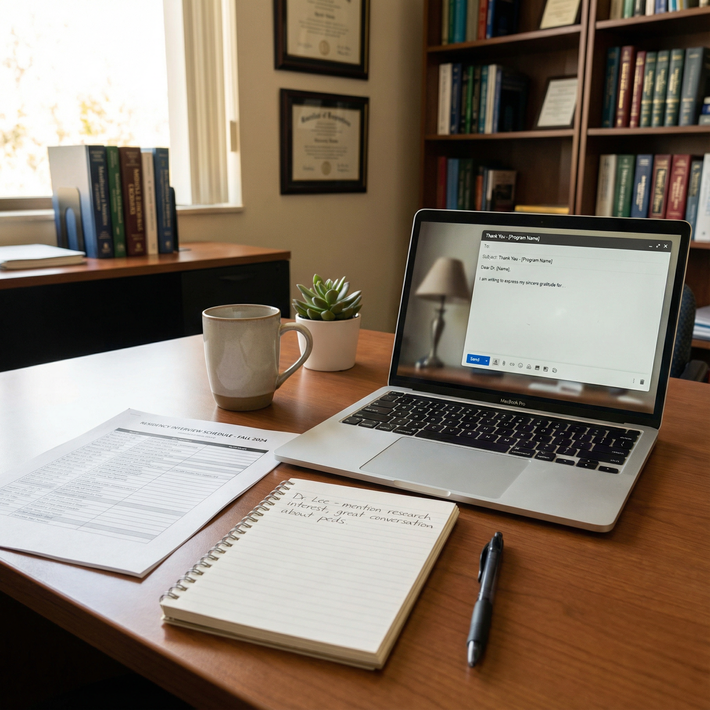
What does it signal to a program if your thank‑you email arrives 10 days late, sent at 1:47 a.m., with the wrong program name in the subject line?
Because that happens. A lot.
And whether anyone tells you or not, it absolutely feeds into one narrative: “This person is disorganized.”
Timing of thank‑you emails after residency interviews is one of those small things that quietly separates “put‑together and reliable” from “scattered and risky.” You don’t get points for doing it perfectly. But you can definitely lose points for doing it badly.
Let me walk you through the timing mistakes that make programs cringe—and how to never be that applicant.
Mistake #1: Waiting Too Long To Send Anything
The classic error: “I’ll do all my thank‑you emails this weekend when things calm down.”
Translation: they never get done, or they go out so late they feel performative and forced.
Programs don’t usually “score” thank‑you notes. But your timing still sends a message about how you operate under pressure.
What “too late” really looks like:
- More than 72 hours after the interview
- A week later “catch‑up batch” of emails
- Thank‑you sent after another interview day has already happened at that program
- Emails going out after rank lists are basically decided
By that point, your note isn’t a natural follow‑up. It looks like you:
- Forgot
- Got overwhelmed
- Are doing it because someone told you you’re “supposed to”
Why this timing hurts you:
It clashes with your interview persona.
You told them you’re “very organized,” “detail‑oriented,” “strong with follow‑through.” Then your thank‑you lands 8 days later. Inconsistent story. People notice.The details are cold.
Faculty barely remember your specific conversation after a few days of back‑to‑back interviews. Late emails often become vague and generic—because you’ve forgotten specifics too. That screams template.It feels like a checkbox, not gratitude.
“Dear Dr. X, Thank you for taking the time… [generic fluff]” sent 10 days later reads as obligation, not appreciation.
Avoid this mistake by:
- Setting a hard rule: You send your thank‑you emails within 24–48 hours. Period.
- Blocking 30–45 minutes at night after each interview while details are still fresh.
- Drafting skeleton emails before interview season so you’re never starting from zero.
If you’re already late, own it directly:
“Thank you again for the opportunity to interview on [date]. I apologize for my delayed note during this very busy interview stretch, but I wanted to be sure to express my appreciation…”
Better late with honesty than late and pretending everything’s normal.
Mistake #2: Hitting “Send” Too Fast
The opposite problem: sending emails from the Uber on your way home, thumbs flying, brain fried.
Rushed thank‑yous are a disaster factory:
- Misspelled names
- Wrong program name
- Wrong specialty (yes, that happens)
- Copy‑pasted chunks from another email that do not fit this conversation
I’ve seen: “I really enjoyed learning about the internal medicine program at [Hospital]” sent… to a pediatrics PD. That email got forwarded with the subject line: “Yikes.”
Red flags you rushed it:
- Sent within 30–60 minutes of the interview ending.
- Multiple typos in the first two lines.
- You repeat the same sentence structure in every thank‑you.
- You mention something that clearly doesn’t match that faculty member’s role.
Why too‑fast sends look disorganized:
Because they show you prioritize “checking the box” over accuracy. Residency is paperwork, orders, prescriptions, documentation. If you can’t slow down enough to write one clean email, that’s not a great look.
Fix this with a simple guardrail:
- No sending for at least 3–4 hours after the interview.
Use that time to decompress, jot notes, then write with a clearer head. - Always:
- Spell‑check the sender and recipient names
- Confirm the program name and specialty in the body
- Read it out loud once (under your breath is fine)
If you absolutely must draft in transit, save as draft. Edit and send later from a real keyboard if possible.
Mistake #3: The Midnight (or 3 a.m.) Thank‑You
You’re exhausted, interviews are stacked, notes are overdue, and suddenly it’s 1:32 a.m. and you’re cranking out thank‑you emails.
Let me be blunt: the timestamp on your email is part of your impression.
No, sending at 1 a.m. won’t by itself sink you. But it feeds an image:
- Poor time management
- Can’t set boundaries
- Always behind, catching up in the middle of the night
Some PDs will shrug and ignore the timing. Others will explicitly comment: “I got a 3 a.m. email from this applicant… concerning.”
Why night‑owl sending backfires:
It advertises burnout behavior.
Residents will work nights. True. But being up late because you had to do something you could’ve planned better? Not flattering.You’re more error‑prone.
Tired brain = dumb mistakes:- “Dear Dr. Smith,” in an email to Dr. Patel
- Attaching the wrong PDF (yes, people still attach resumes “for your reference”—don’t)
- Mixing up details from a different program
It hints you’re overwhelmed already.
Interview season is busy, but not intern‑year busy. If you’re drowning now, what happens when you have 10 active patients?
Easy way to avoid it:
Use scheduled send. Seriously. It’s one of the most underrated tools you have.

| Step | Description |
|---|---|
| Step 1 | Finish Interview |
| Step 2 | Take Notes Within 1-2 Hours |
| Step 3 | Draft Emails Same Day |
| Step 4 | Send Now |
| Step 5 | Schedule for Next Morning 7-9 a.m. |
| Step 6 | Time of Day Reasonable? |
If you’re writing at midnight:
- Draft the email.
- Schedule it to send between 7–9 a.m. local time for that program.
Same work. Much better optics.
Mistake #4: Sending One Mass Email to Everyone
Here’s a timing and structure screw‑up: writing one generic email and sending it to everyone in a single chain or with obvious copy‑paste.
I’ve seen this:
Dear Interviewers,
Thank you all for taking the time to meet with me today…
Sent to four attendings, the PD, the PC, and a chief. No personalization. No specifics. Just one big “thank you, whoever you were.”
This looks:
- Lazy
- Impersonal
- Disorganized (like you don’t even know who you met with)
Timing angle here:
People do this because they’re trying to “be efficient” and “not fall behind.” Wrong efficiency. This is exactly how you look rushed and sloppy.
Instead, you need a simple system:
Take 3 minutes after the interview day and write this in a note on your phone:
- Program name + date
- Names of people you interviewed with
- One specific thing you discussed with each
Then later, you send separate emails:
- One to the PD
- One to each faculty who interviewed you
- Optional: one to the program coordinator (PC) if they were particularly helpful
They can all be short. But they must feel individual, not mass‑produced.
Mistake #5: Going Completely Silent
Some applicants decide: “Programs say thank‑you notes don’t matter, so I’m not sending any.”
Technically? You’re not obligated. Many PDs say explicitly: “Thank‑yous not required.”
But total silence has its own risk: missed chance to reinforce who you are and how you communicate.
Here’s what silence can accidentally signal:
- You’re disorganized and forgot.
- You don’t close loops.
- You’re not particularly interested in the program.
- You’re overwhelmed and barely keeping up.
Is silence fatal? Usually not. But we’re not talking about what’s “fatal.” We’re talking about avoidable small mistakes that chip away at your image.
The sweet spot:
- A concise, clean thank‑you within 24–48 hours.
- Not a love letter. Not a manifesto.
- Just a short, professional close to the encounter.
You are not currying favor. You are demonstrating:
- Professional courtesy
- Basic follow‑through
- Ability to handle minor communications reliably
If you’re tempted to skip them because “everyone says they don’t matter,” remember: they don’t help much when done well. But they do hurt you when done badly or not at all in a pattern that looks like chaos.
Mistake #6: Stacking Thank‑Yous and “I’m Ranking You #1” Messaging Together… At the Wrong Time
Different from a thank‑you. Different from a post‑interview interest signal. The timing here gets messy very fast.
The mistake:
You combine your basic thank‑you email with intense “I will rank you highly / You’re my top choice” language in the first 24–48 hours. Or worse, you send that to multiple programs.
Looks desperate. Also looks dishonest if you do it more than once.
Why timing matters with this:
Programs expect thank‑yous right after the interview. They do not expect rank‑list talk that early. When you shove both into the same window, your message feels manipulative, not appreciative.
Safer pattern:
- Within 24–48 hours: simple, clean thank‑you. No rank language.
- Later in the season (January/February): one or two carefully chosen “you are my top choice / one of my top choices” emails—if you actually mean it.
Do not panic‑blast “you’re my top program” to four different PDs in the last week of ranking. That is how you look both disorganized and unethical.
Mistake #7: Not Matching Your Timing to the Program’s Calendar
Another subtle but real mistake: sending your thank‑you at a time that clashes with the program’s actual workflow.
Classic example:
You interview on Friday. You wait until the next Thursday night to send a thank‑you. Guess what happened on Wednesday? The rank meeting for that interview block.
You are always behind.
This is where a rough sense of timing helps:
- Many programs do block interviews (e.g., 2–3 days), then meet to discuss that group.
- Most discussion happens within a week of your interview, often sooner.
- Your thank‑you is most “visible” if it lands while your face and name are still fresh.
You don’t have their internal schedule. Fine. But that’s exactly why 24–48 hours is your safest window. You hit before most rank discussions, not after.
If you wait too long, your email becomes a post‑hoc formality. No one’s adjusting anything based on it, and it just feels out of sync.
Mistake #8: Letting Volume Destroy Your Timing
Big problem for competitive specialties: you’re interviewing 12, 15, 20+ programs. If you don’t set up a system, your thank‑you process will explode by week two.
What happens without a system:
- Day 1–2: You send beautiful, detailed thank‑yous.
- Day 5–7: You start falling behind.
- Day 10: You realize you “owe” 8 programs emails.
- Day 11 at midnight: You blast out a stream of half‑baked, error‑filled messages.
This is not a time‑management flex. It’s you broadcasting that once the workload scales up, your organization falls apart.
You avoid this by building structure before interviews start:
| Item | Example / Tip |
|---|---|
| Program | Mayo IM |
| Interview Date | 11/10 |
| Contacts | PD, Dr. Lee, Dr. Carter |
| Notes | Dr. Lee - global health; Carter - ICU |
| Status | Sent 11/11 8:30 a.m. |
Then follow a strict daily rule:
- You do not go to sleep on an interview day (or the next) without sending or at least drafting your thank‑yous for that program.
- If you have back‑to‑back interviews, you still protect 20–30 minutes each evening for this.
Yes, everyone’s tired. The ones who still execute the small things reliably? They look like they’ll survive residency.
Mistake #9: Over‑Emailing and Dripping Messages Over Time
Another timing issue: instead of one clean thank‑you, you end up sending multiple small, scattered emails over several days.
Pattern looks like:
- Day 1: “Thank you so much for the opportunity…”
- Day 4: “Also, I forgot to mention how much I enjoyed learning about…”
- Day 7: “One more thing—I was thinking about our conversation regarding…”
To you, it feels like “staying engaged.” To them, it looks like:
- You can’t organize your thoughts
- You’re needy for attention
- You’re crowding their inbox unnecessarily
Remember—these people are flooded with email. The resident who can say what needs to be said in one coherent message is gold.
How to avoid drip‑messaging:
- Jot down your thoughts and let them sit for an hour.
- Combine your points into a single, short message.
- If you remember something small two days later, accept that it’s gone. Do not send a second “PS email” unless it’s truly critical (e.g., major update or correction).
One solid email at the right time beats three scattered ones that make you look unfocused.
Mistake #10: Confusing Thank‑You Timing With Update Timing
Final trap: trying to stuff application updates into your post‑interview thank‑you window because you’re anxious.
Example of what applicants do:
- Interview on Monday.
- On Tuesday, send a thank‑you plus “Since we met, I’ve gotten a new publication accepted…” (flimsy timing, obviously written before you interviewed).
- Then again two weeks later with another “update.”
Programs can smell anxiety. And nonsense timing.
Here’s the distinction:
- Thank‑you email: within 24–48 hours, short, focused on the interview itself.
- Update email (if needed): later in the season, only if you have a meaningful change (new Step score, major award, significant publication acceptance, rank intent message).
If you blur these, you look like you’re trying to sneak in extra “points” rather than just being courteous. That’s not organization; that’s noise.
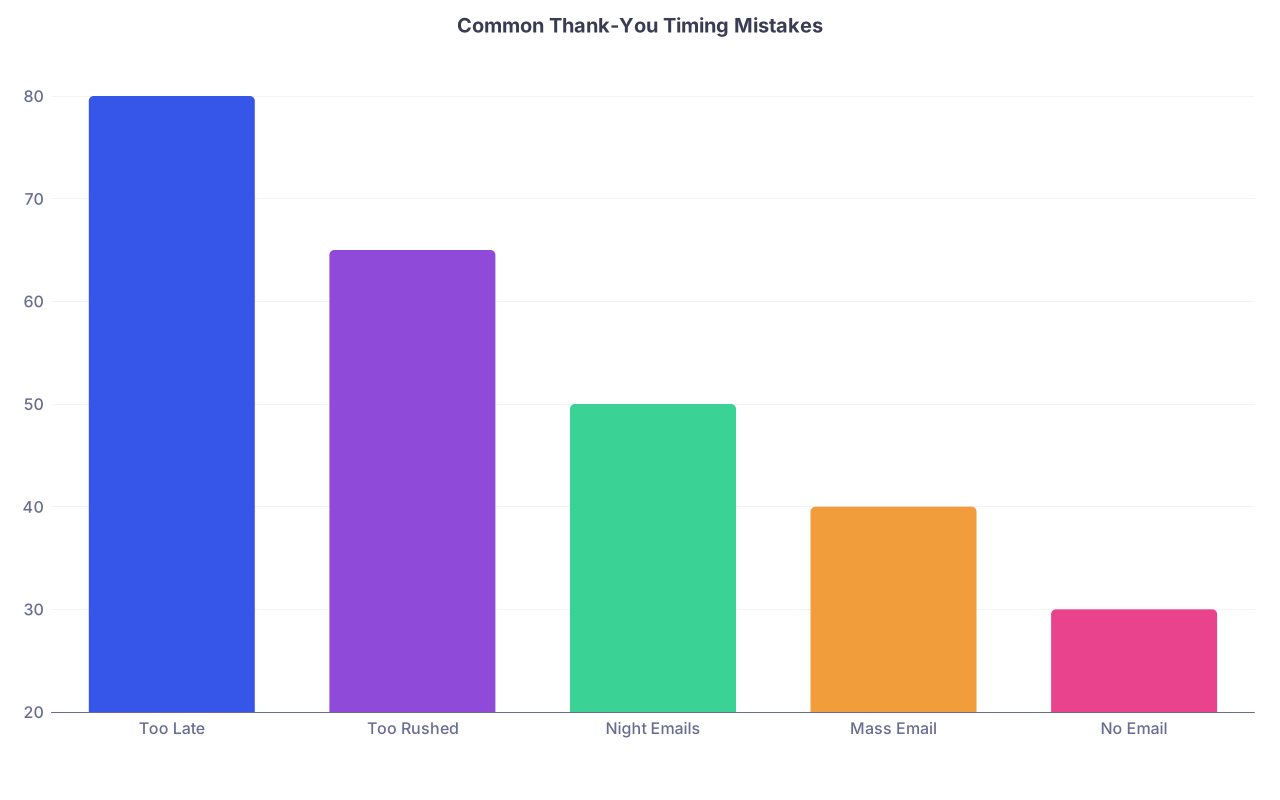
| Category | Value |
|---|---|
| Too Late | 80 |
| Too Rushed | 65 |
| Night Emails | 50 |
| Mass Email | 40 |
| No Email | 30 |
(Percentages represent rough frequency I’ve seen among applicants—point is, these are not rare.)
How To Look Organized Without Overthinking It
Let’s pull this together into a simple system that keeps you out of trouble without turning you into a robot.
Before interview season:
- Create:
- A basic thank‑you template with room for 2–3 specific lines.
- A simple spreadsheet or note to track who you met and when you sent thank‑yous.
- Decide:
- “I will always send within 24–48 hours.”
- “If I’m writing late at night, I will use scheduled send.”
On interview day:
- Immediately after: write down:
- The names of your interviewers
- One or two concrete details from each conversation
- That evening:
- Draft thank‑you emails
- Either send before 10 p.m. local time or schedule for the next morning
Your emails should be:
- Short (5–8 lines is fine)
- Correctly addressed
- Specific enough to prove you paid attention
- Free of rank talk this early
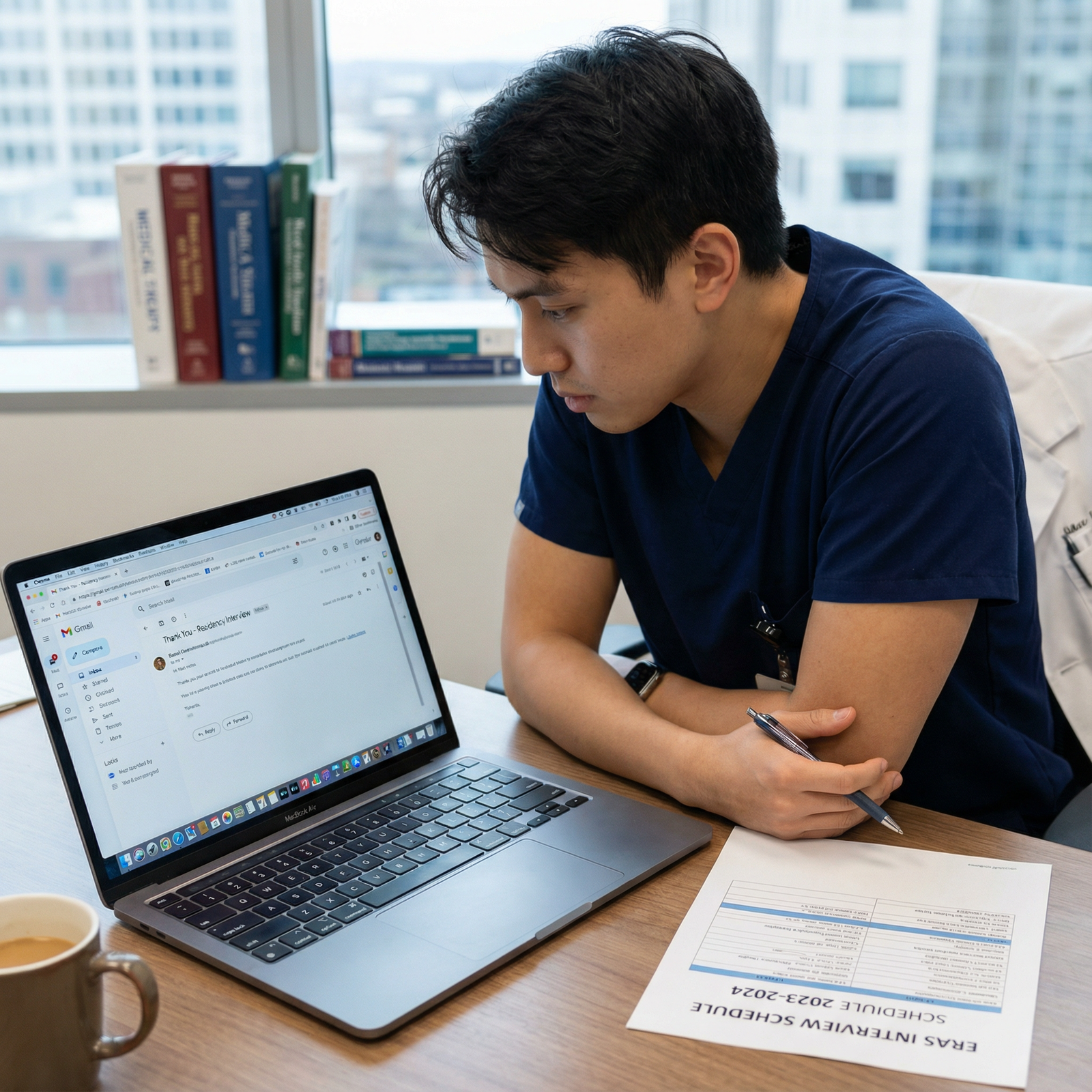
If you stick to that rhythm, you instantly rise above the chaotic middle.
The Bottom Line
Three things to remember so you don’t look disorganized:
- Hit the 24–48 hour window—not same‑hour rushed, not 7‑day‑late forgotten.
- Avoid desperation moves—midnight sends, mass emails, stacked follow‑ups, and premature rank talk.
- Use a simple system—track who you met, draft once per program, and let scheduled send keep your timing professional.
You don’t get extra credit for beautiful thank‑yous. But you absolutely can lose ground with sloppy ones. Don’t let something this fixable be the reason a PD labels you “disorganized.”