Overeager follow-up messages after residency interviews do not “show enthusiasm.” They get you flagged. Sometimes dropped. Fast.
I have watched programs move applicants down their rank lists—or completely off—based on nothing but their post-interview behavior. Not scores. Not letters. Just how they handled email after the interview day.
You can crush your interview, impress the PD, connect with residents, and still sabotage yourself with a single needy, pushy, or manipulative message two weeks later.
Let me walk you through the landmines so you do not become that story everyone remembers for the wrong reason.
The Ugly Truth: Programs Are Watching Your Post-Interview Behavior
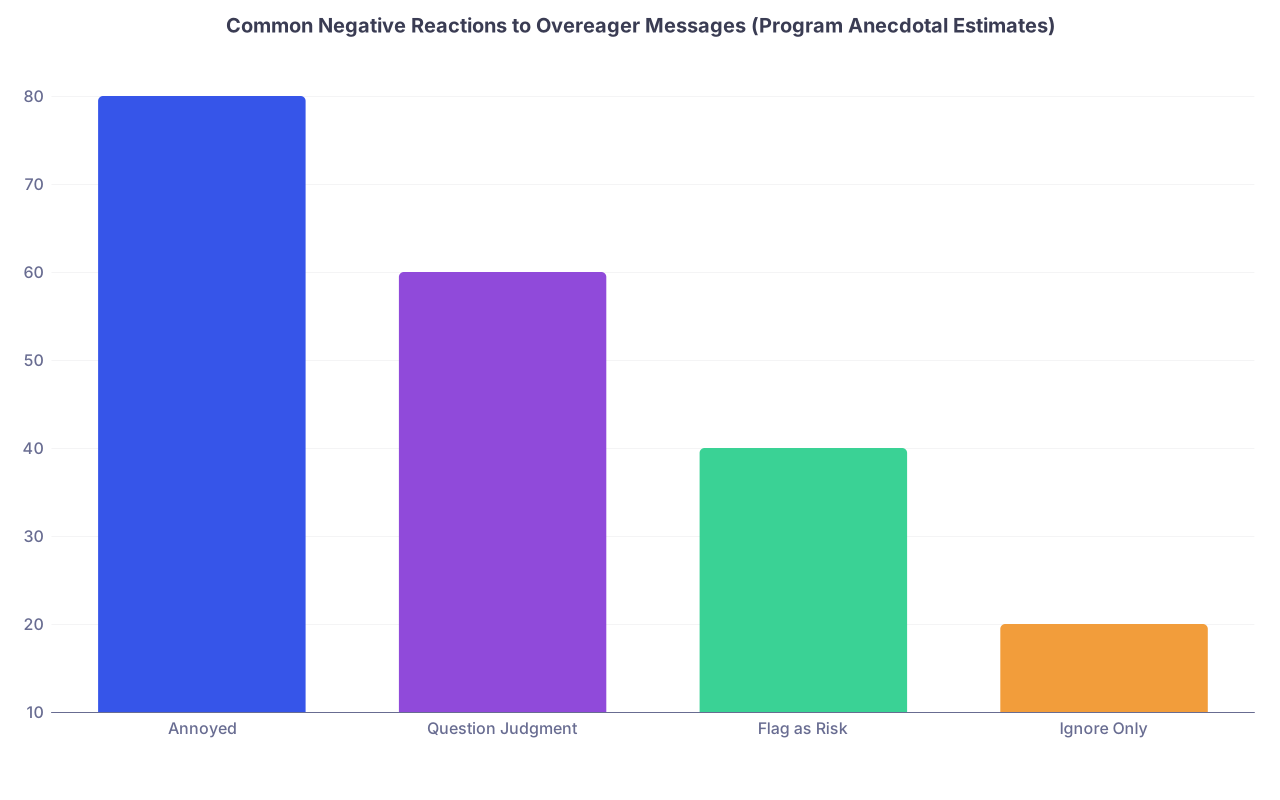
| Category | Value |
|---|---|
| Annoyed | 80 |
| Question Judgment | 60 |
| Flag as Risk | 40 |
| Ignore Only | 20 |
Here is what applicants get wrong: they see follow-up as a chance to “boost their chances.” Programs often see it as a stress test of professionalism.
Program directors and coordinators are drowning during interview season. Hundreds of emails. Schedules changing. Faculty juggling clinics. When you send repeated, long, or emotionally loaded follow-ups, you are not “standing out.” You are adding work. And showing how you might behave as a resident when you are anxious and not getting instant validation.
Common reactions from PDs and coordinators that I have heard verbatim:
- “If they cannot handle waiting a few weeks now, how will they handle waiting for consults or results?”
- “This feels desperate. Why are they emailing us three times?”
- “I am worried this person will be high-maintenance.”
- “We have 900 applicants. I am not rewarding boundary-pushing.”
Do not assume more contact = more interest = higher rank. Many programs explicitly prefer low-drama, low-maintenance residents. Your follow-up messages are a preview.
The Most Dangerous Mistakes Applicants Make After Interviews
There is a short list of behaviors that get talked about behind closed doors. You do not want to be the name attached to any of these.
1. The Multi-Email Spiral
One thank-you email? Fine. Expected, even.
But:
- Thank-you to every single interviewer separately.
- Plus a second message one week later “just checking in.”
- Plus another right before rank list deadline “reaffirming strong interest.”
- Plus a last “update” with a random new research poster.
Now you are not enthusiastic. You are noise.
Why it is a problem:
- It signals poor judgment about professional boundaries.
- It shows you are managing your anxiety by pushing it onto others.
- It forces staff to track and respond to you instead of running the program.
What programs actually do:
- Some quietly ignore after the first thank-you.
- Some literally mark “persistent/overly anxious” in notes.
- I have seen applicants dropped 10–20 spots on a rank list over repeated non-urgent emails.
Avoid this mistake:
- One concise thank-you within 48–72 hours of the interview. That is it for most programs.
- If you truly must send a second message (e.g., major update that significantly changes your application), send exactly one, several weeks later, and make it short and factual.
2. The “You’re My #1” or “Where Am I On Your List?” Email
This one gets people burned every year.
You send:
- “You are my absolute first choice, I will rank you #1.”
- “I just wanted to know if I am ranked to match.”
- “I am deciding between programs and was hoping to learn where I stand with you.”
Problem: NRMP rules. And professionalism.
Why this backfires:
- Programs are not allowed to tell you where you are on the rank list.
- Trying to extract this information puts them in an awkward, legally sensitive spot.
- PDs do not appreciate applicants who seem comfortable pushing against explicit rules.
I have watched PDs read these emails, sigh, and say, “Nope. I do not want this headache for three years.” Then move the applicant down.
What is safer:
- If you truly want to signal high interest, keep it one-way and non-pressuring:
- “Your program is one of my top choices, and I would be thrilled to train there.”
- Do not ask about their list. Do not fish for reassurance.
- Never, ever send “You are my #1” to multiple programs. They talk. And it destroys your credibility if it gets back (and yes, sometimes it does).
3. Emotional Oversharing and Desperation
You are stressed. You are tired. The match is brutal. I get it.
But some applicants pour that raw anxiety straight into their emails:
- “I am really scared about matching this year.”
- “I have not gotten many interviews, so your program is my only hope.”
- “I have always dreamed of your city and would be devastated if I did not match there.”
This does not create empathy. It creates concern.
What PDs and faculty hear underneath:
- “This person may struggle with emotional regulation.”
- “Are they going to fall apart when things get hard?”
- “Are we going to have to manage constant reassurance needs?”
Residency is already high-risk for burnout and mental health crises. Programs want resilient, stable, support-seeking adults—not people who offload their anxiety through boundary-blurring messages.
Better approach:
- Keep emotions out of email. You can like a program without sounding fragile.
- Express enthusiasm in grounded, professional language:
- “I greatly appreciated the opportunity to interview and left even more interested in your program, especially your [X feature].”
If you feel tempted to write anything that sounds like a diary entry, stop. Talk to a friend, mentor, or therapist. Not the PD.
4. The “Update” That Is Not Worth Updating
If you win a national award, submit first-author to a major journal, or add a very significant leadership role after your interview, an update email can make sense.
What does not count as “significant”:
- Another poster at a minor local conference.
- A short letter to the editor accepted.
- Joining a small committee.
- A minor change in Step 2 score if it is still in the same rough range.
Here is the mistake: applicants treat programs like they are tracking every new line of the CV in real time. They are not. They barely have time to eat lunch.
Programs roll their eyes at:
- “Dear Dr. X, I wanted to let you know I have been selected to present a poster at [small local meeting]…” (and this is the entire content of the message)
- “Quick update: our paper is still under review. Just wanted to keep you posted.”
It screams: I am looking for any excuse to reappear in your inbox.
Guideline:
- Only send an update if:
- It would significantly change how a rational PD views your application strength; and
- You can state it in 3–4 sentences, tops; and
- You have not already emailed them twice.
- If you are unsure whether an update is “big enough,” it is probably not.
5. Violating Explicit Communication Policies
Many programs now state in their interview day slides or follow-up emails:
- “Please direct all post-interview communication to the program coordinator.”
- “We do not consider post-interview communications in our rank list decisions.”
- “We are unable to respond to questions about rank or match chances.”
Applicants ignore this constantly. And then wonder why it did not go well.
Examples that get people in trouble:
- Emailing multiple faculty directly when the program said use only the coordinator.
- Calling the office to “follow up” about your message when they said they might not respond.
- Asking, “I know you said you do not consider communication, but I really wanted to express that I will rank you highly…”
What this signals:
- Difficulty respecting boundaries.
- Poor attention to detail.
- A “rules are for other people” attitude—deadly in medicine.
If a program says, “We do not respond to X,” do not try to be the exception. It does not read as special. It reads as entitled.
6. The Social Media Overreach
This one is newer but increasingly problematic.
Risky moves include:
- DM’ing residents or faculty on Instagram/Twitter/LinkedIn after the interview to “follow up.”
- Sending connection requests with long messages about how much you loved the program.
- Commenting repeatedly on residents’ personal posts to stay on their radar.
What you think you are doing: networking, staying visible.
What they often feel: creeped out, cornered, or used.
I have heard residents say:
- “Why is this applicant commenting on my vacation photos?”
- “They DM’d me twice after I did not respond the first time. That feels off.”
- “I do not want them as a colleague if they do not understand boundaries.”
Rule of thumb:
- Social media is not the place for post-interview lobbying.
- Professional platforms (LinkedIn) are safer but still should not be used for repeated outreach.
- Never slide into personal accounts with pressure, flattery, or “just checking in” messages.
If residents like you, they will say so to the committee. You do not need to chase them online.
What Programs Quietly Prefer Instead
Let me be clear: you do not win the match game with clever post-interview communication. You win it with a strong application and solid interviews.
Post-interview, the safest move is actually simple: be calm, be minimal, be professional.
The Low-Risk, High-Respect Pattern
Here is the pattern that rarely backfires:
Single, concise thank-you email
Sent within 48–72 hours. Either:- One email to the program coordinator or PD referencing the day; or
- A brief, individualized thank-you to each interviewer if the program has not discouraged it.
Content:
- 3–6 sentences.
- Specific, but not gushing.
- No rank talk. No pressure. No desperation.
Silence unless you have a truly significant update or legitimate question
- Genuine logistics question (e.g., visa, start date complication)? Fine.
- Major publication in a strong journal? Possibly.
- Everything else? Probably not worth emailing.
If you choose to express preference, do it once, clearly, and ethically
- “Your program is one of my top choices and I would be thrilled to train there.”
- If you truly intend to rank them #1 and want to say so:
- Be honest. Do not send this to more than one place.
- Do it late in the season when you are certain.
- Keep it short and without asking anything in return.
Red Flags Programs Use to Quietly Move You Down

Here is what gets whispered during rank meetings:
- “This one has emailed three times. Seems very anxious.”
- “They tried to pressure us for rank info. I am not comfortable.”
- “They ignored our request to only contact the coordinator.”
- “Resident X felt weird about repeated messages on social media.”
People do not always say, “Drop them.” More often it is:
- “Let us move them down a bit; I am nervous about their judgment.”
- “We have enough strong candidates without this potential headache.”
You almost never hear the real reason communicated back to you. You just see the outcome on Match Day.
Safe Templates That Do Not Make You Look Desperate
Use these as guardrails, not scripts to spam.
Basic Thank-You (Post-Interview)
Subject: Thank you for the opportunity to interview
Dear Dr. [Last Name],
Thank you for the opportunity to interview with the [Program Name] [Specialty] Residency on [date]. I appreciated learning more about your program, particularly [specific element—curriculum, patient population, mentorship model, etc.].
I was impressed by [one concrete detail] and could clearly see myself thriving in your training environment.
Sincerely,
[Your Name], [Med School]
Send this once. Then stop.
Significant Update (Only If Truly Worth It)
Subject: Brief application update – [Your Name]
Dear [Coordinator/Dr. Last Name],
I hope you are well. Since my interview on [date], I wanted to share one brief update on my application. I was recently notified that my [manuscript titled X] was accepted for publication in [well-known journal]. This project focuses on [one line summary, max].
I remain very interested in [Program Name] and appreciate your consideration.
Best regards,
[Your Name]
One time. Very short. No emotional weight.
Quick Comparison: Reasonable vs. Overeager Behavior
| Situation | Reasonable Action | Risky / Overeager Action |
|---|---|---|
| After interview | One concise thank-you email | Multiple follow-ups over several weeks |
| Expressing interest | “I would be thrilled to train here” | “I will rank you #1, please rank me to match” |
| New minor achievement | No email | Emailing about every small poster or update |
| Program says “no rank questions” | Do not ask about ranking | “Can you tell me if I’m ranked to match?” |
| Resident gives email / contact info | One brief thank-you or clarifying question | Multiple DMs, comments on personal social |
If you are ever in doubt, default to the left column.
A Simple Decision Flow: Should I Send This Message?

| Step | Description |
|---|---|
| Step 1 | Thinking about emailing program |
| Step 2 | Send one concise thank-you |
| Step 3 | Do not email |
| Step 4 | Send one brief update |
| Step 5 | Have you already sent a thank-you? |
| Step 6 | Is there a significant, objective update? |
| Step 7 | Will this likely change how they view your file? |
If your situation does not cleanly land on “Send one brief message,” you are probably safer not sending anything.
The Core Principle: Do Not Let Anxiety Drive Your Keyboard

The residency match is engineered to make you feel powerless. That is by design. Overeager follow-up is how applicants try to take control back.
It does not work.
What works:
- Crafting a strong application.
- Interviewing well.
- Behaving like a stable, low-drama professional afterward.
Everything else is noise. And sometimes, self-sabotage disguised as “being proactive.”
If you are about to send a second or third message to a program, assume this: your anxiety is trying to protect you but might be about to hurt you. Pause. Sleep on it. Ask a mentor. Nine times out of ten, you are better off not clicking “send.”

FAQ (Exactly 4 Questions)
1. Do programs actually move people down the rank list over emails, or is that just a myth?
Yes, it happens. I have seen applicants moved down due to repeated, boundary-pushing, or unprofessional follow-up messages. It is usually not a massive freefall, but enough to matter in close calls. Programs have plenty of good candidates; any hint that you may be high-maintenance or disregard policies can push them to choose someone else.
2. Is it ever okay to tell a program they are your #1?
Only if three conditions are met:
- You are absolutely certain you will rank them first.
- You say it to exactly one program, not several.
- You keep it short and do not ask them how they will rank you.
Even then, it rarely changes much. Some PDs appreciate the honesty; others ignore all post-interview communication by policy. Never expect a promise or reassurance in return.
3. What if a program says they do not consider post-interview communication at all—should I still send a thank-you?
Yes, a single professional thank-you is still fine. Their statement usually means they will not adjust the rank list based on emails. It does not mean they view basic courtesy as a negative. Just do not interpret that as an invitation to send multiple follow-ups or long expressions of interest. One and done.
4. How do I handle genuine questions (e.g., couples match, visa) without looking overeager?
If the question affects your ability to rank them honestly—like visa sponsorship, couples match logistics, or call schedule realities—it is appropriate to ask. Send one concise email to the coordinator or designated contact. Clearly state your question, avoid emotional language, and do not repeat the question if they are slow to respond. Legitimate, concrete questions are different from anxiety-driven fishing for reassurance.
Key points:
- Overeager follow-up does not make you stand out positively; it raises red flags about judgment and emotional regulation.
- One concise thank-you and, at most, one truly meaningful update are enough for almost every applicant and program.