Most residency applicants butcher multi-interviewer thank-you emails—and programs can tell instantly.
You sat through a 3–5 person panel, everyone introduced themselves in a blur, and now you are staring at your inbox thinking:
“Do I email everyone? One group email? What if I mix up names? What if I remember nothing about Dr. X?”
Let me break this down precisely, the way chiefs quietly teach their favorites.
The Core Rule: Every Interviewer Gets Their Own Tailored Email
A panel interview does not mean a group thank-you.
Group thank-you emails scream three things to a program:
- You are disorganized.
- You did not care enough to individualize.
- You probably do not do details well. Which, in residency, is a problem.
You send:
- One personalized email to each physician who interviewed you (faculty, PD, APD, chief resident, senior resident).
- Within 24–48 hours of the interview day.
- Using a consistent, professional structure.
No exceptions unless the program explicitly instructs: “Please send a single thank-you email to our coordinator to share with the team.” Rare, but it happens. If they say that, do it exactly as told.
Step 1: Get Your Interviewer Information Organized Before You Leave
If you wait until you are home to remember who said what, you are already in trouble.
During or immediately after the panel interview, you should capture:
- Full names (with correct spelling)
- Titles/roles (Program Director, APD, Chief Resident, etc.)
- Distinguishing features (research area, specific anecdote, clinic they mentioned)
- One or two concrete points you discussed with each person
If the panel is on Zoom, keep the participant list open. Many platforms show full names and titles. Screenshot the participant window if needed.
If in person, two options:
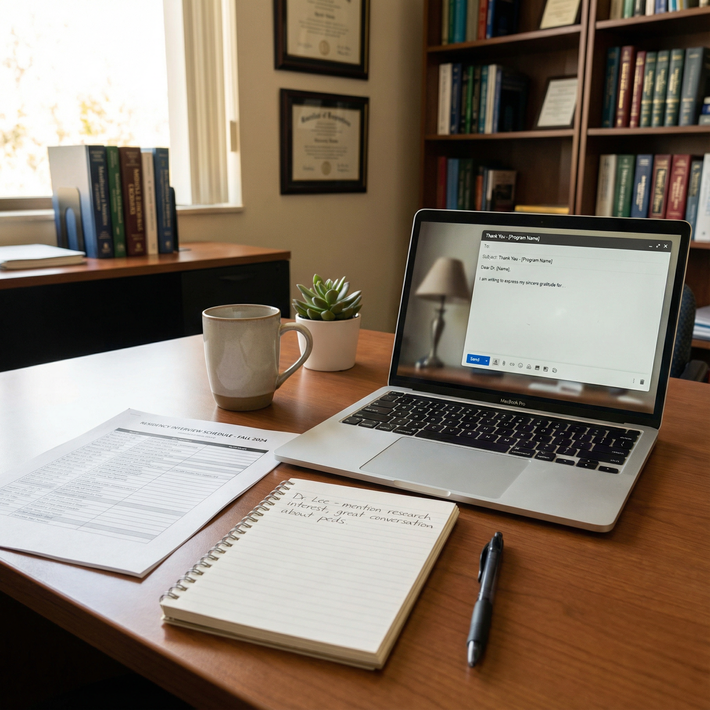
- Take quick notes right after the panel: “Dr. Patel – PD – global health – loves resident autonomy,” “Dr. Nguyen – APD – simulation director – critical care.”
- Use your printed schedule. Most programs include names and titles. Annotate it.
You are building a reference sheet so your thank-you emails do not turn into vague, generic nonsense.
Step 2: Understand the Hierarchy (Because Tone Should Shift Slightly)
You do not write the same email to the PD and to the PGY-3 chief. The structure is similar, but emphasis changes.
Here is the usual panel composition and what each person pays attention to:
| Interviewer Role | Primary Focus in Follow-Up |
|---|---|
| Program Director | Overall fit, professionalism, maturity |
| Associate/Assistant PD | Curriculum fit, resident support, remediation |
| Core Faculty | Clinical/research alignment, teachability |
| Chief Resident | Team fit, work ethic, culture |
| Senior/PGY-3 Resident | Day-to-day life, workload, call, morale |
So:
- To the PD: emphasize overall program fit, training philosophy, and why their program aligns with your career path.
- To APDs/faculty: emphasize clinical/research alignment, specific rotations, educational structure.
- To chiefs/residents: emphasize culture, team dynamics, and how you would fit into the resident group.
Same skeleton, different focus.
Step 3: Use a Simple, Reusable Email Structure
You do not need to reinvent the wheel every time. You need one strong template that you customize.
Here is the structure I consistently recommend:
- Subject line: Clear + program name + your full name
- Greeting: Correct title and name (this is where many people blow it)
- Opening: Express gratitude and reference the panel context briefly
- Middle: One or two specific callbacks to your interaction or something they said
- Program fit sentence: Why this residency (brief, not a second personal statement)
- Closing: Professional sign-off + name + ERAS AAMC ID (yes, include it)
Let us walk each piece with concrete templates and then talk about how to flex them for multiple interviewers.
Step 4: Subject Lines That Do Not Look Like Spam
Your subject line should be searchable and instantly recognizable.
Use a format like:
- Thank you – [Program Name] Interview – [Your Full Name]
- Gratitude for [Program Name] Panel Interview – [Your Full Name]
- Appreciation for Today’s Interview – [Program Name] – [Your Full Name]
Avoid vague garbage like: “Thank you!” or “Great to meet you!”
Programs are tracking dozens of applicants. Help them help you.
Step 5: The Template – Faculty / PD Version
Here is a concrete, scalable template for PDs, APDs, and faculty. This is the backbone. You customize the middle.
Subject: Thank you – [Program Name] Interview – [Your First and Last Name]
Dear Dr. [Last Name],
Thank you for taking the time to speak with me during the panel interview for the [Program Name] [Specialty] residency on [Interview Date]. I appreciated the chance to hear your perspective on the program and to discuss [brief reference to topic].
I especially valued your comments about [specific detail they mentioned: e.g., resident autonomy in the ICU, the night float system, your QI curriculum, your work in inflammatory bowel disease]. Our conversation reinforced my impression that [Program Name] offers [specific attribute: e.g., rigorous clinical training with close mentorship, strong support for research, excellent operative experience paired with a supportive culture].
I remain very interested in the opportunity to train at [Program Name] and believe it would be an excellent fit with my goals in [specific career interest: academic medicine, community practice with X focus, fellowship in Y, etc.].
Thank you again for your time and for the thoughtful discussion.
Sincerely,
[Your First and Last Name]
AAMC ID: [#########]
Notice the key points:
- Panel is acknowledged, but the email is one-on-one.
- There is at least one specific callback to your conversation.
- The “fit” sentence does not sound like a generic copy-paste if you tweak the details.
Step 6: The Template – Chief Resident / Senior Resident Version
Residents care less about your long-term research agenda and more about whether you will be miserable or fun at 2 a.m. on call.
Shift tone slightly. Still professional, but you can use one notch more warmth.
Subject: Thank you – [Program Name] Interview – [Your First and Last Name]
Dear Dr. [Last Name]
or
Dear [First Name], (only if they explicitly said “Please call me [First Name]” and the culture felt informal; if in doubt, stick with “Dr. [Last Name]”)
Thank you for speaking with me during the panel interview for the [Program Name] [Specialty] residency on [Interview Date]. I enjoyed hearing your perspective on the program from the resident side, especially your description of [specific topic: call structure, ICU months, wellness initiatives, how attendings treat residents, your class’s camaraderie].
Your comments about [specific detail: e.g., how chiefs advocate for schedule changes, support for board preparation, the way residents help each other on busy nights] gave me a clear sense of the culture and day-to-day life in the program. It sounds like a place where I would be excited to train and contribute.
I remain very interested in [Program Name] and would be grateful for the opportunity to join your resident team.
Best regards,
[Your First and Last Name]
AAMC ID: [#########]
You are signaling: I heard you, I care about how residents live, and I see myself on your team.
Step 7: Customizing for Multiple People from the Same Panel
Here is where people get lazy and programs notice.
Scenario: You had a panel with:
- Dr. Smith – Program Director
- Dr. Lee – Associate Program Director, Simulation
- Dr. Hernandez – Core faculty, GI
- Dr. Davis – Chief Resident
You do not send four identical emails where you just swap names. That looks robotic. Faculty see this pattern all the time.
Instead, keep the skeleton but change:
- The specific callback line
- The “fit” sentence to reflect their angle of the program
Example differences:
- PD email: Emphasize training philosophy, board pass rates, overall structure, career support.
- APD (Simulation) email: Emphasize sim curriculum, procedural confidence, your interest in hands-on learning.
- GI faculty email: Emphasize your Step 2 CK shelf experience, your GI research, or a complex case you discussed.
- Chief email: Emphasize resident camaraderie, call, wellness, teaching culture.
If you truly cannot remember distinct details for one person, fall back to:
- Something they said about the program as a whole
- A question you asked and their response
- A theme they emphasized (autonomy, feedback, wellness, research, etc.)
Vague is better than wrong. But specific is best.
Step 8: Handling “Blurred” Panels When You Barely Remember Who Said What
Yes, it happens. 3 interviews, 4 panels, 12 total faces. Zoom lag. Names off-screen. By the end you are cooked.
Here is how you recover intelligently:
- Reopen your interview day materials. Many programs send a PDF with photos and roles. Match faces to names.
- Check your emails for pre-interview schedules listing your panel assignments.
- Check LinkedIn or program websites to confirm titles and research interests if needed.
- If you are truly unsure who said what, avoid “I appreciated when you said X,” and instead use safer phrasing like:
- “I appreciated hearing about the program’s emphasis on [topic] during our panel discussion.”
- “I enjoyed your perspective on [topic] and how it shapes resident training at [Program Name].”
Do not attribute an APD’s grant to the PD. Or confuse GI with Pulm/CC. That makes you look careless.
If you genuinely cannot reconstruct anything meaningful for one specific panelist, send a shorter, more general thank-you. Less detail. Fewer opportunities for obvious error.
Step 9: Timing, Frequency, and “Is It Too Late?”
The gold standard:
- Send within 24 hours.
- 48 hours is still acceptable.
- Beyond 72 hours, it starts to look like an afterthought, but still better than nothing.
If your interview was on:
- Friday: Sending Sunday evening or Monday morning is fine.
- Right before a holiday: Next business day is fine.
Do not send:
- Multiple follow-up thank-you emails to the same person unless you have a genuine update (new publication, significant award) and it is close to rank list time. Even then, keep it short and not needy.
Programs will not rank you first because your thank-you was faster than someone else’s. But late or sloppy thank-yous can hurt you, especially at small or mid-sized programs where faculty actually read them and remember applicants.
Step 10: Email Logistics That Separate Adults from Amateurs
A few non-negotiables:
- Use a professional email address. [email protected] is fine. Not “medguy2020” or your undergrad gamer tag.
- Triple-check spelling of names and program names. “Residency Program at Mass General” and you typed “Mass General Hospital of Harvard University Program of Internal Medicine Residency” wrong? You look unserious.
- Use proper formatting. Normal font, black text, no weird colors, no emojis.
- Put your AAMC ID in your signature. It helps coordinators file things correctly.
- Do not attach your CV, personal statement, or other documents unless explicitly requested.
And yes, you send separate emails, not one email with all the interviewers CC’d.
Step 11: The Group Thank-You Email to the Coordinator (Optional but Smart)
You should also send a brief note to the program coordinator. They are the engine that keeps everything running and the person the PD trusts.
Template:
Subject: Thank you for organizing the [Program Name] interview day – [Your First and Last Name]
Dear [Mr./Ms./Mx. Last Name],
Thank you for coordinating the interview day for the [Program Name] [Specialty] residency on [Interview Date]. The schedule was well-organized, and I appreciated the opportunity to speak with the faculty and residents and to learn more about the program.
I am very grateful for the time and effort you invested in arranging the interviews and for answering my questions throughout this process.
Best regards,
[Your First and Last Name]
AAMC ID: [#########]
Short. Respectful. Shows you understand how programs actually function.
Step 12: Common Mistakes That Make Your Thank-You Emails Backfire
Let me be blunt. These are the red flags I have seen programs laugh about in conference rooms.
Obvious Copy-Paste with No Customization
Every email says: “I appreciated learning about your strong clinical training and research opportunities.”
No specific references. No unique angle. Faculty know you sent the same thing to 12 people.Getting the Program Name Wrong
Example: You write “Thank you for the opportunity to interview at [Rival Program].”
Yes, this happens. You will be a cautionary tale for years.Overly Emotional or Desperate Language
“This is my absolute top choice and I will rank you #1 no matter what.”
Early in interview season, this sounds naïve or manipulative. Save explicit #1 statements (if you ever use them) for later, and only if you mean it.Trying to Re-Argue Weaknesses
Do not use your thank-you to re-litigate a poor answer:
“I wanted to clarify my response about my Step 1 score…” No. You will only draw attention to it.Lengthy Essays
Anything over 250–300 words is pushing it. Remember: attendings are reading on their phone in between cases or clinic visits. Get in, say thank you, be specific, get out.Typos in Names and Titles
“Dear Dr. Smyth” when it is “Dr. Smith” on their email signature.
Or calling a PD “Ms.” instead of “Dr.” if they have MD/DO/PhD after their name. This irritates people more than you think.
Step 13: Example Set – Full Panel Coverage
Let me give you a realistic set so you see how this looks in practice. Assume: Internal Medicine interview at “Cityview Medical Center.”
1. Program Director Email
Subject: Thank you – Cityview Medical Center IM Interview – Jane Doe
Dear Dr. Patel,
Thank you for speaking with me during the panel interview for the Cityview Medical Center Internal Medicine residency on January 5. I appreciated hearing your perspective on how the program balances autonomy with supervision, especially your description of senior residents leading the MICU service with close attending backup.
Your comments about developing clinically independent internists who can manage complex patients in a safety-net setting resonated with my own goals. Our conversation reinforced my impression that Cityview offers rigorous training in a diverse patient population with strong mentorship and support for residents pursuing academic careers in hospital medicine.
I remain very interested in the opportunity to train at Cityview.
Sincerely,
Jane Doe
AAMC ID: 12345678
2. APD (Simulation) Email
Subject: Thank you – Cityview Medical Center IM Interview – Jane Doe
Dear Dr. Lee,
Thank you for your time during the panel interview for the Cityview Internal Medicine residency on January 5. I enjoyed learning about your work with the simulation curriculum and how you integrate code leadership and procedures into longitudinal training.
Hearing how interns start with supervised central line and paracentesis simulations before performing procedures on the wards was particularly encouraging. I value structured, hands-on teaching, and I can see how your approach builds resident confidence and patient safety simultaneously.
Cityview’s emphasis on simulation-based education aligns well with how I learn best, and it strengthened my interest in the program.
Best regards,
Jane Doe
AAMC ID: 12345678
3. Core Faculty (GI) Email
Subject: Thank you – Cityview Medical Center IM Interview – Jane Doe
Dear Dr. Hernandez,
Thank you for speaking with me during the panel interview for the Cityview Internal Medicine program on January 5. I appreciated hearing about your work in inflammatory bowel disease and your involvement in the longitudinal GI clinic.
Our conversation about managing complex IBD patients in a safety-net setting and your description of residents following patients across multiple admissions really stood out. I am very interested in pursuing a GI fellowship, and it was encouraging to hear how you support residents in research and case presentations at regional meetings.
I remain very enthusiastic about the possibility of training at Cityview and working with faculty like you.
Sincerely,
Jane Doe
AAMC ID: 12345678
4. Chief Resident Email
Subject: Thank you – Cityview Medical Center IM Interview – Jane Doe
Dear Dr. Davis,
Thank you for sharing your perspective during the Cityview Internal Medicine panel interview on January 5. I especially appreciated your candid description of the call schedule, night float system, and how your class supports each other during busy inpatient months.
Hearing how chiefs and seniors actively protect interns’ education time and help redistribute work when services are heavy gave me a clear sense of the program’s culture. It sounds like a resident group that looks out for one another while maintaining high clinical standards.
I would be excited to join a team with that level of camaraderie and mutual support.
Best regards,
Jane Doe
AAMC ID: 12345678
You see the pattern. Same skeleton. Different spine.
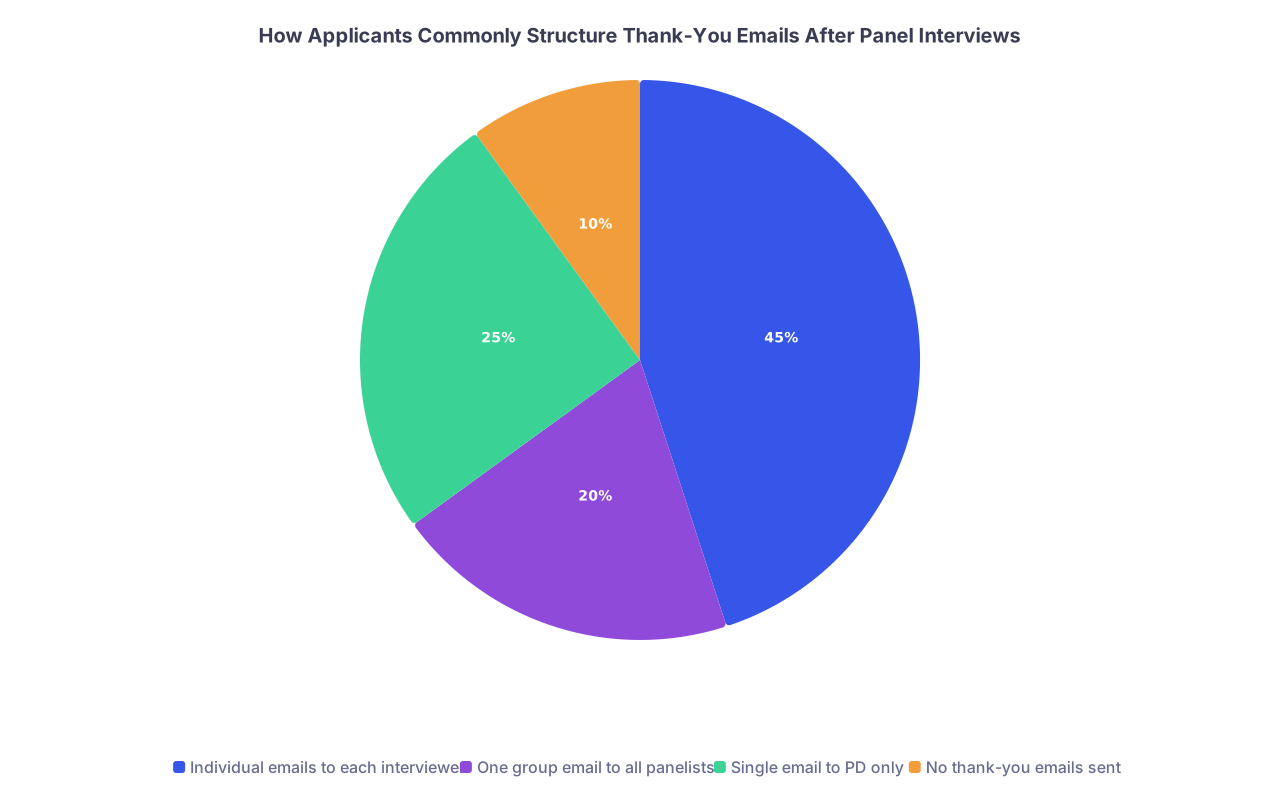
| Category | Value |
|---|---|
| Individual emails to each interviewer | 45 |
| One group email to all panelists | 20 |
| Single email to PD only | 25 |
| No thank-you emails sent | 10 |
Step 14: Tracking and Staying Consistent Across Multiple Programs
During interview season, chaos wins if you don’t have a system.
Create a simple tracking sheet with:
- Program name
- Interview date
- Names of interviewers (PD/APD/faculty/chief/resident)
- 1–2 specific memory triggers per interviewer (“talked about global health track”, “discussed QI project on sepsis bundle”, “joked about overnight cross-cover”)
- Date thank-you sent
Something like a basic spreadsheet is enough:
| Program | Interview Date | Number of Interviewers | Emails Sent Date |
|---|---|---|---|
| Cityview MC IM | Jan 5 | 4 | Jan 6 |
| Riverside Gen Surg | Jan 8 | 3 | Jan 9 |
| Lakeside Peds | Jan 10 | 5 | Jan 11 |
You are trying to avoid:
- Forgetting one person on a panel (they notice).
- Sending two very different narratives about your career goals to people who will discuss you together. They do compare notes.
Keep your core story consistent: same broad career goals, same reasons you like the program. Small differences in emphasis are fine. Total contradictions are not.

| Step | Description |
|---|---|
| Step 1 | Finish Panel Interview |
| Step 2 | Capture interviewer names & notes |
| Step 3 | Create/update tracking sheet |
| Step 4 | Draft PD/faculty emails |
| Step 5 | Draft chief/resident emails |
| Step 6 | Proofread & personalize |
| Step 7 | Send emails within 24-48 hours |
| Step 8 | Log sent dates in tracking sheet |
FAQs
1. Do programs actually care about thank-you emails, or is this just etiquette theater?
Some big academic programs barely glance at them. Others—especially mid-sized or community programs—absolutely read them and remember you by them. Thank-you emails will not rescue a terrible interview, but they can reinforce a good one and prevent small doubts about your professionalism.
2. What if my interviewers did not give me their email addresses?
Usually, the coordinator email includes a list of interviewers or the program website lists faculty with email links. If you truly cannot find an address (rare), send a thank-you to the coordinator mentioning specific faculty by name and asking that your appreciation be passed along.
3. Should I say the program is my top choice in a thank-you email?
Only if three things are true:
- It is late enough in the season that you have real basis for comparison.
- You truly intend to rank them #1.
- You are prepared to stand by that statement if you also communicate with other programs.
Generic thank-you emails do not need rank language. Save explicit “top choice” statements (if ever) for a later, targeted communication.
4. Can I reuse the same template across different programs?
Yes, the structure can (and should) be reused. The danger is when the content becomes generic. If you change the program name, the interview date, the interviewer’s name, and at least one or two specific references to that particular conversation, reuse is fine. If you are sending the same body text to everyone, you are cutting corners.
5. Is it worse to send a late thank-you email or none at all?
If you are more than a week out, a short, sincere, slightly late email is still better than silence—especially for programs that value professionalism and courtesy. Keep it simple: acknowledge the delay indirectly by skipping any references to “yesterday” or “earlier this week,” express appreciation, and move on. Do not apologize excessively; it draws attention to the lateness.
Takeaway:
- Every panel interviewer gets an individual, tailored email—faculty and residents included.
- Use one clear structure, customize the middle with specific callbacks, and keep it under 250–300 words.
- Avoid sloppy mistakes (names, programs, generic cut-and-paste) and treat thank-you emails as a professional finishing move, not an afterthought.