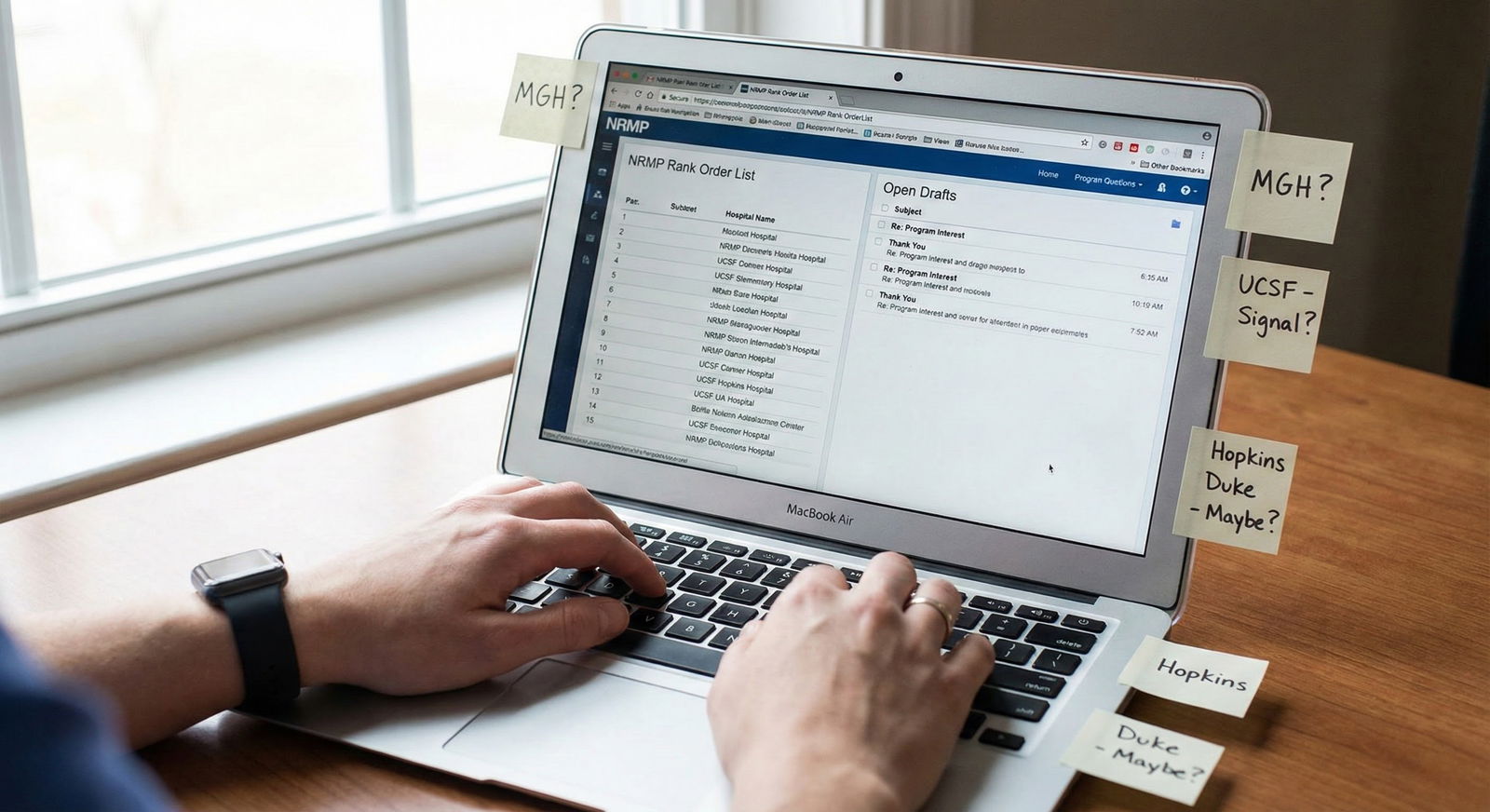
You just finished a long interview day. It is 10:47 p.m., you are in a hotel room with your suit half on the chair, half on the floor, and your inbox is open. You know you should send thank‑you / follow‑up emails. But suddenly you are stuck on basic questions:
Do I write the same thing to the program director and to the residents?
Can I be a little more casual with fellows?
If I really loved this place, who do I actually signal that to?
Let me be blunt: most follow‑up emails are generic noise. “Thank you for your time, I enjoyed learning about your program” sent to eight different people with the same wording. Program directors skim them, residents barely read them, fellows ignore half of them.
You can do better than that. And you should—because while a perfect email will not rescue a weak application, a targeted, thoughtful one can solidify an already good impression and make you easier to advocate for in a ranking meeting.
Let me break this down specifically.
The Core Principle: Same Interview Day, Different Jobs
Everyone you met sits in a different part of the power structure.
- Program Director (PD): Controls rank list structure and culture priorities. Strategic. Limited time.
- Associate PDs / Core Faculty: Significant influence, sometimes run the rank meeting.
- Fellows: Bridge between resident and attending worlds. May have a say on “fit,” especially in subspecialty‑heavy programs.
- Residents: Ground‑truth experts. Either champions or quiet vetoes. Their informal feedback can help or hurt.
You cannot send the same email to all four and expect a smart outcome.
The key differences:
- PD email = professional, concise, strategically aligned with program values.
- Faculty / fellows email = academic and interest‑oriented, a bit more content, specific clinical or scholarly angles.
- Resident email = collegial, grounded, specific to culture and day‑to‑day life.
Everything else is detail.
Timing and Targeting: Who Gets an Email and When?
Before we talk content, you need a timing and target strategy. Otherwise you end up spamming half the department.
| Category | Value |
|---|---|
| Same day | 10 |
| Next day | 50 |
| 2-3 days | 30 |
| 4-7 days | 10 |
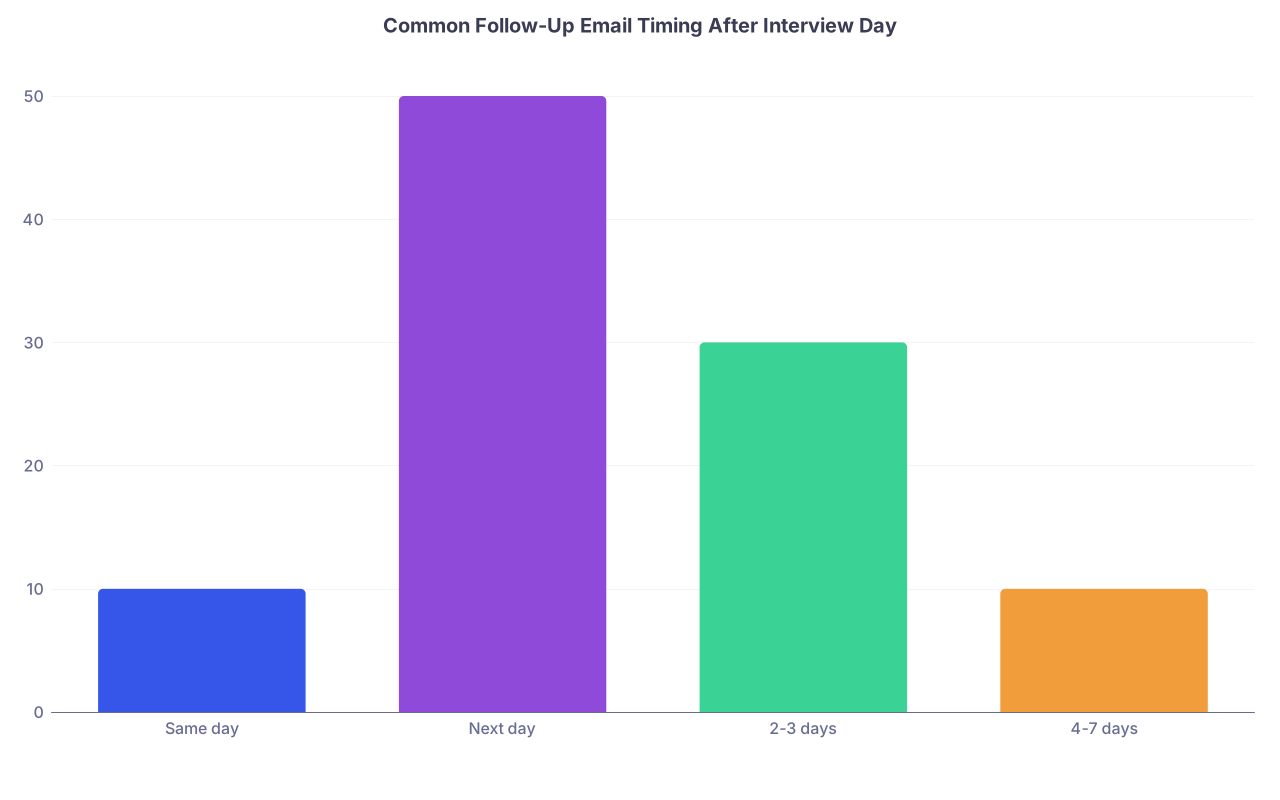
Ideal window: within 24–72 hours of the interview day. After one week, the emotional memory of you starts to blur.
Who should you email?
PD:
Always. Whether it was a 10‑minute group session or a full 30‑minute one‑on‑one.
Associate PD / Main Faculty Interviewers:
Usually. Anyone who spent ≥20 dedicated minutes with you, or who clearly aligned with your interests (research mentor, clinic director, etc.).
Fellows:
Selective. Email those who:
- Interviewed you one‑on‑one, or
- Spent significant time with you in a small‑group session where you had real back‑and‑forth.
Residents:
Targeted. Do not write every resident you met on Zoom. Typically:
- One or two residents you really connected with on social or interview day
- The chief resident, if they clearly function as a leadership representative
- The resident who ran the pre‑interview dinner, if you had a meaningful conversation
Rule of thumb: 3–6 total follow‑ups per program is plenty. More than that and it starts to look desperate.
Follow-Up to Program Directors: Strategic, Not Friendly
PDs are busy and ruthless with their inboxes. They do not want your life story. They want to know three things:
- You are professional.
- You understood what their program is about.
- You see a plausible fit between your trajectory and their program’s strengths.
Aim for 150–250 words. One screen. No scroll required.
Structure for a PD Email
Subject line options:
- “Thank you – [Your Name], [Specialty] interview [Date]”
- “Appreciation for interview day – [Your Name]”
Skip the gimmicky subject lines.
Body structure:
- Brief greeting + clear context
- Specific reference to something discussed or distinctive about the program
- One or two sentences connecting your trajectory/interests to their program’s strengths
- Polite close (optionally: signal of sustained interest, but not a binding statement)
Example frame (not a template to copy‑paste word for word):
Opening:
“Dear Dr. Smith,
Thank you for the opportunity to interview with the [Program Name] Internal Medicine residency on November 4.”Specific program detail:
“I appreciated your candid discussion about graduating residents as independent hospitalists who are comfortable managing complex patients at night, and the way you have structured the X+Y schedule to protect continuity clinic time.”Fit alignment:
“As someone who has really enjoyed night float and managing high‑acuity patients in our county hospital, I was drawn to the autonomy your upper‑level residents described and the emphasis you place on direct resident‑attending interaction rather than layering multiple fellows between them.”Close:
“I am very grateful for the chance to learn more about your program and will be thinking carefully about how it aligns with my training goals. Thank you again for your time and for leading such a thoughtful interview day.
Sincerely,
[Name], [Med School], AAMC ID [optional]”
Notice what is missing:
- No ranking promises.
- No “You are my top choice” this early.
- No references to other programs.
- No weird flattery about reputation or prestige.
You are signaling: I listened. I understand who you are. My goals match your design.
Mistakes PDs Actually Complain About
I have heard PDs say all of these out loud:
- “If one more person tells me they ‘loved my program’s commitment to excellence’ I will scream.”
- “Don’t tell me you ‘vibe with our culture’ if you cannot name a single concrete aspect of it.”
- “People write me three paragraphs about their pet. Why.”
So avoid:
- Vague fluff: “amazing culture,” “impressive training,” “renowned faculty” without specifics.
- Oversharing: long explanations of personal hardship in a thank‑you email. That belongs in your application or, if raised, in the interview itself.
- Attachments: do not attach updated CVs, manuscripts, or anything else unless explicitly invited.
- Asking procedural questions: application status, rank list, visa logistics—send those to the coordinator, not the PD, unless they raised it directly.
Follow-Up to Residents: Collegial, Concrete, Human
Residents are not grading your writing. They are reading this on their phone between pages or in a call room at 1 a.m.
Email style:
Plain. Warm but not gushing. Slightly more relaxed tone than with the PD, but still professional.
Length: 100–180 words.
Main job of this email:
Reinforce that you are someone they would not mind working with at 3 a.m. for four weeks straight.
Structure for a Resident Email
Subject:
- “Thank you – [Your Name], [Residency] interview”
- “Great to meet you at [Program] interview day”
Body flow:
- Greeting + where you met
- One or two very specific call‑backs to your conversation
- Brief comment on how their perspective shaped your view of the program
- Open door for future questions / contact (optional but helpful)
Example frame:
“Hi [First Name],
Thank you again for chatting with me during the resident social before the [Program Name] Pediatrics interview day. I appreciated your honesty about what call is really like on the NICU months and how the seniors make an effort to front‑load teaching on the first few nights.
Hearing about your experience moving from a smaller medical school to a large children’s hospital made the program feel much more approachable. It was helpful to hear that new interns get paired early with consistent faculty in continuity clinic; that kind of structure is something I value.
I really enjoyed meeting you. If I end up matching at [Program], I would be glad to work with seniors like you.
Best,
[Name]”
Key details:
- First names are fine for residents.
- You can reference lifestyle and culture more with residents: schedule, support, how attendings behave, camaraderie.
- Do not try to “sell yourself” aggressively. This is not your advocate letter; it is a relationship seed.
Residents remember applicants who sound like real people, not like drafted corporate emails.
Follow-Up to Fellows: Academic + Practical Bridge
Fellows occupy a strange middle zone. They are trainees, but usually with significant clinical responsibility and deep subspecialty investment. Programs with heavy subspecialty presence (cards, GI, heme/onc, PICU, NICU, trauma, etc.) often lean on fellows’ feedback for “fit”, especially for applicants who clearly signaled subspecialty interest.
Tone:
Professional like faculty, but you can match some of the informality of your interview if it was more conversational.
Purpose of this email:
- Reinforce your interest in their subspecialty area or teaching environment.
- Clarify that you understood the structure (how fellows interact with residents, what autonomy looks like).
- Signal that you would be a resident who takes advantage of that environment.
Length: 130–220 words.
Structure for a Fellow Email
Subject:
- “Thank you – [Your Name], [Subspecialty] discussion during [Program] interview”
- “Appreciation for our [ICU/Cardiology/etc.] conversation – [Your Name]”
Body:
- Greeting + context of meeting
- One concrete element of the fellowship‑resident interaction that appealed to you
- One line linking your prior experience or goals
- Reserved close
Example frame:
“Dear Dr. Patel,
It was a pleasure speaking with you during the [Program Name] Internal Medicine interview day. I enjoyed our discussion about how the cardiology fellows strive to give residents primary operator opportunities on straightforward caths while still maintaining a safe learning environment.
During my sub‑internship on our CCU, I found that having fellows who explained their thinking around hemodynamics and device selection made the rotation much more educational. The way you described your approach to involving residents during codes and post‑MI care sounded very similar, and it reinforced my sense that [Program] would be a strong place to grow clinically, especially for someone like me who is considering cardiology fellowship.
Thank you again for your time and for sharing your perspective.
Best regards,
[Name]”
Fellows read for: Is this someone who seems teachable, curious, and respectful? If yes, that is already a win.
Side‑by‑Side: PD vs Resident vs Fellow – What Actually Changes?
Let me lay it out in one place.
| Aspect | Program Director | Residents | Fellows / Faculty |
|---|---|---|---|
| Tone | Formal, concise, strategic | Collegial, warm, human | Professional, academic |
| Focus | Program structure, values, fit | Culture, day‑to‑day life, support | Subspecialty teaching, autonomy |
| Length (approx.) | 150–250 words | 100–180 words | 130–220 words |
| Subject line style | “Thank you – [Name], interview” | “Great to meet you at [Program]” | “Thank you for [topic] discussion” |
| Level of detail | High‑level specifics | Concrete anecdotes from conversation | Specific clinical/academic points |
If your three emails feel identical when you reread them, you have not adjusted enough.
Advanced Moves: Signaling Interest Without Violating Rules
Now we get to the question everyone asks quietly: “Can I hint I will rank them highly without breaking NRMP rules or sounding manipulative?”
Short answer: yes, but you need to be precise.
Early Thank‑You vs Post‑Rank Signaling
Two different phases.
Immediate thank‑you (within 1–3 days of interview)
Primary goal: reinforce positive impression, show professionalism.
Secondary goal: mild, non‑committal interest.Phrases that are fine:
- “Your program will remain at the top of my list as I consider my options.”
- “Our conversation reinforced that [Program] would be an excellent place for me to train.”
These are directional but not absolute.
Later interest email (after you have a clear rank list, often late January–February)
If you really intend to rank a program number one, one clear, honest statement is acceptable. One program only.Example:
“After completing my interviews, I have decided to rank [Program Name] as my top choice. I believe your combination of [X] and [Y] makes it the best fit for my training goals.”
Never promise more than one program that you will rank them first. PDs talk to each other. This is not a myth.
And do not write residents or fellows with rank‑list promises. Those messages belong—sparingly—with the PD or, in some programs, an APD.
Process Map: Who to Email, About What
Sometimes it helps to see it as a flow, because your brain is fried during interview season.
Keep that mental checklist. It prevents shotgun emailing.
Style and Mechanics: Small Details That Make You Look Like A Resident, Not A Student
You want your emails to read like they are from someone who is already half a colleague.
Key rules:
Use a professional email address.
FirstName.LastName@something. If your med school email looks ridiculous or is about to expire, use a neutral Gmail.Include a clean signature block:
- Name
- Medical school
- “MD Candidate, Class of 202X”
- AAMC ID (optional, but PDs and coordinators appreciate it for lookup)
Avoid over‑formatting.
No colored fonts. No pictures. No quotes. This is not a newsletter.Proofread once. Then stop.
One typo will not kill you. A rambling, overworked paragraph that screams “I spent 40 minutes polishing this” is worse.Do not recycle the exact same paragraph to people in the same program.
They sometimes forward emails to each other. I have seen PDs scroll and say, “He sent this word‑for‑word to three of us.”
How Much Does Any of This Actually Matter?
Let me set expectations.
Follow‑up emails rarely move you from “probably not rank” to “top 5.” They are not that powerful. Where they matter:
- Fringe cases: You are on the borderline between two tiers on the list. Being remembered positively by the PD or by a vocal resident can nudge you up a bit.
- Advocacy scenarios: A resident or fellow really liked you and is willing to stick their neck out slightly. Your thoughtful email gives them something concrete to reference.
- Red flag mitigation: If there was a minor awkward moment in the interview, a grounded, professional email can remind them that you are more than that one stumble.
Where emails will not help:
- You bombed every interview.
- You were dismissive of staff or residents during the day.
- Your application is fundamentally misaligned with the program’s priorities.
In other words: this is optimization, not salvation. But in the Match, optimization counts.
Visual Snapshot: Who Cares Most About What?
| Category | Professionalism | Culture/Collegiality | Academic/Clinical Alignment |
|---|---|---|---|
| Program Director | 60 | 10 | 30 |
| Residents | 20 | 50 | 30 |
| Fellows/Faculty | 40 | 20 | 40 |
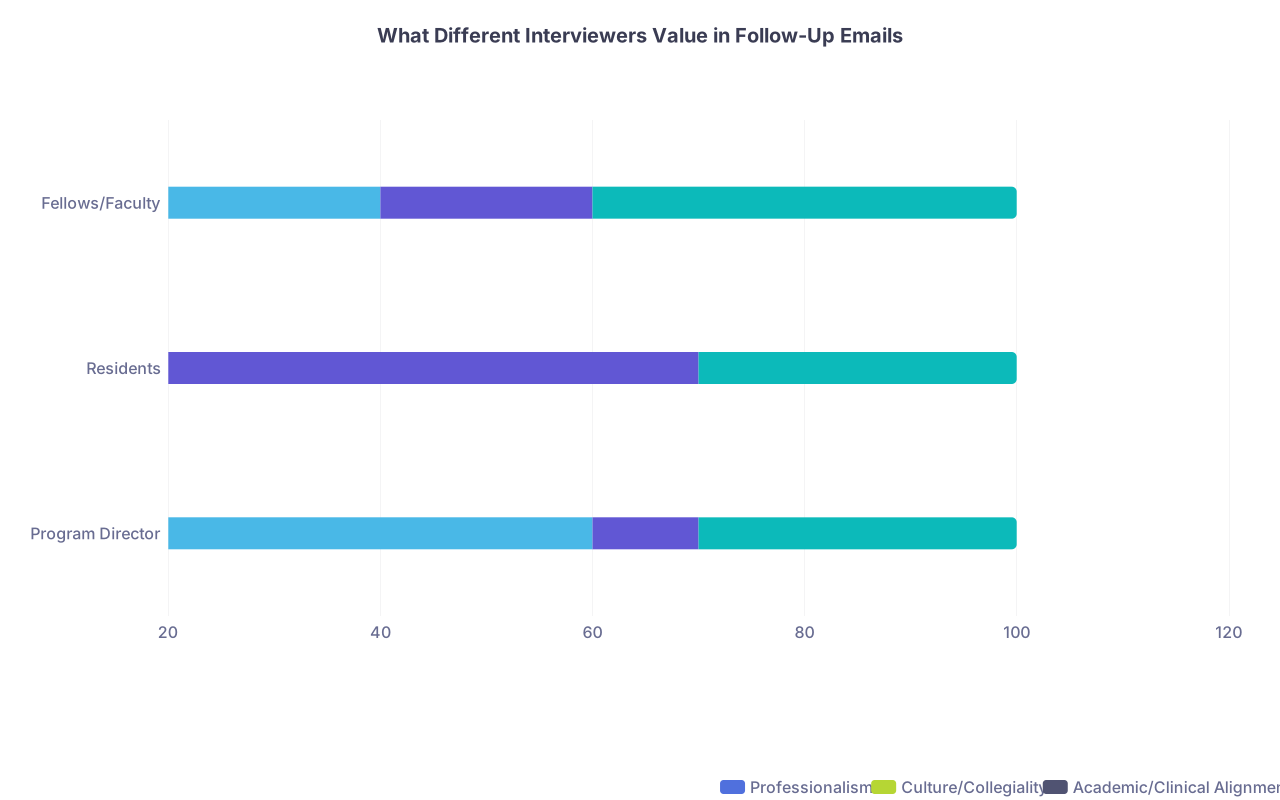
Interpretation (rough, but directionally true):
- PDs = heavy on professionalism + alignment.
- Residents = heavy on culture + “do I like you as a person.”
- Fellows / faculty = split between professionalism and academic/clinical alignment.
Write with that in mind.
Common Bad Patterns I See Over and Over
Let me call out a few archetypes.
The “Copy-Paste Robot”
Same three sentences to PD, APD, 2 residents, and a fellow. Only name swapped. They will notice. It reads lazy.The “Oversharing Confessional”
600 words to a PD about every trauma and hardship that shaped your path, none of which came up in the interview. This does not belong in a thank-you follow‑up.The “Over-Familiar Bro”
Writing the PD: “Hi John, great to hang out with you all today, loved the vibes.” You are not there yet.The “Transactional Closer”
Ending with: “I hope you will rank me highly.” Just… no.
If you avoid those four, you are already in the top half of follow‑ups.
Quick Reference: Sample Skeletons
Not templates to mindlessly copy, but skeletons to adapt. Keep it short.
PD Skeleton (Fill‑In)
“Dear Dr. [Last Name],
Thank you for the opportunity to interview with the [Program Name] [Specialty] residency on [Date]. I especially appreciated [specific thing they emphasized – e.g., your description of the X+Y schedule, your focus on underserved care at the county hospital, your commitment to resident autonomy on night float].
Hearing about [concrete detail from interview or presentation] resonated with my experiences in [brief reference to your background] and with my goal of [one training goal that matches their strengths]. The day reinforced my sense that [Program] would be a strong environment for me to develop as a [hospitalist/clinician‑educator/subspecialist, etc.].
Thank you again for your time and for a very well‑organized interview day.
Sincerely,
[Name]
MD Candidate, Class of [Year]
[School]”
Resident Skeleton
“Hi [First Name],
Thank you again for speaking with me during [resident social / small‑group Q&A / lunch] on the [Program Name] interview day. I enjoyed our conversation about [specific topic – e.g., how seniors support interns on wards, the night float experience, life in the city, mentorship].
Your perspective on [one culture or lifestyle element] made the program feel [more concrete, more supportive, whatever is true]. I could clearly see the camaraderie among the residents, which is something I value highly.
I appreciated your time and hope we may cross paths again.
Best,
[Name]”
Fellow Skeleton
“Dear Dr. [Last Name],
It was a pleasure speaking with you during the [Program Name] [Specialty] interview day. I enjoyed our discussion about [specific subspecialty topic, patient population, rotation, or conference].
Hearing how the fellows [teach residents on rounds / involve them in procedures / allow them to present at conferences] aligned with what I am looking for in a training environment, especially as someone who is interested in [subspecialty or career path]. It reinforced my impression that [Program] offers strong preparation in [clinical area].
Thank you again for your time and insight.
Best regards,
[Name]”
Save those skeletons, customize tightly, and you will not overthink this at midnight.



FAQ (Exactly 6 Questions)
1. Do I have to send thank‑you emails to every single person who interviewed me?
No. Email the PD in every program. Then selectively email key faculty/fellows and 1–3 residents you connected with. Sending 8+ nearly identical emails at the same program adds little value and can backfire if they see the duplication.
2. Is it acceptable to use the same basic template for multiple programs?
Using a structural template is fine; reusing the same sentences is lazy. The “thank you for your time, I enjoyed learning about your program” line pasted everywhere is exactly what PDs ignore. Each email needs at least 2–3 program‑specific and person‑specific details that would make no sense if you accidentally sent it to another institution.
3. Can I say a program is my #1 in a follow‑up email?
You can tell exactly one program they are your top choice, and only if that is true. That message should go to the PD (or APD if the PD is inaccessible) later in the season when you are confident about your rank list. Do not promise “#1” status to multiple programs, and do not involve residents or fellows in those statements.
4. Should I send handwritten thank‑you cards instead of or in addition to emails?
In 2026, handwritten cards are mostly symbolic. They may sit on a desk, but they are not part of the digital thread PDs review. If you genuinely enjoy writing them, fine, but do not substitute them for emails. Programs route and forward emails internally; physical notes rarely reach everyone who matters in time.
5. What if I realize I made a mistake in my email after sending it (typo, wrong name, etc.)?
If it is a minor typo, leave it alone. They do not care. If you used the wrong name or program (e.g., “I enjoyed learning about [Other Hospital]”), send a brief, direct correction email: one sentence apologizing, one sentence with the corrected line. Do not over‑apologize. Fix it and move on.
6. Should I follow up again if I do not get a reply to my thank‑you email?
No second follow‑up just to your own thank‑you. Many PDs and residents will not respond at all; that is normal and not a bad sign. The next time you email them should be for a substantive reason: a genuine update they requested, or a single, clear interest/rank‑intent email later in the season if appropriate.
Key points to walk away with:
- PD vs resident vs fellow emails are not interchangeable; match tone and content to their role.
- Keep emails short, specific, and program‑anchored—no fluff, no mass copy‑paste.
- Use follow‑ups for refinement and relationship building, not as a Hail Mary to rescue a weak application.