
It is 10:37 p.m. You are back at the hotel after a long interview day. Suit jacket on the chair. Name tag tossed on the desk. Your head is buzzing with faces, names, service schedules, “Do you have any questions for us?” moments.
And now you are staring at a half-written thank-you email, stuck on the dumbest questions:
“Do I write ‘Dear Dr. Lastname’ or ‘Hi Firstname’?” “Do I put my AAMC ID in my signature?” “Is it weird if my email font changes when I paste from my notes?” “Do I sign as ‘Jane Doe, MS4’ or ‘Jane Doe, M.D. Candidate’?”
This is where people make avoidable, low-level mistakes that do not help them and occasionally hurt them. Not because programs are petty, but because sloppiness in small things suggests sloppiness in bigger ones.
Let me break this down specifically.
1. The Goal of a Thank-You (And What It Is Not)
You are not winning the Match with a brilliant thank-you email. The thank-you is not your personal statement 2.0.
The thank-you does three things:
- Confirms your professionalism.
- Reinforces your interest and fit in a concrete, specific way.
- Keeps your name associated with a positive memory of the interview.
That is it. The micro-details we are about to go through matter because they support those three functions. Not because PDs sit around grading typography.
The bar is not “perfect and poetic.” The bar is “clean, correct, and frictionless.”
2. Subject Line, Greeting, and Titles: Do Not Get Cute
You can write the most thoughtful note in the world and still trigger an eye twitch if you mess up the subject line, greeting, or title.
Subject lines that work
Keep it boring and searchable. Faculty search their inboxes. Help them.
Good patterns:
- “Thank you – [Your Name], [Specialty] Interview [Month Day]”
- “Thank you for the interview – [Your Name]”
- “Appreciation for [Program Name] interview – [Your Name]”
Example:
- “Thank you – Jane Doe, Internal Medicine Interview 11/18”
Avoid:
- “Great to meet you!!!”
- “Loved your program”
- “Follow up from our conversation” (too vague)
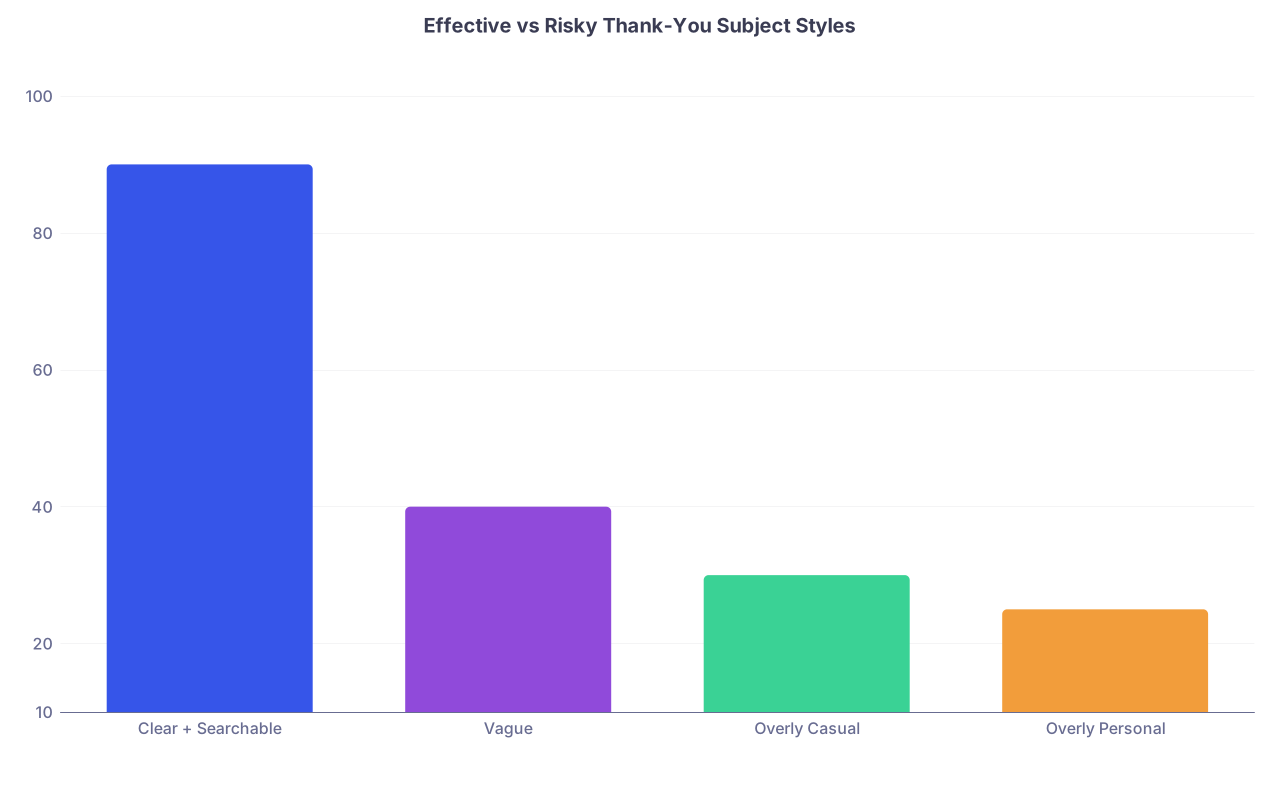
| Category | Value |
|---|---|
| Clear + Searchable | 90 |
| Vague | 40 |
| Overly Casual | 30 |
| Overly Personal | 25 |
The “90” here is not data from a study. It is reality from reading hundreds of these. Clear + searchable wins.
Greeting: “Dear” vs “Hi”
You are applying for a professional training position, not texting a co-intern.
Best default:
“Dear Dr. Lastname,”
This works for:
- PDs
- APDs
- Faculty interviewers
- Chiefs (yes, still “Dr.” if they are physicians)
For residents you interviewed with:
- “Dear Dr. Lastname,” if you know they are a PGY-2+ physician
- “Dear Firstname,” is fine for current residents if the interview vibe was casual
If in doubt: use “Dear Dr. Lastname,” and you will not be wrong.
Never:
- “Hey”
- First name only with no “Dear/Hi” for attendings (reads too familiar)
- “To whom it may concern” for a specific person
Titles and roles: get them right or leave them out
This is one of those micro-details that can sting.
Good:
- “Thank you again for the opportunity to interview with you and learn more about the Internal Medicine Residency Program at [Institution].”
- “It was a privilege to speak with you about your role as Associate Program Director.”
Risky:
- Promoting or demoting someone:
Calling an APD “Program Director” or vice versa. - Upgrading degrees:
Calling a PhD “M.D.” or a PA “Dr.”
If you are not 100% sure, default to:
- “your program”
- “the residency program”
- “your team”
- “your department”
You do not need to write: “Thank you for speaking with me about your role as Vice Chair of Education, Department of X, Y Division…” That is LinkedIn energy. Keep it simple and correct.
3. Formatting That Looks Like You Know How Email Works
Programs do not care if you pick Calibri vs Arial. They do care if your email looks like a ransom note pasted from five different apps.
The clean baseline format
Here is the basic structure that should not vary much:
Line 1: Greeting
Blank line
2–4 short paragraphs (2–4 sentences each)
Blank line
Closing phrase
Your signature block
No weird centering. No colored text. No underlined colored phrases that look like broken links.
Font, size, and spacing
You are not designing a flyer. Default email settings from Gmail/Outlook are usually fine:
- Font: Calibri, Arial, Helvetica, or whatever your email defaults to
- Size: 11 or 12
- Color: black (not dark gray, not blue, not something you think is “subtle”)
The problem is what happens when you paste from:
- Your notes app
- Word/Docs
- Another email draft
You get this Franken-email effect: different fonts, slightly different sizes, broken spacing. Most faculty will not consciously analyze it, but they feel it. It reads as sloppy.
Fix: After pasting, “clear formatting” the whole body and re-apply bold/italics if needed (hint: you should rarely need either in a thank-you).
Paragraph length and line wrapping
Long walls of text make people skim. If your email looks like a mini personal statement in one block, they are not reading it.
Aim for:
- 2–4 short paragraphs
- Each paragraph 1–4 lines on a typical laptop email window
Looks normal on screen, not like a manifesto.
Avoid attachments and fancy add-ons
Common questions:
- “Should I attach my CV again?” No.
- “Should I add a photo in my signature?” No.
- “Should I embed my personal logo / website?” Absolutely not.
Rare exception: If a faculty member explicitly asked for a specific document during the interview, you can attach that and reference it clearly:
“I have attached the teaching evaluation summary we discussed during our interview.”
4. Signature Blocks: The Micro-Bio You Are Sending Everywhere
This is where many applicants get oddly creative. Do not.
Your signature should answer three questions immediately:
- Who are you?
- What are you (MS4, transitional year resident, etc.)?
- How can they identify you in ERAS or contact you?
| Type | Example Line | |
|---|---|---|
| Name | Jane Doe | |
| Degree/Status | M.D. Candidate, Class of 2025 | |
| Institution | University of Example School of Medicine | |
| Contact | Phone | |
| Optional ID Line | AAMC ID: 12345678 |
What to include
The safe, clean version:
Jane Doe
M.D. Candidate, Class of 2025
University of Example School of Medicine
Phone: (555) 555-5555
Email: [email protected]
AAMC ID: 12345678
A few specifics:
- Use “M.D. Candidate, Class of 2025” or “Medical Student, MS4” – both are fine.
- If you are a DO student: “D.O. Candidate, Class of 2025” is correct.
- If you already graduated: “M.D., Class of 2024” or “Preliminary Medicine Resident, PGY-1, [Institution]” etc.
Do not over-stack degrees. If you have a prior MPH or PhD, you can list them:
- “Jane Doe, M.P.H.” then line below: “M.D. Candidate, Class of 2025”
Do not write a paragraph of credentials.
The AAMC ID question
You will not hurt yourself by including it. It occasionally helps if your name is common or if the program coordinator wants to quickly confirm your record.
I tend to recommend:
- Include AAMC ID on your first thank-you set to each program.
- Keep it in your standard signature for the season. It is harmless and sometimes handy.
What to avoid in signatures
I have seen all of these. They do not help you.
- Inspirational quotes (any kind, any source)
- Personal pronouns line (“Pronouns: she/her”) is fine if you routinely use it; do not add it only for interviews because you think it plays well. Consistency matters.
- Social media links (Twitter, Instagram, TikTok) – unless it is a professional, relevant account that you would be happy for PDs to scroll at 11 p.m. on a bad day.
- Multi-colored text or backgrounds
- Huge logos, banners, or scanned handwritten signatures
Simple, legible, uncontroversial. That is the bar.
5. Titles, Roles, and Honorifics: Avoiding the Subtle Insult
You will not get ranked higher because your email was beautifully formatted. You can, however, come across as careless if you mislabel people.
Doctors vs non-doctors
If someone is an attending physician, use:
- “Dr. Lastname”
If someone is a resident physician, still:
- “Dr. Lastname” (unless they clearly invited first-name basis and you feel that is appropriate)
If someone has a PhD and is on faculty:
- “Dr. Lastname” is still fine and often preferred.
If the person is a coordinator, administrator, or non-clinical staff:
- “Mr. Lastname” / “Ms. Lastname” / “Mx. Lastname” if you are sure
- If unsure of gender or preference: just “First Lastname” in the address line, and start email with “Dear First Lastname,”
Never guess gender from a name if you are not 100% certain.
Handling unclear roles
If your Zoom label said “Sam Brown” and you are not sure if they were a resident, fellow, or faculty:
- Check the program website first.
- If you cannot confirm, keep it formal: “Dear Dr. Brown,” is a safer mistake than under-titling.
Worst-case scenario: they are a coordinator and chuckle; they will not tank your application over that. The opposite mistake (calling a PA “Dr.” in a department touchy about titles) annoys more.
Program leadership titles
Common safe phrases:
- “your role in resident education”
- “as part of the residency leadership”
- “within the residency program”
If you know it concretely:
- “Program Director, Internal Medicine Residency”
- “Associate Program Director”
- “Chair of the Department of Neurology”
If you are not absolutely sure, keep it more generic.
6. Content Micro-Details: Length, Specificity, and Tone
You asked about formatting, signatures, and titles. But those sit inside content. If the content is off, no amount of clean formatting saves it.
Length and density
Think “short, specific, and human.”
Ideal:
- 120–220 words total
- 2–4 short paragraphs
Wrong direction:
- A page-long recap of your entire application
- One sentence that reads like an auto-generated script
Structure of a solid thank-you
Paragraph 1 – Gratitude + anchor:
- Thank them.
- Reference the specific interview day/program.
- One specific reminder of who you are, if appropriate.
Example:
“Dear Dr. Smith,
Thank you very much for taking the time to speak with me during my interview day at the [Institution] Internal Medicine Residency on November 18. I appreciated the opportunity to learn more about your approach to resident autonomy in the MICU.”
Paragraph 2 – Specific connection:
Pick one or two concrete things you discussed. Not generic fluff.
- A specific patient-care philosophy they mentioned
- A particular rotation, curriculum piece, or initiative they lead
- Something they said that resonated with your goals
Example:
“I especially enjoyed our discussion about how you empower interns to lead family meetings with graduated supervision. As a student, some of my most meaningful experiences came from guiding families through complex decisions, and your description of the MICU structure aligned closely with how I hope to grow during residency.”
Paragraph 3 – Interest + professionalism:
- Brief statement of continued interest (without ranking promises unless this is your explicit #1 and you are using that email for that purpose).
- Forward-looking, professional tone.
Example:
“My interview day reinforced my strong interest in [Institution] for residency training. Thank you again for your time and for sharing your perspective on the program. I would be honored to train at [Institution] and to learn from faculty like you.”
Closing and signature follow.
Tone: enthusiastic but not desperate
Watch for overstatements that sound either fake or strategically clumsy:
Too much:
- “I have never been more certain that this is my dream program.”
- “I know I would be a perfect fit for your residency.”
- “I will rank your program #1” (unless this is a true, explicit #1 letter sent strategically to the PD, not to every interviewer).
Better:
- “The interview reinforced my strong interest in your program.”
- “I can see myself thriving in your training environment.”
- “Your description of the program matched closely with what I am seeking in residency.”
The micro-detail here: faculty read dozens of these. When every program is your “top choice,” you sound insincere.
7. Timing, Batch vs Individual, and Technical Details
Formatting and signatures are useless if your thank-you never lands or lands three weeks too late.
When to send
Best window:
- 24–72 hours after the interview
Same night is fine if you are clear-headed and not rushing. Waiting 2–3 days is also fine, especially with weekend interviews. After a week, you are drifting into “late but still acceptable.”
Individual vs group emails
Program coordinators sometimes tell you: “You do not need to send thank-you emails.” That is not a trap. It is partly them protecting faculty inboxes. You should still send concise, high-yield ones, especially to:
- Program Director
- Associate Program Director(s) who interviewed you
- Any faculty you had a substantial one-on-one conversation with
- Chief residents who interviewed you
Should you send one giant group email to “all interviewers”? Do not. Feels lazy and impersonal. Exceptions: when the interview day email is explicitly a group alias (e.g., “[email protected]”) and they invited replies there.
Technical details that quietly matter
A few small but real issues I have seen:
Wrong program name copied from a prior draft.
Fatal? Usually no. But ugly. Proofread the program name and institution every time.CC vs BCC vs To:
Each thank-you should go directly to the recipient. No need to CC the coordinator unless they requested it.Reply vs new thread:
If the invitation came from a central system (Thalamus, Interview Broker, ERAS messaging), start a fresh email directly to the interviewer if you have their address. If the coordinator connected you by email, replying within that thread is fine.Attachments blocked / images stripped:
Another reason to avoid heavy signature images and attachments. Many hospital email systems mangle or quarantine those.
8. A Visual of the Whole Flow
Here is how this actually plays out in a smooth, professional way from interview to thank-you.

| Step | Description |
|---|---|
| Step 1 | Finish Interview Day |
| Step 2 | Review Notes Same Day |
| Step 3 | Confirm Interviewer Names & Emails |
| Step 4 | Draft Clean Template |
| Step 5 | Customize Per Interviewer |
| Step 6 | Proofread Formatting & Titles |
| Step 7 | Send Within 24-72 Hours |
| Step 8 | Archive Sent Emails Per Program |
Notice: formatting and signatures sit in the “proofread” step. They are not the point. They are friction to remove.
9. Good vs Problematic Examples (Micro-Detail View)
Let me show you what this looks like in practice.
Cleaner example
Subject: Thank you – Jane Doe, Internal Medicine Interview 11/18
Dear Dr. Smith,
Thank you very much for taking the time to speak with me during my interview day at the [Institution] Internal Medicine Residency on November 18. I appreciated hearing your perspective on how the program balances strong inpatient training with dedicated ambulatory time.
I especially valued our discussion about resident ownership in the MICU and your approach to supporting interns through their first night shifts. As I have grown more comfortable managing complex patients on our step-down unit, I have become increasingly interested in programs that emphasize graduated autonomy in high-acuity settings, and your description of the MICU experience at [Institution] resonated with me.
The interview day reinforced my strong interest in [Institution] for residency training. Thank you again for your time and for sharing your insights about the program.
Sincerely,
Jane Doe
M.D. Candidate, Class of 2025
University of Example School of Medicine
Phone: (555) 555-5555
Email: [email protected]
AAMC ID: 12345678
Formatting checks out:
- Consistent font, standard sizes
- Clear subject
- Correct title
- Simple signature block
Problematic example (with commentary)
Subject: Best Interview EVER!!!
“Best” – too much. “EVER!!!” – no.
Hey Sarah,
(“Hey,” + first name for an attending you met once in a formal setting? Not good.)
Thanks SO much for chatting with me yesterday!!! I honestly can say your program is my absolute #1 and I would for sure come there if you ranked me highly!!
(Reads desperate and non-credible, especially when sent to multiple programs. Also, three exclamation marks.)
I loved how you guys do the ICU and wards and clinic and everything just sounds amazing. I know I’m going to be an amazing resident and I really hope you can see that too.
(Vague, no concrete specifics, and self-promotional in a way that feels off.)
Best,
Jane
MS4, Medical School
(Minimal ID; no institution typed out, no AAMC, no phone. Not fatal, but weaker.)
If this person had the exact same underlying interview performance, they slightly harmed themselves. Not catastrophically. But why give that impression?
10. Quick Comparison: High-Yield vs Low-Yield Micro-Details
| Area | High-Yield Practice | Low-Yield / Risky Practice |
|---|---|---|
| Subject Line | Clear + searchable | Vague or overly casual |
| Greeting | “Dear Dr. Lastname,” | “Hey” or first name only for attendings |
| Titles | Correct or safely generic | Guessing, promoting/demoting roles |
| Formatting | Default email styling, cleared pastes | Mixed fonts, colors, images |
| Signature | Simple, complete, with AAMC ID optional | Quotes, graphics, social media clutter |
| Length | 120–220 words, 2–4 paragraphs | One-liner or full-page essay |
| Specificity | 1–2 concrete details from your conversation | Generic praise “Loved your program” |
Notice: every high-yield action is about clarity and professionalism, not creativity.
FAQs
1. Do programs actually care if I send thank-you emails at all?
Some PDs care, some do not. A few explicitly say they ignore them. But you cannot predict who is who. A good thank-you will not rescue a bad interview, but a sloppy or inappropriate one can leave a mild negative impression. I treat them as low-risk, modest-upside, professionalism checkpoints. You send them because it is standard, not because you expect magic.
2. Should I send separate thank-yous to every single resident I met?
No. Focus on residents who interviewed you formally or spent substantial one-on-one time with you (30+ minutes, career discussion, deep-dive on the program). A 3-line polite email to a panel of residents after a group Q&A is optional, not mandatory. You do not get extra points for blanketing thirty inboxes with identical notes.
3. Is it okay to reuse a basic template across programs?
Yes, with caution. The core structure can repeat; your gratitude sentence and closing can look nearly identical. The danger is in lazy find-and-replace errors. I have seen “Thank you for the opportunity to interview at [Wrong Institution].” If you template, slow down: update every program name, every specific detail, and every interviewer reference. Then read it once more out loud.
4. Can I mention that I am ranking a program #1 in a thank-you email?
You can, but only to one program, and only when you are absolutely certain they are your true #1. That message should go to the Program Director, not every interviewer. It needs to be clear but not manipulative: “I wanted to let you know that I will be ranking [Program] as my first choice.” Do not send similar language to multiple programs. Yes, PDs talk. Yes, people remember when applicants play that game.
5. What if I realize I used the wrong title or misspelled a name after sending?
Do nothing. Do not send a second email apologizing for a minor error. That just draws attention to it. Faculty understand that you are writing multiple emails during a stressful season. One typo or a slightly off title will not tank you. Learn from it, tighten your proofreading for the next batch, and move on.
Key points to walk away with:
- Clean, consistent formatting and a simple, complete signature block signal that you are a functional professional adult. That is the bar.
- Titles, greetings, and program names are small but emotionally loud details; get them correct or keep them generic.
- The entire thank-you should be short, specific, and sane. No theatrics. No design experiments. Just clear writing that reminds them why you would be a good resident to work with at 3 a.m.