
Most residents either oversell or say nothing in their follow-ups—and both approaches are wrong.
You are not “just thanking them for their time.” You are programming how they remember you. Done right, a 4–6 line email can quietly anchor your values—work ethic, humility, team mentality—in their heads without sounding desperate or fake.
Let me break this down specifically.
What “Brief Callbacks” Actually Are (And Why They Work)
A “brief callback” in a follow-up is a short, specific reference to something that happened or was said during your interview day:
- A moment in your own story
- Something the interviewer shared
- A program feature or value that clearly resonated
Then you very lightly connect that callback to a value you want them to remember about you.
This is not:
“I really value teamwork, dedication, and patient-centered care.”
That reads like a personal statement that lost its way into an email.
This is:
“Your comment about residents stepping in for each other on tough MICU weeks stuck with me; that kind of team-first mentality is exactly what I try to bring to my own rotations.”
Short. Concrete. Anchored in their words, not yours.
Why this works cognitively
Program leadership is reading follow-ups after a long day, with 12–20 interviews blurred together. They remember:
- Stories
- Emotions
- One or two defining traits per applicant
A strong brief callback does three things at once:
- Triggers their memory of the conversation (“Oh right, this was the applicant who…”).
- Associates you with a specific positive value (reliability, curiosity, resilience, etc.).
- Signals that you listened and understood the program’s culture.
You are not writing marketing copy. You are planting recall hooks.
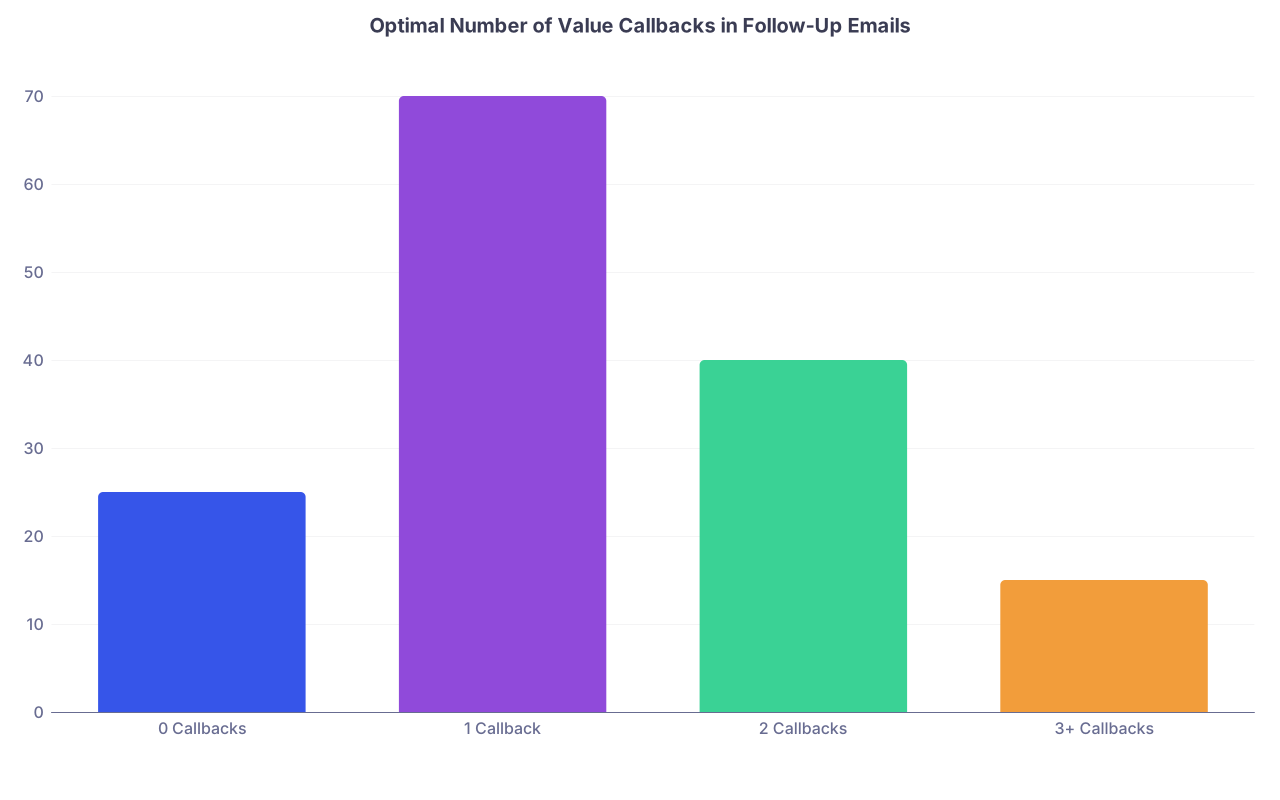
The Core Rule: One Callback, One Value, One Email
| Category | Value |
|---|---|
| 0 Callbacks | 25 |
| 1 Callback | 70 |
| 2 Callbacks | 40 |
| 3+ Callbacks | 15 |
The fastest way to overdo this is to jam three values into one short email. That makes you sound like someone performing “being impressive,” not someone genuinely following up.
Use this rule and you will not go wrong:
- One callback to something specific from the day
- One value you want associated with you
- One sentence doing the connection work
Everything else is simple thank-you and logistics.
Example: Internal medicine applicant
Interview moment: Faculty mentioned they value residents who “own their patients” and follow through over days, not just per shift.
Bad follow-up:
“I really value ownership, hard work, and collaboration, and I am confident I will be an asset to your program.”
Better:
“Our discussion about residents ‘owning’ their patients across multiple days really resonated with how I try to practice on my current wards—following through on loose ends and making sure plans actually happen.”
One callback (their phrase).
One value (follow-through/ownership).
No extra fluff.
Dissecting The Follow-Up Email: Line by Line
You do not need a long email. In fact, if your email scrolls on a phone, you are probably saying too much.
Think in 4–6 short lines. Here is the scaffold:
- Subject line
- Thank you and anchor (who you are)
- Brief callback (moment from the day)
- Value connection (what that says about you)
- Reaffirmed interest (if true)
- Simple close
1. Subject line that orients, not performs
Avoid cutesy or dramatic subjects.
Use something like:
- “Thank you – [Your Name], [Interview Date] IM Interview”
- “Appreciation – [Your Name], Categorical Pediatrics Interview”
They are scanning hundreds of emails. Make it painless.
2. Open with a clean thank you + identifier
They interviewed a lot of you. Help them anchor you.
“Dr. Smith,
Thank you again for taking the time to speak with me during my interview at [Program Name] this Monday. I enjoyed our conversation about your experience building the night float curriculum.”
Identify: which day, which role, which program. No 3-sentence intro.
3. The brief callback sentence
This is the line where most people either ramble or get fake-deep.
Structure:
- Start with “Your comment about…” / “Our discussion about…” / “Hearing about…”
- Mention the specific thing
- ONE short clause on why it stuck with you
“Your comment about residents supporting each other during intense ICU blocks stuck with me.”
That is enough to cue their memory and show you were listening.
4. The value connection sentence
Now a half-step further. Tie that moment to who you are as a resident.
Template you can adapt:
- “…which aligns with how I have tried to [value] on my current rotations.”
- “…which is exactly the kind of [environment/value] where I have thrived during [specific experience].”
- “…and it reflects the [value] I am looking for in a residency.”
Example:
“That emphasis on team support aligns with how I have tried to show up on my current night float rotation—checking in on co-residents and making sure no one is drowning alone with admissions.”
Notice: you are not just saying “teamwork.” You are giving a micro-picture of it.
5. Reaffirmed interest (but avoid fake superlatives)
This is where people start lying: “XYZ is my top choice” to five different programs. Programs smell that from orbit.
You can be honest and enthusiastic:
- “Our conversations reinforced my strong interest in training at [Program Name].”
- “The day confirmed that [Program Name] offers the mix of [X and Y] that I am looking for in a residency.”
- “I would be very excited to train at [Program Name] and contribute to the community you have built.”
If and when you truly have a number one, that is a separate, later, very explicit email.
6. Close simply
No inspirational quotes. No “looking forward to hearing from you soon” (they may not).
“Thank you again for the opportunity to interview.
Sincerely,
[Name]
AAMC ID: [#######]
Medical School: [School]”
Done.
Choosing Which Values To Program (And How To Tie Them To Reality)

Let me be blunt: some values are overused to the point of meaninglessness.
If I read “hard-working, compassionate, and team-oriented” one more time, I might scream.
Programs care about:
- Will this person make my life easier or harder at 3 a.m.?
- Will they disappear when things get rough?
- Will they poison or strengthen the team culture?
Good values to program, if you actually live them:
- Reliability / follow-through
- Ownership of patients
- Intellectual curiosity
- Humility and teachability
- Emotional steadiness under stress
- Collegiality / backing up the team
How to avoid generic value statements
Never state a value as a noun by itself. You are not a brochure.
Bad:
“I value teamwork and patient-centered care.”
Better:
“Your description of residents stepping up to help each other on busy call nights reflects exactly the kind of culture I have appreciated in my current program, where we redistribute admissions when someone is overwhelmed rather than letting them sink.”
Same idea, completely different level of credibility.
Matching the Callback to the Interviewer Type
You do not talk to the PD the same way you talk to a PGY-2 resident or the program coordinator. The callback and value should match their lens.
| Interviewer | Good Callback Target |
|---|---|
| Program Director | Culture, training philosophy |
| Associate PD | Curriculum, evaluation, growth |
| Faculty Attending | Clinical reasoning, teaching |
| Chief/Residents | Day-to-day culture, workload |
| Coordinator | Logistics, communication |
Program Director / Associate PD
They care about fit with the program’s mission and your developmental trajectory.
Example:
“Our discussion about training residents to be confident decision-makers by the end of PGY-2 mirrored what I am seeking—a program that pushes me while still offering close supervision early on.”
Value: growth mindset / seeking challenge.
Faculty Attending
They remember clinical stories and teaching moments.
Example:
“I kept thinking about your story of the septic shock patient whose diagnosis only became clear on day three; cases like that are exactly why I enjoy digging into primary literature and discussing management nuances with my attendings.”
Value: intellectual curiosity.
Residents / Chiefs
They care whether you will be a good colleague at 2 a.m.
Example:
“Hearing the residents talk honestly about supporting each other on difficult rotations matched what I try to bring to my own teams—checking in with co-interns and redistributing tasks when someone is buried.”
Value: team-first behavior.
Program Coordinator
You can absolutely send a short, respectful thank you. For them, the “value” is that you are organized and polite.
Example:
“Thank you as well for coordinating such a smooth interview day; your clear communication before and during the visit made everything much less stressful.”
Value: respect, professionalism.
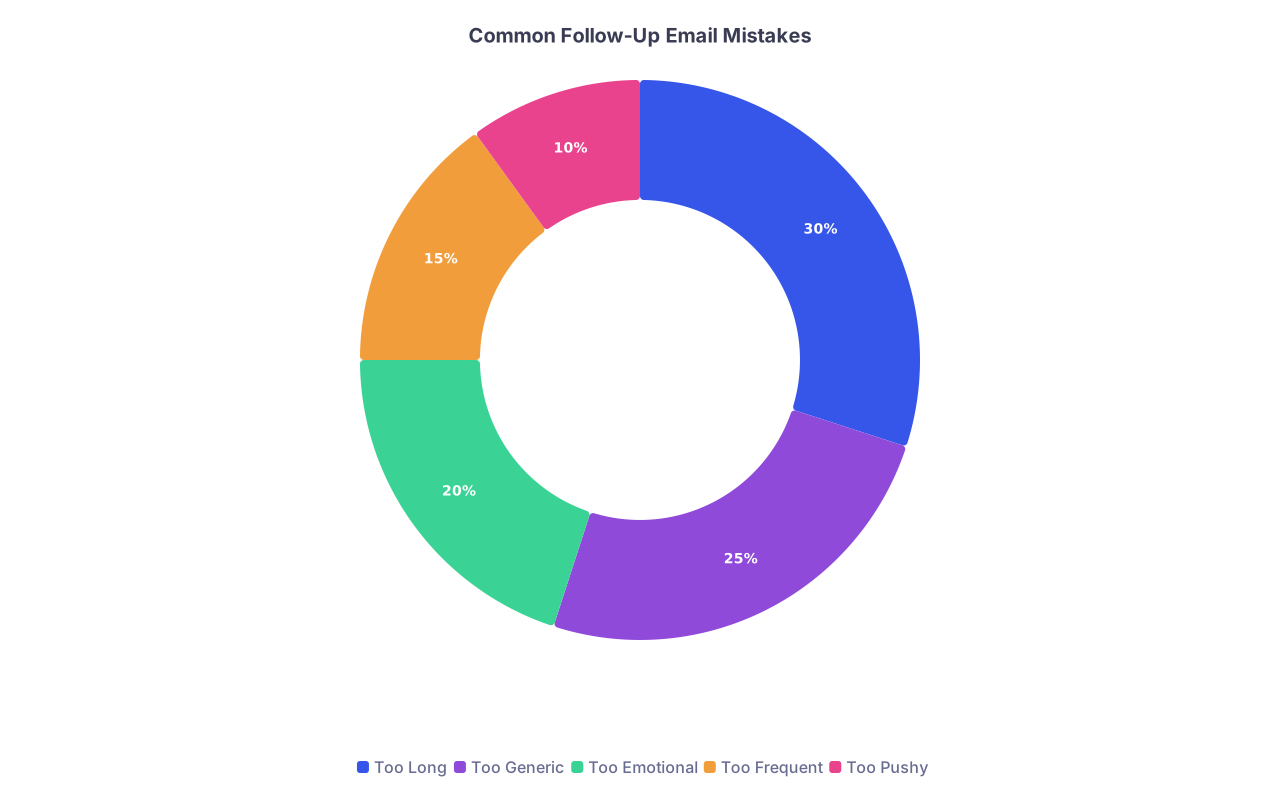
How Not To Overdo It: Red Flags That You Are Trying Too Hard
| Category | Value |
|---|---|
| Too Long | 30 |
| Too Generic | 25 |
| Too Emotional | 20 |
| Too Frequent | 15 |
| Too Pushy | 10 |
I have watched applicants talk themselves down the list with follow-ups that tried to be “memorable” and ended up being… alarming.
Here are the main ways you overdo it.
1. Emailing everyone about everything
You do not need:
- A separate values-programming email to every single resident you met
- A “quick follow-up” two days later
- Monthly “update” emails unless major news (publication accepted, Step 2 score, real rank #1 email)
Rule of thumb:
- One thank-you email per interviewer (PD, APD, attendings, residents who formally interviewed you).
- It is optional but fine to email a resident who spent a full hour touring you and chatting.
- Do not spam the coordinator or PD with repeated “just checking in” messages.
2. Writing essays
If your email takes more than 20–30 seconds to read, it is too long.
Signs you are overdoing it:
- Multiple paragraphs about your entire life story
- Repeating your CV items
- Listing “5 reasons why your program is my top choice”
Your interview was the time for that. The follow-up is a nudge, not a second interview.
3. Emotional oversharing or pressure
Things that cross the line:
- “I will be heartbroken if I do not match here.”
- “My entire family is counting on me matching at your program.”
- “Please let me know if there is anything at all I can do to secure a spot.”
This reads as unstable or manipulative. Programs do not want that drama.
4. Making promises you cannot keep
Do not say:
- “I will rank you #1” unless that is true and you are very clear and late in the season.
- “I am certain I will accept an offer if given one” (this is not a job; it is the Match).
Be honest. They do not need drama; they want clarity.
5. Over-programming values
If every sentence contains a value word, you sound like a textbook.
Bad:
“I appreciated the chance to discuss my passion for leadership, teamwork, resilience, and lifelong learning, which I believe align with your program’s values of excellence, service, and collegiality.”
This is a salad of buzzwords. Pick one. Ground it in a real moment.
Concrete Examples: Strong vs Weak Brief Callbacks

Let’s run a few real-world scenarios.
Example 1: Surgery applicant
Interview moment: The PD emphasized resilience and operating volume.
Weak:
“I loved hearing about the high operative volume at your program and I think my resilience and dedication would make me a great fit.”
Strong:
“Your description of residents being in the OR early and often, even on challenging post-call days, matched how I have approached my sub-I—showing up in the OR for cases after long call nights because I learn best by being scrubbed in.”
Callback: early frequent OR time.
Value: tangible resilience / commitment to operative learning.
Example 2: Pediatrics applicant
Interview moment: Resident talked about continuity clinic as the “heart” of the program.
Weak:
“I care deeply about continuity of care and building strong patient relationships.”
Strong:
“Hearing the residents describe continuity clinic as the ‘heart’ of the program resonated with my experience following a panel of medically complex kids across multiple admissions and visits this year; those long-term relationships are what keep me energized.”
Callback: their phrase “heart of the program.”
Value: commitment to long-term patient relationships.
Example 3: Psychiatry applicant
Interview moment: Faculty discussed valuing self-awareness and boundaries to prevent burnout.
Weak:
“I value work-life balance and self-care.”
Strong:
“Your comments about residents developing self-awareness and healthy boundaries to sustain a career in psychiatry aligned with the reflective work I have done in supervision this year, particularly around managing emotional carryover from difficult cases.”
Callback: their emphasis on self-awareness and boundaries.
Value: insightfulness and willingness to reflect.
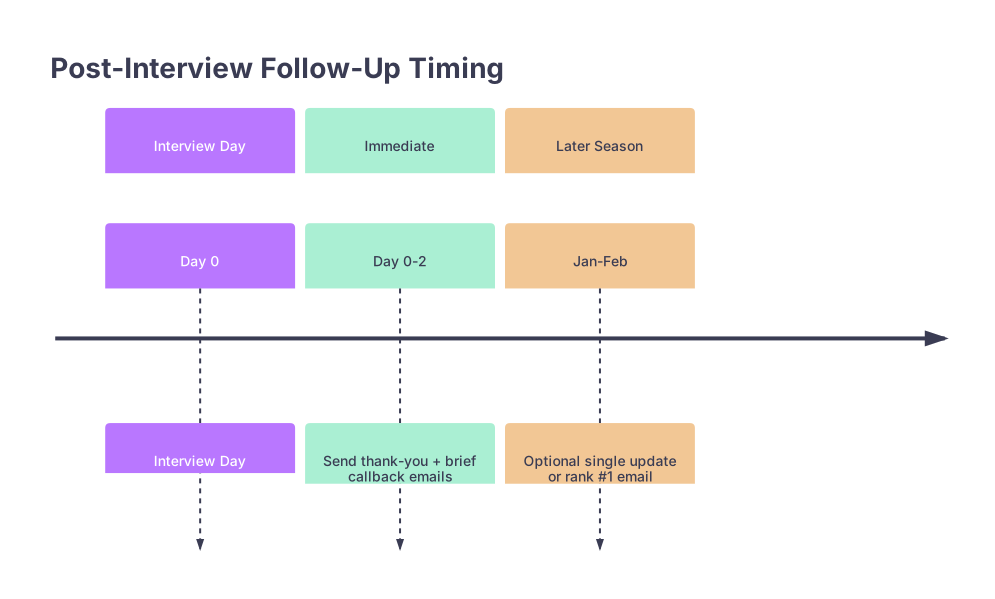
Timing, Frequency, and The Myth of “Perfect Wording”
| Period | Event |
|---|---|
| Interview Day - Day 0 | Interview Day |
| Immediate - Day 0-2 | Send thank-you + brief callback emails |
| Later Season - Jan-Feb | Optional single update or rank #1 email |
You are not being graded on literary quality. Nobody is diagramming your sentences. They are scanning for three things:
- Politeness
- Sanity
- A reason to remember you positively
When to send
- Ideal: Same day or next day (Day 0–1).
- Acceptable: Within 48–72 hours.
- After a week: Still better than nothing, but do not pretend it is “right after.”
Do not obsess over hitting “send” at the perfect hour. This is not a marketing campaign.
How often
Baseline:
- 1 email → each interviewer / key resident within 1–2 days.
- Optional: 1 later-season “update/continued interest” email to PD or APD if you have something real to say (publication accepted, AOA, meaningful new role, or true #1 rank).
Anything beyond that usually starts to feel like noise.
What if you forgot to send?
Stop spiraling. If you realize two weeks later:
“Dr. Lee,
I realized I had not yet thanked you for taking the time to speak with me during my interview at [Program] on [date]. I especially appreciated our discussion about [callback…].”
Then a normal callback/value sentence. No dramatic apology paragraph.
How This Actually Lands On The Other Side

Let me tell you what actually happens with your email.
A PD, APD, or attending:
- Opens email on phone between cases or after clinic
- Skims subject and first 2 lines
- Maybe reads the middle if it looks short
- Closes it and subconsciously updates their mental tag of you: “polite,” “thoughtful,” “try-hard,” “generic,” or “red flag”
On ranking day, when they look at the list and ask, “Who was this again?” the brief callback can flip the switch:
- “Oh, that was the one who talked about following through on loose ends on nights.”
- “Right, she was the applicant who took extra OR time post-call—seemed hungry to operate.”
- “He was the one who had a very self-aware take on burnout; I liked that.”
You are not going to jump from bottom to rank #1 because of a single email. But you can:
- Avoid being forgotten.
- Avoid accidental red flags.
- Nudge yourself up a tier when they are splitting hairs between similar applicants.
That is the realistic power of brief callbacks.
Quick Templates You Can Adapt (Without Sounding Like a Robot)
Use these as skeletons, not scripts. Customize the callback and the value line.
General template
Subject: Thank you – [Your Name], [Specialty] Interview
Dr. [Last Name],
Thank you again for taking the time to speak with me during my interview at [Program Name] on [Day]. I enjoyed our conversation about [topic].
Your comment about [brief callback] stuck with me, and it aligns with how I have tried to [value/behavior] during my [specific experience or rotation].
Our conversation reinforced my strong interest in training at [Program Name].
Sincerely,
[Full Name]
AAMC ID: [#####]
[Medical School]
Resident-specific template
[First Name],
Thank you for taking the time to talk with me during my interview day at [Program]. Hearing your perspective on [specific aspect—night float, ICU, resident camaraderie] was especially helpful.
Your description of [brief callback] matched the kind of environment where I have felt most at home—teams that [value/behavior], as I have experienced on [specific rotation/team].
I appreciate your honesty and insight.
Best,
[Name]
FAQs
1. Should I send different follow-up emails to every interviewer, or can I reuse the same text?
You should customize at least the callback sentence for each interviewer. The thank-you and closing can be similar, but if your email looks like a copy–paste job with only the name changed, some faculty will notice. They compare emails more than you think, especially in smaller programs. One unique callback + value line per person is enough personalization.
2. Is it ever appropriate to mention ranking intentions in a follow-up?
Not in the initial thank-you. Save explicit rank intentions (“I will be ranking [Program] first”) for a single, clear email to the PD or APD later in the season, and only if it is absolutely true. Programs take that seriously. Sprinkling “top choice” language casually in early thank-yous to multiple programs is both transparent and counterproductive.
3. What if my interview felt flat and I do not have a good callback?
Use something simple from the day: a case they mentioned, a teaching point, or a program feature from the overview. For example: “Hearing about your emphasis on [X rotation / [clinic structure / academic half-day] aligned with…” You do not need a magical, profound moment. You need one concrete detail you can connect to a value or behavior you already show.
4. Do programs actually care if I send follow-up emails?
Some do, some barely skim, but almost none penalize you for a short, polite thank-you. A few PDs explicitly track who sends thoughtful notes as a mild positive. The real risk is not “sending or not,” it is sending something long, needy, or unhinged. A concise, respectful email is low-risk, small-upside insurance.
5. Can I reference something personal the interviewer shared (e.g., family, hobbies)?
You can, but keep it professional and light. “I enjoyed hearing about your path from community practice back into academics” is appropriate. “It was great hearing about your kids and I hope their soccer game went well” can feel too familiar unless the tone was clearly that casual. When in doubt, reference professional stories and program culture rather than personal life details.
6. How do I handle a group interview in terms of follow-ups?
If you had a true group interview with multiple faculty at once and no individual sessions, you can send one email addressed to all of them (if you have their addresses), or to the primary listed interviewer. In that case, your brief callback can reference a moment from the group discussion: “Our group discussion about managing high-acuity nights in the ICU…” Still keep it to one callback + one value sentence. Do not send three nearly identical emails to three people who were in the same room reading them side by side.
Key points to keep front and center:
- One callback, one value, one short email.
- Concrete beats generic: show the value in a tiny, real example.
- Do not try to “win” the Match by email; just avoid hurting yourself and give them a reason to remember you positively.