
It is 10:47 p.m. The interview day adrenaline is crashing. Your suit is on the chair, your name tag is on the dresser, and your inbox is open to a blank email addressed to the PD and that one faculty who grilled you on a septic shock case.
You remember the case you discussed — that ICU patient with rising lactate and a questionable fluid status — and you want to reference it in your thank‑you note. You know it would show engagement, clinical reasoning, actual interest.
But you also hear your school’s compliance officer in the back of your head: “HIPAA. No identifiers. Don’t ‘tell stories’ in emails.”
So you sit there, stuck. How specific is too specific? How vague is too vague? How do you sound sharp and memorable without wandering into a HIPAA violation or coming off as unprofessional?
Let me walk through exactly how to do this well.
1. The Real Problem: Competing Pressures in Post‑Interview Emails
You are juggling three conflicting goals in a residency thank‑you note:
- Show that you were paying attention and engaged in the interview.
- Differentiate yourself from the generic “Thank you for your time, I enjoyed learning about your program” boilerplate.
- Avoid any hint of PHI, unprofessional gossip, or “telling war stories” that land badly.
Most applicants get one of these right and blow the other two.
Some write a very safe, very forgettable email: “Thank you for taking the time to interview me. I really enjoyed learning about your program. Sincerely, [Name].” That gets read, maybe, and then disappears into the void.
Others overcorrect and write a mini‑SOAP note: “I still think about the 63‑year‑old male with alcoholic cirrhosis, MELD 29, who coded in the ED after receiving 2L NS…” That is a problem. For multiple reasons.
The sweet spot: you reference the themes and learning points of the case you discussed — not the identifiers. You remind the interviewer, “We had a substantive clinical conversation,” but you do not recreate chart notes in Gmail.
2. What Exactly Counts as “Too Specific” in a Thank‑You Note?
Let’s be concrete.
HIPAA is about “protected health information” (PHI). The classic list of identifiers is long: names, exact dates, locations smaller than a state, contact info, MRNs, etc. But in real life, on interview emails, these are the traps people actually fall into:
- Age + rare diagnosis + city (“the 23‑year‑old with Wilson disease who flew in from Phoenix”)
- Exact dates or timeframes (“the patient we admitted on 10/31 after the Halloween MVC”)
- Highly unusual social details (“the homeless violinist who lives in the subway station”)
- Specific units or room numbers (“the patient we saw in MICU bed 5”)
- Anything that sounds like a quote from the actual chart
Now add one more layer: professionalism. Even if a description was technically de‑identified, if you sound like you are gossiping about a trauma case for entertainment, you look immature.
Here is the mental rule I use:
If a colleague at your home institution would raise an eyebrow hearing you say this in an open elevator, do not put it in an email to a PD.
So no:
- “I really enjoyed talking about that drunk trauma who tried to punch the nurse.”
- “I keep thinking about that crazy psych patient who swallowed 30 razor blades.”
That is not just a HIPAA problem. It is a judgment problem.
3. The Safe‑But‑Specific Framework: How to Reference Case Discussions Correctly
Here is the structure that works, every time, when you want to reference a specific case from your interview.
Think in four pieces:
- Anchor to the topic, not the patient.
- Mention your reasoning, not their identifiers.
- Reflect a learning point, not a story.
- Tie it back to why you like their program.
3.1 Anchor to the Topic, Not the Patient
Bad:
“I really appreciated discussing the 46‑year‑old woman with metastatic breast cancer who coded after a massive PE in your ICU last week.”
Better:
“I really appreciated our discussion of complex ICU patients with competing goals of care and hemodynamic instability.”
You are referencing the type of case: “complex ICU patients,” “undifferentiated shock,” “challenging goals of care conversations.” That is specific enough to remind the interviewer what you talked about, but generic enough to avoid PHI.
Examples of safe anchors:
- “our conversation about evaluating undifferentiated syncope in older adults”
- “the case you described of a patient with septic shock requiring nuanced fluid and vasopressor management”
- “the challenge of diagnosing autoimmune encephalitis in a patient with non‑specific neuropsychiatric symptoms”
- “that example of a complex discharge for a patient with limited social support and polypharmacy”
Notice: clinical problem, context, no age, no date, no location specifics.
3.2 Focus on Your Reasoning, Not Their Story
The goal of referencing a case is not to re‑tell it. It is to show how you think.
Instead of this:
“I keep thinking about the patient who had recurrent fevers after a trip to India and was eventually diagnosed with typhoid. I remember you said she had a WBC of 18 and platelets of 60…”
Try this:
“I keep thinking about our discussion of a febrile returning traveler and the way you emphasized using an epidemiologic approach to building a differential.”
You move from “facts about that patient” → “frameworks and reasoning.”
This is what faculty actually want to see: that you are absorbing the reasoning process, not flexing your memory of lab values.
3.3 Reflect a Learning Point, Not a War Story
If your email sounds like you are bragging about how wild the case was, you missed the point.
Good signals to include:
- “I appreciated the way you walked through…”
- “I have been reflecting on your point about…”
- “Our conversation reinforced for me the importance of…”
- “I especially liked your emphasis on…”
Example:
Instead of:
“I loved hearing about that massive GI bleed in your ED and how everyone was freaking out.”
Write:
“I appreciated hearing how your ED team coordinated care during a massive GI bleed, and how you emphasized clear role assignment and closed‑loop communication. It highlighted the kind of high‑acuity team environment I hope to train in.”
You can feel the difference.
3.4 Tie It Back to the Program
Do not just drop a case reference and move on. You want the faculty member to connect: “This applicant liked our approach to care and would fit here.”
Example template:
“Discussing [clinical topic] with you highlighted how [program/clinic/team] approaches [education / complex decision‑making / patient‑centered care]. It reinforced my sense that [Program Name] would be an excellent environment for my training, especially as I hope to develop in [X interest: critical care, complex outpatient medicine, patient communication, etc.].”
You are making the jump: case → teaching style → program identity → your fit.
4. Concrete Phrases You Can Steal (And Ones You Should Avoid)
Let me make this painfully practical.
4.1 Good, Specific, Safe Phrases
These you can more or less plug in, with slight edits.
“I especially enjoyed our conversation about approaching undifferentiated shock in the ICU, and how you described balancing fluid resuscitation with early vasopressor use.”
“Our discussion about managing complex anticoagulation decisions in older adults with multiple comorbidities has stayed with me, and I appreciated the structured way you think through risks and benefits.”
“I have been reflecting on your example of navigating goals‑of‑care conversations in seriously ill patients and how you emphasize aligning critical care interventions with patients’ values.”
“Your example of a diagnostic dilemma in a patient with recurrent fevers really highlighted the program’s commitment to thoughtful, hypothesis‑driven medicine rather than reflexive imaging.”
“I appreciated the case you shared that illustrated how residents are given increasing autonomy in the ED while still having strong attending back‑up.”
Notice: all of these point to themes and teaching, not “Mr. X with Y disease who came in on Z date.”
4.2 Bad or Risky Phrases (Do Not Use)
These either flirt with PHI or sound unprofessional.
- “I keep thinking about that 27‑year‑old guy from [nearby town] who came in with a GSW to the chest. That was wild.”
- “I loved hearing about the patient who overdosed twice in one week and kept screaming at everyone.”
- “The case where your resident got sued because the patient fell out of bed sounds terrifying but also kind of interesting.”
- “I could not believe you had a patient with [extremely rare disease] who was also [unusual social detail].”
If an outside reader could reasonably identify the patient from your description, you are over the line. But honestly, these are problematic even before you hit the HIPAA threshold because of tone.
5. Subject Lines and Structure: Keep It Clean, Not Cute
Your thank‑you email is not where you try to be clever in the subject line. Faculty get dozens of these in a season. Make it easy.
| Purpose | Example Subject Line |
|---|---|
| General PD thank-you | Thank you – [Your Name], [Specialty] applicant |
| Faculty interviewer thank-you | Thank you for today’s interview – [Your Name] |
| Follow-up after specific case | Thank you – [Your Name], enjoyed our case discussion |
| Chair/Program leadership | Thank you – [Your Name], [School] MS4 |
| Group interview panel | Thank you from [Your Name], [Date] interview |
Basic Structure
You do not need a novel. 2–4 short paragraphs is fine.
- Opening: gratitude + anchor to the specific day / role.
- Middle: one case/clinical discussion reference + reflection.
- Closing: fit statement + polite sign‑off.
Example skeleton:
“Dear Dr. [Last Name],
Thank you for taking the time to speak with me during my interview day at [Program] on [day if same week, or omit date]. I appreciated hearing more about your role in [ICU/clinic/education].
I especially enjoyed our discussion about [clinical topic/case theme] and the way you emphasized [specific reasoning / teaching point]. It gave me a clear sense of how residents at [Program] are taught to think through complex patients and make thoughtful decisions.
Our conversation reinforced my impression that [Program] would be an excellent place for me to train, particularly given my interest in [X]. Thank you again for your time and for sharing your perspective on resident education.
Sincerely,
[Full Name]
[Medical School]”
Notice there is one specific, well‑developed reference. Not five.
6. Subspecialty and Case Type: How Granular to Get
The acceptable level of “clinical nerdiness” varies slightly by specialty, but the safety rules do not.
Internal Medicine / Critical Care
You can be fairly granular about physiology and uncertainty. Just keep identifiers out.
Good:
“I really valued our discussion of managing mixed septic and cardiogenic shock and the challenges of dynamic assessment of fluid responsiveness. That kind of nuanced reasoning is exactly what draws me to [Program]’s ICU training.”
Emergency Medicine
EM loves pattern recognition and systems.
Good:
“Our conversation about structuring the evaluation of the undifferentiated dizzy patient and avoiding unnecessary imaging highlighted the thoughtful, high‑volume environment I am seeking.”
Bad:
“Talking about the Halloween MVC with the drunk driver who tried to run out of the CT scanner was crazy.”
You see the difference.
Pediatrics / OB‑GYN / Psych
You must be even more cautious with identifiable narratives because these cases often hinge on sensitive social or reproductive details.
Safe:
“I appreciated your example of collaborating with child protective services when there are safety concerns, and the emphasis you place on supporting residents through those emotionally complex situations.”
Skip the specifics of abuse, reproductive choices, or highly unusual family structures in email.
Surgery / Anesthesia
Refer to decision‑making under time pressure, multidisciplinary coordination, and pre‑/post‑op care rather than dramatic intraoperative details.
Safe:
“I enjoyed hearing about how your team handles complex airways in the OR and the way residents are gradually given more autonomy supported by clear backup.”
7. How Much Detail Is “Enough” To Be Memorable?
You are not writing a progress note. You are trying to trigger a memory.
Imagine the interviewer scanning their inbox weeks later during rank list season. You want them to think: “Ah, yes, the student who really engaged with that shock case / goals‑of‑care discussion / dizzy workup.”
Here is the sweet spot:
Too vague:
“I really enjoyed our conversation about medicine.”
Too detailed:
“I liked hearing about the 75‑year‑old man with ESRD and heart failure who had three syncopal episodes over 2 weeks, one occurring at his church while standing, with prodromal nausea…”
Just right:
“I really enjoyed our discussion about a patient with recurrent syncope and the way we walked through distinguishing cardiac, neurologic, and orthostatic etiologies. It was a perfect example of the analytic approach to complex presentations that I hope to develop in residency.”
That level of detail is enough to be personal without drifting into chart‑note reconstruction.
8. Common Mistakes: What I See Applicants Do Wrong
I have read many of these emails (and heard attendings complain about them out loud).
Here are the patterns that hurt you:
The “multi‑case montage”
You mention four different cases in one email. It reads like a highlight reel of “look how much I remember,” and faculty tune out. Pick one. Maybe two at most.The “I’m teaching you now” tone
You start explaining the case back to the attending in great detail: “Of course, as you know, the latest guideline recommends…” That feels insecure and a bit arrogant. Reflect learning, do not lecture.The over‑familiar nickname thing
“Thanks again, Jim, I had a blast talking about that shock case.”
Unless they explicitly said “Call me Jim,” and the culture clearly matched that, it is safer to stay with “Dr. LastName” in writing.Copy‑paste with wrong details
Using one template and forgetting to change the program name or the clinical topic. This happens embarrassingly often. I have seen “I enjoyed learning about your EM program” in an IM PD’s inbox. Slow down and proofread.Overstating your enthusiasm as a signal
Saying “You are my top choice” or “I will rank you #1” in a thank‑you email to every program is not just ethically gray; programs talk. Do not do this. You can express strong interest without promising rank order.
9. Quick “Safety Checklist” Before You Hit Send
Run your thank‑you note through this 30‑second filter:
- Did I mention a type of case or clinical problem instead of a fully identifiable patient?
- Did I avoid age + rare disease + specific location combos?
- Did I avoid any exact dates, room numbers, or detailed social histories?
- Does the email sound more like “reflecting on what I learned” and less like “telling a wild story”?
- If my school’s compliance officer read this, would I be fine?
- If this exact email were read aloud in morning report, would I feel comfortable?
If yes across the board, you are in safe territory.
10. Example Emails: From Generic to Sharpened (Safely)
Very Generic (Too Vague)
“Dear Dr. Smith,
Thank you for taking the time to interview me for your internal medicine residency. I really enjoyed learning about your program and appreciate your time.
Sincerely,
Alex Lee”
This is harmless but forgettable.
Sharpened, Case‑Anchored, Still Safe
“Dear Dr. Smith,
Thank you for taking the time to speak with me during my interview day at [Program] on Monday. I appreciated hearing about your role in the MICU and the way you work closely with residents on complex cases.
I especially enjoyed our discussion about caring for critically ill patients with mixed shock states and the way you walked through using bedside assessment and hemodynamic data to guide fluid and vasopressor decisions. Our conversation highlighted the thoughtful, physiology‑based approach to critical care that I am looking for in a residency program.
Speaking with you reinforced my strong interest in [Program] as a place where I could grow into a careful, analytic internist. Thank you again for your time and for sharing your perspective on resident education.
Sincerely,
Alex Lee
[Medical School]”
No identifiers. Clear reference. Strong fit signal. Safe.
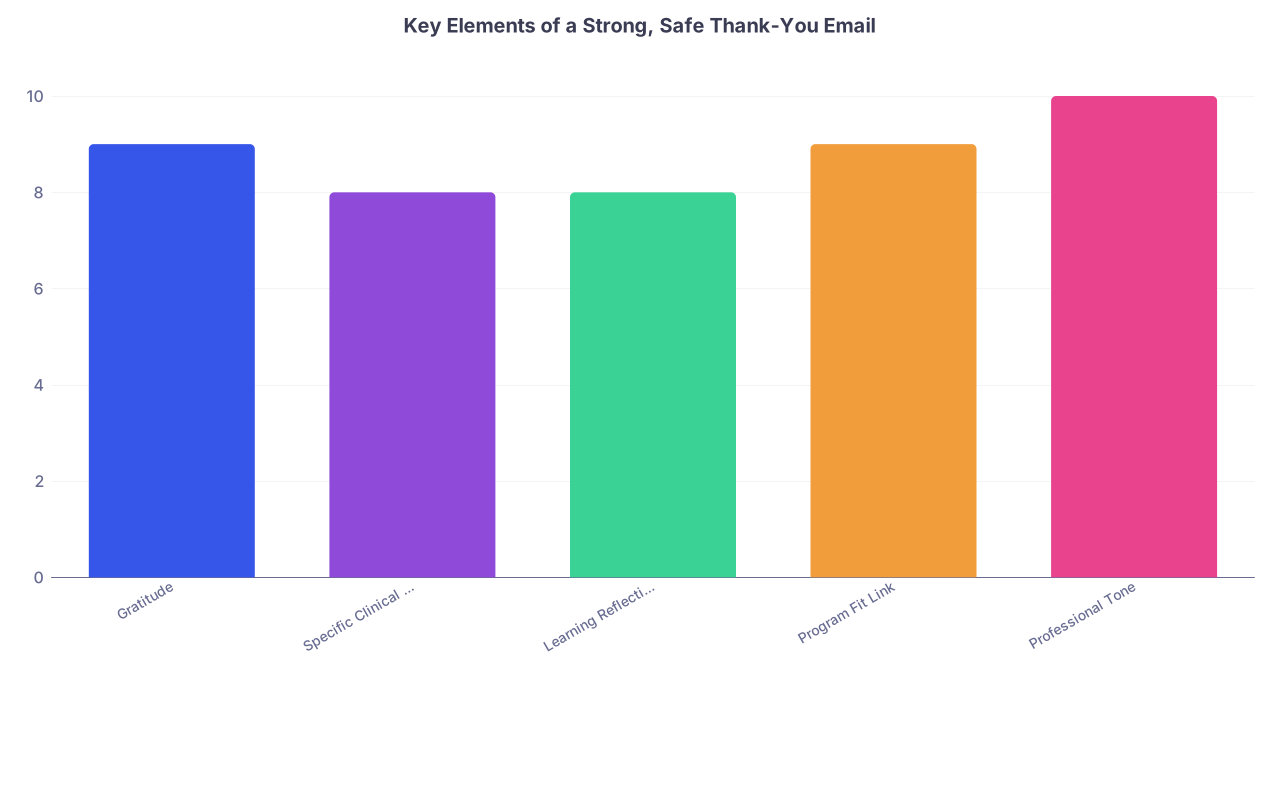
| Category | Value |
|---|---|
| Gratitude | 9 |
| Specific Clinical Anchor | 8 |
| Learning Reflection | 8 |
| Program Fit Link | 9 |
| Professional Tone | 10 |
11. Timing, Frequency, and Who Gets the Case‑Focused Version
Do not overcomplicate this.
- Send within 24–72 hours of your interview. After a week, the impact drops.
- PD and primary faculty interviewers absolutely should get a note.
- Chief residents, residents you chatted with at lunch: optional. If you had a particularly meaningful case discussion with a resident (for instance, they walked you through a tough code they led), you can send a brief, similar‑format note.
For leadership (PD, chair), lean a bit heavier on program structure, curriculum, and program‑level takeaways. For frontline faculty or fellows who geeked out with you about a specific case, lean more on the clinical reasoning angle.
Just do not send a 1,200‑word thank‑you essay to anyone. Concise, targeted, respectful.

| Step | Description |
|---|---|
| Step 1 | Finish Interview Day |
| Step 2 | Same Evening: Jot case/topics |
| Step 3 | Within 24-72h: Draft emails |
| Step 4 | Remove identifiers |
| Step 5 | Proofread names & programs |
| Step 6 | Send to PD & interviewers |
| Step 7 | Archive templates for next programs |
| Step 8 | Check for PHI? |
FAQs
1. Can I ever mention age, gender, or a specific diagnosis in a thank‑you note?
You can mention generic things like “older adult,” “pediatric patient,” or “patient with heart failure.” Once you start combining exact age with unusual diagnoses or very specific context, you risk identifiability. For a thank‑you note, there is zero upside to that level of precision. Stay at the level of “complex ICU patient with shock” or “patient with refractory seizures,” and you are both safe and sufficiently clear.
2. What if the interviewer themselves gave lots of specific details? Does that make it okay?
No. Faculty sometimes overshare out of habit. Your standard has to remain higher, because your email becomes part of a written record and can be forwarded, printed, or audited later. You can reference “the case you described of a challenging goals‑of‑care situation” without repeating the precise details they gave you. Modeling good judgment in writing is part of looking like a resident, not a student.
3. Is it better to skip case references entirely if I am not sure I can make them safe?
If you are genuinely unsure and cannot frame it at a thematic level, skip it. A clean, specific‑to‑the‑program thank‑you (referencing curriculum, culture, or research instead) is always better than a risky case description. That said, if you follow the “topic, not patient” rule, you can almost always make a case reference safe enough.
4. Should I use the thank‑you email to correct myself if I think I answered a case question poorly?
Careful here. A brief, humble clarification can work, but a long correction essay can backfire. At most, one line: “I have since looked up [topic] we discussed, and I appreciated the chance to think more about [key point].” Do not send a PubMed bibliography or try to retroactively “ace” the question. They are assessing how you think under uncertainty, not whether you can Google at home.
5. Do programs actually care about thank‑you notes, or is this just performative?
It varies. Some programs barely glance at them. Others absolutely remember who wrote thoughtful, specific emails. You cannot predict which is which. A well‑constructed note will not save a disastrous interview, but it can nudge a “maybe” into a “probably” and keep you mentally salient when rank lists are made. At minimum, it is a professional courtesy. Done correctly — with a smart, safe case reference — it quietly reinforces that you are already thinking like a resident.
Key takeaways:
- Reference the clinical theme, not the patient’s identity — topic, reasoning, and learning point are your safe anchors.
- One well‑crafted, case‑linked sentence in your thank‑you note is far more powerful than generic fluff or a detailed chart re‑write.
- If an elevator‑full of colleagues or your compliance officer could read your email without flinching, you are doing it right.