
You’re not going to “ruin your chances” over a thank-you email.
I know your brain doesn’t believe that. Mine wouldn’t either. It’s 1 a.m., your mind is replaying every interview answer you gave, and now it’s latched onto this: “I never sent that thank-you… did I just kill my shot at this program?”
Let’s walk through this like two people sitting in the call room whispering between pages. I’m going to be honest about what actually matters, what doesn’t, and whether sending a late thank-you helps, hurts, or just makes you feel a little bit less like you’re spiraling.
First: How Much Do Thank-You Emails Actually Matter?
Here’s the part nobody wants to say out loud:
Thank-you emails are mostly courtesy, not criteria.
Programs rarely make rank list decisions based on:
- Who sent the prettiest thank-you
- Who replied fastest
- Who remembered every single interviewer
They’re looking at your:
- Interview performance
- Application strength
- Fit with the program
- Professionalism overall
The thank-you falls under “tiny professionalism bonus,” if they care at all. And many honestly don’t.
I’ve heard actual PDs say:
- “I don’t even read them. They go to a folder.”
- “We don’t track them. At all.”
- “If someone sends something bizarre, that I notice. Normal thank-yous? No.”
But here’s the part your anxiety keeps twisting:
You’re not asking, “Do thank-yous matter overall?”
You’re asking:
“Is sending one late going to make me look worse?”
or
“Does not sending one mean they’ll be annoyed at me?”
Different question. Different answer.
The Real Question: What Does “Too Late” Even Mean?
Let’s define “late,” because that word is doing way too much emotional damage.
Typical “ideal” timing people throw around:
- 24–48 hours after the interview = “on time”
- 3–7 days = still normal
- 1–3 weeks = late, but not bizarre
- Months later or after rank lists submitted = symbolic at best
Does being “late” hurt you? Usually no. Worst-case, they ignore it.
The only people who get themselves in trouble are the ones who:
- Send something wildly over-the-top
- Sound desperate/pleading
- Mention ranks or “You’re my top choice” in a way that conflicts with NRMP rules
- Try to “fix” a bad interview with a novel-length email
A short, professional, slightly-late thank-you? No one’s punishing you for that.
Quick Decision Guide: Should You Send It Now?
You’re probably looking for a simple yes/no. So let’s build it.

| Step | Description |
|---|---|
| Step 1 | How long since interview? |
| Step 2 | Send short, focused thank-you |
| Step 3 | Send, but keep it very simple |
| Step 4 | Send brief, no-expectation note |
| Step 5 | Skip, let it go |
| Step 6 | Less than 3 weeks? |
| Step 7 | Have ranks been submitted? |
| Step 8 | Do you genuinely want to express gratitude? |
Let me break it down in real words.
If your interview was…
1–7 days ago
You’re totally fine. Seriously. Many applicants batch their emails on weekends or after a long interview stretch. Nobody’s clocking you to the hour.
→ Send it. It will look normal.
8–21 days ago (1–3 weeks)
This is “late,” but still within reason. Programs know this is peak interview chaos. People are traveling, on rotations, exhausted.
→ You can still send it.
Just don’t pretend you “forgot” the date. You don’t need to over-explain.
3+ weeks ago and BEFORE rank lists are due
Now we’re in “they might not care, but it won’t hurt” territory. Is it necessary? No. But if this is a top program and it’s eating you alive?
→ You can send a short, neutral note.
Focus on appreciation, not influence.
AFTER you know rank lists are certified or Match is over
At this point, it’s not about strategy. It’s about closure and professionalism.
→ Ask yourself:
- Do I genuinely want to thank them?
- Or am I just sending this to relieve my guilt?
If it’s purely guilt: You’re allowed to let it go.
If it’s real gratitude: You can still send something like, “I’ve been meaning to say this…” with no expectation.
What a Late Thank-You Should Actually Say (And Not Say)
Let’s rip off the Band-Aid. Here’s the basic structure that won’t make you look weird.
Keep it:
- Short (3–6 sentences)
- Specific (1 concrete detail from your interview)
- Professional (no ranking language if that makes you uneasy)
Here’s one template you can steal and tweak:
Subject: Thank you – [Your Name], [Specialty] Interview
Dear Dr. [Last Name],
I wanted to thank you for taking the time to speak with me during my interview at [Program Name] on [date or “earlier this month”]. I really appreciated our conversation about [specific topic you discussed – e.g., resident autonomy in the MICU, global health opportunities, etc.].
The interview day reinforced my strong interest in [Program Name] because of [1 concrete reason: the resident camaraderie, curriculum structure, patient population].
Thank you again for your time and consideration.
Best regards,
[Your Full Name]
AAMC ID: [#######]
If it’s been a while and you feel awkward, you can soften the time reference:
- “…during my interview at [Program Name] earlier this season…”
- “…when I interviewed with you at [Program Name] recently…”
No one’s cross-checking their calendar.
What NOT to do in a late thank-you
Don’t:
- Apologize 5 times for the delay (“I’m so sorry this is late, I feel terrible, I know I should’ve…”)
- Explain your life story (“I’ve been on nights, my cat got sick, I lost my spreadsheet…”)
- Ask for feedback on how you did
- Say “I will be ranking you #1” unless you absolutely mean it and understand the implication
- Use it to argue or clarify an answer you regret (“When I said X, what I really meant was…”)
The cleanest late thank-you is calm, confident, and boring. Boring is good. Boring doesn’t backfire.
How Much Damage Did Forgetting Actually Do?
Let’s play the worst-case-scenario game, since that’s where your brain is going anyway.
You’re thinking:
- “They’re going to think I’m ungrateful.”
- “They’ll assume I’m not interested.”
- “They’re comparing me to everyone who sent a perfect email 3 hours later.”
Here’s what I’ve actually seen happen on rank committees:
| Situation | What Usually Happens |
|---|---|
| You never send a thank-you | Most programs never notice |
| You send a normal late thank-you | Briefly glanced at, then archived |
| You send an over-the-top essay | Mild eye-roll, sometimes remembered |
| You send something unprofessional | Gets mentioned, can hurt you |
They have:
- 100–800 applicants
- 60–200+ interviews
- A rank meeting agenda that’s already packed
They are not building a “thank-you vs no thank-you” spreadsheet with your name highlighted in red.
Where thank-yous might matter a tiny bit:
- Super small programs with very few interviewees
- Borderline tie situations, where they’re splitting hairs about who seemed more engaged
Even then, it’s about impression, not timestamps.
If your interview went decently and you weren’t rude or checked out, the lack of a thank-you is not what decides your fate. It just isn’t.
Special Situations You’re Probably Overthinking
Let me guess, one of these is you.
“I sent some thank-yous right away… and forgot others.”
You’re worried they’ll compare timestamps between faculty.
Reality: Faculty don’t usually sit around saying, “Oh, Dr. Lee got an email but I didn’t.” They don’t cross-reference. Many don’t even talk about thank-yous.
If you realize you missed one or two:
- You can still send them now.
- Don’t mention that you mailed others earlier. No one needs a timeline.
Just send the same neutral format. Move on.
“I only sent a thank-you to the PD, not my individual interviewers.”
That’s common. Plenty of people only email:
- Program Director
- Associate PD
- Coordinator
If you’re worrying now, you can send brief notes to your interviewers, even late. But you don’t have to “fix” this. Many residents never emailed individual interviewers and matched just fine.
“The program specifically said ‘No thank-you emails needed.’”
Okay, this one matters slightly.
If a program explicitly said:
- “Please do not send thank-you emails”
- “We will not respond to post-interview communication”
Then don’t send one. You won’t look more professional by ignoring instructions. You’ll look… not great.
If you already did send one anyway? Stop. Don’t follow up or double down. Just leave it alone.
Late Thank-You vs. No Thank-You: Which Is Better?
If you’re still on the fence, here’s the trade-off.
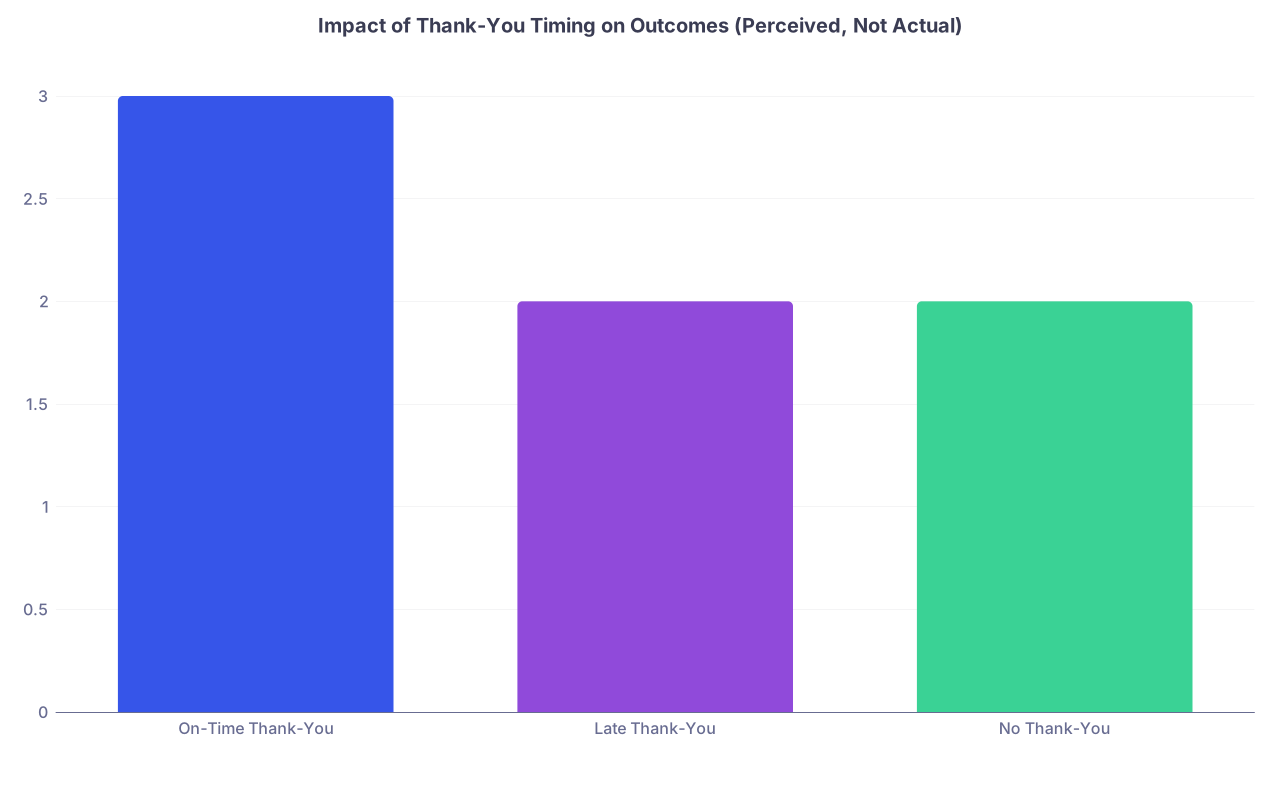
| Category | Value |
|---|---|
| On-Time Thank-You | 3 |
| Late Thank-You | 2 |
| No Thank-You | 2 |
(Think of 1–3 as “tiny positive impression,” not actual score changes.)
Here’s how I’d think about it:
Send a late thank-you if:
- You genuinely appreciated the interview
- It’s a program you could realistically see yourself at
- Your gut says you’ll keep obsessing if you do nothing
Skip it if:
- They told you not to send one
- You’re purely doing it to try to “fix” a bad interview
- It’s months later and you don’t actually care about the program, you just feel guilty
The truth: between a normal late thank-you and none at all, the impact on your rank spot is usually microscopic. So this becomes less about “strategy” and more about “what helps me sleep tonight without doing something unprofessional.”
How to Stop This From Consuming Your Whole Brain
Because that’s what it’s doing, right? You’re refreshing your email, rereading your drafts, wondering if your subject line sounds dorky.
Here’s a quick, non-fluffy way to contain this:
- Make a quick list of programs you’re actually considering ranking meaningfully.
- For each, ask: “Do I want them to remember that I was appreciative and engaged?”
- If yes and it’s not months past? Send the simple template.
- If no or you’re forcing it? Cross them off the thank-you list.
Then close the damn tab.
If you want structure, pick one 30–45 minute block:
- Open your interview spreadsheet
- Send all remaining thank-yous in one sitting
- After that, no revising, no follow-up, no second-guessing
You’re not writing love letters. You’re checking a small, optional box.
FAQ – Late Thank-You Anxiety Edition
1. Is sending a late thank-you worse than not sending one at all?
No. A normal, short, respectful late thank-you is not worse than nothing. At most, it’s neutral. The only “worse” scenario is a weird, overly intense, or apologetic mess of an email. If you keep it simple, you’re safe.
2. Should I mention that I’m sorry it’s late?
If it’s been a few days to a week? Don’t mention it. That’s normal timing.
If it’s been 2–3+ weeks and you feel compelled, one short line is enough:
“Apologies for the delay—thank you again for taking the time to speak with me.”
No multi-sentence explanations. No guilt-dumping.
3. What if I realized I messed up someone’s name or title in the first email?
Do not send a whole second apology essay. If it was minor (Dr. vs. Prof., or a small typo), let it go. They are not dissecting your thank-you email. If you truly botched it (wrong program name, wrong person entirely), you can send a correction once, very briefly: “My apologies for the earlier typo—I meant to write [correct name].” Then stop.
4. Can I use the thank-you to tell them I’m ranking them highly?
You can, but be careful. If you say “ranking you highly,” it’s vague but safe. If you say “You’re my #1,” then ethically you shouldn’t be telling anyone else that. Also, keep it honest: don’t use ranking language as a trick. And don’t expect it to magically move you up 20 spots.
5. I didn’t send any thank-you emails all season. Did I tank my match chances?
No. Plenty of people don’t send them and match perfectly well. Programs are used to a wide range of applicant behavior. No one is sitting there thinking, “Wow, we liked this candidate but they never emailed ‘thanks,’ so let’s drop them 40 spots.” If you want, you can still send a few now to places you genuinely care about, but your match outcome isn’t hinging on this.
Open your email right now and pick ONE program that’s been living rent-free in your head. Write a 4-sentence thank-you using the template above, send it, and then—this part matters—close your laptop for an hour. Let that be enough for today.