The obsession with thank-you emails after residency interviews is wildly overblown.
You Probably Didn’t Ruin Anything
Let me just say the thing you’re scared to say out loud:
“I didn’t send thank-you emails after my residency interviews. Did I just silently kill my chances everywhere?”
Short answer: No.
Longer, more honest answer: You’re not doomed, but there are a few situations where it can sting a little—and some easy damage-control moves you can still make.
Programs do not build their rank lists around who wrote the nicest “thank you for your time” email. They just don’t. They care about performance on interview day, letters, Step scores, fit, vibes, and whether they can picture you at 3 a.m. on a terrible call night without wanting to scream.
But I get why you’re spiraling. You see people on Reddit posting their color-coded spreadsheets: “Thank-you email sent to PD, APD, faculty 1, faculty 2, chief… subject line: ‘Thank you + callback to specific case we discussed’” and you’re sitting there like, “I barely remember what day of the week it is.”
So let’s untangle this.
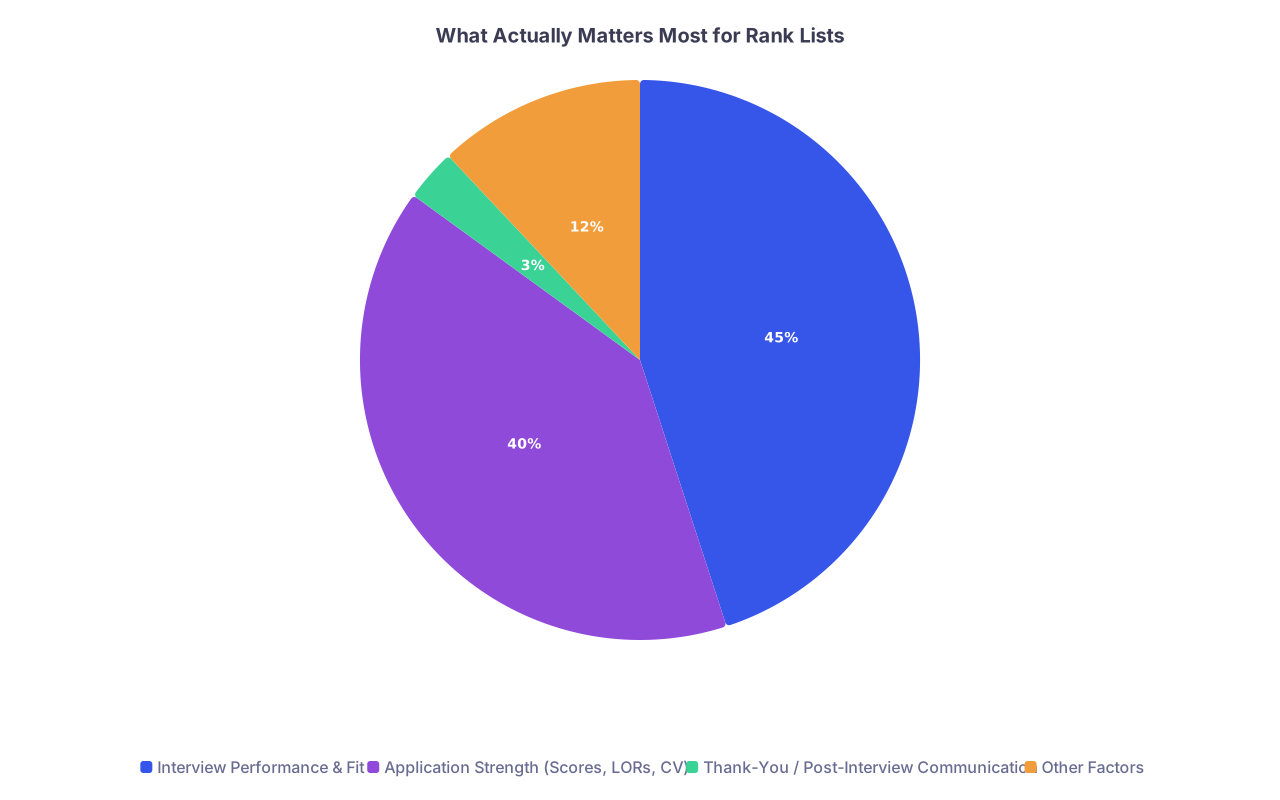
| Category | Value |
|---|---|
| Interview Performance & Fit | 45 |
| Application Strength (Scores, LORs, CV) | 40 |
| Thank-You / Post-Interview Communication | 3 |
| Other Factors | 12 |
How Much Do Thank-You Emails Actually Matter?
Here’s the blunt truth I’ve heard over and over from residents, PDs, and faculty (the ones who are honest, not the ones giving squeaky-clean PR answers):
Thank-you emails are:
- Nice
- Polite
- Mostly irrelevant to your actual ranking
Most programs are not sitting in a room going, “Well, Applicant A had a great interview and strong letters, but Applicant B wrote a more heartfelt email about our continuity clinic, so bump B up 5 spots.”
What they might do:
- Use emails as a mild positive tiebreaker in rare, razor-thin comparisons
- Notice super thoughtful, specific notes and vaguely remember you slightly more clearly
- Use personalized notes as a signal of genuine interest (again, small effect)
What they definitely do not do:
- “Auto-reject” you in the rank meeting for not sending emails
- Track who sent emails like a graded assignment
- Punish people from cultures or backgrounds where this is less common
A lot of PDs openly admit they barely read these. Some skim. Some don’t even see them because everything goes through a coordinator.
Is it possible that one or two particularly old-school attendings silently judge the lack of a thank-you? Sure. But those people are also still forwarding articles by fax. You can’t build your entire anxiety structure around them.
Worst-Case Scenarios You’re Imagining (And What’s Actually True)
Let’s walk through the exact nightmares that keep popping into your head.
“Everyone else sent emails. I’m the only one who didn’t. I’ll look rude.”
Reality: You are definitely not the only one who didn’t send them. Tons of applicants either:
- Forget
- Melt down after interviews and freeze
- Think they sounded awkward and delete drafts
- Misread advice and think “thank-you emails are banned”
Faculty see all versions: the over-the-top essay, the two-line polite note, and radio silence. Silence is not automatically interpreted as disrespect. Usually it’s interpreted as nothing.
“The PD will think I don’t care about their program.”
Real talk: If a PD is using your thank-you email as the primary indicator of your interest, that’s a problem with their process, not with you.
Programs know:
- You’re interviewing at multiple places
- You’re exhausted and traveling
- Messages get lost, delayed, and buried
They look much more at your behavior on interview day:
- Did you ask thoughtful questions?
- Did you seem engaged, awake, and at least semi-human?
- Did you interact decently with residents and staff?
That’s what signals interest. Not a “Dear Dr. Smith, Thank you for your time” template.
“I missed the window. Now it’s too late and I’ll look even worse.”
This is where the anxiety really spikes, right? Not just that you didn’t send them—but that now sending them will expose how long you’ve been silently panicking.
Here’s the thing: you can still send something. But you shouldn’t pretend it’s a thank-you email from 3 weeks ago. You reframe it.
Something like:
- A brief “I’ve been reflecting on my interviews, and I wanted to reach out to say…”
- Or “As I work on my rank list, I keep coming back to…”
That stops it from feeling like “Hey, I just realized I forgot the social rule and now I’m patching it.”
You haven’t missed a “deadline.” There is no official “email within 24 hours or perish” rule. That rule lives only in neurotic group chats and Reddit threads.
What You Can Still Do (Without Looking Desperate)
If you’re in full damage-control mode, here’s how to move without making this worse.
Step 1: Decide Who Actually Warrants a Message
You don’t need to email every single person you met. That looks fake anyway.
Focus on:
- Programs you’re seriously considering ranking high
- Programs where you had a genuinely good conversation with someone
- PDs/APDs where your interest is strong or growing
If you interviewed at 15+ places, you might end up sending 5–8 notes. That’s plenty.
Step 2: Change the Frame: Reflection > Obligation
At this stage in the season, don’t write “thank-you emails.” Write post-interview reflection emails that also contain thanks.
Something like:
Dear Dr. [Name],
As I’ve been thinking back on my interview day at [Program], I keep coming back to our conversation about [specific thing you actually remember]. It really stood out to me how [something genuine about their teaching style, patient population, resident culture, etc.].
I also wanted to say thank you for taking the time to speak with me. Our discussion has stayed with me as I work on my rank list, and [Program] remains a place I’m very interested in.
Best regards,
[Your Name], [AAMC ID (optional)]
Short. Specific. Not a groveling apology for “being late.”
No one is going to look at that and think, “Wow. Where was this 18 days ago?”
Step 3: Do Not Over-Explain
Don’t write:
- “I’m so sorry I didn’t email sooner…”
- “I’ve been really anxious / overwhelmed / depressed…”
- “I was told not to send thank-you emails…”
You’re not testifying in court. You’re sending a 6–8 line email. Over-explaining just drags their attention to the delay instead of the content.
You’re allowed to have been busy. You’re allowed to be human. You don’t have to justify your reaction time like you’re defending a malpractice suit.
Step 4: Don’t Promise Things You Can’t Back Up
Please don’t send “You are my absolute #1 program” emails to three different places because some rando on SDN said “send a love letter.”
If you send a strong “I plan to rank your program very highly” type email, make it:
- Honest
- Non-specific enough that you’re not lying
- Consistent with how you actually feel
Something like:
“Your program will be ranked among my top choices because of [specific reasons].”
That’s sincere, non-messy, and not going to boomerang back as guilt later.
Programs That Don’t Want Thank-You Emails At All
Some programs literally say: “Please do not send thank-you emails.”
Or they:
- Route everything through a portal
- Tell you “no further communication is necessary”
- Explicitly discourage follow-up, especially about ranking
Here, ignoring that instruction would hurt you more than silence ever could.
If you’re not sure how much they care about post-interview communication, check your invitation email or website screenshots you hopefully saved.
| Program Type | Typical Stance on Thank-You Emails |
|---|---|
| Big university IM program | Mixed, often neutral / ignored |
| Community program | Sometimes appreciates them |
| Super competitive specialty | Often neutral, rank by committee |
| Programs stating "no emails" | Actually mean it—don’t email |
| Small niche programs | May remember thoughtful messages |
If they said no emails, you’re actually safer for not sending anything. You accidentally followed instructions. Look at you.
How Much Damage Is Even Possible From Not Sending Them?
Let’s assume the absolute most dramatic version of reality, just to satisfy the anxious brain.
Worst case:
- One or two faculty slightly notice you didn’t send anything
- Among equally ranked applicants with near-identical stats and vibes, they vaguely prefer the one who did
This is a tiny, end-stage tiebreaker at best. And most programs don’t even get that granular. For a lot of them, the rank list is made based on:
- Interview impressions
- File review
- Input from multiple residents and faculty
Your 3-sentence email just isn’t going to outweigh “we really liked their situational judgment answers” or “they seemed awkward with residents” or “their letters were incredible.”
If you crushed the interview and clicked with residents, not sending thank-you emails is not going to knock you from “probable match” to “not ranked.” That’s just not how this works.
What You Should Focus on Instead (The Stuff That Actually Moves the Needle)
You can’t go back and rewrite interview day. You can’t retroactively erase the silence of the last two weeks. So put your energy where it matters.
Here’s what’s worth your anxiety budget:
- Building an honest, thoughtful rank list based on places you can actually picture surviving and not hating your life.
- Reading your notes (or reconstructing them from memory) about residents’ vibes, call schedules, and how people talked about wellness vs. just slapping “we care about wellness” on slides.
- Making peace with the fact that this process is chaotic and not fully under your control—even if you’d like to micromanage it into submission.
And if you still want to send a few messages, do it. Calmly. Targeted. No theatrics.

| Step | Description |
|---|---|
| Step 1 | Realize you didnt send thank-you emails |
| Step 2 | Focus on rank list and move on |
| Step 3 | Identify top programs & key interviewers |
| Step 4 | Write short, specific reflection emails |
| Step 5 | Send within 1-3 days |
| Step 6 | Stop checking inbox obsessively |
| Step 7 | Finalize rank list |
| Step 8 | Do you still want to reach out? |
How to Cope With the Ongoing Spiral
Because let’s be honest: even after all this, your brain’s still going to whisper, “But what if…”
Some grounding thoughts you can come back to:
- Plenty of people match every single year without sending a single thank-you email. I’ve seen it. I’ve watched them ugly-cry on Match Day with “no-email” histories.
- If a program really wants you—based on fit, skills, letters, and interview—your lack of a formulaic “thank you” isn’t going to override that.
- The programs that would actually hold a grudge over this are probably not where you want to spend three to seven of the hardest years of your life anyway.
You are allowed to be imperfect in this process and still match.
FAQ (The 5 Questions You’re Probably Still Asking)
1. Is it better to send late thank-you emails or just skip them entirely now?
If you’re within a few weeks of the interview, a short, reflective, semi-thank-you note is fine and not weird. Past that, only reach out if you genuinely have something meaningful to say (clarifying interest, a specific connection, an update). If sending them is going to send you into a new spiral—skip them. Silence is safer than panicked over-writing.
2. Should I send a thank-you email to the program coordinator too?
If you interacted a lot with them and they were especially helpful, a quick thank-you can be nice, but it’s not required. Something like: “Thank you for organizing a smooth interview day at [Program]. I really appreciated how clear the communication was.” Coordinators don’t typically vote on rank lists, but they’re human and it’s kind.
3. What if I sent thank-you emails to some programs but not others—will that look inconsistent?
Only you know that. Programs don’t have a shared spreadsheet of “who got thank-you emails.” Each program only sees what they received. You don’t get a global grade on “thank-you consistency.” Do what makes sense, program by program, from here on out. You’re not being audited.
4. Can I use a template for all my messages, or does everything need to be totally unique?
You can absolutely use a base template for structure (intro, specific detail, thank you, interest), but you must customize at least one concrete detail for each program or interviewer. They can smell “Dear [insert name], I really liked talking about [insert vague topic]” templates from a mile away. One real detail is enough.
5. Will not sending thank-you emails tank my chances at super competitive specialties?
Those specialties (Derm, Ortho, ENT, etc.) care way more about research, letters from big names, strong interviews, and fit with their culture. Some applicants in those fields do send carefully crafted follow-ups, but they’re not magic keys. You won’t go from “top-third of our list” to “off the list” just because you skipped an email. The things that matter most already happened before and during interview day.
Open your email right now and pick one program that honestly matters most to you. Write a 6–8 line, specific, calm message to one person there—and then stop. Hit send. Close the tab. You’ve done enough for today.