
Two days after your interview, you finally hit send on the perfect thank‑you email. You reread it ten times, checked the program name three more, and then tried to move on. A week later, you’re staring at your screen, frozen, as a horrifying realization hits you:
What if it went to spam?
Now your brain is off to the races: “They think I didn’t send anything. They think I’m rude. Everyone else sent thank‑yous, mine’s the only one missing, and I just nuked my chances at this program.”
Let me walk through this with you, because I’ve watched people spiral over this exact thing. I’ve also watched attendings open their inboxes with 300 unread messages and say, “Oh, I’m sure they thanked me, email’s a mess,” and move on with their day.
You’re convinced this is a catastrophe. It’s not. But you do need a plan.
Reality check: do thank‑you emails actually matter that much?
I know, you’ve heard every possible opinion:
- “Thank‑you emails don’t matter at all.”
- “They’re unprofessional if you don’t send one.”
- “My PD said they do look at them.”
- “My senior said no one reads them.”
The truth is messy. And annoyingly gray.
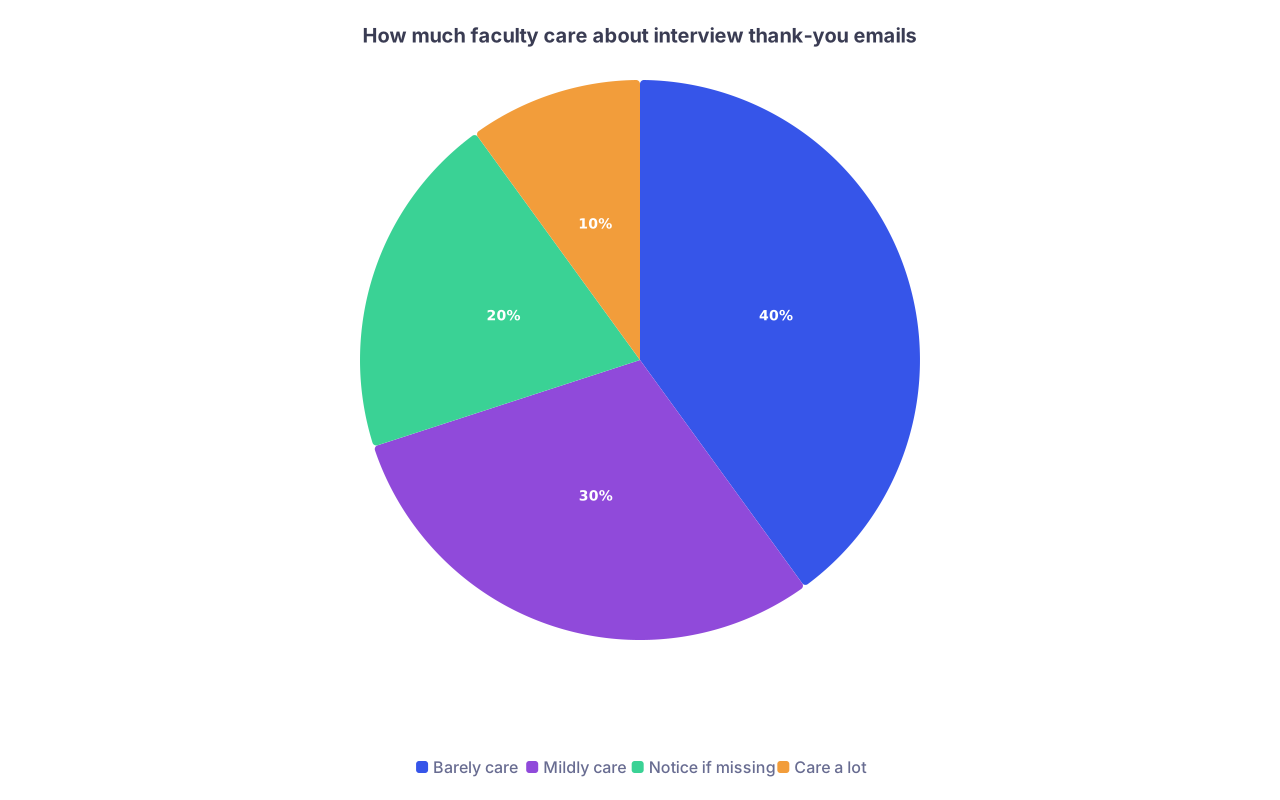
| Category | Value |
|---|---|
| Barely care | 40 |
| Mildly care | 30 |
| Notice if missing | 20 |
| Care a lot | 10 |
Here’s what I’ve consistently seen across programs:
- Some faculty never check their email properly. Your thank‑you could be in spam, promotions, or a black hole of 4,000 unread emails. They’ll assume you sent one or forget everyone did.
- Some skim them quickly on their phone while walking between cases. They vaguely remember you were “polite” but won’t remember whether it was day-of, day-after, or never.
- A smaller subset actually reads them and occasionally makes a note if you were particularly thoughtful or specific.
But this is the key point:
Programs don’t systematically punish people for lost or missing thank‑yous. They just don’t. They have too much else to care about—your interview performance, letters, Step scores, perceived fit, internal candidates, service coverage.
Your brain is telling you this:
No thank‑you = automatic “do not rank”
Reality is closer to this:
No thank‑you = 99.9% chance no one notices or they assume tech/email weirdness.
And even in the 0.1% where someone actually thinks, “Huh, they didn’t send one,” it’s background noise. Not a rank‐list‑destroying event.
How do I even know if it went to spam?
Here’s the worst part: you usually won’t know.
You might suspect it because:
- You used your med school email and it’s been glitchy
- You sent it to a hospital domain that’s notorious for overzealous filters - You attached something (like a photo or CV) and worry that triggered spam - You got zero response from anyone at a place where people usually reply
Or maybe your fear is based on nothing concrete. Just that gut-level panic that says, “Something went wrong and I can’t see it.”
Your brain fills in the gaps with the worst possible narrative. Mine does that too.
But if we’re being honest:
- Lots of faculty never respond to thank‑you emails, even when they see them.
- Some programs explicitly tell faculty not to engage much post‑interview.
- Your lack of reply doesn’t actually prove anything.
So you’re left with a Schrödinger’s thank‑you email situation:
- It might have landed perfectly and been skimmed.
- It might be in spam.
- It might’ve been buried under hospital admin emails and never seen.
You’ll likely never know. And that uncertainty is what keeps chewing at you.
So instead of chasing proof, the better move is to ask:
“Okay, if my thank‑you did go to spam, what’s the smartest, least desperate way to handle it now?”
Should I re-send it? Or follow up? Or just leave it?
This is the question that keeps people refreshing their sent folder at 1 AM. Here’s how I’d think through it.
Step 1: How long has it been?
If it’s been:
- Less than 24–48 hours? Do nothing. Honestly. Email systems can lag, faculty can be on service, call, or post‑call. You’re way too early to panic.
- 3–7 days? Still very much in the “normal” window where many faculty will either not reply or will batch‑reply later.
- More than 1–2 weeks and you’re still obsessing? That’s when you can consider a gentle move—but only if there’s a reason.
Step 2: Did you make any clear mistake?
Things like:
- Sent to the wrong address (you discovered a typo in “@mayo.edu” or similar)
- Sent to an old or bounced email (you got an error message and ignored it)
- Mixed up the program name or specialty in a horrifying way
- Attached the wrong file
If yes, then yeah—this justifies a second message. Not because of spam specifically, but because there was a concrete error.
You can send a very short, calm follow‑up like:
“Dr. Smith,
I realized after sending my previous email that I may have used an incorrect address. I wanted to briefly reiterate my appreciation for the opportunity to interview with [Program Name] on [date] and for your time discussing [specific topic].
Best,
[Your Name]”
No drama. No “I’m so sorry if…” paragraph. Just fix it and move on.
Step 3: If there’s no obvious mistake—only anxiety
This is most people.
You sent acceptable emails. You just don’t know if they were received. And now you’re tempted to send a, “Hi, just checking if you got my thank‑you” message.
Don’t. That second email is more likely to:
- Make you look anxious and overly self‑focused
- Annoy a busy faculty who’s already drowning in email
- Call attention to a non-issue they didn’t notice
If you really can’t let it go and it’s eating you alive, a better option is:
- Reach out once to the program coordinator (not every interviewer)
Something like:
“Dear [Coordinator Name],
I just wanted to thank you again for organizing the interview day for [Program Name] on [date]. I sent thank‑you notes to my interviewers from [your email], and I’m hoping they were received, though I know institutional filters can be strict. Either way, I’m very grateful for the opportunity to learn more about your program.
Best regards,
[Your Name, AAMC ID]”
You’re not asking for confirmation. You’re not demanding anything. You’re just documenting that you tried, while sounding normal and appreciative.
But again: this is optional. Not required. And honestly, most people should just leave it alone.
Will a missing thank-you actually hurt my rank?
Let’s be blunt. Here’s what actually moves your position on a rank list:
| Factor | Real Impact on Rank | Anxiety Level for Applicants |
|---|---|---|
| Interview performance | Very High | High |
| Fit with residents/faculty | High | Medium |
| Letters of recommendation | High | Medium |
| Step scores / academic record | Moderate–High | Medium |
| Thank-you emails | Low–None | Ridiculously High |
I’ve heard PDs say:
- “I like thoughtful thank‑yous, but I don’t penalize people who don’t send them.”
- “Half these emails look templated anyway.”
- “Honestly, if I loved an applicant and they didn’t email me, I’d still rank them high.”
It might nudge you slightly if:
- You were on the borderline in their mind
- You wrote a very specific, program-tailored, genuine message that reinforced your interest, and they actually saw it
But the idea that your entire ranking hinges on one email slipping to spam? That’s your anxiety talking, not reality.
Think about the chaos on their side:
- They’re interviewing dozens to hundreds of applicants
- They’re juggling service needs, internal candidates, visa issues, diversity goals
- They’re arguing in ranking meetings over clinical strength, red flags, and who they’d actually want to work with at 3 AM on call
No one’s going to say:
“You know, their clinical skills are great, residents loved them, but we didn’t get a thank‑you. Drop them 20 spots.”
That’s not how any of this works.
What should I do now if I’m stuck spiraling?
Let’s say you’ve already sent the thank‑you. You’re not going to resend it. You don’t have concrete evidence it went to spam. But your brain won’t shut up.
Here’s how I’d handle it:
1. Write it down once, then stop poking it
Open a notes document and literally write:
- Program
- Date of interview
- Date I sent thank‑you
- Emails I used
If you want, paste the actual email text. This does two things:
- Confirms you did your part
- Gives you something to refer to later if, for some reason, it becomes relevant (it won’t, but your brain likes receipts)
Then you’re done. You’re not allowed to go edit this 20 times a week.
2. Set a hard rule: no resending unless X, Y, or Z
For example:
- Only resend if you notice a typo in the address
- Only resend if the email actually bounced
- Only resend if the program specifically says “We didn’t receive your email” (which they won’t, but fine)
Everything else—assumed spam, no reply, vague unease—does not qualify.
3. Redirect your control to something that actually matters
You know what will matter more than the thank‑you that possibly went to spam?
- How you answer “Tell me about a time you made a mistake” at your next interview
- Whether you read the program website before your next meeting with a PD
- How thoughtful and honest you are in your rank list
Right now your anxiety is fixating on the one thing that’s already done and can’t be measured. That’s classic pre‑Match brain. So you have to force it back to things with real impact.
A quick way to stop ruminating on this specific “what if”
Here’s a simple, slightly brutal thought experiment I use when people spiral on this:
Imagine your thank‑you definitely went to spam. 100% confirmed. No one saw it.
Now ask: Would you seriously change your rank list because of that?
- If you loved the program? You’d still rank it high.
- If you felt meh about it? You’d still rank it where it fits.
- If there were red flags? You wouldn’t magically rank it higher just because of an email.
Now flip it. Do you honestly think they’re going to overhaul their rank list over this? A busy PD who barely reads half their inbox? A faculty member who can barely remember each applicant’s name by February?
Of course not.
The only person really punishing you for this is…you.

| Step | Description |
|---|---|
| Step 1 | Interview Day |
| Step 2 | Send thank-you within 24-72 hours |
| Step 3 | Send brief corrected follow-up |
| Step 4 | Do NOT resend |
| Step 5 | Document what you sent |
| Step 6 | Focus on next interviews & rank list |
| Step 7 | Obvious problem? Wrong email, bounce, wrong name |
FAQ: Six Specific Spirals About Thank‑Yous and Spam
1. Is it unprofessional if I never send thank‑you emails at all?
No. Some programs and attendings truly don’t care. A lot of applicants don’t send them, especially in very busy, high‑volume specialties. If anything, what looks worse is sending obviously copy‑pasted, generic, error‑filled thank‑yous. If you send nothing, they just have…nothing. They won’t blacklist you for it.
2. What if one interviewer got a thank‑you and another didn’t?
That happens constantly. Someone gave you their card, someone else didn’t. One email was easy to find, another was hidden behind a hospital intranet. Or you just missed one. Annoying? Yes. Rank‑destroying? No. Faculty are used to this. They don’t line up in a room and compare who got thanked and who didn’t.
3. Should I CC the program coordinator on every thank‑you so there’s proof?
Please don’t. It looks weird and a little overly tactical. The coordinator is already drowning in logistics emails. If you want proof for your own sanity, save the sent email as a PDF or screenshot it. You don’t need to drag the coordinator into every message to document that you’re polite.
4. What if I spelled the program name wrong or mixed it up with another one?
Okay, this is one of the few actually bad situations. If you wrote “Thank you again for the great day at [Other Program]” to the wrong place, that can make you look careless. If you catch it, send one short correction to the right person. Don’t over-apologize, just fix it and move on. Will it sting? Maybe a bit. Will it obliterate your chances? Usually not, especially if the rest of your interview was strong.
5. Do I need to send thank‑yous to every single person I met on interview day?
No. Focus on your actual interviewers and maybe the PD/APD if the program culture seems to support that. You don’t have to track down every resident, every faculty at the social, every coordinator. That way lies madness. Quality over quantity. A few thoughtful notes beat a dozen generic ones.
6. Can a really good thank‑you save a mediocre interview?
Very unlikely. You might bump yourself in someone’s mental list from “forgettable” to “pleasant,” but you’re not going from bottom tier to top tier based on a paragraph of text. The thank‑you is seasoning, not the main dish. It can mildly help a bit, but it’s not a rescue rope. And if it doesn’t arrive? You’re basically just back to where you already were from your interview alone.
Years from now, you won’t remember which emails landed in spam and which got read on an attending’s phone between cases. You’ll remember the places you clicked with, the people who made you feel like you belonged, and the fact that—despite all this noise—you still showed up and did your best.