
Last night, I stared at a two-sentence thank-you email draft for almost an hour. It said all the “right” things—thank you for your time, loved meeting the residents—but it sounded like something literally anyone could’ve written. I kept imagining a PD opening it, rolling their eyes, and mentally tossing my application in the trash. Over one email.
If you’re here, I’m guessing you’ve got a draft sitting on your screen and this awful thought looping in your brain: “What if my follow-up sounds generic and they think I don’t care?” Let’s pull that fear apart and actually fix it.
First: How Much Do Follow-Ups Really Matter?
Let me just say the nightmare thought out loud: “If my email is generic, they’ll drop me on the rank list.”
No. That’s not how this works.
Programs rank you on:
- How you interviewed
- Your letters
- Your scores / transcript / MSPE
- Your fit with their culture
- Sometimes your pre-interview communication
Follow-up emails are usually a tiebreaker, not the main event. I’ve heard PDs say things like:
- “I don’t remember who followed up and who didn’t. I remember who was awkward or rude on interview day.”
- “Nice to get, not required. I scan for red flags more than I scan for poetry.”
- “If it’s generic, I skim and move on. It doesn’t hurt them. If it’s weird or pushy, that can hurt.”
So your generic-sounding follow-up? At worst, it’s emotionally neutral. It might not win you any bonus points, but it’s not a silent career-killer.
What can hurt you is:
- Super long, rambling essays
- Over-the-top flattery that feels fake
- Dishonest “you’re my #1” promises to multiple programs
- Repeated, pushy follow-ups after no response
But a short, slightly bland thank-you?
Not the villain your brain is making it.
Spot-Check Questions: Is My Follow-Up Actually Too Generic?
Here’s where we stop spiraling and start checking. Open your draft. Don’t rewrite yet—just test it against these questions.
1. Could this email be sent to any program just by changing the name?
Look at your first paragraph. Ask:
- If I did a find-and-replace on the program name, would this make perfect sense for 10 different places?
- Did I mention anything specific about that program, that day, or that conversation?
If your whole email is basically:
“Thank you for the opportunity to interview with XYZ. I enjoyed learning about your program and believe it would be a great fit for my career goals.”
That’s template-level generic.
Fix: Add one concrete detail:
- A specific feature of the program you genuinely liked
- Something you talked about with the interviewer
- A resident interaction that stuck with you
You don’t need five. One or two is enough.
2. Did I reference at least one real thing from the interview day?
Scroll your draft and check:
- Do I mention a faculty member’s particular focus, clinic, or project?
- Do I reference something unique: schedule structure, patient population, curriculum, vibe?
- Do I mention a moment from the day: case discussion, noon conference, resident panel?
If you have zero specifics, it reads like you wrote it before you actually visited them.
Fix idea: Fill in this blank:
“I especially appreciated ____ because ____.”
Examples:
- “I especially appreciated hearing about your strong med-ed culture, especially the weekly teaching workshops residents lead for each other.”
- “I especially appreciated watching the resident-led case conference—seeing interns present with so much confidence made me excited about the teaching environment.”
Doesn’t have to be dramatic. Just real.
3. Am I oversharing or trying too hard to sound special?
Weirdly, our fear of being generic can push us into the other extreme: overly dramatic, trying-to-be-epic emails.
Red flags in your draft:
- Long emotional monologues about your childhood, trauma, or “lifelong dream” (this isn’t another personal statement)
- Flowery phrases: “I was profoundly moved by…” “life-changing experience”… “indelibly shaped my vision of medicine”
- Stiff, unnatural language you’d never say out loud
Programs don’t need Shakespeare. They need a clear, respectful human.
Ask yourself:
- If I read this out loud to a friend, would I cringe?
- Would I actually say this to the PD face-to-face?
If the answer is no, tone it down. Being normal is not generic. It’s a relief to the reader.
4. Is my email longer than one screen on my phone?
Harsh truth: PDs and coordinators read these on their phones. Fast. While walking between meetings, while scarfing lunch, while clearing out a bloated inbox.
If your email is a wall of text, it won’t feel impressive; it’ll feel like work.
Do this:
- Open the draft on your phone
- Scroll once
- If it takes more than one quick scroll to get to your name, it’s too long
Ideal length:
- 3–6 sentences for standard thank-you
- Maybe 2 short paragraphs if you’re expressing strong interest
Short isn’t generic. It’s respectful of their time.
5. Does the subject line scream “template”?
Look at your subject line. Common safe-but-bland ones:
- “Thank you for the interview”
- “Thank you for the opportunity”
They’re fine. But if you’re worried you sound like a robot, you can add a tiny bit of specificity without being weird.
Swap:
- “Thank you for the interview” → “Thank you for the interview – [Program Name]”
- “Thank you” → “Thank you – [Specialty] interview at [Hospital]”
If you’re following up with a specific interviewer:
- “Thank you – [Your Name], [Specialty] interview on [Date]”
That’s it. Don’t overcomplicate it.
6. Did I avoid landmines (false commitments, ranking talk, desperation)?
This is where generic is actually safer.
Scan your draft for:
- “You are my #1 choice” (dangerous if you tell more than one place)
- “I will definitely rank you first” (NRMP frowns on this kind of explicit ranking language)
- “I will cancel other interviews because of your program” (comes off dramatic or manipulative)
- Repeated “please rank me highly” type statements
Better wording:
- “Your program is one of my top choices.”
- “I’d be thrilled to train at [Program].”
- “My interview day strengthened my interest in your program.”
That’s honest, interested, and not ethically messy.
7. Does my tone feel like a normal human adult?
Read it out loud. That’s the fastest tone test.
Ask:
- Do I sound like myself on my best professional day?
- Am I overly submissive (“I’m so undeserving but thank you for this chance”)?
- Am I weirdly formal (“Esteemed Dr. Smith, I remain deeply obliged for your benevolent consideration”)?
If you’re leaning into stiff formality out of fear of sounding unprofessional, relax. Polite, direct, and simple beats ornate and stiff.
You can literally write:
“Thank you again for your time and for sharing more about the program. I appreciated your honesty about the challenges residents face and how the program supports them.”
That sounds human. That’s enough.
Quick Template You Can Personalize (Without Sounding Fake)
If you’re fully stuck, use this as your skeleton and replace the brackets thoughtfully:
Subject: Thank you – [Your Name], [Specialty] Interview on [Date]
Dear Dr. [Last Name],
Thank you for taking the time to speak with me during my interview at [Program Name] on [Day/Date]. I appreciated hearing more about [specific aspect – e.g., “your approach to resident autonomy in the ICU” or “the tight-knit feel among the residents”].
Our conversation about [specific topic you discussed] stood out to me and made me even more excited about the possibility of training at [Program Name]. I believe the strong [teaching/research/patient care/whatever genuinely fits] culture would be an excellent fit with my goals in [career interest].
Thank you again for your time and consideration. I would be thrilled to join the [Program Name] team.
Sincerely,
[Your Name]
[AAMC ID (optional)]
Is it generic-leaning? A bit. But it’s safe, respectful, and becomes “yours” as soon as you plug in real specifics.

| Step | Description |
|---|---|
| Step 1 | Finish Interview Day |
| Step 2 | Draft Email |
| Step 3 | Okay - Not Required |
| Step 4 | Spot-Check for Specifics |
| Step 5 | Add 1-2 Concrete Details |
| Step 6 | Send Email |
| Step 7 | Send Thank-You? |
| Step 8 | Too Generic? |
What If I Already Sent a Super Generic Email?
This is the nightmare scenario people don’t admit out loud: “I already sent them something that looks copy-pasted. Am I doomed?”
Short answer: no. Longer answer:
Programs do not keep a scoreboard of “generic vs non-generic emails.” Nobody’s in a conference room going, “Well, this candidate had a stellar interview and strong letters, but this thank-you lacked specificity, so let’s tank them.”
What actually happens:
- They glance at it
- Think “nice”
- Maybe remember a moment from your interview
- Move on with their day
If your email was bland but polite:
- You’ve already cleared the bar: you weren’t rude.
- You didn’t say anything unprofessional.
- You didn’t make false promises.
That puts you firmly in the “fine” category. And “fine” is completely compatible with matching.
If you really feel you blew it and it’s a top choice, you can send a short, later follow-up closer to rank time:
“Since my interview on [date], my interest in [Program Name] has only grown. After reflecting on my conversations with you and the residents, I believe your program’s [X and Y] would be an excellent fit for my training goals in [career interest]. Thank you again for your consideration.”
Not dramatic. Not apologizing. Just a calm, clear signal of interest.
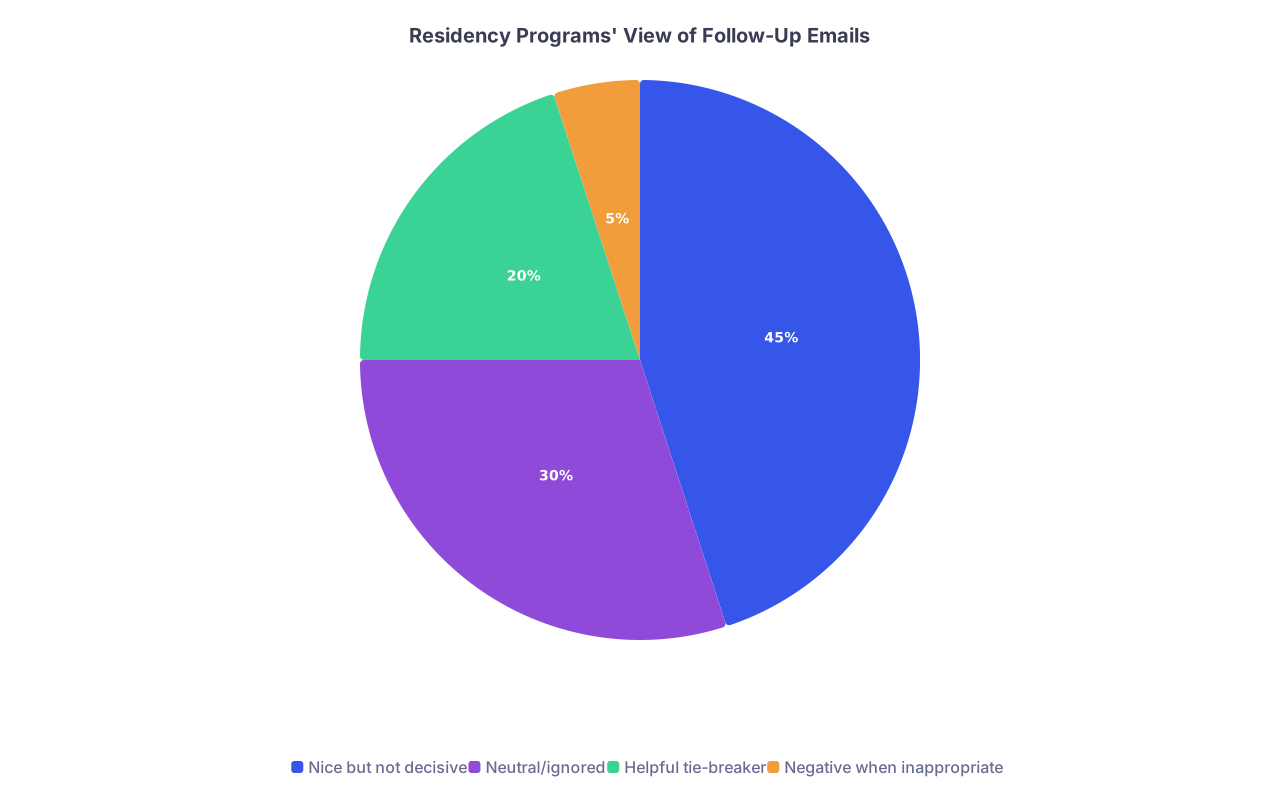
| Category | Value |
|---|---|
| Nice but not decisive | 45 |
| Neutral/ignored | 30 |
| Helpful tie-breaker | 20 |
| Negative when inappropriate | 5 |
How Different Should Follow-Ups Be Between Programs?
Another anxiety trap: “If any of my follow-ups look similar, they’ll know I’m copying and pasting and think I don’t care.”
Reality check: everyone uses templates. Residents did. PDs know it. You’re not writing handcrafted love letters to 30 programs.
Your follow-ups will share:
- Same overall structure
- Same basic lines about your interest in the specialty
- Same sign-off
What needs to change:
- Program name (obviously, double-check this obsessively)
- One or two specific details about that program or that conversation
- Any program-specific interests (e.g., their global health track, their community ER, their research focus)
Think of it like this:
- 60–70% can be template
- 30–40% should be clearly unique to them
It doesn’t have to be dramatically different to be genuine. Just anchored in something real from that day.
| Section | Template Portion | Program-Specific Portion |
|---|---|---|
| Greeting | 100% | 0% |
| Thanking for time | 80% | 20% |
| Program fit/interest | 50% | 50% |
| Closing/signature | 100% | 0% |

How Many Follow-Ups Is Too Many?
You know that urge to “stay on their radar”? That’s how people accidentally become that applicant.
Sanity rules:
- Standard: one thank-you email per interviewer, within ~24–72 hours
- Optional: one later note of continued interest to your top programs
- Probably too much: more than 2 emails per person without them responding with a question or inviting more communication
If you’ve already sent:
- A reasonable thank-you
- A later “you’re one of my top choices” note
You’re done. More emails won’t make them remember you better; they’ll make them slightly uncomfortable.
Remember: silence from them doesn’t equal “we hate you.” It equals “we’re busy and we don’t answer every thank-you.”

Quick Reality Reset
If you get stuck in the spiral again, come back to these facts:
- A generic but polite follow-up will not sink your application.
- An amazing follow-up will not resurrect a terrible interview.
- Programs care way more about how you showed up on interview day than how artfully you say thank you.
- Templates are normal. Specifics make them just personal enough.
Your brain is using the follow-up email as a stand-in for “Do they like me?” That question can’t be answered by tweaking adjectives. And it definitely doesn’t get solved at 1:47 a.m. by rewriting the same sentence 12 times.
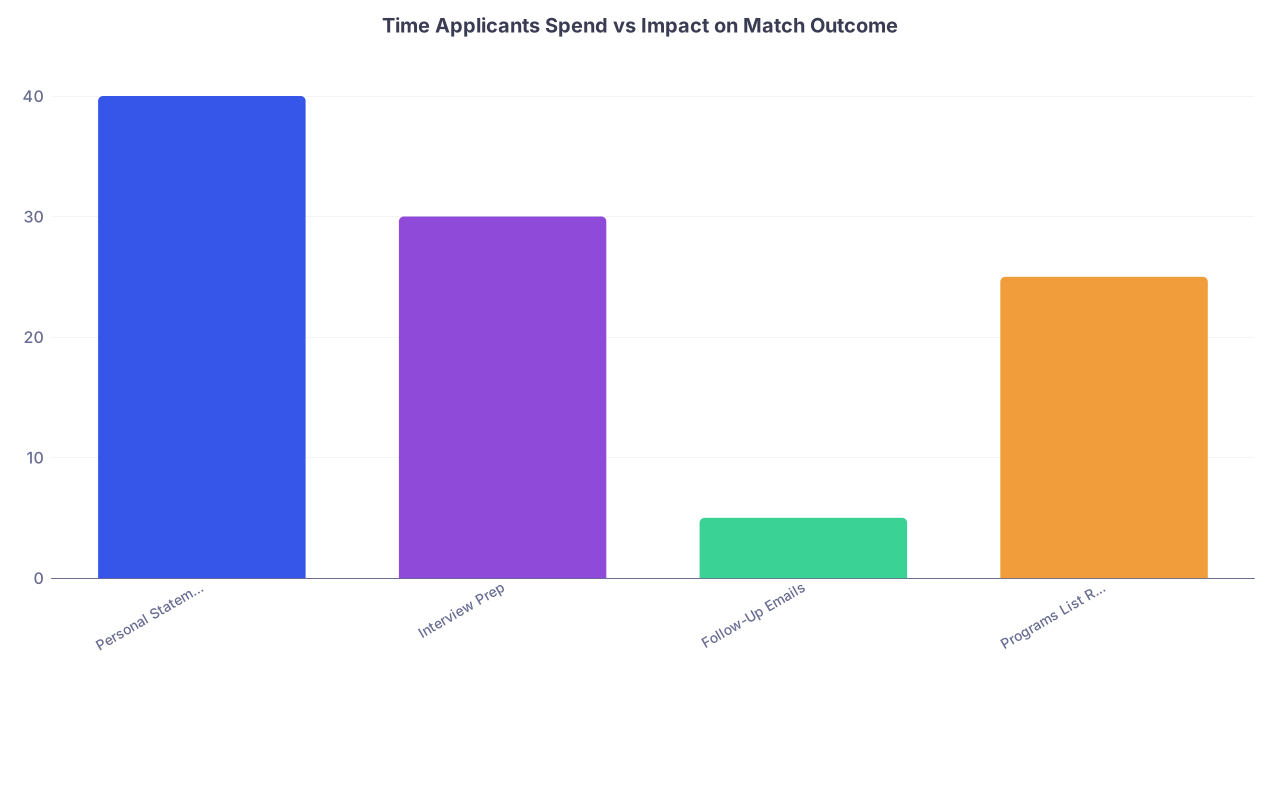
| Category | Value |
|---|---|
| Personal Statement | 40 |
| Interview Prep | 30 |
| Follow-Up Emails | 5 |
| Programs List Research | 25 |
FAQ (Exactly 5 Questions)
1. Do I have to send a thank-you email after every residency interview?
No. Some programs even say “no thank-you emails needed” in their instructions. If they say that, believe them. If they don’t say anything, a short thank-you is polite and common, but not mandatory. Not sending one doesn’t automatically hurt you; sending an unhinged or pushy one can.
2. What if I forgot to send a thank-you and it’s been two weeks?
You can still send a brief note, but don’t apologize dramatically. Something like:
“Thank you again for the opportunity to interview at [Program Name] on [date]. I appreciated learning more about [specific thing] and remain very interested in your program.”
Then stop. You’re not confessing a crime; you just sent it a bit late.
3. Should I send physical thank-you cards instead of email to stand out?
Honestly? No. They’re slow, they get lost, and a lot of PDs barely see their physical mail. Email is the norm. Standing out with content (specific, sincere, grounded) is better than standing out by format. Don’t overcomplicate this.
4. Can I reuse the same basic email for different interviewers at the same program?
Yes—with tweaks. Core structure can be similar, but each email should reference something from your conversation with that person. They do occasionally compare notes. Getting two nearly identical emails from the same applicant can look lazy.
5. How do I tell a program they’re my top choice without sounding fake?
If it’s truly your top choice, you can say:
“[Program Name] is my top choice, and I would be thrilled to train there.”
Use this line sparingly and honestly. Don’t send it to multiple programs. If you want to show strong interest without making a “#1” promise, say:
“Your program is one of my top choices, and I would be very excited to match there.”
Open your follow-up draft right now and ask just two questions: “Did I mention one real, specific thing from that day?” and “Would I actually say this out loud?” Make those small fixes, set a 10-minute timer, and when it goes off—hit send and walk away.