
The way you write your post-interview thank-you is telling programs more about you than you think—and not always in the way you intend.
Let me be blunt: no one is ranking you higher because you sent a thank-you email. But they absolutely will form opinions about you based on how you sent it… or if you didn’t send it at all. And those opinions can nudge you up or down when the committee is splitting hairs between similar applicants.
I’ve sat in those rank meetings. I’ve watched PDs pull up emails. I’ve heard the exact phrases: “Very professional follow-up,” “Seemed a bit needy,” “This one clearly mass-blasted the same note.” You deserve to know what’s actually happening behind the curtain.
What Programs Really Do With Your Thank-You Emails
First reality: most attendings are not sitting by their inbox, eagerly awaiting your gratitude. Half of them forget to even check their spam folder. The PD and coordinator? Different story. They see more than you think.
Here’s what typically happens:
- You send a thank-you.
- Individual interviewers: some skim, some ignore, a few reply “Pleasure meeting you,” and move on.
- The PD and/or coordinator may scan a few, especially from borderline or standout applicants.
- Occasionally, a particularly good or bad thank-you becomes a talking point in rank discussions.
No one is making a spreadsheet of “thank-you sent vs not sent” and ranking accordingly. That fantasy comes from anxious applicants and consulting companies who want to sell templates.
But here’s the secret: a thank-you is not really about gratitude in the director’s eyes. It’s a micro-assessment of your professionalism, social awareness, and how you might communicate as a resident.
Programs read your thank-you like a Rorschach test.
They’re picking up signals in five main areas: timing, targeting, tone, specificity, and neediness.
Let’s break those down.
Signal #1: Your Timing Shows How You Operate Under Pressure
The timestamp on your email says more about you than the actual text most of the time.
The “Sent from the Uber” Email
Same day, within hours of the interview, 5:12 p.m.:
“Thank you so much for the opportunity to interview with your esteemed program… [generic fluff]”
I’ve watched faculty roll their eyes at these. One attending said it out loud in the workroom:
“We literally just spoke to you. You could’ve taken a breath.”
The signal this sends: anxious, box-checking, possibly performative. It doesn’t kill you, but it doesn’t help you either. It feels like you had a prewritten template waiting to deploy.
The Sweet Spot
The best signal? Within 24–72 hours. Not instant. Not two weeks later.
When you send a thoughtful, specific note a day or two after, you signal that you process information, reflect, and follow through. You are not firing off a transactional auto-response. You let the experience land, then you responded like a normal functioning adult.
The “Oh Right, Rank List Time” Email
Programs see the time-stamp patterns. Emails start trickling in 1–2 days after the interview. Then there’s another wave… right before rank lists are due.
Those late, sudden messages? They scream: “I just realized I’m not as strong as I thought and now I’m trying to play the game.”
If your first communication comes weeks later, right when applicants start freaking out about rank lists, that does get noticed. And not in a flattering way. You look opportunistic and a bit desperate.
Signal #2: Who You Email Tells Them How You Understand Hierarchy
Here’s the part no one tells you: who you choose to email can either subtly help you or quietly annoy the people who actually run the show.

Emailing Only the PD
If you interviewed with 4–7 people but only email the PD, it sends two possible messages:
- You only care about the person with power.
- You don’t understand that the committee is a group, not a dictator.
PDs don’t love being treated like royalty. They rely heavily on the impressions from their faculty and chief residents. When they see an applicant ignore everyone else and send a single glowing thank-you to the PD, they might not punish you for it—but they notice the lack of social intuition.
Emailing Everyone You Actually Interviewed With
This is the most balanced and professional pattern. Faculty you met get a short, personal note. PD and maybe APD as well. You’re acknowledging the time people spent on you.
You’re signaling: “I understand medicine is a team sport. I’m not just sucking up to the top of the org chart.”
Emailing Random People You Never Met
Huge red flag.
Programs occasionally get messages like:
“Dear Dr. X, although we did not meet during interview day, I’ve read about your work and wanted to express my strong interest…”
Behind the scenes?
- At best: it’s ignored.
- At worst: “Why is this person emailing people they didn’t even meet? Feels off.”
This comes across as overly aggressive networking or game-playing. It may not get you dropped, but you’ve added a weird data point with zero upside.
Signal #3: Your Tone Exposes Your Professional Maturity
Most programs are not parsing your every word for content. They’re feeling the vibe.
Are you polished? Weirdly intense? Too casual? Borderline unprofessional?
I’ve seen PDs read a thank-you aloud and then say a single sentence: “Yeah, this tracks with how they presented.” That’s it. But that sentence can nudge you up or down.
Overly Formal, Stiff Emails
“Esteemed,” “It was an unparalleled honor,” “I remain deeply grateful for the privilege…”
Medicine is still professional, but you’re not applying to the Vatican. Emails that read like a 19th-century diplomatic letter signal one of three things:
- You’re trying too hard and don’t have a natural professional voice.
- You copied from a template or advisor.
- You lack social calibration.
They won’t fail you for it. But when someone else has the same file strength and sounds like a normal human, guess who feels easier to work with at 2 a.m. on call.
Sloppy, Casual, or Slangy Emails
“Hi there!! I just wanted to say it was super awesome meeting you guys. I’m really stoked about your program!”
Residency is a job. If you sound like you’re texting a friend about a concert, programs assume you may talk to nurses, patients, and consultants with the same tone.
We’ve had discussions like: “Great scores, strong rotation feedback, but this communication is really immature. Anyone else feel that?” And yes, that matters when we’re trying to predict who will represent the program well.
The Balanced, Mature Voice
Direct, warm, and concise wins. For example:
“Dr. Smith,
Thank you for taking the time to speak with me on Tuesday. I really enjoyed our conversation about resident autonomy in the ICU and appreciated your honesty about the learning curve as an intern. Our discussion reinforced my sense that your program would be an excellent fit for my interests in critical care and a strong, supportive teaching environment.
Best,
Alex Kim”
Simple. Human. Professional. No theatrics.
That tone signals: this person will write appropriate notes, communicate clearly, and not embarrass us on email threads with outside attendings.
Signal #4: Specificity vs. Copy-Paste
PDs and faculty can smell a generic template immediately. Especially when five of you from the same school “just wanted to reiterate how impressed I was by your commitment to resident wellness and diverse patient population.”
We read that phrase 20 times a season.
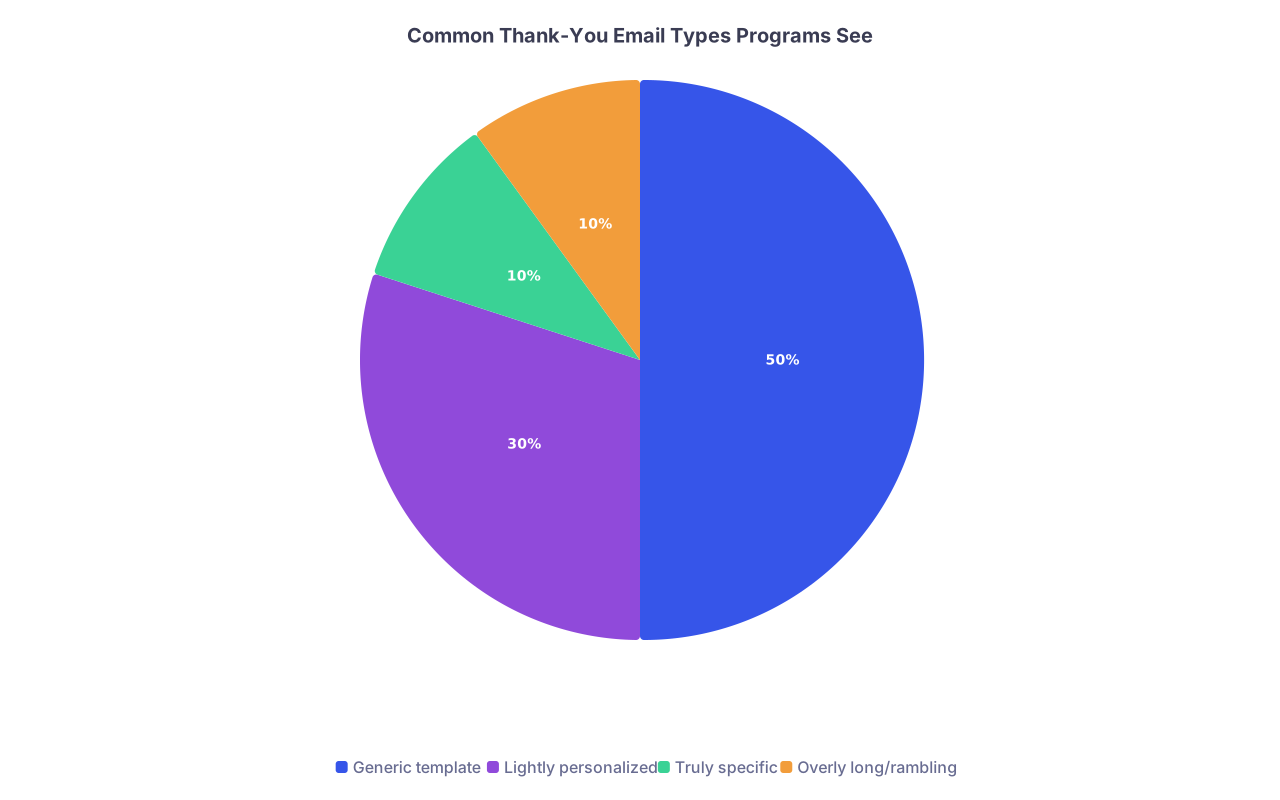
| Category | Value |
|---|---|
| Generic template | 50 |
| Lightly personalized | 30 |
| Truly specific | 10 |
| Overly long/rambling | 10 |
The Copy-Paste Disaster
I’ve personally seen this multiple times:
Applicant B:
“I especially appreciated hearing about your global health opportunities in Kenya.”
Problem? That program has zero global health. They have a community track four hours away, not Kenya.
What happened: the applicant reused the thank-you from another program and forgot to scrub a sentence. Everyone laughed about it in the office. And yes, they dropped a notch. If you cannot edit a four-sentence email correctly, what does that say about your discharge summaries?
The Vague “Great Program!” Email
“Thank you for the opportunity to interview. I was very impressed by your program and can see myself thriving there.”
Translation inside the faculty brain: This could’ve gone to any of the 40 programs you applied to. Zero additional information. Zero signal of true interest.
It’s not harmful, just neutral and forgettable. And if there’s one thing you don’t want to be in a rank meeting, it’s forgettable.
The Specifically Anchored Email
The best thank-you emails contain 1–2 concrete callbacks from your conversation or their program.
Things like:
- “I appreciated your honesty about how duty hours are enforced on the busy trauma service.”
- “Our discussion about mentoring residents into competitive cardiology fellowships resonated with my long-term plans.”
- “Hearing how your interns run the stroke code pages with direct backup strengthened my interest in your training model.”
Those details signal that you listened, processed, and are actually picturing yourself there. That’s the kind of interest that feels credible, not manufactured.
Signal #5: How Needy You Sound About Ranking
This is where many otherwise strong applicants shoot themselves in the foot.
There’s a line between “I’m sincerely interested” and “Please love me, I’ll do anything.”
Programs see both.

The Overeager “You’re My #1” Chaos
Before we talk ethics: ignore the official NRMP language for a moment. Here’s what actually happens.
Programs hear this every year:
- “You’re my top choice.”
- “I plan to rank you #1.”
- “If you rank me highly, I will rank you highly.”
PDs roll their eyes because they know these same phrases are being sent to multiple programs. And yes, some PDs talk. I’ve heard, “Funny, Applicant X told us the same thing yesterday,” in real time.
So what signal does this send?
- You’re willing to play games.
- You may be telling multiple places the same story.
- You’re focused on match strategy more than fit.
Will they punish you for it? Not always. But that gushy, manipulative undertone rarely helps. It often makes you look insecure.
The Subtle, Strong Interest Signal
Far better approach: express strong, specific interest without promising ranks you might not honor.
For example:
“Our conversations on interview day confirmed that your program is among my very top choices. I’d be genuinely excited to train there.”
Or:
“I left the interview even more enthusiastic about the possibility of joining your team in July.”
This signals: I care. I’m serious. But I’m not trying to negotiate or overstep match rules.
Programs respect that. It reads more grounded and honest.
What Programs Talk About Behind Closed Doors
Let me pull you into the rank meeting for a minute.
Picture this: conference room, stacks of packets or a shared screen with ERAS files, coffee cups, people half-recovering from night float. The list is on the board.
For anyone not obviously at the top or bottom, the conversation is remarkably human and unsophisticated. No secret algorithm. A lot of, “Remind me who this is?” and “How did they come across?” and “Anyone have concerns?”
And sometimes, someone will say:
- “They wrote a very thoughtful follow-up. Felt quite mature.”
- “They sent… several emails. A bit much.”
- “They misnamed us in their thank-you, so that was something.”
Do you see the pattern? The thank-you is rarely the reason someone rises or falls. But it’s confirmation or dissonance.
If you interviews as calm, insightful, and professional, and your email matches that—good. Cohesive narrative.
If you interview as confident and balanced, then send a panicked, clingy, multi-paragraph manifesto about how much you love them—that contrast raises eyebrows. “Did we miss something? Is this person more anxious than they appeared?”
Your goal isn’t to win them over with your thank-you.
Your goal is not to contradict the positive impression you already made.
Practical “Do This, Not That” (Without the Fluff)
| Aspect | Sends Good Signal When… | Sends Bad Signal When… |
|---|---|---|
| Timing | 24–72 hours, once | Minutes after, or weeks later by surprise |
| Recipients | PD + actual interviewers only | Random faculty you never met |
| Tone | Warm, concise, professional | Overly formal, slangy, or emotionally intense |
| Specificity | 1–2 concrete callbacks from your interview | Generic template, wrong program details |
| Interest | “Very interested / top choices” type language | “You’re my #1 if…” or quid-pro-quo hints |
And no, you don’t need to obsess over perfect wording. Avoid obvious landmines and you’re already ahead of half the field.
How Many Emails, How Long, How Personal?
This is where people over-engineer the whole thing.
How Many?
- One email per interviewer.
- If you had a large panel with 5–6 residents at once, a single group email to the resident coordinator or chief is fine.
- Do not send a follow-up to your thank-you unless they’ve explicitly asked you for an update or additional material.
Multiple “just checking in” or “wanted to reaffirm my interest” emails in the absence of any inquiry? Programs label that as needy. Sometimes unstable.
How Long?
Think 4–7 sentences. That’s it.
Your 800-word essay about how much the program meant to you is going to be skimmed, if not closed immediately. Faculty are scanning emails between pages, consults, and OR turnover.
Short, tight, and human beats long and “passionate.”
How Personal?
This is professional rapport, not diary entry.
Yes:
- Referencing a shared interest (critical care, medical education, advocacy).
- Mentioning something meaningful from your conversation: “I appreciated your advice about balancing parenthood and residency.”
No:
- Trauma dumping or disclosing way more personal detail than you did in the interview.
- Overly emotive language: “I’ve never felt as seen as I did at your program.”
Remember: they don’t know you yet. Don’t emotionally attach to them on email.
When Not Sending a Thank-You Is Actually Fine
Programs are split on this, and you’re never going to hear this from official sources: not sending a thank-you is usually neutral, not fatal.
Some PDs genuinely don’t care, explicitly tell applicants not to send them, and move on with their lives. At those places, thank-you emails are basically noise.
The silent signal of “no thank-you” is interpreted in a few possible ways:
- You’re following instructions (if they explicitly said not to send one).
- You’re overwhelmed (which they understand).
- You’re not especially interested (this matters only in tight tie-breakers).
Where it stings a bit is when everyone else in a small pool sends something thoughtful and you’re the only one who disappears. In a borderline call, someone might say, “They never followed up, seemed less engaged.” It’s not decisive, but it’s a data point.
If you’re on the fence, default to sending something brief and professional. It’s cheap insurance—as long as you don’t screw it up.
Special Cases: Red Flags, Updates, and Couples Match

| Step | Description |
|---|---|
| Step 1 | After Thank-You Sent |
| Step 2 | Do Nothing |
| Step 3 | Send Single Update Email |
| Step 4 | Send to Coordinator/PD |
| Step 5 | Send Only if Major News |
| Step 6 | New Info? |
| Step 7 | Materially Changes Application? |
| Step 8 | Program Invited Updates? |
Addressing a Red Flag
If something concerning came up in the interview and you didn’t handle it well (failed a course, gap year issues, professionalism concern), the thank-you is not the place for a full legal defense.
You can:
- Acknowledge briefly if appropriate: “I’ve reflected further on your question about my leave of absence and would be happy to discuss in more depth if needed.”
- Offer clarity: “Since we spoke, my remediation is now fully completed, and I’ve received strong feedback on my current rotation.”
Don’t write a manifesto. That hurts more than it helps. If it’s complex, a short update via the coordinator is usually better.
Significant Updates
Match-season updates buried inside a thank-you are fine if they’re short and real:
- New publication accepted.
- Step 2 score just released and significantly stronger than Step 1.
- New leadership role directly relevant.
One or two sentences. No attachments unless requested.
Couples Match Angles
Programs know you’re juggling other sites. They’re not naïve.
What they don’t appreciate is this kind of thing:
“My partner is applying to [another local program]. If you rank me highly, I’ll be more likely to rank you first.”
That reeks of trying to negotiate. And it does not work.
Better signal:
“My partner is also applying in [specialty] in the same city, which makes your program particularly attractive to us. We’d be thrilled to train in [city] together if it works out.”
That’s honest without sounding transactional.
FAQs
1. Do programs actually keep track of who sent thank-you emails?
Some do in a loose way, most don’t systematically. No one is building a rank list based on a thank-you spreadsheet. But specific emails—excellent or terrible—do get remembered and occasionally mentioned in meetings. It’s less “tracked” and more “stored in people’s heads.”
2. Can a bad thank-you really hurt my rank?
Yes, but usually only at the margins. A disastrously sloppy, incorrect, or unhinged email can absolutely sour the room on you, especially if you were borderline. The most common effect is smaller: you lose a bit of shine or you confirm concerns they already had.
3. Should I say “You’re my #1” if that’s honestly true?
I wouldn’t. Not because it’s immoral, but because it’s strategically dumb. Programs know applicants play that game. You gain very little in credibility and risk a lot if your plans change or they hear you told someone else the same thing. “Very top choice,” “I’d be thrilled to train here,” etc., sends a strong signal without painting yourself into a corner.
4. What if I realized I really love a program weeks later—can I send another email?
You can, once. Make it a brief, clear statement of ongoing interest, not a second thank-you. Something like: “Since interview day, your program has remained one of the top choices on my list, especially given my interests in X and Y. I just wanted to reiterate my enthusiasm.” Then stop. Multiple follow-ups start to feel desperate.
Key points to walk away with:
- Your thank-you email is a signal amplifier, not a magic spell. It confirms or undermines the impression you already made.
- Programs read your timing, tone, and specificity as proxies for professionalism and emotional stability.
- Simple, specific, and sane beats dramatic, generic, or overly strategic—every single time.