
The longer your follow-up email, the less seriously most faculty take it.
Let me tell you what actually happens on the other side of that inbox, because the advice you’ve heard from classmates and Reddit threads is mostly wrong.
What Faculty Really Think When Your Email Lands
Here’s the unvarnished truth: the majority of faculty and program directors prefer short, surgical follow-ups. One line, maybe two. Anything beyond that had better be very targeted and very necessary, or it gets mentally filed as “needy,” “generic,” or “I don’t have time to read this.”
Most applicants imagine faculty printing their emails, reading them over coffee, thoughtfully nodding, then bringing your beautifully crafted paragraph to the rank meeting. That’s fantasy.
Real life looks more like this:
It’s 10:47 pm. A program director just finished notes from a brutal clinic day, signed off two patient deaths, approved next month’s schedule, and is finally checking email before bed. Your message is stacked between a complaint from the chief resident, a reminder from GME, and an OR block request.
They open your email. They see a wall of text. Their eyes flick to the first and last line. If there isn’t a clear, quick value signal, they close it. Sometimes without finishing. Often without replying.
This is why a crisp one-line email often works better than the heartfelt five-paragraph essay you were about to send.
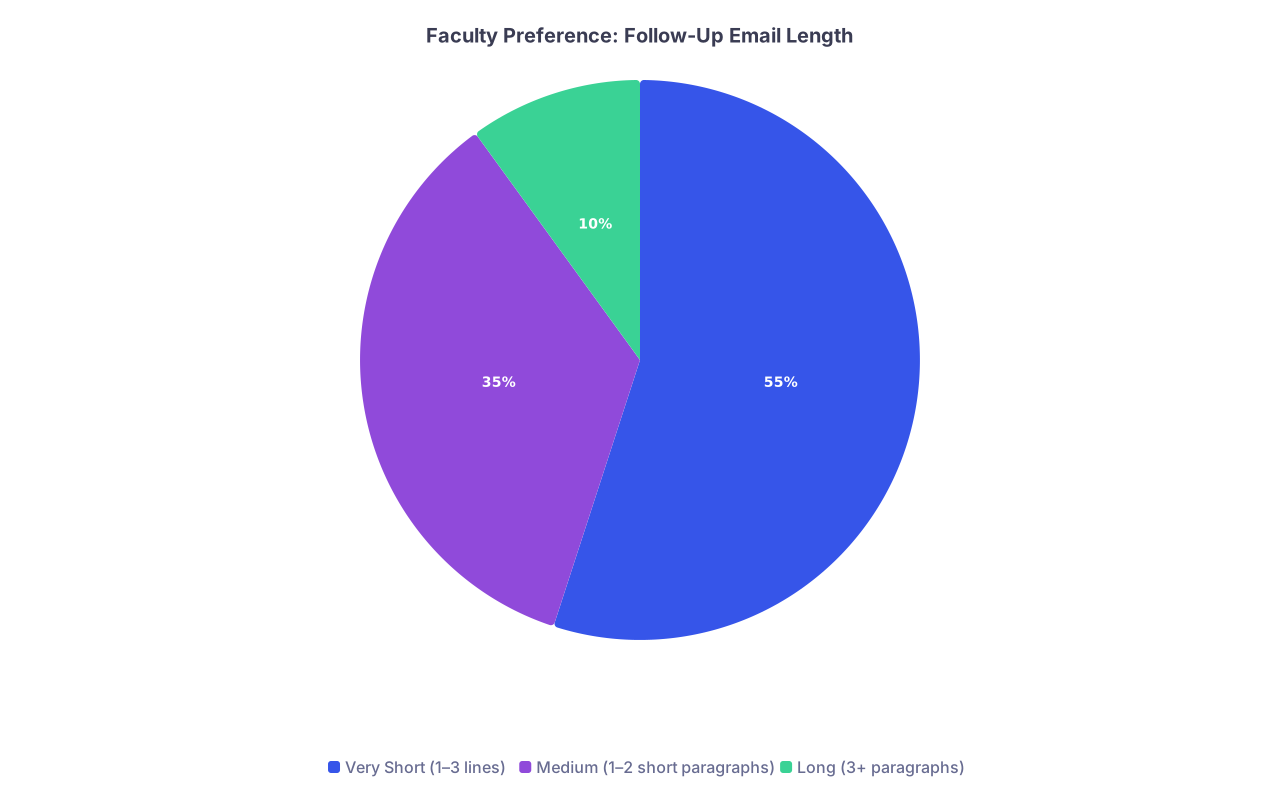
| Category | Value |
|---|---|
| Very Short (1–3 lines) | 55 |
| Medium (1–2 short paragraphs) | 35 |
| Long (3+ paragraphs) | 10 |
Yes, some faculty appreciate a bit more substance. But the baseline: brevity earns respect.
One-Line Follow-Ups: Why They Work (And When They Don’t)
Let’s start with what almost no one tells you outright: follow-up emails are rarely a major positive. They’re usually either neutral or mildly negative. Your best move is to avoid hurting yourself.
A tight one-liner does exactly that. It’s safe. It signals maturity. It respects their time.
I’ve watched multiple attendings scroll on their phones between cases. They’d read something like:
“Thank you again for taking the time to speak with me today — I really enjoyed learning more about your program.”
Then they’d nod slightly. Sometimes they’d forward it with a 3-word note: “Good candidate, FYI.” That’s the maximum upside. And a single clean line is enough to get it.
Here’s what a good one-line follow-up actually looks like:
“Thank you again for the opportunity to interview today — I appreciated hearing more about your program’s approach to resident autonomy.”
That’s it. You could add one more sentence if you’re tying it to something specific you discussed:
“I especially enjoyed our conversation about X and would be excited to train in an environment that values Y.”
Two sentences. Not five.
One-liners work best:
- Right after an interview day (same day or next morning)
- To individual faculty or residents you had a meaningful interaction with
- When you don’t have anything specific or unique to say, but you want to close the loop
What one-liners do not do:
- Move you 10 spots up the rank list
- Erase a weak interview performance
- Fix questionable professionalism
They’re a small, neat bow on top of the impression you already made. Nothing more.
Long Emails: When They Help, When They Hurt
Long emails are risky currency. Sometimes they pay off. Usually they don’t.
Program directors and faculty mentally categorize long follow-ups in three buckets:
- “Necessary and appropriate”
- “Trying too hard”
- “Red flag”
You don’t want buckets 2 or 3.
Let’s talk about when a long email actually makes sense.
A longer, well-structured email can be appropriate if:
- You’re providing a significant update that genuinely matters for their decision: new Step 2 score that changes your profile, major award, first-author publication at a reputable journal, significant leadership role, or a major geographic/family factor that explains your interest in that specific program.
- You’re clarifying something important from the interview: a misunderstanding, incorrect impression, or something you completely blanked on that substantially affects your application.
- You’re writing a single, carefully thought-out “this is my top choice” or “I will rank you highly” note, and you have specific, concrete evidence you get their program (not “I was impressed by your commitment to excellence” fluff).
Even then, “long” doesn’t mean an essay. I’ve seen effective “long” emails that are still only 2–3 short paragraphs. Anything beyond that starts to feel like a personal statement sequel.
Here’s where long emails backfire hard:
- Paragraphs of generic praise that could apply to any program: “your dedication to excellence, your outstanding faculty, and your commitment to patient care…”
- Emotional oversharing: “This program is my dream, I’ve wanted this since I was a child, I cried after interview day because it meant so much to me…”
- Repeated follow-ups: a long update, then a long “just checking in,” then a long “I hope you saw my previous message.”
- Trying to negotiate or hint at your rank list in a weird way: “You are in my very top group of programs and I hope that we can match…”
I have literally watched directors roll their eyes at these. Not because they’re cruel. Because they’re exhausted and overloaded, and melodramatic emails feel immature.
There’s a pattern I’ve seen too many times: the most anxious, least self-aware applicants write the longest follow-ups. Faculty notice that.
What Actually Matters More Than Email Style
Here’s the brutal hierarchy from the program side:
- Your interview performance
- What residents say about you
- Your letters and scores
- How you handled yourself over the entire day (professionalism, curiosity, how you treated staff)
- Any meaningful pre-existing connection to the program
- Specific, high-yield updates or communications
Your follow-up email lives down here at number six. It’s seasoning, not the meal.
At rank meetings, the conversation sounds like:
“Great interview, strong letters, residents liked them.” “Seemed quiet but solid, Step 2 high, good research.” “Red flag from resident feedback, seemed disinterested.”
No one says, “Well, their email was very detailed and heartfelt, so let’s move them up.”
But they do say: “They’ve emailed us four times this month. I’m getting a weird vibe.” That hurts.
This is why one-line or very short emails are safer and in many cases actually preferred: they cannot hurt you if they’re respectful, professional, and typo-free.
What Program Directors Secretly Prefer (But Rarely Say Out Loud)
Most PDs won’t publicly admit this because they don’t want to discourage contact, but let’s talk about the real preferences I’ve heard behind closed doors:
- Short, polite, on-time thank you notes are appreciated and quickly forgotten. And that’s fine.
- Medium-length, thoughtful updates that are clearly tailored and relevant get filed mentally as “serious, professional, mature.”
- Overly long, emotional, repetitive messages trigger concern about how high-maintenance you’ll be as a resident.
They want residents who are steady. Who don’t dramatize normal processes. Who can communicate efficiently.
I once watched a PD scroll through three different emails from the same applicant over two weeks. Each one was long, increasingly emotional, and full of “this program is my dream” language. The PD said one sentence: “I’m worried they won’t cope well when things don’t go their way.”
That applicant was not ranked to match. Their follow-up didn’t sink them alone, but it confirmed concerns about emotional regulation from the interview.
This is the part nobody tells you: your follow-up style is being read as data about your future behavior on call at 3 am.
Concrete Examples: One-Line vs. Long Email
Let’s get specific.
Scenario 1: Standard Post-Interview Thank You
What students think they should write: A 3–4 paragraph message recapping the day, reflecting on program strengths, re-stating CV highlights, and expressing undying interest.
What faculty actually prefer: Something like this:
“Dr. Smith,
Thank you again for the opportunity to interview today and for sharing more about how your program supports early operative experience for residents. I appreciated your time and insight.
Best regards,
[Name]”
Clean. Two sentences. Done.
Scenario 2: You Have a Big Update
You took Step 2 and scored significantly higher than Step 1. Or you just had a first-author paper accepted in a solid journal. This can warrant a “longer” email—still tight.
“Dr. Lee,
I wanted to thank you again for the opportunity to interview with [Program] on [date]. I remain very interested in your program.
Since we last spoke, I received my Step 2 CK score (###) and had a manuscript accepted as first author in [Journal] on [brief topic]. I’ve attached an updated CV for your reference.
Thank you again for your time and consideration.
Best,
[Name]”
Three short paragraphs. One update email. Not a monthly newsletter.
Scenario 3: Expressing Strong Interest / “Top Choice” Type Message
This is where people get weird and overdo it. Don’t.
If you truly want to communicate strong interest (and you should only send this to a small number of programs you actually mean), something like:
“Dr. Patel,
Thank you again for the chance to interview at [Program]. After completing my interviews, I wanted to let you know that [Program] remains my top choice. The combination of [specific thing 1] and [specific thing 2], along with the culture I saw among your residents, makes it the environment where I’d be most excited to train.
Thank you again for your consideration.
Sincerely,
[Name]”
Specific. Not gushy. One email like this is enough.

Timing, Frequency, and the “Annoyance Threshold”
You’re not only judged on what you send, but how often you send it.
Here’s the pattern that faculty talk about:
- No follow-up at all: completely fine. You are not penalized for silence at most programs.
- One short thank-you within 24–48 hours: positive/neutral.
- One update email later in the season if you have real news: acceptable.
- Anything beyond that: people start remembering your name for the wrong reason.
If a PD or coordinator starts a sentence with “This is the applicant who keeps emailing about…”, you’ve already lost.
One overlooked detail: many programs now explicitly say “No post-interview communication is necessary and will not affect ranking.” They mean it more than you think. Continuing to send stuff anyway makes you look like you don’t follow instructions.
When in doubt: fewer emails, shorter content.
How Residents View Your Follow-Ups (Yes, They See Them Too)
Residents have more influence than you think. In a lot of programs, PDs forward applicant emails to chiefs or key residents with a simple “Thoughts?” or “You worked with them—what did you think?”
Those same residents remember if you were respectful, engaged, and normal on interview day. They also see your follow-ups sometimes.
Here’s what they tell each other:
- “Short and polite, seemed normal” → good.
- “Long love-letter to the program, kind of over the top” → eye roll.
- “They emailed me on my personal address/social media to follow up again” → absolutely not.
Do not cross into personal channels. You’re not building a friendship. You’re closing a professional loop.
| Email Type | Typical Faculty Reaction |
|---|---|
| No follow-up | Neutral |
| One-line thank-you | Slightly positive / neutral |
| Short, specific thank-you (2–3 lines) | Positive if personal, otherwise neutral |
| Medium update with real news | Positive / useful |
| Long emotional email | Annoyance / mild concern |
The Quiet Power of Precision
The applicants who impress faculty the most post-interview are not the ones who pour their hearts out in email form. They’re the ones who:
- Send a short, specific thank you that proves they were actually present and listening.
- Share updates only when those updates are truly meaningful.
- Don’t badger, double-email, or play games about rank lists.
- Write like a future colleague, not a desperate applicant.
Precision is a professional flex. It says: I understand your time is limited, I’m confident in what I bring, and I don’t need to oversell.
The subtext matters more than the literal words.
FAQs
1. Do I have to send any follow-up at all after a residency interview?
No. Despite what your classmates say, many applicants send nothing and do just fine. A short thank-you can slightly reinforce a good impression, but you are not penalized for silence at most programs, especially those that explicitly say follow-ups don’t affect ranking.
2. Should I send separate emails to every interviewer or one email to the program coordinator/PD?
If you have their emails, brief individual notes (1–3 lines) to each interviewer are reasonable. If you met 8–10 people, it’s acceptable to send a single concise note to the PD or coordinator thanking the team as a whole. No one is sitting there counting how many individual thank-yous they received.
3. Can a strong “I will rank you #1” email actually move me up the rank list?
Occasionally, at the margins. If you were already in the mix and a program’s culture values commitment, a sincere, well-written note can nudge you up a bit. But it won’t rescue a bad interview, and if you send versions of that to multiple programs, people talk, and it backfires.
4. What if I realize after the interview that I misspoke or made a factual error?
A brief, direct clarification email is appropriate. Own it without drama. Something like: “During our conversation I mentioned X, but I realized afterward I misstated the timeline. To clarify, Y. I apologize for the confusion.” One email. Short. Then let it go.
The bottom line:
Keep it short. Make it specific. Do not let your anxiety spill into their inbox.