
The way most applicants say “You’re my top choice” in follow-up emails sounds unprofessional, desperate, or both.
If you get this wrong, you do not just “miss an opportunity.” You actively plant doubt in the program’s mind about your judgment, maturity, and understanding of match rules. I have watched excellent candidates hurt themselves with one badly worded “top choice” email.
Let me walk you through the biggest traps so you do not become that story someone brings up in the next applicant committee meeting: “Remember the one who sent that weird top-choice email?”
The Core Problem: Confusing Enthusiasm With Neediness
You are supposed to communicate interest. You are not supposed to sound:
- Desperate
- Manipulative
- Naive about the Match
- Ethically flimsy
Programs smell this instantly.
The mistake many applicants make: they believe “If I tell them they’re my number one, they will rank me higher.” So they fire off a “you’re my top choice” email that:
- Violates match communication guidelines
- Sounds like a romantic confession instead of a professional update
- Over-promises in a way they cannot or will not keep
Programs do not reward that. They question it.

Mistake #1: Using “Top Choice” Language You Do Not Actually Mean
This is the big ethical landmine.
Saying “You are my top choice” has a specific implication:
You will rank that program first. Period.
Here is where people go wrong:
- They tell multiple programs “You’re my top choice.”
- They write “You’re my number one” when they are not sure yet.
- They use vague but misleading language that sounds like a promise.
Examples that scream “red flag” to anyone who has done this long enough:
- “You are my number one choice and I hope you will rank me highly too.” (Sent to three programs.)
- “I will definitely rank you at the top of my list.” (But their list still has 12 interviews left.)
- “You are my top program in the Midwest.” (They send the same line to three different Midwest programs.)
That last one? I have actually seen that verbatim. Guess what happened when one PD shared it with another PD friend at a regional meeting.
How to avoid this
Do not use “top choice / #1 / number one” unless it is absolutely true.
- You have finished interviews.
- You have built your list.
- You know with 100% certainty: this program is Rank #1.
If you say it, mean it cleanly.
Not “top program in X region.”
Not “one of my top programs.”
If you are going to use that strong language, it should sound like:- “I have decided to rank [Program Name] first on my rank list.”
Only send that email to one program.
You want one rule that keeps you safe? This is it.
Mistake #2: Ignoring Match Communication Rules and Program Policies
Nothing makes you look more unprofessional than openly disregarding the NRMP Match Communication Code of Conduct or the program’s explicit directions.
Common violations:
- Program said on interview day: “We do not expect or respond to post-interview communication.” You email anyway. Twice.
- You ask, “Where will I be on your rank list?” (Directly prohibited.)
- You imply a quid pro quo: “I’ll rank you highly if you rank me highly.”
Programs do not just dislike this. They are contractually obligated to follow NRMP rules. If you ask them to break them—or sound like you do not care—they will drop you.

| Step | Description |
|---|---|
| Step 1 | Finished Interview |
| Step 2 | Send no top choice email |
| Step 3 | Send single, honest #1 email |
| Step 4 | Send polite thank-you only |
| Step 5 | Did program say no follow-up? |
| Step 6 | Is this truly your #1? |
Red-flag phrases that sound unprofessional
Avoid language that hints at rank bargaining:
- “I hope this email will convince you to rank me highly.”
- “If I knew I was ranked to match, I would feel comfortable ranking you first.”
- “I will rank you highly if I receive reassurance from your side.”
This sounds transactional and clueless. Ranking is not a negotiation.
Safer, professional alternatives
If the program allows communication and you want to express strong interest without going into unethical territory, use:
- “I remain very enthusiastic about the possibility of training at [Program].”
- “Our conversations confirmed that [Program] aligns extremely well with my goals in [X].”
- “I left the interview more certain that I would be very happy training at [Program].”
That is interest, not bargaining.
Mistake #3: Turning Your Follow-Up into a Second Personal Statement
Another common failure: turning the “top choice” follow-up into an essay.
I have watched applicants send 600–900 word emails trying to “re-sell” themselves. It backfires in three ways:
- Time disrespect. PDs and coordinators are drowning in email. Long blocks of text signal that you do not understand their reality.
- Boundary blindness. You already had your chance: the application, the interview, the thank-you email. A long “top choice” letter feels like you are trying to re-open an exam after time is called.
- Desperation vibe. The longer the email, the more anxious you sound. Programs pick up on that.
Programs want follow-ups that are:
- Short
- Clear
- Professional
Not mini-memoirs.
Keep it tight
- 3–6 sentences is enough for a “top choice” or “strong interest” email.
- Stick to:
- Brief gratitude
- One or two concrete reasons you like them
- Your level of interest (honestly stated)
- Optional: a short, relevant update (e.g., accepted abstract, new leadership role)
If your email needs a scroll bar on a phone, you probably wrote too much.
Mistake #4: Sounding Like You’re Begging for Validation
This is the cringe category.
Emails that ask:
- “Do I have a realistic chance of matching at your program?”
- “Could you tell me if I’m still under consideration?”
- “I’m very anxious about the Match; if you could give me any reassurance I would be grateful.”
I understand the anxiety. I have seen people sitting in call rooms refreshing their email every two minutes in January. But putting your anxiety in front of a PD or faculty member does not make them sympathetic. It makes you look unstable under stress.
What this communicates to a program
Whether fair or not, messages like that trigger thoughts:
- “How will this person handle a night float month?”
- “Will this be the resident crying in my office every week?”
- “Is this someone I want on rounds with a crashing patient?”
Residency is hard. Programs want resilient trainees. Do not use your follow-up message to showcase your most fragile moment.
What you should do instead
- Vent to friends, family, or classmates.
- Talk to a mentor at your school, not the PD you just met.
- Use your email to show composure, not panic.
Professional tone sounds like:
- Calm.
- Brief.
- Confident without arrogance.
Mistake #5: Over-Following Up and Harassing the Program
Yes, harassment. That is how it looks from their side.
Patterns that get mentioned in selection committee meetings:
- Multiple follow-up emails to the PD, APD, and coordinator saying the same “top choice” message.
- “Just checking in” messages every week after the first one.
- Calling the office to “confirm receipt” of your email.
- DMing faculty or residents on social media with “I ranked you #1!!!” messages.
This is not enthusiastic. It is intrusive.
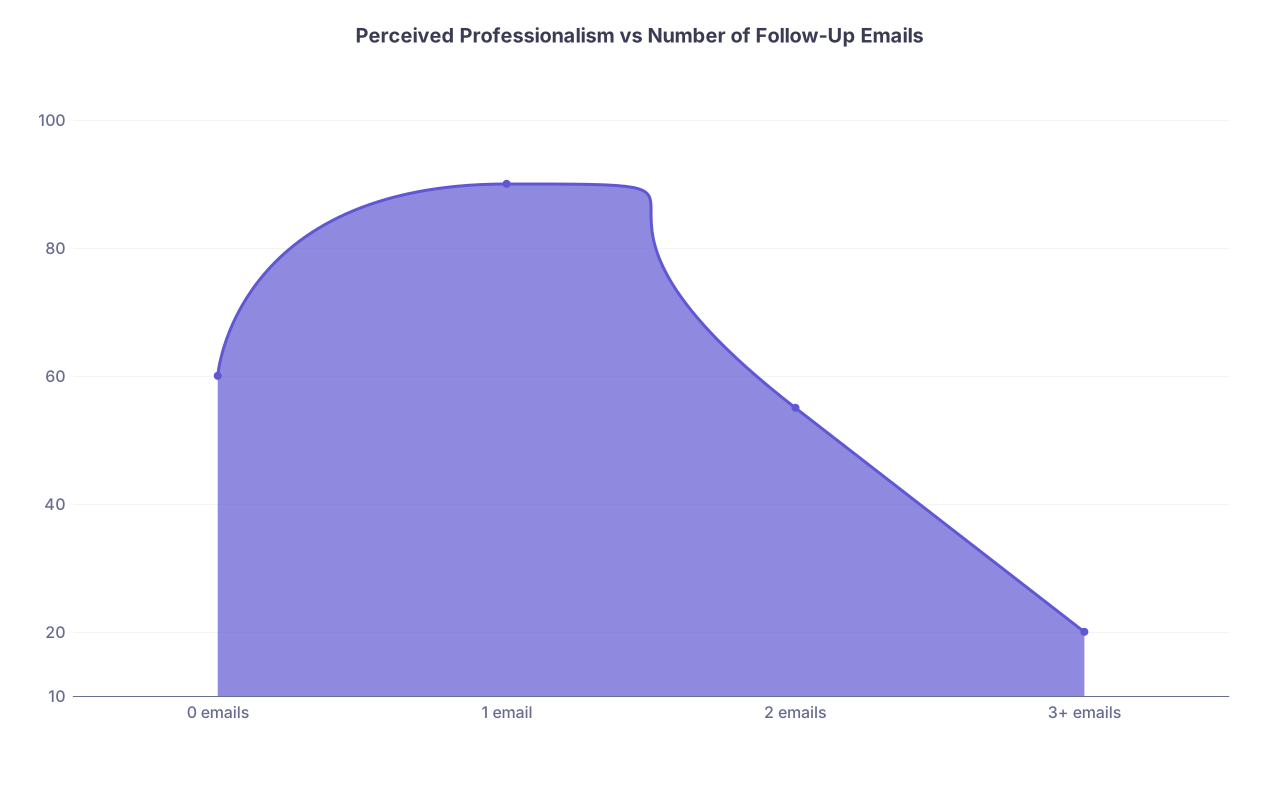
| Category | Value |
|---|---|
| 0 emails | 60 |
| 1 email | 90 |
| 2 emails | 55 |
| 3+ emails | 20 |
You want to be the person in the “1 email” zone. That is the sweet spot: appreciative, clear, and then done.
Reasonable limits
- Thank-you email: within 24–72 hours of the interview.
- If you genuinely will rank them #1: one additional short message in late January / early February.
- No more than one “interest/updates” email per program beyond that.
If you feel tempted to send more, that is your anxiety talking. Not strategy.
Mistake #6: Being Vague, Sloppy, or Generic
If your “top choice” email could be sent to three different programs by changing only the name, it is weak. And worse, it is risky, because people forward emails.
I have seen:
- “I am very excited about the chance to match at [Program Name].” (Forgot to change the bracketed placeholder.)
- A copy-paste message where they left the wrong PD’s name in the salutation.
- “Your program’s focus on underserved urban populations resonates deeply with me.” Sent to a mostly suburban academic center that never claimed that focus.
That is how you get labeled as careless.
Make your interest specific and believable
You do not need a paragraph. Two targeted phrases will do:
- “I was especially drawn to the opportunity to work at both [Hospital A] and [Hospital B], and the strong ICU exposure early in PGY-1.”
- “The resident culture you described—supportive but high-expectation—felt like exactly the environment where I would grow best.”
Nationally, lots of strong applicants interview at similar programs. The only way your email sounds real is if it proves you were actually paying attention to that program.

Mistake #7: Using Overly Emotional or Flattering Language
You are not writing a love letter. You are communicating with future colleagues.
Cringe phrases that instantly downgrade your professionalism:
- “I fell in love with your program.”
- “I have never wanted anything as much as I want to match at [Program].”
- “You are the perfect program for me in every way.”
- “I am begging you to consider me for a spot.”
This may feel genuine. On the receiving end, it feels uncomfortable and a bit unstable.
Excess flattery also backfires:
- “You are clearly the best program in the country.”
- “You are the most prestigious faculty I have ever met.”
- “Your residents are obviously far superior to those at other institutions.”
Programs know where they stand. If you oversell, you sound insincere or manipulative.
Professional tone = respect + composure
Try:
- “My interview day confirmed that [Program] is an outstanding fit for my goals in [X].”
- “I would be honored to train at [Program] and contribute to your work in [specific clinic / research area / patient population].”
Respectful. Not romantic.
Mistake #8: Revealing Too Much About Other Programs or Your Rank Strategy
This is a subtle but common error.
Oversharing examples:
- “I canceled my other interviews because you are now my top choice.”
- “I had ranked [Other Program] first, but after interviewing with you, I changed my mind.”
- “I will probably rank you #1 unless I get an interview at [More Prestigious Program].”
This reads as:
- Impulsive
- Disrespectful to peers
- Slightly disloyal or transactional
Programs do not need to know:
- Who else you interviewed with
- Where they stand relative to others
- Which programs you liked less
They only need to know your genuine enthusiasm for them, stated simply and cleanly.
What to share vs what to keep to yourself
| Type of Content | Safe to Include | Risky / Avoid |
|---|---|---|
| Gratitude for interview | Yes | No |
| Specific aspects you liked | Yes | No |
| Honest, single #1 declaration | Yes | Only one program |
| Rank list strategy details | No | Yes |
| Mention of other programs | Rarely | Usually |
| Emotional life story | No | Yes |
Less is safer. You do not need to “explain” your entire thought process.
Mistake #9: Terrible Timing
Timing can turn a neutral email into a problem.
Common timing mistakes:
Too early “top choice” declaration.
Sending “You’re my #1” in November after three interviews, then regretting it in February when you liked another program more.Too late emails after rank lists are submitted.
PDs cannot change anything after their list is in. Your emotional confession on February 28 helps no one.Multiple “update” emails every time something tiny happens.
New shadowing day? Another poster submission? Programs do not need five separate updates.
Reasonable timing pattern
- Thank-you emails: within a couple days of each interview.
- Single strong-interest or #1 email: late January to early/mid-February.
- Update email: only if something substantial changed (major publication acceptance, new degree, significant award).
After that, stop. You have done your part.
Mistake #10: Writing Like a Text, Not Like a Professional Email
You are still applying for a job. A real one. With HR files and institutional memory.
Unprofessional formats I have actually seen:
- No greeting: “Just wanted to say you’re my first choice!!”
- All lowercase, no punctuation, text style.
- Emojis: “You’re my #1! 🤞😊”
- From a joke email address: “drswag2024@…”
Spellcheck errors, mis-capitalized names, wrong program titles—these are small but cumulative strikes against you.
Minimal professional structure
You do not need flowery language. You do need:
- Correct salutation: “Dear Dr. [Last Name],” or “Dear [Program Director’s Name],”
- One short, clean paragraph (two if really needed)
- Proper spelling of the program name, hospital, and people
- A simple sign-off:
- “Sincerely,” or
- “Best regards,”
Then your full name and AAMC ID (or ERAS ID), if you want to make their life easier.
What a Professional “Top Choice” Email Actually Looks Like
Here is what does not raise eyebrows in committee discussions:
- Short
- Specific
- Honest
- Ethically clean
Example if this is truly your #1:
Dear Dr. Smith,
Thank you again for the opportunity to interview at the Internal Medicine Residency at Riverside Medical Center. My conversations with you and the residents, along with the strong emphasis on underserved care at your county hospital site, confirmed that Riverside is an outstanding fit for my goals in primary care and academic teaching.
After completing my interviews, I have decided to rank Riverside first on my rank list. I would be honored to train in your program.
Sincerely,
[Your Name]
AAMC ID: XXXXXXXX
That is it. No need for more.
Example if they are a top program, but not necessarily #1, or you are not sure yet:
Dear Dr. Smith,
Thank you again for the chance to interview at Riverside’s Internal Medicine program. I especially appreciated hearing about your residents’ early ICU responsibility and the strong support for teaching skills development.
I remain very enthusiastic about the possibility of training at Riverside and believe it would be an excellent fit with my interests in critical care and medical education.
Best regards,
[Your Name]
Notice what is missing:
- No begging
- No rank bargaining
- No cluster of exclamation marks
- No discussion of other programs
Clean. Mature. Easy to respect.

| Step | Description |
|---|---|
| Step 1 | Want to say top choice |
| Step 2 | Use very enthusiastic language only |
| Step 3 | Do not send top choice email |
| Step 4 | Write short, specific, honest email |
| Step 5 | Send once, then stop |
| Step 6 | Is it truly #1? |
| Step 7 | Program allows follow-up? |
Final Takeaways: Do Not Be the Story They Tell Next Year
Keep yourself out of the cautionary tales.
- Only say “you’re my #1” if it is absolutely true, you understand what that means, and you say it to one program in clean, professional language.
- Respect the Match rules, the program’s stated policies, and their time. One short, specific email beats five anxious essays.
- Show maturity: no begging, no bargaining, no emotional oversharing, no sloppy or generic messages. Calm, precise, and honest always sounds more professional than “top choice” drama.