
Most residents send second-interview thank-you emails that hurt them more than they help.
Too long. Too generic. Or they weirdly change the tone after the second look and set off alarms.
You do not have to be that person.
You’re in a very specific situation: you’ve had a second interview or second look at the same residency program (or a follow-up Zoom after an in-person day), and now you’re staring at your inbox wondering:
- Do I email again?
- What do I say that isn’t just a copy-paste of the first thank-you?
- How do I sound genuinely interested without sounding like I’m promising to rank them #1?
Here’s exactly how to handle it.
1. Understand What a Second-Interview Thank-You Is Actually For
Second thank-you emails are not status updates. They are calibration tools.
Faculty and PDs use them to answer a few quiet questions:
- Did this second interaction change your understanding of the program?
- Are you thoughtful about fit (or just signaling desperation)?
- Can you communicate like a normal, collegial adult they’d want on a call night?
So your goals are:
- Acknowledge the second interaction specifically (not just “thanks again”).
- Show that you learned something new from this second visit.
- Tighten (or clarify) your narrative about why this program fits you.
- Keep it short enough that they actually read it.
If your second email doesn’t do those four things, it’s background noise.
2. When You Should (and Should Not) Send a Second Thank-You
Let me be clear: you do not need to email every person from every interaction twice. That’s performative, not professional.
You should send a second-round thank-you when:
- You had a designated “second interview” or “second look” (virtual or in-person).
- You met new key people (PD, APD, chief residents, program coordinator, chair).
- Your understanding of the program changed in a meaningful way.
- You had specific follow-up questions answered that influenced your interest.
You can skip a second thank-you when:
- You just attended a generic open house / large Q&A with 40+ applicants on Zoom.
- You didn’t interact directly with someone (no one-on-one, no direct chat).
- You already sent a strong, recent thank-you after the main interview and the second contact was trivial (e.g., a 5-minute hello in a hallway during a rotation).
Middle ground: if you’re not sure, send one concise email to the main decision-maker (often PD or APD) referencing the second interaction, not to every resident you met.
3. Timing, Subject Lines, and Who to Email
Timing
Do not overthink this. Same basic rule as the first interview:
- Ideal: Within 24–48 hours of the second interview/second look.
- Acceptable: Up to 72 hours.
- Later than that: Only if something important changed (e.g., you realized a new fit angle you want them to understand).
Earlier isn’t always better. You don’t need to send it from the Uber ride home. Take a few hours to think clearly.
Subject Line
Make it obvious and easy to search. Use the second interaction as the anchor.
Examples that work:
- “Thank you for the second look – [Your Name], [Specialty] Applicant”
- “Thank you for today’s follow-up meeting – [Your Name]”
- “Appreciation after our second conversation – [Your Name]”
- “[Program Name] – thank you for the second interview”
Avoid vague stuff like “Thank you again” with no name or context.
Who To Email
Prioritize:
- Program Director (PD) – almost always worth a second thank-you if you met again.
- Associate PD / key faculty you had actual conversation with during second look.
- Chief residents or faculty you met one-on-one or in a small group where you spoke meaningfully.
You do not need to:
- Email every single resident you shook hands with on a tour.
- CC a huge group.
- Send a near-duplicate message to five different people at the same program.
If in doubt: PD + 1–2 key faculty is enough.
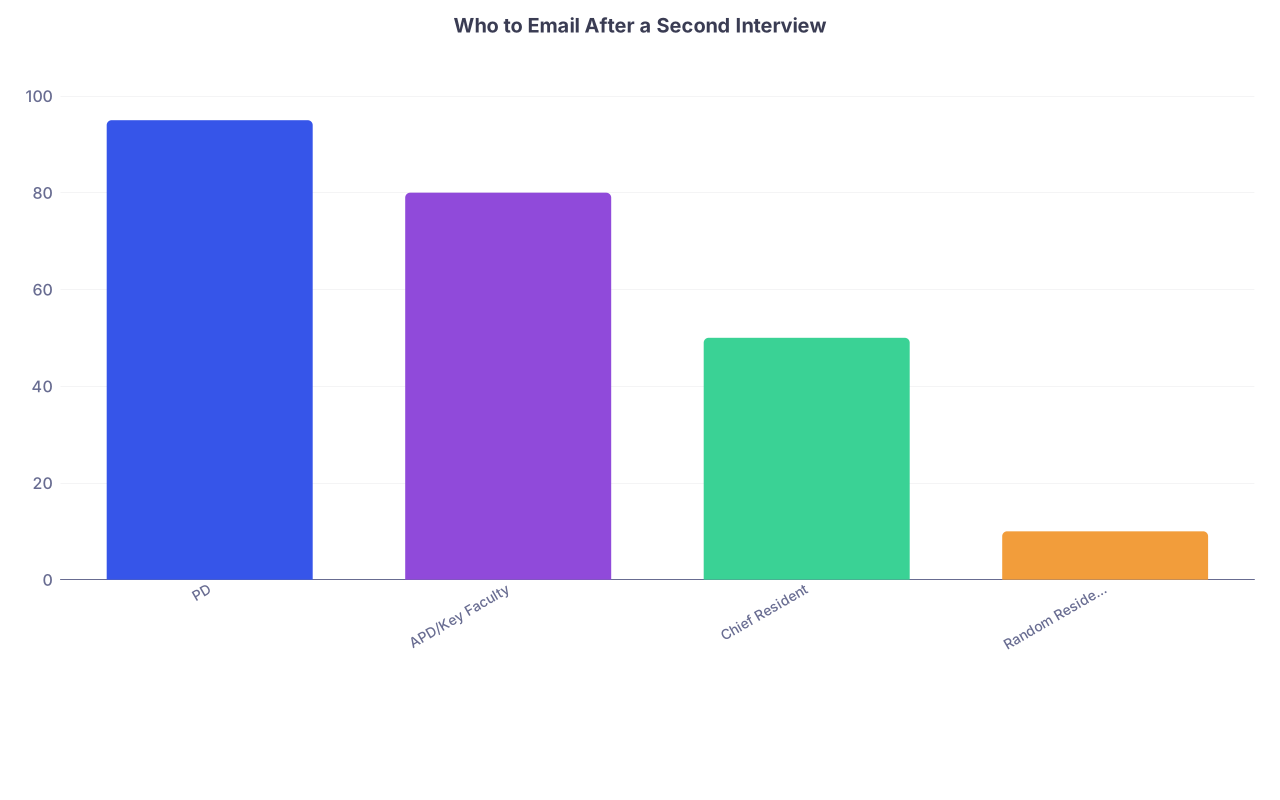
| Category | Value |
|---|---|
| PD | 95 |
| APD/Key Faculty | 80 |
| Chief Resident | 50 |
| Random Resident from Social | 10 |
4. Structure: The 5-Sentence Second-Interview Thank-You
You’re not writing a mini-personal-statement. You’re confirming fit.
Use this template mentally. You don’t have to label the parts, but hit each one.
- Thank them for this interaction specifically.
- Mention one specific detail from the second interview.
- Connect that detail to your training goals or values.
- Reaffirm your strong interest in the program (without ranking promises).
- Close politely and briefly.
That’s it. 5 sentences. Maybe 7 max.
Let me show you the difference between a bad version and a good version.
Bad, generic second thank-you
“Dear Dr. Smith,
Thank you again for taking the time to meet with me. I continue to be very impressed with your program and its strong clinical training and collegial atmosphere. I appreciated hearing more about the curriculum and opportunities for research. I remain very interested in your program and hope to have the opportunity to train there.
Sincerely, Alex Lee”
This tells them almost nothing:
- No evidence you actually had a second specific conversation.
- No sense of what changed for you or what you learned.
- You could send this to 40 programs and no one would know.
Strong second thank-you (specific, concise)
“Dear Dr. Smith,
Thank you for taking the time yesterday to speak with me again about the [Program Name] Internal Medicine Residency. Hearing how you’ve structured the senior resident autonomy on the MICU months, and how closely attendings supervise while still letting seniors run the list, gave me a much clearer picture of how your program develops independent decision-makers.
That balance of responsibility with support is exactly what I am looking for in training, especially with my long-term goal of practicing in a community setting where I will often be the only internist in-house overnight. Our conversation reinforced my strong interest in your program and how well it aligns with how I want to grow as a physician.
Thank you again for your time and for the second look.
Best regards,
Alex Lee”
Specific. Tied to your future. Clear, genuine interest. That’s what you want.

5. How to Handle Different Second-Interview Scenarios
You’re not all in the same boat. The way you write the thank-you should match what actually happened.
Scenario 1: Formal scheduled second interview (zoom or in-person)
This is the cleanest scenario. They clearly wanted to talk again.
Focus your email on:
- What new information you gained (specific rotations, mentorship, program changes).
- How your perception of fit changed.
- Any clarification you appreciated (concerns you had that they addressed).
Template language you can adapt:
“Thank you for meeting with me again today to discuss [X]. I especially appreciated your explanation of [specific thing]… This helped me see how [program] would prepare me for [your goal]. Our second conversation has only strengthened my interest in [program].”
Scenario 2: Second look day / open house where you had 1:1 time
These can be chaotic. The mistake people make is trying to summarize the entire day in an email.
Pick one or two key interactions.
For example, you:
- Spoke with a senior resident about workload and call.
- Talked with the PD briefly about a niche interest (global health, ICU, med-ed).
- Sat in on morning report and saw something that clicked for you.
Email the person where you had the highest-yield interaction.
Sample:
“Dear Dr. Patel,
Thank you for speaking with me during the second look day on Friday and for answering my questions about your program’s approach to teaching on busy ward months. Hearing how the seniors actively coach interns through their first admissions, while still maintaining high standards, matched the teaching culture I am looking for.
Seeing that dynamic in morning report as well made the structure feel real, not just theoretical. The second look reinforced for me that [Program Name] would be an excellent place for me to grow as both a clinician and teacher.”
Scenario 3: You rotated there after interviewing (sub-I / audition rotation)
This is trickier, and more powerful.
You already sent a post-interview thank-you. Then you spent 2–4 weeks on service. That’s not just a “second interview.” That’s a full trial run.
Your email should sound more grounded. Less speculative, more “I saw this firsthand.”
Focus on:
- What you observed about resident culture.
- How staff treated each other when no one was “on display” for interview season.
- Specific moments: a senior walking you through a tough case, an attending giving real feedback, how your input was treated.
Example:
“Dear Dr. Nguyen,
Thank you again for the opportunity to rotate on the inpatient team after my earlier interview with your program. Working with your residents for the past two weeks gave me a much more concrete sense of the culture you described on interview day.
I was especially impressed by how the seniors balanced efficiency with teaching during our busy admitting days, and by how comfortable interns felt asking for help without judgment. Experiencing that firsthand confirmed for me that [Program Name] is exactly the type of environment where I would thrive during residency.”
Notice the shift: “confirmed,” “experiencing that firsthand.” That’s fair to say after a rotation.
Scenario 4: The second interview made you less certain
Yes, this happens. You saw some red flags. Or something felt off.
You have two options:
- If you’re pretty sure you’re ranking them low: you can skip the second thank-you. They’ll survive.
- If you’re on the fence and want to preserve the relationship: send a neutral, respectful note that doesn’t oversell interest.
Something like:
“Thank you for taking the time to speak with me again about your program and for answering my questions about [topic]. I appreciated the additional perspective on [specific thing]. I’m grateful for the opportunity to learn more about [Program Name] and will be thinking carefully about how it fits with my goals as I complete my rank list.”
That’s honest without burning a bridge or promising something you do not intend.

| Step | Description |
|---|---|
| Step 1 | Had second interview/second look |
| Step 2 | Email PD and key faculty |
| Step 3 | Optional: 1 email to PD only |
| Step 4 | Skip second thank-you |
| Step 5 | Send within 24-48 hrs |
| Step 6 | Meaningful 1:1 interaction? |
| Step 7 | Group/open house only? |
6. Ranking Language, NRMP Rules, and How Honest to Be
You’ve heard varying advice about saying “I will rank you highly” or “I will rank you first.” A lot of it is bad.
Here’s the reality:
- NRMP forbids coercive or contingent statements, not basic expressions of interest.
- Programs and applicants are both allowed to say how interested they are.
- Both sides are also allowed to be… less than fully honest. (Is that good? No. Is it common? Yes.)
What you should not do:
- Promise “I will rank you #1” if that is not 100% true.
- Try to negotiate or extract information about how they’ll rank you.
- Say anything that sounds like a deal (“If you rank me, I’ll rank you”).
Safe, honest phrases that work well in second thank-yous:
- “Our conversation further strengthened my interest in your program.”
- “[Program Name] remains one of the programs I am most excited about.”
- “I would be thrilled to train at [Program Name].”
- “I see a strong fit between my goals and what your program offers.”
If—and only if—you are 100% certain you are ranking them #1, and you’ve decided that’s a message you want to send, you can say:
- “I will be ranking [Program Name] as my first choice.”
But if you say that, mean it. Programs do not forget when that turns out to be a lie.
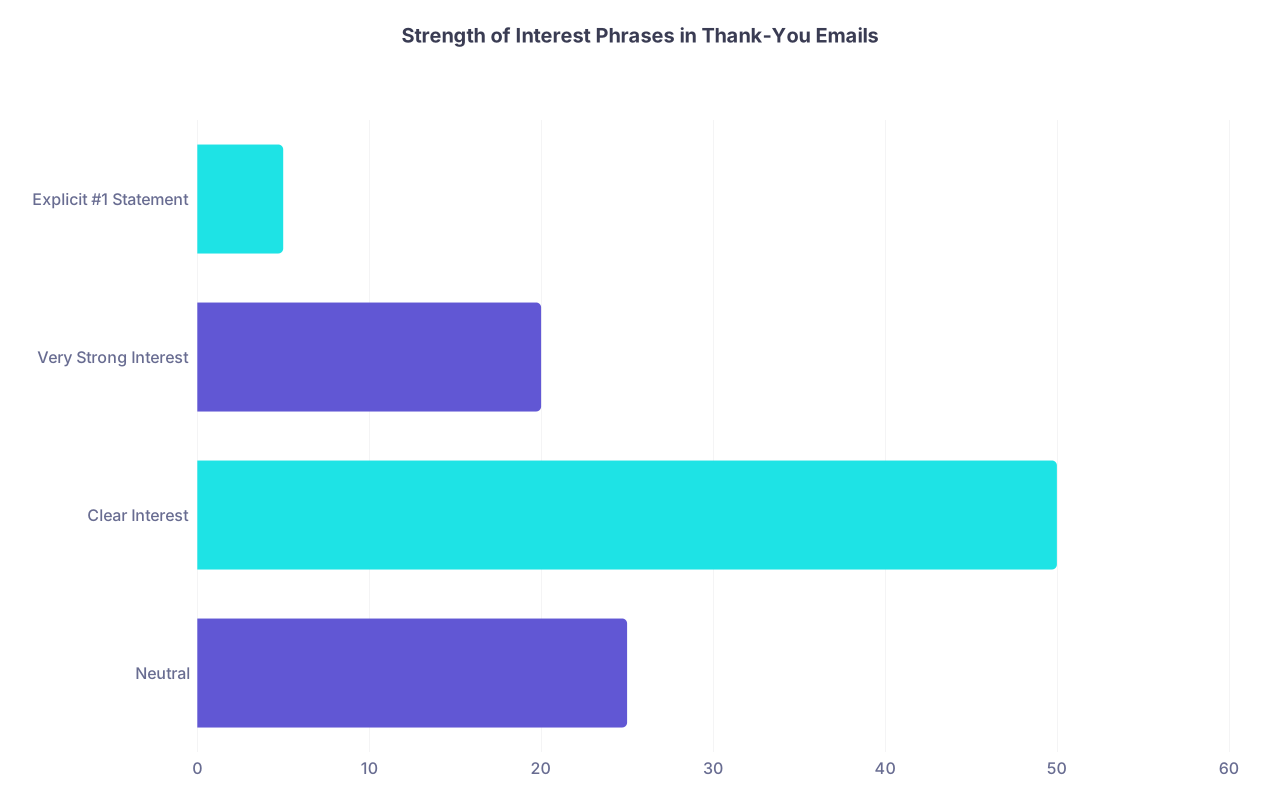
| Category | Value |
|---|---|
| Neutral | 25 |
| Clear Interest | 50 |
| Very Strong Interest | 20 |
| Explicit #1 Statement | 5 |
7. Style, Tone, and Length: How to Sound Like a Future Colleague
Your second thank-you should sound like you writing a brief note to a future colleague, not like a formal grant application.
Some simple rules:
- Length: 5–10 sentences total. Under 200–250 words. If they have to scroll twice, it’s too long.
- Tone: Warm, professional, specific. Not stiff. Not chatty.
- Language: Use normal words. Cut “esteemed,” “illustrious,” “world-renowned.” They know who they are.
- Formatting: Short paragraphs. Avoid giant blocks of text.
Common mistakes that scream “I copied this from a template”:
- Overly formal: “I would like to sincerely express my utmost gratitude for the opportunity…”
- Flattery overload: “Your world-class, unparalleled program, second to none, would be a dream come true…”
- Vague adjectives: “impressive,” “amazing,” “great” with no concrete follow-up.
Replace them with specifics:
Instead of: “I was impressed by your research opportunities.” Use: “Our discussion about the QI curriculum and the chance for interns to lead small projects on the wards made me excited about continuing the QI work I started in medical school.”
Specifics are your proof of attention.

8. Practical Workflow: How to Actually Get These Done Without Losing Your Mind
Interview season is exhausting. You’re not going to write Pulitzer-level prose for every program. You don’t need to.
Here’s a clean, efficient workflow:
Right after the second interview / look, jot 3 bullets in your phone:
- One specific detail you learned.
- One thing that changed your perception of the program.
- One sentence on how it ties to your future goals.
That evening or next morning, open a simple template in your notes:
- “Thank you for [today’s/this morning’s] [second look/meeting].”
- “I especially appreciated [specific detail].”
- “This aligns with my goal of [goal].”
- “Our conversation reinforced my interest in [program].”
- “Thank you again for your time.”
Drop in the bullets, smooth the transitions, and read it out loud once.
- If it sounds like something you’d actually say, you’re done.
- If you feel like a Victorian letter-writer, cut 30% of the adjectives.
Send it. Then stop rereading it in your Sent folder. It’s not a Step score.
9. Common Pitfalls to Avoid
I’ve seen applicants tank their vibe with follow-up emails. Do not do these:
- Over-updating: Sending multiple follow-ups after the second thank-you (“Just checking in…” “I remain very interested…”). They get it. One note is enough.
- Over-sharing anxieties: “I just wanted to clarify X because I’m really worried about Y…” This is not the place for therapy. Ask clear questions during the meeting instead.
- Copy-paste errors: Sending “I loved meeting your residents in Chicago” to a program in Seattle. Yes, it happens. Triple-check the program name and city.
- Bcc disasters: Never send one generic thank-you to multiple PDs in bcc. That’s instant “no.”
- Aggressive ranking talk: “If you rank me to match, I’ll guarantee I’ll rank you to match.” NRMP violation territory. Do not touch it.
Your goal is simple: leave them with a clear, calm impression that you’re serious, thoughtful, and would fit in well. Not that you’re panicking.
FAQ (Exactly 3 Questions)
1. Do I need to send a second thank-you if my first interview thank-you was already very detailed?
No. You’re not obligated. Send a second thank-you only if you had a new, meaningful interaction (second interview, second look, rotation) that gave you additional context about the program. In that case, keep the second email focused on what changed or became clearer after this latest interaction, not a rehash of your original thank-you.
2. Should I mention other programs or compare them in my second thank-you?
Absolutely not. Do not write, “Compared to other places I’ve seen, your program…” or “You stand out above X and Y.” It sounds tacky and sometimes insecure. Focus entirely on their program and your fit there. They do not need or want to hear about your comparison shopping in your thank-you email.
3. What if I forgot to send a second thank-you and it’s been a week?
If it has been more than 72 hours, only send a follow-up if you have something real to say—like a brief, specific note about how something from the second conversation has continued to stick with you or clarified your goals. Keep it extra short, acknowledge the delay (“I’ve been reflecting on our second conversation last week…”), and avoid over-apologizing. If you truly have nothing substantive to add, skip it and focus your energy on your rank list instead.
Open your email right now and draft one 5–7 sentence thank-you to the single most important person from your last second interview—PD or key faculty—and make sure it includes one concrete detail from that second conversation and one clear sentence about how their program fits your goals. Then send it and move on.