
Most applicants screw this up by either gushing or ghosting. Both can hurt you.
You just got off an interview day (or a post-interview call) where a program director or resident all but said: “We’re ranking you highly” or that classic line, “You’d be a great fit here.” Maybe you even heard, “We hope to see you here in July.”
Now you’re sitting there wondering:
Do I email them? What do I say? Do I promise to rank them #1? Can I ask them where I stand?
Here’s how to handle this situation like a professional adult physician-in-training, not a desperate applicant or a robot.
1. First, Decode What “Heavily Hinted” Actually Means
Let me be blunt: programs hint way more than they mean.
Common “hint” phrases you’ll hear:
- “You’d be an excellent fit for our program.”
- “We’d be very excited to work with you.”
- “You’d have no problem thriving here.”
- “We’ll be ranking you highly.”
- “I expect we’ll see you here in July.”
- “You’re the kind of resident we want.”
Sometimes they mean it. Sometimes it’s boilerplate flattery. Sometimes it’s a PD trying to keep strong applicants engaged without violating policy.
Here’s the mental model I want you to use:
- Anything short of “We will rank you to match” = not a promise
- Anything said to you in a group Zoom = generic morale-boosting
- Anything said by a resident (not PD/APD) = opinion, not policy
- Anything that sounds too good to be true = probably is
So you do not:
- Change your whole rank list based purely on “We’ll rank you highly”
- Email back asking, “Where am I on your rank list?”
- Treat this as a contract
You do:
- Take it as a positive sign: they liked you
- Use it as data, not destiny, in your ranking decisions
- Respond in a way that maintains professionalism and keeps the door open
2. Understand the Match Rules Before You Hit Send
You cannot respond intelligently if you don’t know the guardrails.
The NRMP (for the main Match) and SF Match (for some specialties) have very clear rules about communication. Here’s the distilled version that matters for you:
- Programs cannot ask you how you will rank them as a condition of ranking you.
- You cannot ask for your specific rank position.
- Both sides can express interest, even strong interest.
- You can tell a program they’re your #1.
That’s not illegal. But if you say that to multiple programs, it’s dishonest.
| Situation | Allowed? | Example Phrase |
|---|---|---|
| Tell a program they are your #1 | Yes | "I will be ranking your program first." |
| Ask where you are on their list | No | "Can you tell me how high I am ranked?" |
| Express strong interest without rank talk | Yes | "Your program is one of my top choices." |
| Ask them to commit to ranking you to match | No | "Will you rank me to match?" |
Key rule: Never pressure them. Never fish for promises.
Programs are paranoid about complaints. The fastest way to go from “we liked you” to “let’s not risk this applicant” is to push for information they’re not supposed to give.
3. Decide Your Actual Strategy Before You Write Anything
You have three distinct scenarios:
- You already know they’re your clear #1
- They’re competitive in your top tier, but you don’t know final ranking yet
- You appreciate the interest, but they’re not near the top of your list
You respond differently in each.
Scenario 1: They’re Your Clear #1
This is the only time you should explicitly say you’ll rank them first.
Why? Because once you write this, you have an ethical obligation to follow through. No one’s going to arrest you if you change your mind. But people remember. This is a small profession.
Your move: send a short, direct, sincere message.
Example:
Subject: Thank you and ranking intentions
Dear Dr. [Last Name],
Thank you again for the opportunity to interview at [Program Name]. My conversations with you and the residents confirmed what I felt going into the day — this is exactly the type of program where I want to train.
I want to let you know that I will be ranking [Program Name] first on my rank list. The combination of strong clinical training, supportive culture, and your focus on [specific feature: e.g., “resident education and autonomy in the ICU”] makes it the best fit for me.
I appreciate the time you and your team took to get to know me, and I would be honored to train at [Program Name].
Sincerely,
[Your Name], [Med School]
AAMC ID: [XXXXXXX]
That’s it. No begging. No, “Please rank me highly too.” The message: I’m serious, I respect your time, I understand the process.
Scenario 2: They’re in Your Top Tier, But You’re Not Sure Yet
This is where most people overpromise because they panic. Don’t.
You can express strong interest without lying or locking yourself in.
Your target language:
- “One of my top choices”
- “Among the programs I am most excited about”
- “A program I would be thrilled to match at”
Example:
Subject: Thank you for the interview at [Program Name]
Dear Dr. [Last Name],
Thank you again for the opportunity to interview at [Program Name]. I enjoyed learning more about your approach to [e.g., “resident autonomy in the ED”] and speaking with your residents about their experiences.
I left the interview even more enthusiastic about your program, and [Program Name] is now one of the programs I am most excited about on my rank list. I would be very happy to train with your team next year.
Thank you again for your time and consideration.
Best regards,
[Your Name], [Med School]
AAMC ID: [XXXXXXX]
This acknowledges their interest in you, signals reciprocal interest, and stays within NRMP expectations.
Scenario 3: They’re Not Going to Be Near the Top
You still respond professionally. You do not vanish. Silence can be read as disinterest or immaturity.
You focus on gratitude and fit, not ranking.
Example:
Subject: Thank you for the interview
Dear Dr. [Last Name],
Thank you for the opportunity to interview at [Program Name] and for the kind feedback you shared with me after our conversation. I appreciated learning more about [specific aspect], and I enjoyed meeting your residents.
I’m grateful for your time and for being considered by your program.
Sincerely,
[Your Name], [Med School]
AAMC ID: [XXXXXXX]
You’re polite. You acknowledge their enthusiasm. You don’t mislead them about your rank intentions.
4. Timing: When to Send the Follow-Up
If they “heavily hinted” during:
The interview day itself
→ Send your follow-up within 24–72 hours.A post-interview phone call or Zoom
→ Reply within 24–48 hours.A late-season email saying they’re ranking you highly
→ Respond within 24 hours, especially if you like them.
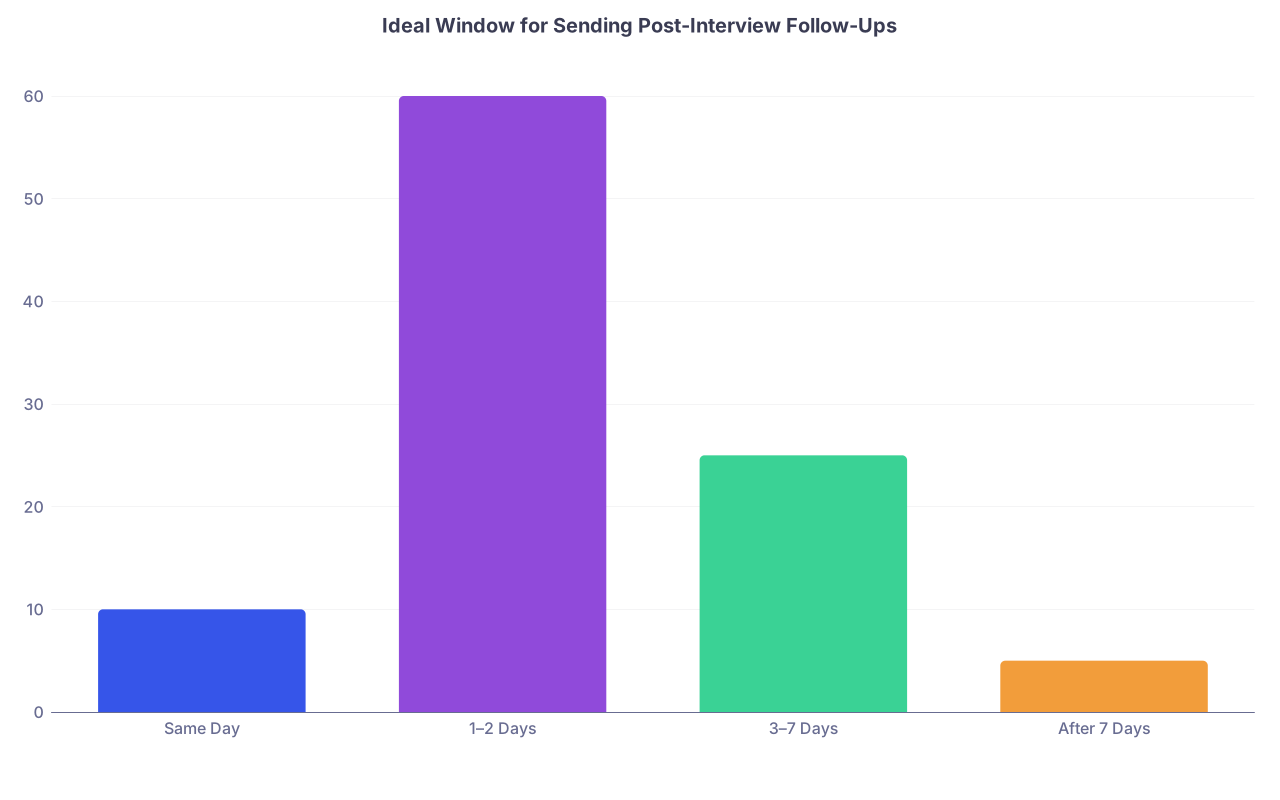
| Category | Value |
|---|---|
| Same Day | 10 |
| 1–2 Days | 60 |
| 3–7 Days | 25 |
| After 7 Days | 5 |
If it’s been two weeks and you haven’t responded, don’t overthink it. Late is still better than never. Just write a normal thank you. Do not apologize for timing unless it’s really egregious.
5. How to Reply When They Email “We’ll Rank You Highly”
This trips people up.
Common scenario: You get an email from a PD or coordinator saying some version of:
“We were very impressed with your application and interview and plan to rank you highly.”
Here’s exactly how to handle it.
Step 1: Reply. Always.
Ignoring this is weird. They took a step that not all programs take.
Step 2: Match their level of enthusiasm without exaggerating
If they say “rank you highly,” you can say “very excited about your program” or “one of my top choices” if true.
If they’re not top tier for you, you still thank them and stay neutral on rank language.
Two templates:
If they’re top-tier for you:
Dear Dr. [Last Name],
Thank you very much for your message and for your kind words. I truly enjoyed interviewing at [Program Name], especially getting to see how engaged your residents are in [X, e.g., “quality improvement efforts”].
Your email reinforces how strongly I feel about [Program Name]. It is one of the programs I am most excited about, and I would be very happy to match there.
Thank you again for your support and for considering my application.
Best regards,
[Your Name]
If they’re not top-tier:
Dear Dr. [Last Name],
Thank you very much for your message and for your kind feedback. I appreciated the opportunity to interview at [Program Name] and to learn more about your residency.
I’m grateful for your consideration and for the time you and your team invested in my interview day.
Sincerely,
[Your Name]
Notice what’s missing: any attempt to pry into their rank list or ask for more.
6. What NOT to Do (These Are the Things That Actually Backfire)
I’ve seen these mistakes sink otherwise strong applicants:
Fishing for rank info
- “Do you know where I will be on your list?”
- PD reads this as: red flag on judgment.
Emotional over-sharing
- “I am so anxious about matching and your email is the only thing keeping me calm.”
- They’re not your therapist.
Guilting or pressuring them
- “I really need to match close to my family so I hope you will rank me highly.”
- They’re ranking you for fit and performance, not your personal story.
-
- Sending: “I will be ranking [WRONG PROGRAM NAME] first.”
- Instant credibility hit.
Multiple #1 promises
- Yes, people talk. Programs swap notes. Don’t be that story.
](https://cdn.residencyadvisor.com/images/articles_svg/chart-common-post-interview-email-mistakes-9586.svg "Common Post-Interview Email Mistakes")
| Category | Value |
|---|---|
| Over-sharing emotion | 30 |
| Asking rank position | 35 |
| Copy-paste errors | 20 |
| [Multiple #1 claims](https://residencyadvisor.com/resources/follow-up-residency-interview/love-letters-to-programs-how-often-they-backfire-behind-the-scenes) | 15 |
If you’re unsure if an email sounds needy, it probably does. Trim it. Make it shorter, more factual, and more focused on gratitude than outcome.
7. How These Communications Actually Affect Your Rank Position
Let’s be clear on the impact.
- A solid, professional follow-up can help slightly. Especially at programs that value “professionalism,” “communication skills,” and “interest in our program.”
- A terrible follow-up (or a creepy one) can hurt you.
- No follow-up at all? Usually neutral to slightly negative.
Most places:
- Use the interview day to set your approximate spot
- Then tweak at the margins based on post-interview impressions, red flags, or strong signals of interest

Do not assume your email will leapfrog you 30 spots. But at the margin, that one line—“I will be ranking your program first”—can absolutely break ties in your favor at some programs.
And remember: the Match algorithm favors your preferences. Ranking a program higher just because they seemed to like you more is backwards. You rank in your true order of preference.
8. If You Changed Your Mind After Telling a Program They’re #1
It happens. You told Program A they were your #1. Then you rotated at Program B late. It blew you away. Now what?
Let me be honest: this is ugly territory.
You have 3 options, none perfect:
Stick with what you told Program A
- Pros: You maintain integrity.
- Cons: You might not match at your true favorite.
Change your rank list quietly, don’t tell anyone
- Pros: You maximize your own outcome.
- Cons: Burned trust if they find out (and yes, sometimes they do).
Email the PD to clarify (only if you must)
- Risky. Usually draws more attention than it solves.
My stance:
If you told a PD explicitly “I will rank you first,” you should treat that as a serious commitment, not a throwaway line. In most cases, live with it.
If you only said “You are one of my top choices,” you’re free. That’s intentionally non-committal. No drama.
So going forward: do not tell a program they’re #1 unless you’re 99% sure. Save yourself the ethical gymnastics.
9. Quick Flow: What To Do, Based on Your Situation
Use this as your decision cheat sheet.

| Step | Description |
|---|---|
| Step 1 | Program hinted theyll rank you highly |
| Step 2 | Email: Explicitly say youll rank them first |
| Step 3 | Email: Strong interest, one of my top choices |
| Step 4 | Email: Polite thank you, no rank language |
| Step 5 | Send within 1-3 days |
| Step 6 | Where do you rank them? |
If you follow that exact flow, you will not embarrass yourself. You’ll stay within match rules. And you’ll come across like a future colleague, not an anxious premed 2.0.
10. Final Reality Check
You are not negotiating a contract. You are building a reputation.
Program hints that they’ll rank you highly? Good. Take the compliment.
Your job:
- Respond professionally
- Be honest but not oversharing
- Protect your own true preferences
- Avoid anything that smells like pressure or desperation

If you treat every email like something a future colleague could someday read out loud in a conference room, you’ll write the right kind of emails.