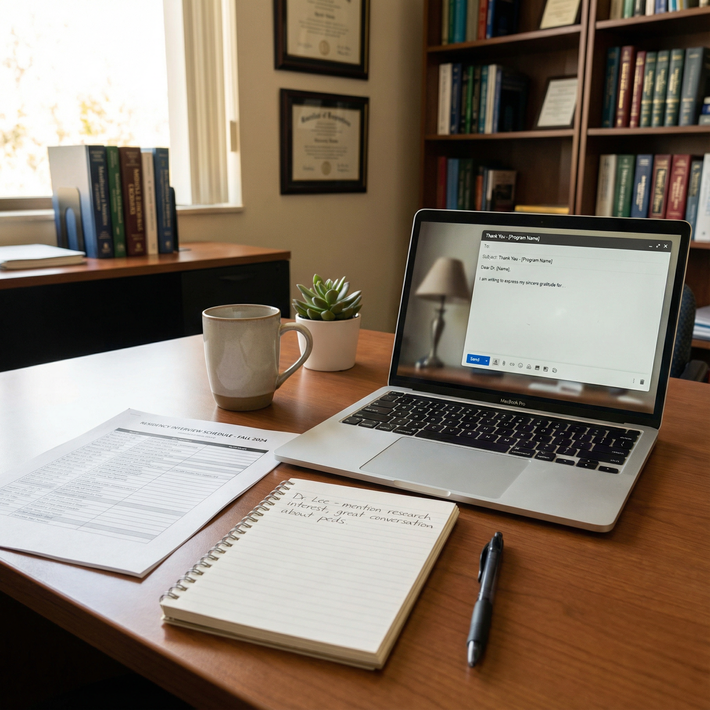
It is 8:29 a.m. Your interview block started at 8:15. You are still in the Uber, watching the GPS crawl forward at 3 miles per hour. Or you are staring in horror at your laptop as Zoom insists on updating, while the meeting link mockingly sits in your email.
Either way, you were late. The interview happened (or partially happened). You know you did not show your best. And now you are replaying every minute, wondering if there is anything you can do to salvage this.
There is. But only if you stop spiraling and handle the follow-up correctly. This is not about “hoping it goes away.” It is about taking responsibility, quickly and professionally, in writing.
This is the playbook.
Step 1: Get Your Head Straight Before You Email
Before you write anything, you need to stop making it worse in your own head. You are not the first applicant to be late. You will not be the last. I have seen applicants be 30–40 minutes late and still match at that program.
The pattern is always the same:
- The ones who own it concisely and professionally sometimes recover.
- The ones who send a weird defensive explanation or say nothing are done.
So first, your ground rules:
- You are not going to over-explain. Nobody needs your full travel log, screenshots of the accident, or the time stamp from your Zoom crash.
- You are not going to blame. Not traffic. Not your computer. Not your cat. You can mention context. But blame kills professionalism.
- You are going to be fast. Your email should go out the same day, ideally within a few hours.
Aim for calm, clinical, accountable. Like a progress note after a complication. Not like a confession.
Step 2: Decide Who You Are Emailing
You do not send this to every single interviewer unless you were hours late and missed the entire day. In 95% of cases, you email:
- The program coordinator (PC)
- The program director (PD)
If you had a specific faculty member whose interview you missed entirely, you can:
- Email the PC + PD, and
- Ask them to extend your apology to that faculty member
or - Add that faculty member in CC if you interacted with them enough that it makes sense
Keep the “To” field clean:
- To: Program Coordinator
- CC: Program Director (and maybe one faculty if appropriate)
Do not BCC anyone. This is not a stealth operation. It is a straightforward professional communication.
Step 3: Get the Subject Line Right
Overly dramatic: bad. Vague: also bad. You want something that immediately orients the reader.
Use one of these:
- “Apology for Late Arrival to Residency Interview – [Your Name]”
- “Follow-Up and Apology – [Program Name] Interview, [Date]”
- “[Your Name] – Thank You and Apology for Tardiness”
Pick one and move on. Do not waste 15 minutes workshopping the subject line.
Step 4: Use This Exact Email Structure
Here is the basic skeleton you should follow. Short, clear, professional.
- Opening thank you + context
- Direct apology and full ownership
- Very brief explanation (one sentence, maybe two)
- Reaffirm enthusiasm and professionalism
- Optional: offer to make up missed portion (if applicable)
- Formal close
Let’s walk through each.
4.1 Opening: Start With Gratitude, Not Excuses
You want to signal that you still respect their time and the opportunity, even though you screwed up.
Example:
Dear [Program Director Name] and [Program Coordinator Name],
Thank you again for the opportunity to interview with the [Program Name] residency today. I appreciated the chance to learn more about your program and to meet the residents and faculty.
That is it. No need to be poetic.

4.2 The Actual Apology: Take Full Responsibility
Be blunt. No passive voice. No “I am sorry if…” or “It was unfortunate that…”
Do this:
I would like to sincerely apologize for arriving late to the interview session this morning. I recognize this disrupted the schedule and was not reflective of the professionalism I expect of myself.
Notice a few things:
- No “due to circumstances beyond my control” fluff.
- Clear acknowledgment that it affected them, not just you.
That line alone puts you in the “adult” category instead of the “student with excuses” category.
4.3 Brief Explanation: One Short Sentence
Programs understand life happens. They do not want a full narrative.
Your explanation should:
- Be brief
- Be factual
- Avoid blame-heavy language
Examples by scenario:
1. Travel delay (you still made interview, just late):
I misjudged my travel time and encountered unexpected traffic, which resulted in my late arrival.
You can stop there. You do not need to describe the exact highway closure.
2. Major external event (accident, transit shutdown):
There was a significant traffic accident that closed the main route to the hospital, and I did not allow enough buffer time to account for that possibility.
Notice how even here you still acknowledge you could have accounted for it.
3. Tech problems for virtual interview:
I experienced an unexpected computer issue at the start of the virtual session and should have had a better backup plan in place.
That is all you need. They know technology flakes out. They care more about whether you shift into problem-solving mode or victim mode.
4.4 Reaffirm Interest: They Need to Know You Still Care
You had one bad process moment. You need to remind them that the fit is still strong.
Despite this misstep, my enthusiasm for [Program Name] remains very strong. The conversations I had with your residents and faculty reinforced my sense that your program’s focus on [specific feature: e.g., resident autonomy, underserved care, strong ICU training] aligns closely with my goals.
Drop in one specific detail you picked up from interview day so it does not sound like a generic template.
4.5 Offer to Make Up Missed Time (If Applicable)
If you missed a whole interview block, or skipped the PD’s session completely, you can include an offer.
Do not demand a second chance. Offer.
If there is any possibility to reschedule the portion of the interview I missed with Dr. [Name], I would be very grateful, but I understand completely if the schedule does not allow for this.
They may say no. Fine. You showed you cared enough to ask, without being entitled.
4.6 Close Professionally
Thank you again for your time and understanding. I appreciate your consideration.
Sincerely,
[Your Full Name]
[AAMC ID / ERAS AAMC ID, if appropriate]
[Email] | [Phone]
Done.
Step 5: Full Email Templates for Common Scenarios
You do not need to reinvent the wheel. Use these as a base and tweak the details.
Scenario 1: You Were 10–20 Minutes Late, Still Completed Most of the Day
Subject: Apology for Late Arrival to Residency Interview – [Your Name]
Dear Dr. [PD Last Name] and [Coordinator First Name] [Coordinator Last Name],
Thank you again for the opportunity to interview with the [Program Name] residency today. I appreciated the chance to learn more about your program and to meet your residents and faculty.
I would like to sincerely apologize for arriving late to the interview session this morning. I recognize this disrupted the schedule and was not reflective of the professionalism I expect of myself. I misjudged my travel time and encountered unexpected traffic, which resulted in my late arrival.
Despite this misstep, my enthusiasm for [Program Name] remains very strong. Hearing about your [specific element: e.g., night float system, community hospital experience, global health track] confirmed that your program aligns closely with the kind of training environment I am seeking.
Thank you again for your time and understanding. I appreciate your consideration.
Sincerely,
[Your Name]
AAMC ID: [XXXXXXX]
[Phone] | [Email]
Scenario 2: You Missed an Entire Interview Block (e.g., One Faculty)
Subject: Follow-Up and Apology – [Program Name] Interview, [Date]
Dear Dr. [PD Last Name] and [Coordinator First Name] [Coordinator Last Name],
Thank you for the opportunity to interview with the [Program Name] residency today. I was grateful to learn more about your program and to speak with your residents and faculty.
I want to offer a sincere apology for my late arrival and for missing the scheduled interview with Dr. [Faculty Last Name]. I understand this was disruptive and unprofessional, and I take full responsibility. An unexpected delay in transit caused me to arrive later than planned, and I did not build in sufficient buffer time to prevent this.
I remain very interested in [Program Name]. The discussions about your [specific: e.g., mentorship structure, curriculum, patient population] reinforced how well your program fits with my goals in [specialty].
If it happens to be possible to reschedule the missed interview with Dr. [Last Name], I would be very grateful, though I completely understand if the schedule does not allow for this.
Thank you again for your time and understanding.
Sincerely,
[Your Name]
AAMC ID: [XXXXXXX]
[Phone] | [Email]
Scenario 3: Virtual Interview – Tech Issues, Late to Zoom
Subject: [Your Name] – Thank You and Apology for Tardiness
Dear Dr. [PD Last Name] and [Coordinator First Name] [Coordinator Last Name],
Thank you for the opportunity to interview with the [Program Name] residency today. I appreciated being able to learn more about your program and to meet the residents and faculty over Zoom.
I want to sincerely apologize for joining the morning session late. I experienced an unexpected issue with my computer and Zoom at the start of the day and did not have a sufficient backup plan in place, which is my responsibility. I recognize this caused disruption and was not up to the standard of professionalism I hold myself to.
I remain very enthusiastic about [Program Name]. Hearing about your [specific: e.g., telehealth integration, simulation curriculum, research support] confirmed that your program aligns with the training environment I am seeking.
Thank you again for your time, patience, and consideration.
Sincerely,
[Your Name]
AAMC ID: [XXXXXXX]
[Phone] | [Email]
Use these as templates. Replace the bracketed parts. Do not over-edit yourself into a 700-word apology letter.
| Scenario | How Late | Email Needed? | Ask to Reschedule? |
|---|---|---|---|
| 5 minutes, still completed all blocks | Minor | Yes, brief | No |
| 15–30 minutes, missed some content | Moderate | Yes, standard | Maybe |
| Missed entire interview half-day | Major | Yes, detailed | Yes |
| Virtual, tech issues, joined late | Moderate | Yes, standard | Maybe |
Step 6: When to Send the Email
Timing matters.
- Same day is best. Within 2–4 hours after the interview day ends.
- If it was a morning interview and you were late: send before evening.
- If they are across time zones, still send same calendar day local to them if you can.
If you are so rattled that you are about to write something emotional and messy, draft the email, step away for 20 minutes, then edit it down to something clean and restrained.
But do not wait 48 hours. By then it reads as reactive, not proactive.
Step 7: What Not To Do (Where Applicants Blow It)
I have seen strong candidates completely tank their chances not by being late, but by how they handled it afterward. Avoid these:
7.1 Do Not Over-Explain
Bad version:
There was a six-car pileup on I-95 and then the GPS rerouted me three times and then the Uber driver took a wrong turn and I have screenshots if needed…
Nobody wants that. It reads as desperate and defensive.
You want one sentence of context. That is all.
7.2 Do Not Minimize or Joke
You are not writing to a friend.
Avoid:
- “Hope it was not too big a deal!”
- “Well, at least I got there eventually!”
- “Guess it shows how badly I want it, fighting through all that traffic haha.”
They are not amused. They are evaluating whether to trust you at 3 a.m. with a crashing patient. Take it seriously.
7.3 Do Not Shift Blame
If your email has more than one “because” and three external factors, you have gone off track.
You can say “unexpected,” but then you follow with “I should have…”
The formula:
Unexpected event + I did not plan adequately = my responsibility.
That is what they want to see: insight and ownership.
7.4 Do Not Send Multiple Apologies
You send one email. You do not send:
- One to the PC
- One to the PD
- One to each faculty
- Another one two days later “just checking in”
Over-apologizing starts to look like anxiety they will have to manage for three years. Keep it tight.
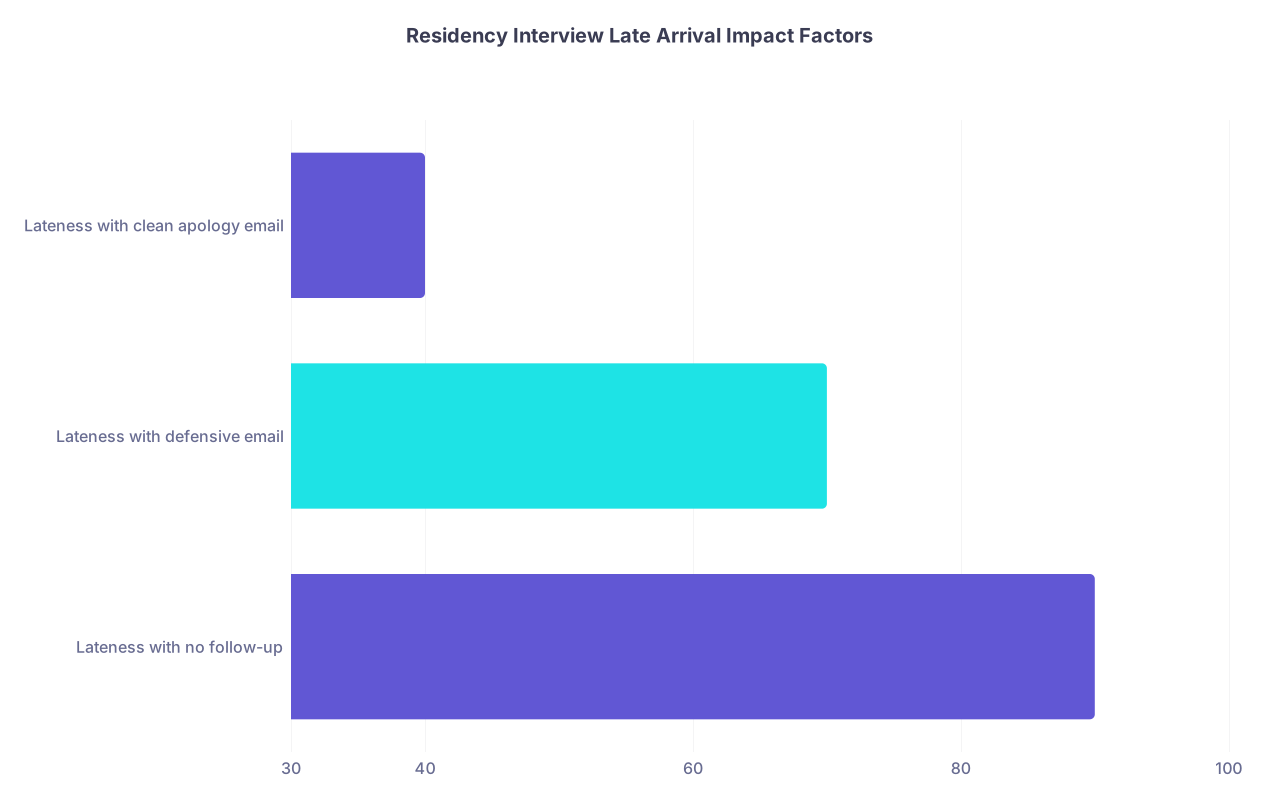
| Category | Value |
|---|---|
| Lateness with no follow-up | 90 |
| Lateness with defensive email | 70 |
| Lateness with clean apology email | 40 |
(Illustrative: lower number = perceived negative impact)
Step 8: How This Actually Plays in a Committee Room
Here is how it usually looks from the program side. I have literally heard versions of these exchanges.
Case A: Late, No Email
“He was 20 minutes late to the morning session and just walked in without saying much. No follow-up. That is a red flag for me. I am not ranking him.”
Case B: Late, Defensive Email
“She sent a long email blaming the airline, the weather, TSA, and her hotel shuttle. Zero acknowledgment that she could have planned differently. Hard pass.”
Case C: Late, Clean Apology Email
“Yeah, he was late, but he emailed afterward, took responsibility, and he actually interviewed very well. I would still rank him, maybe not near the top, but I am okay with him.”
Programs are not looking for perfect people. They are looking for residents who handle imperfection like professionals.
You cannot erase the late arrival. But you can turn it into a small professionalism ding instead of a fatal character issue.

| Step | Description |
|---|---|
| Step 1 | You were late |
| Step 2 | Silent red flag |
| Step 3 | Email tone |
| Step 4 | Defensive, likely ranked low or not |
| Step 5 | Professional, may still be ranked |
| Step 6 | Send email? |
| Step 7 | Takes responsibility? |
Step 9: How This Affects Your Rank List and Future Contact
Two questions always come up: “Will this kill my chances?” and “Can I still send a thank-you or interest letter later?”
Will this kill your chances?
It depends on:
- How late you were
- How strong your application is otherwise
- How you behaved during the rest of the day
- How well you handle this email
If you were late by 10–20 minutes, performed well, and send a solid apology email, you are often still in the ranking mix. Maybe not bumped to the top, but not automatically off the list.
If you no-showed or were an hour late with no good explanation and come across as disorganized in person, then yes, it might be fatal. But nothing you write now will fix that. Focus on what you can control.
Can you still send a later thank-you or “letter of intent”?
Yes. One does not replace the other.
Sequence usually looks like:
- Same day – apology email as above.
- Later in the season – if you end up really liking the program, you can still send:
- A normal thank-you / interest letter, or
- A clear “I will rank you #1” letter (if true)
You do not need to re-apologize in every future message. At most, one brief reference:
I continue to appreciate your understanding regarding my late arrival on interview day.
Then move on. Do not anchor your entire relationship with the program to the worst 15 minutes of that day.
Step 10: What To Do Next (Beyond the Email)
You have sent the email. Now what?
Fix the actual problem.
- Start building in 30–60 minutes of extra buffer for every single in-person interview.
- For virtual, test your link, device, and backup device the day before.
Document the lesson.
This sounds corny, but write down somewhere:- What went wrong
- What you will do differently
This is literally how behavior changes. Residents who keep making the same “unexpected” mistakes do not last long.
Stop obsessively re-reading the email.
Once you have sent a clean, professional note, your work is done. They will either accept it and move on, or they will not. You catastrophizing in your head does nothing.Zoom out.
You are applying to multiple programs. One imperfect day does not define your career. Unless you let it.