Most residency thank-you emails are useless—and a few are actively hurting applicants.
You can fix that in one night.
You are not being judged on your ability to say “Thank you for your time.” You are being judged on whether you understood the program, whether you are someone they can picture on their team, and whether you can communicate like a functioning physician instead of a template robot.
Let me walk you through how to repair weak thank-you emails with concrete rewrites and examples you can steal today.
What A Thank-You Email Actually Needs To Do
Forget the myths. A thank-you email is not:
- Some magical “boost” that will rescue a poor interview
- A place to beg for a position
- An essay about your life story (they already saw your ERAS)
A good residency thank-you email has three real jobs:
Confirm you are normal, professional, and sane.
No red flags. No typos, no sloppy formatting, no bizarre oversharing.Reinforce one or two specific things that made you a good fit for that program.
Specific is the key word. Vague = forgettable.Make it easy to remember and rank you.
They will later say things like, “Oh, that was the applicant who was interested in X and talked about Y.” You want to control what X and Y are.
That is it. Not complicated. But most people blow it by sending the same generic mush to every program.
The Most Common Weak Thank-You Emails (And How To Fix Them)
We will go through the four main types of bad emails I see every year and rewrite each into something usable.
1. The Empty Fluff Email
Original (weak) version:
Subject: Thank you
Dear Dr. Smith,
Thank you so much for taking the time to interview me yesterday. I really enjoyed learning more about your program.
I appreciate the opportunity to interview and hope to work with you in the future.
Sincerely,
John Doe
This says nothing. You could send it to any program in the country and not change a word. That is the problem.
What is wrong here:
- Subject line is meaningless
- No specific detail from the interview
- No reminder of who you are (they just interviewed 12 people that day)
- No signal of genuine interest or fit
Fixed version:
Subject: Thank you – 1/6 Interview, Interest in MedEd & QI
Dear Dr. Smith,
Thank you for speaking with me during my interview day on January 6. I especially appreciated our conversation about your residents’ role in the QI curriculum and the weekly case-based teaching conferences.
Our discussion about your senior residents leading M&M and the opportunity to pair with a faculty mentor for education-focused projects confirmed that your program aligns well with my interests in medical education and quality improvement. I would be excited to contribute to those conferences and learn how you structure resident-led teaching.
Thank you again for your time and for sharing more about the culture of the program.
Best regards,
John Doe
MD Candidate, Class of 2025 – State University College of Medicine
AAMC ID: 12345678
Why this works:
- Clear subject line: date + your angle
- One or two specific details from the interview
- Connects those details to your interests
- Gives them a labeled mental file: “MedEd/QI person, 1/6 interview”
2. The Overly Desperate “You Are My #1” Email
Original (weak and risky) version:
Subject: Thank you and I will rank you #1
Dear Dr. Patel,
Thank you for the opportunity to interview at your program. After seeing everything, I am certain that your program is my top choice and I will be ranking you #1. The residents were amazing and I know I would be a perfect fit.
Please let me know if there is anything else I can do. I really hope to match at your program.
Sincerely,
Sarah Lee
I have seen PDs roll their eyes at these. Some even keep a mental tally of who tries to game the system and says “You are my #1” to three different places.
What is wrong here:
- Feels transactional and slightly manipulative
- Vague (“residents were amazing,” “perfect fit”)
- “Please let me know if there is anything else I can do” is filler
- Can be ethically questionable if not actually your #1
If you truly want to send a “strong interest” message, keep it serious, specific, and not whiny.
Fixed “strong interest” version:
Subject: Thank you – Strong interest in [Program Name]
Dear Dr. Patel,
Thank you again for the opportunity to interview at [Program Name] on December 15. I particularly valued hearing how your residents manage high-acuity patients in the ED while still maintaining close mentorship with faculty.
The combination of strong clinical training, the 4+1 schedule, and your emphasis on resident wellness and longitudinal mentorship make [Program Name] a standout for me. I would be genuinely excited to train on your team and contribute to the resident QI initiatives we discussed.
Thank you for your time and for sharing such a clear view of the program’s culture and expectations.
Sincerely,
Sarah Lee
MD Candidate, 2025 – Midwest University School of Medicine
AAMC ID: 23456789
If they are truly your #1, you can say so explicitly closer to rank-list time with a separate, short, honest note. But that is not the job of the general thank-you email.
3. The Rambling Personal Essay Email
Original (weak) version:
Subject: Thank you for the interview
Dear Dr. Nguyen,
Thank you for the opportunity to interview with your program. I wanted to share more about my background and why I am interested in internal medicine. Growing up, I spent a lot of time in hospitals because my grandmother was sick, and that experience taught me the value of compassionate physicians. During college, I volunteered at a local clinic, where I realized how much I enjoy working with underserved populations…
[3 more long paragraphs about life story, personal statement content, and unrelated details]
Sincerely,
Michael Chen
They already read your personal statement. Or decided not to. Re-sending it by email does not help.
What is wrong here:
- Too long. PDs and faculty are skimming between cases.
- Repeats information from the application
- Focused on you, not on the fit with the program
- High risk of typos and awkwardness because of length
You need to compress all of that into one or two sharp, relevant sentences.
Fixed, concise version:
Subject: Thank you – Focus on Underserved Primary Care
Dear Dr. Nguyen,
Thank you for taking the time to speak with me during my interview at [Program Name]. I appreciated our discussion about your clinic’s work with uninsured patients and the ways residents are involved in longitudinal primary care at the community health center.
My prior work in student-run free clinics and my interest in long-term primary care for underserved populations align strongly with the patient population you described. I would welcome the chance to continue that work in your residency and contribute to your community outreach initiatives.
Thank you again for your time and for the insight into your program.
Best regards,
Michael Chen
MD Candidate, 2025 – East Coast University School of Medicine
AAMC ID: 34567890
Notice what stayed:
- Specific clinic context
- Clear link between his interests and the program’s mission
Everything else got cut. As it should.
4. The Awkward Group / CC Email
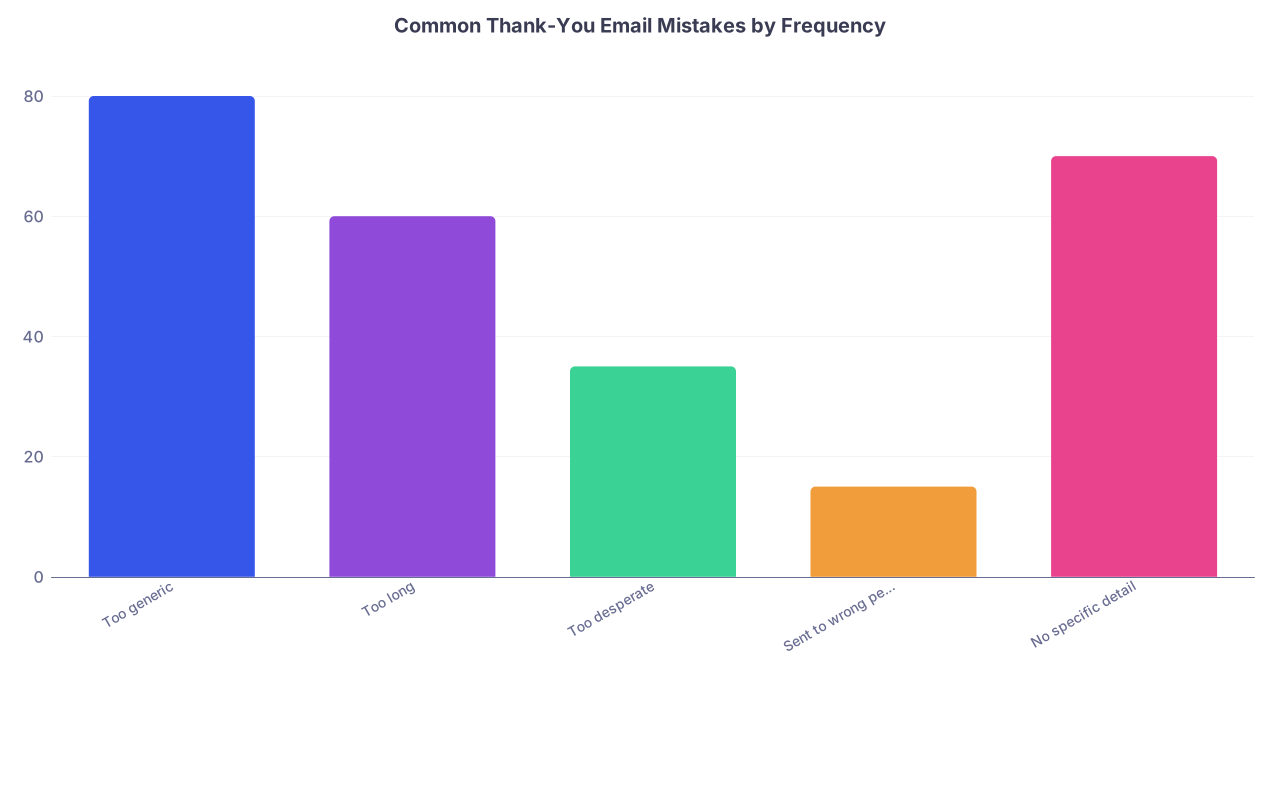
| Category | Value |
|---|---|
| Too generic | 80 |
| Too long | 60 |
| Too desperate | 35 |
| Sent to wrong person | 15 |
| No specific detail | 70 |
Some applicants try to save time by emailing everyone at once.
Original (weak) version:
Subject: Thank you to the interview team
Dear Interviewers,
Thank you all for taking the time to interview me today. It was a pleasure meeting each of you and learning more about your program. I really enjoyed talking to you all and hope to work with you in the future.
Sincerely,
Emily Johnson
This looks lazy. It also forces people into a weird reply-all situation. Faculty do not love that.
Better approach:
- Separate, short email to the PD and maybe APD
- Optional: 1–3 key faculty you had actual conversations with
- You do not need to email every single resident you met on Zoom
Fixed PD email:
Subject: Thank you – January 10 Interview Day
Dear Dr. Lopez,
Thank you for the opportunity to interview at [Program Name] on January 10. I appreciated your overview of the program and especially your comments about preparing residents for both community and academic careers.
The balance of strong inpatient training with protected time for research and scholarship is exactly what I am seeking. After meeting your residents and faculty, I left with a very positive impression of the culture and would be excited to train on your team.
Thank you again for your time and consideration.
Sincerely,
Emily Johnson
MD Candidate, 2025 – Western State University School of Medicine
AAMC ID: 45678901
Fixed faculty email (shorter):
Subject: Thank you – Conversation about cardiology
Dear Dr. Rivera,
Thank you for speaking with me during my interview day at [Program Name]. I enjoyed our conversation about your approach to teaching residents on the cardiology service and your experience with fellows who pursue academic careers.
I appreciate the insight you shared and hope we may have the chance to work together in the future.
Best regards,
Emily Johnson
Short. Specific. Not trying to be a second personal statement.
The Simple Structure That Works Every Time
Here is the skeleton you can reuse. Do not overcomplicate this.
Subject line
Formula:
Thank you – [Date or “Interview Day”], [1–3 word interest]Examples:
- Thank you – Jan 8 Interview, MedEd Focus
- Thank you – Interview Day, Critical Care Interest
- Thank you – December 12 Interview
Greeting
- Use
Dear Dr. [LastName], - If you genuinely are not sure (group coordinator, generic email):
Dear [Program Name] Residency Team,is acceptable.
- Use
Opening sentence (thank + context)
One sentence. Mention the interview day and that you appreciated their time.
Example:
Thank you for taking the time to speak with me during my interview day at [Program Name] on January 4.
Middle 2–4 sentences (specific + alignment)
This is the core. Do three things:
- Mention 1–2 specific things you discussed or observed
- Connect them to your interests or goals
- Optionally, restate your positive impression / enthusiasm
Example:
I especially valued our conversation about your residents’ role in the ICU and the emphasis on bedside ultrasound. My Sub-I in the MICU confirmed my interest in critical care, and your description of how residents progressively gain autonomy in that unit matches the kind of training environment I am looking for.
Closing sentence
Short, polite, and final.
Example:
Thank you again for your time and for sharing more about the program.
Signature block
Consistent, simple format:
- Full name
- MD Candidate, Class of [year] – [School Name]
- AAMC ID
- (Optional) Phone number
Concrete Before-and-After Rewrites By Specialty
You want examples you can actually adapt. Here you go.
Internal Medicine – Hospitalist / Academic Interest
Weak:
Thank you for the interview. I liked learning about the internal medicine program and the residents seemed very nice. I think I would be a great fit for your residency and hope to match there.
Strong:
Dear Dr. Allen,
Thank you for the opportunity to interview at [Hospital] Internal Medicine on January 9. I enjoyed our conversation about how your residents manage complex patients on the teaching services and the support they receive for pursuing academic projects.
Your description of the hospitalist-focused third year and the chance to work closely with faculty on clinical research fits well with my interest in becoming an academic hospitalist. After meeting your residents, I was struck by how collegial and engaged they are with teaching, which reinforced my positive impression of the program.
Thank you again for your time and consideration.
Sincerely,
[Name]
General Surgery – Operative Exposure Emphasis
Weak:
Thank you for the opportunity to interview. I really liked your surgery program and thought the facilities were great. I hope to have the chance to work with you.
Strong:
Dear Dr. Martinez,
Thank you for speaking with me during my interview at [Program Name] General Surgery. I appreciated your candid discussion about operative autonomy, particularly the expectation that chiefs function as junior attendings in the OR.
The high operative volume you described, combined with your emphasis on early exposure to complex cases and structured simulation training, matches the kind of hands-on environment I am seeking. I would be very excited to train in a program where residents graduate with that level of confidence and independence.
Thank you again for your time.
Best regards,
[Name]
Pediatrics – Advocacy / Community Focus

Weak:
Thank you for the interview. I enjoyed meeting everyone and thought your pediatrics program was very impressive. I hope to match there.
Strong:
Dear Dr. Shah,
Thank you for the chance to interview at [Program Name] Pediatrics on December 18. I especially appreciated learning about your residents’ involvement in the community asthma initiative and the school-based health partnerships you described.
My prior work in community health programs and my interest in outpatient pediatrics and advocacy made those aspects of your program stand out. I would welcome the opportunity to continue that work and contribute to your community projects during residency.
Thank you again for your time.
Sincerely,
[Name]
Timing, Logistics, And Who To Email
This is where people quietly sabotage themselves.
When to send
- Ideal: Within 24 hours of the interview day
- Acceptable: Within 48 hours
- Beyond that, still send it, but you lose some impact. Do not skip just because you are late; just keep it clean and professional.
Who to email
- Program Director: Almost always, yes
- Associate PD(s): If you interviewed with them 1:1 or in a small group
- Faculty interviewers: Reasonable to email those with whom you had meaningful conversation
- Residents: Optional. If you had a strong, specific interaction, fine. Otherwise you are not obligated.
Do not email:
- Random faculty you never met
- The entire CC list of everyone in the department
- People pulled from the website “just to show interest”
Separate vs. combined emails
- PD: Always a separate email
- Other faculty: Individual emails are better, but can be short
- Coordinators: You can send a thank-you to the coordinator separately; they actually keep the place running and remember who is decent
What Programs Actually Notice (And What They Ignore)
I will be blunt.
Programs mostly ignore:
- Overly long, emotional messages
- Generic copy-paste emails with no specific detail
- “I will rank you #1” emails from people they are not planning to rank highly anyway
Programs do notice:
- Clean, on-time, specific, professional emails
- Obvious errors (wrong program name, wrong PD name, wrong specialty)
- Signs of actual fit: you mention the ICU, they remember you were clearly into critical care
| Element | Impact Level |
|---|---|
| Specific program details | High |
| Clear interest / fit statement | High |
| Professional tone and format | High |
| Length under ~200–250 words | Medium |
| Timing within 24–48 hours | Medium |
Quick Checklist Before You Hit Send
Run each email through this list. Out loud if needed.
- Does the subject line include “Thank you” and either the interview date or a brief interest tag?
- Did you spell the program name and PD’s name correctly? Twice?
- Is there at least one detail that is clearly unique to this program or conversation?
- Can someone who skimmed your application remember who you are from this email?
- Is the total email under ~200–250 words?
- No rank-list promises unless absolutely honest and intentional?
- Signature block consistent with your AAMC ID?
If you can tick these off, you are fine.
Putting It All Together: A Mini Template Pack
You can adapt these almost word-for-word. Just do not be lazy—swap in specifics.
General template (PD or key faculty):
Subject: Thank you – [Date] Interview, [Interest/Focus]
Dear Dr. [LastName],
Thank you for taking the time to speak with me during my interview at [Program Name] on [Date]. I appreciated [specific thing you discussed / something you observed].
[1–3 sentences linking that element to your background, interests, or goals. Be concrete: prior experiences, specific career direction, or reasons this program’s structure or culture fits you.]
Thank you again for your time and for sharing more about the program.
[Closing: Sincerely/Best regards],
[Full Name]
MD Candidate, Class of [Year] – [School]
AAMC ID: [Number]
Ultra-short faculty follow-up:
Subject: Thank you – [Topic you discussed]
Dear Dr. [LastName],
Thank you for speaking with me during my interview at [Program Name]. I enjoyed our discussion about [specific topic] and appreciated your perspective on [brief point].
I hope we may have the opportunity to work together in the future.
Best regards,
[Name]
Use these as scaffolding, not scripture.

| Step | Description |
|---|---|
| Step 1 | Finish Interview Day |
| Step 2 | Same Day: Jot 2-3 Specific Details per Interviewer |
| Step 3 | Within 24 Hours: Draft PD Email |
| Step 4 | Within 24-48 Hours: Draft Faculty Emails |
| Step 5 | Proofread Names, Program, Details |
| Step 6 | Send Emails Individually |
| Step 7 | Log Sent Emails in Simple Tracker |
FAQ (Exactly 4 Questions)
1. Do programs actually care about thank-you emails, or are they just a formality?
They care enough to notice when you mess them up. Few programs will bump you significantly upward because of a thank-you email, but they absolutely notice professionalism, clarity, and fit. A clean, specific email reinforces a good impression; a sloppy or incorrect one can undercut it. Think of this as “do no harm” plus a small upside if you do it well.
2. Should I say the program is my #1 choice in a thank-you email?
Not in the generic post-interview thank-you. That email is about gratitude and fit, not rank list games. If a program is truly your number one, you can send a separate, concise message closer to rank submission stating that clearly and honestly. But do not make promises to multiple programs, and do not expect that line alone to change their rank list dramatically.
3. Is it better to send one combined email to the whole interview panel or individual emails?
Individual emails are better. One to the PD is non-negotiable. Then send brief, tailored notes to any faculty you had meaningful conversations with. Group “Dear Interviewers” emails look generic and lazy, and they create awkward reply-all chains. Keep it personal and specific, even if that means fewer total emails.
4. What if I forgot to send a thank-you email and it has been a week or more?
Send it anyway, but keep it extra concise and do not apologize excessively. A simple message thanking them for the opportunity, briefly mentioning one specific detail from the interview, and reiterating your interest is sufficient. They will not reorganize their rank list because you were late, but a polite, professional note is still better than radio silence.
Key points:
- Weak thank-you emails are generic, vague, and forgettable. Strong ones are specific, concise, and clearly tied to that program.
- Use a simple structure: clear subject, one sentence of thanks, 2–4 sentences of specific fit, clean closing. And send within 24–48 hours.
- Do not try to win the Match in the email. Just prove you are thoughtful, professional, and a good fit for their program.