
The panic you feel after spotting a typo in a thank‑you email is wildly disproportionate to the actual risk.
Most of the time, the typo is not what hurts you. Your clumsy attempt to fix it is.
You are not getting rejected from residency because you wrote “it was a plesure” instead of “pleasure.” But you can make yourself look worse by overreacting, sending three follow‑ups, or writing a weirdly dramatic apology email.
Let me walk you through how to fix this like a sane, competent adult physician-in-training—not like a panicked MS4 at 1:30 a.m.
Below is a simple framework: identify the damage, choose the right level of response, then use tight scripts that do not dig the hole deeper.
Step 1: Figure Out What Actually Happened
Before you do anything, you need to classify the “typo situation.” Most mistakes fall into one of four buckets:
| Level | Example | Risk |
|---|---|---|
| 1. Trivial | 'teh' instead of 'the' | Essentially none |
| 2. Mild | Misspelled name once | Very low |
| 3. Moderate | Wrong program name | Non-zero |
| 4. High | Inappropriate / wrong person / wrong specialty | Needs fixing |
Level 1: Trivial Typos
Examples:
- “It was greta meeting you”
- Double word (“the the”)
- Missing comma or small grammar issue
- Minor autocorrect oddity that keeps your meaning clear
Reality check: Nobody cares. Faculty type fast too. Their emails are full of garbage. This will not move your rank up or down.
Default action: Do nothing.
Level 2: Mild But Personal
Examples:
- You spelled the interviewer’s last name wrong, but the email clearly went to the right person.
- You wrote “Dr. Smith” instead of “Dr. Smyth.”
- You slightly mangled the program coordinator’s name.
Annoying, yes. Catastrophic, no.
Default action: Usually do nothing.
Exception: If the only sentence in your email that references them personally has the error (e.g., “Dr. Smyth, I enjoyed meeting with you today” spelled incorrectly), consider a light‑touch, one‑line correction if you catch it immediately (within a couple of hours).
Level 3: Moderate — Program or Institution Errors
Examples:
- You wrote: “I am very interested in the Internal Medicine program at [Wrong Hospital Name].”
- You mentioned a different city: “I would be thrilled to train in Chicago,” but the program is in Cleveland.
- You obviously reused text from another program and left their name in.
This flags you as careless. It does not automatically kill your chances, but it is the first level where a careful, minimal correction can actually help.
Default action: One well‑crafted correction email. Then stop.
Level 4: High-Risk Mistakes
Examples:
- You sent a thank-you meant for Program A to Program B, name-dropping another institution or PD.
- You referred to the wrong specialty (“your pediatrics program” when it is EM).
- You included something that reads as unprofessional or offensive due to a typo or bad phrasing.
- You accidentally attached the wrong document (e.g., different program’s letter or your rank list).
This is where you must respond quickly, clearly, and then move on. You are doing damage control, not begging for forgiveness.
Default action: Prompt, direct apology + clarification. No drama.
Step 2: Decide Whether To Send a Follow-Up at All
Here is the rule I have watched work, year after year:
If they can read your original email and still understand that you are professional, interested in their program, and not confused about who they are or what they do, you probably do not need any correction.
Only send a second email if:
- The typo changes who the email seems to be about (wrong program, wrong institution, wrong specialty), or
- The typo or mistake would make a reasonable person question your professionalism, judgment, or genuine interest.
Everything else? Live with it.
Step 3: Scripts For Different Levels Of Damage
Now the part you actually want: the exact words.
Use these as templates. Do not over-customize to the point of writing an essay. Short, calm, competent is the goal.
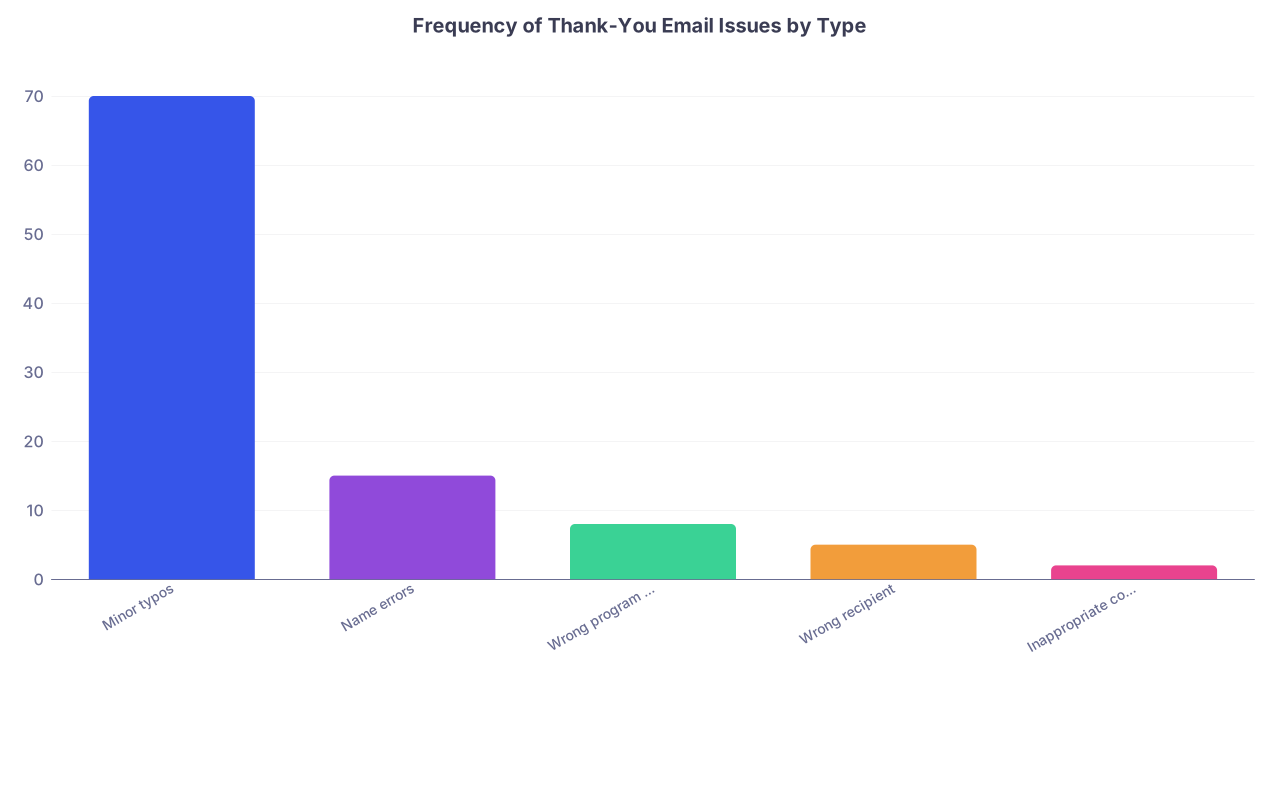
| Category | Value |
|---|---|
| Minor typos | 70 |
| Name errors | 15 |
| Wrong program name | 8 |
| Wrong recipient | 5 |
| Inappropriate content | 2 |
Scenario A: Small Typo, No Real Confusion (Do Nothing)
Example:
- “Thank you again for you time today.”
- “I am excited about opportunties in your program.”
Action plan:
- Close your laptop.
- Do not send a correction.
- Fix your template for future emails.
- Go to bed.
No script needed, because you are not responding. The “fix” is not making it worse.
I have seen students tank their own impression more by sending a second neurotic email about “I just realized I said ‘you’ instead of ‘your’” than if they had done nothing.
Scenario B: You Slightly Botched a Name
Let us say you wrote “Dr. Stuart” instead of “Dr. Stewart,” or you missed a letter.
If you notice within 30–60 minutes and it is bothering you:
Subject line options (pick one):
- “Quick correction”
- “Minor correction to earlier email”
Script:
Dr. Stewart,
I realized I misspelled your name in my note a few minutes ago—my apologies for the oversight.
Thank you again for taking the time to speak with me today. I appreciated our conversation about [specific topic you discussed].
Sincerely,
[Your Name]
Key points:
- Acknowledge it once.
- Do not over-apologize.
- Re-anchor on something substantive (the conversation topic).
- Do not do this a day later. If you are seeing it the next morning, let it go.
If you are tempted to write “I’m usually very detail-oriented…” — stop. That line is overused and sounds insecure. Just fix it and move on.
Scenario C: Wrong Program or Institution Name (Moderate Fix)
This is the most common scary mistake. You copy-pasted from Program A’s email, forgot to swap the name, and sent it to Program B.
Example original line:
I would be thrilled to train at the Internal Medicine Residency at Riverside Medical Center.
But you actually interviewed at Riverbend Medical Center.
This is worth correcting.
Timing:
As soon as you notice, ideally same day or next morning.
Subject line options:
- “Clarification from [Your Name]”
- “Correction to my earlier thank-you email”
Script:
Dr. [Last Name],
I wanted to send a brief correction to my thank-you email from earlier today. In that note, I mistakenly referenced “[Wrong Name]” instead of [Correct Program Name] at [Correct Institution]. My apologies for the error.
I was referring to your [Specialty] residency program at [Correct Institution], and I remain very interested in the opportunity to train there. I particularly appreciated our discussion about [specific topic].
Thank you again for your time and consideration.
Sincerely,
[Your Name]
AAMC ID: [Optional but helpful]
Important details:
- Name the error once. Cleanly.
- Clearly state the correct program name.
- Reaffirm your interest without sounding dramatic.
- Resist the urge to explain why the mistake happened (“I was tired,” “I had many interviews,” “I was writing from my phone”). Explanations often sound like excuses.
If you sent multiple thank-you emails to different faculty at that same program with the wrong name, you can send the correction to each or to the program coordinator/PD with them CC’d. That is a judgment call; I lean toward sending to the PD and coordinator with a clean correction.
Scenario D: You Emailed the Wrong Program Entirely
This is uglier, but still salvageable in how you carry yourself.
Example:
You interviewed at University Hospital. You accidentally send:
Dear Dr. Lopez,
Thank you again for the opportunity to interview with the Internal Medicine residency at City Medical Center. I was very impressed by your program…
But Dr. Lopez is at University Hospital, not City Medical Center. And you just praised the wrong shop.
You must correct this. Not because it will definitely save you, but because leaving it uncorrected looks oblivious.
Subject line:
- “Correction to earlier email sent in error”
Script:
Dr. Lopez,
I owe you a brief clarification. The note I sent a few minutes ago included the wrong institution name due to my error using a prior template.
To be clear, I am referring to my interview with the Internal Medicine residency at University Hospital and the opportunity to train on your faculty’s diverse inpatient services, which we discussed. I apologize for the confusion.
Thank you again for your time and for sharing more about the program.
Sincerely,
[Your Name]
Does this fully erase the mistake? No. But you now look like someone who:
- Noticed the error.
- Took responsibility.
- Corrected it cleanly without a meltdown.
That is about as good as you can reasonably do.
Scenario E: You Mentioned the Wrong Specialty
Example:
- You interviewed for Internal Medicine but wrote “your Pediatrics program.”
- You did a dual interview day and swapped them.
Again, this is a moderate to high‑risk error. But fixable in tone.
Subject line:
- “Clarification from [Your Name] regarding my interview”
Script:
Dr. [Last Name],
I wanted to send a quick clarification. In my earlier thank-you email, I mistakenly referred to your program as a [Wrong Specialty] residency. I apologize for that error.
I was referring to the [Correct Specialty] residency, and I remain very interested in the training opportunities we discussed, especially [specific topic you covered—e.g., your ICU curriculum, your emphasis on ambulatory training].
Thank you again for your time and for the interview.
Sincerely,
[Your Name]
Short. Calm. Correct.

| Step | Description |
|---|---|
| Step 1 | Notice typo |
| Step 2 | Do nothing |
| Step 3 | Optional brief correction if immediate |
| Step 4 | Send correction email |
| Step 5 | One email only, no follow-up |
| Step 6 | Does it change meaning or program? |
| Step 7 | Wrong name or institution? |
Scenario F: You Sent It to the Wrong Recipient
Two common flavors:
- You emailed the PD of Program A but thanked them for something that clearly happened at Program B.
- You addressed the coordinator from Program A but wrote about faculty from Program B.
You need two steps here:
- Clarify with the actual recipient.
- Decide whether to alert the program you meant to send it to.
Step 1: Fix it with the accidental recipient
Subject:
- “Apology for misdirected email”
Script:
Dr. [Last Name]/[Coordinator Name],
I apologize—the thank-you note I just sent was intended for another program and was sent to you in error. I appreciate your understanding and regret the confusion.
Respectfully,
[Your Name]
You do not need to name the other program. Do not over-explain.
Step 2: Send the intended thank-you (correctly this time)
When you send the proper thank-you to the program you meant to thank, you do not need to mention “I accidentally sent this to someone else first.” That adds nothing useful.
Just send a clean, standard thank-you.
Scenario G: Something Reads as Unprofessional or Inappropriate
Sometimes the problem is not a simple typo. It is wording that can be misread.
Examples:
- Autocorrect changed “I hope to match there” to “I hope you match there.”
- A missing “not” completely reversed your sentence.
- You made a joke that sounded funnier in your head than in print.
- Swear word slipped in via voice dictation. Yes, I have seen it.
If the content could be:
- Interpreted as rude,
- Interpreted as dismissive of their program,
- Interpreted as unprofessional,
you should send a short, direct clarification.
Subject:
- “Clarification regarding my prior email”
Script:
Dr. [Last Name],
I wanted to clarify a line from my thank-you email earlier today. My wording/autocorrect error made it sound as though [briefly state the problematic implication]. That was not my intent.
I appreciate the opportunity to interview with your program and remain very grateful for your time.
Sincerely,
[Your Name]
Example filled out:
…My wording made it sound as though I “hoped you match there,” which was not my intent. I meant that I sincerely hope I have the opportunity to match at your program.
Do not write a multi-paragraph explanation or recount the entire email. One line of clarification is enough.

Step 4: One Email Only — Then Stop
Programs are not cataloguing your micro-errors. But they will absolutely remember if you send five anxious follow-ups about a comma.
The rule:
- You get one correction email.
- No follow-up to the correction.
- No “just checking that you got my last email.”
- No “I am really worried this ruined my chances.”
You are modeling how you will behave as a resident when you inevitably make small errors on notes, orders, and communication. Responsible acknowledgment? Good. Neurotic spiraling? Not good.
Send the correction. Then release it.
Step 5: Prevent This From Happening Again
You will not achieve typo‑free perfection while doing 12 interviews in 4 weeks. But you can stop making the avoidable, reputation‑hurting errors.
Here is a tight protocol:
1. Use a Smart Template System
Have a master thank-you template with clear swap‑out zones:
- [Program Name]
- [Institution]
- [Specialty]
- [Faculty Name]
- [Specific topic we discussed]
Before each interview day, pre‑create:
- PD template
- Faculty template
- Coordinator template
Then after the interview, just add 1–2 custom lines about each conversation.
2. Freeze Before You Hit Send
Adopt a simple three‑step check routine for every thank-you:
- Name check
- Subject line: correct?
- Salutation: “Dr. [Correct Last Name]” or “Ms./Mr. [Coordinator]”
- Program check
- Program name and institution are correct.
- Correct city if mentioned.
- Correct specialty (IM vs FM vs Peds).
- Scan for obvious garbage
- Look for underlined red spellcheck marks.
- Read the first and last sentence out loud. Out loud catches weird phrasing.
Time cost: 60–90 seconds per email. Worth it.
3. Avoid Editing On Your Phone When You Are Exhausted
Phone keyboard + autocorrect + post‑interview fatigue is how 80% of the worst typos happen.
If possible:
- Draft on a laptop.
- If you must do it on your phone, keep emails shorter and more generic. Do not attempt intricate, customized paragraphs from the Uber back to the airport.
4. Run a Sanity Check on Reused Phrases
Any time you paste from an old email:
- Search for the prior program name and city. Replace all.
- Search for the old PD or faculty name. Replace all.
Very literal step: use Ctrl+F / Command+F to search the document for that old name before sending.
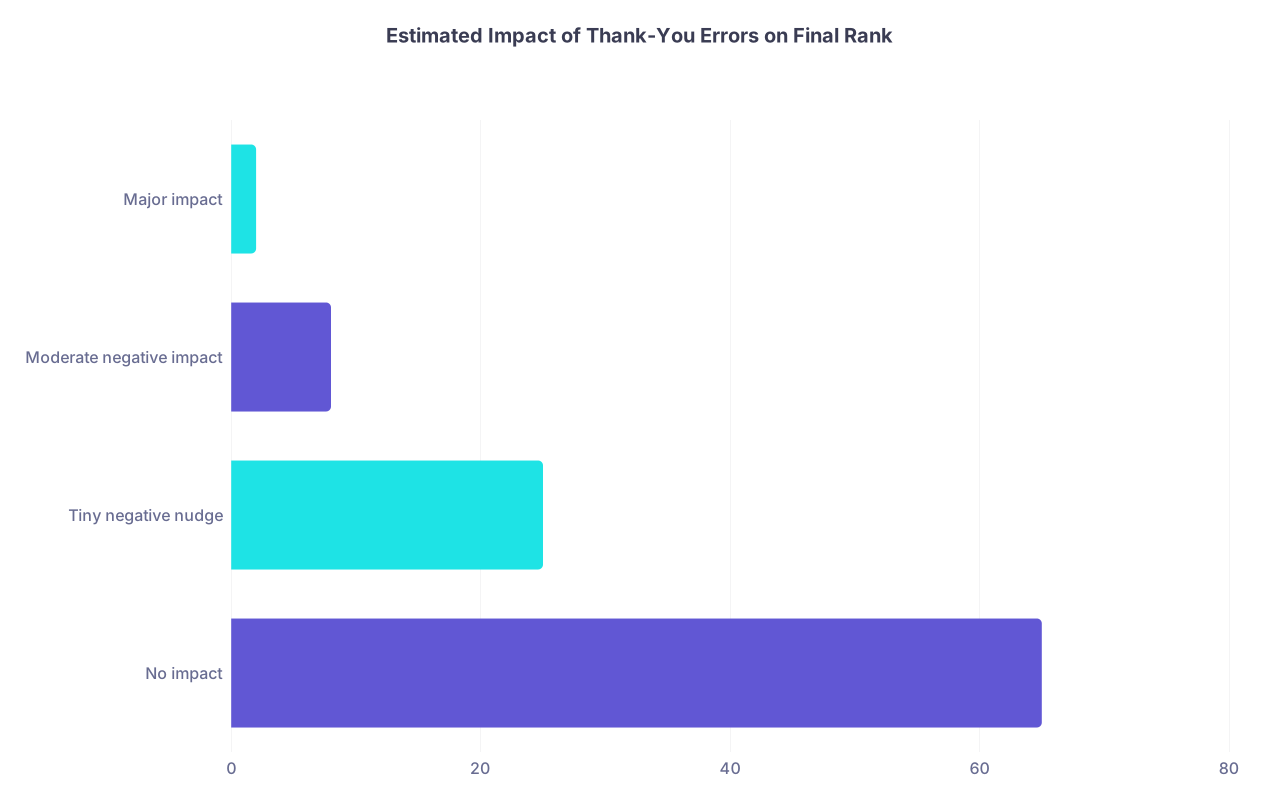
| Category | Value |
|---|---|
| No impact | 65 |
| Tiny negative nudge | 25 |
| Moderate negative impact | 8 |
| Major impact | 2 |
Perspective: How Much Does This Really Matter?
Here is the part few people will say aloud: thank-you emails are, at best, a small tie-breaker. Not a primary driver of your rank.
What actually moves the needle:
- Your performance on interview day.
- Letters of recommendation.
- Your application strength and perceived fit.
- How your personality came across.
Faculty often:
- Skim thank-yous quickly.
- Read them once, on their phone.
- Remember only the general tone: “professional, interested, pleasant.”
A clean, typo-free email will not rescue a weak interview. A small typo will not sink a strong one.
The only time this becomes a real problem is when:
- The error suggests you are not really interested in their program (wrong name, wrong city, wrong specialty), or
- The follow-up makes you look unhinged.
So your actual job is not to be perfect.
Your job is to:
- Show basic professionalism.
- Recover gracefully when you slip.
- Avoid turning a small bruise into open-heart surgery.

Quick Reference: Damage Control Scripts by Scenario
Here is a compressed cheat sheet you can screenshot.
| Situation | Action | Script? |
|---|---|---|
| Minor typo, meaning clear | Do nothing | No |
| Slight misspelling of name | Optional brief correction if immediate | Short correction |
| Wrong program or institution name | Send one correction email | Yes |
| Wrong specialty mentioned | Send one correction email | Yes |
| Wrong recipient (sent to other program) | Apologize to accidental recipient | Yes, very brief |
| Inappropriate/ambiguous wording | Clarify intent once | Yes |
Final Takeaways
- Most typos do not need fixing. The ones that do get a single, calm correction—nothing more.
- Own the mistake briefly, correct the record, and pivot back to your interest in the program. No excuses, no drama.
- A simple pre-send checklist (name, program, specialty) will prevent 90% of serious errors and keep you from having this exact panic again.
FAQ
1. Could a single thank-you email typo actually knock me off a rank list?
Extremely unlikely. A trivial typo will not change your rank. A glaring mistake, like naming the wrong program or city, might slightly lower your standing at a marginal program if they are already lukewarm, but it is rarely decisive by itself. Your interview performance and overall fit matter far more. The real risk is not the typo but looking unstable in your attempts to fix it.
2. What if I notice the typo days later—should I still send a correction?
Usually no. If more than 24 hours have passed and the mistake did not fundamentally misidentify the program, institution, or specialty, let it go. Sending a correction days later just re-surfaces an issue they probably never noticed and makes you look anxious. The exception is a serious misidentification (“your pediatrics program” instead of “internal medicine”); in that case, a short, direct clarification is still reasonable, even after a couple of days.