
Most residents botch post‑interview “clarifications” and quietly hurt their rank, not help it.
You can fix that. And you can use thank‑you emails to safely correct or clarify a misunderstood answer—if you follow a strict, disciplined protocol.
I have seen both ends of this:
- The applicant who turned a shaky answer into a strength with one sharp, restrained email.
- The applicant who essentially sent a panicked Step 2 essay and got labeled “high maintenance” in three minutes.
Let me walk you through how to be the first type. Not the second.
1. The Real Risk: Why Clarifications Backfire So Often
Before you write anything, you need to understand what you are up against.
After interviews, programs are watching for:
- Emotional control under pressure
- Judgment
- How easy (or hard) you will be to work with
A follow‑up clarification is not neutral. It is a data point.
Used badly, it screams:
- “I ruminate over everything.”
- “I cannot let go.”
- “I might be a documentation nightmare.”
Used correctly, it says:
- “I communicate clearly.”
- “I am accountable.”
- “I can fix misunderstandings concisely and professionally.”
Here is the core principle:
You are not rewriting history. You are offering a brief, factual clarification as part of a normal, gracious thank‑you.
Anything that looks like you are trying to re‑interview by email is a problem.
2. Decide: Should You Clarify At All?
Most candidates overestimate how bad their “bad answer” was. Faculty forget half the details before they even get to the debrief.
So the first step is triage. You only clarify in specific situations.
A. When You Should Consider Clarifying
Objective, high‑stakes inaccuracies
- You gave a wrong fact about your CV that could look like dishonesty.
- You misstated a score, date, or credential.
- You misdescribed your visa status or graduation year.
Example:
“I said I graduated in 2022, but I actually graduated in 2021.”
That is worth fixing. It affects how they document you.Professionalism or ethics misunderstandings
If your answer could be reasonably interpreted as unprofessional or ethically shaky, clean it up.
Example:
- You tried to explain a system issue and it sounded like you were blaming nurses.
- You described a boundary situation with a patient and you can hear now how it could sound careless.
Program‑fit misalignment that is clearly fixable
- You answered a question about career goals too narrowly (e.g., sounded like you only want a hyper‑subspecialized path that their program does not support).
- You made it sound like you will definitely move away immediately after residency, when actually you are quite open.
This matters for ranking. They care if you will fit what they can realistically offer.
B. When You Should Not Clarify
Minor clinical details
You fumbled which guideline version you quoted for sepsis, or forgot one step in a workup. Let it go.
Correcting this in an email reads as obsessive and insecure.Style or personality answers
Things like: “What are your strengths?” “Tell me about yourself.” “Why our program?”
If you think you could have said it better, join the club. Do not try to redo it in writing.Anything that requires more than 3–4 clean sentences to fix
If you cannot clarify succinctly, you will end up arguing with your own past answer. That looks messy. And needy.
Interviewer did not actually misunderstand; you just regret your answer
If your answer was honest but not glamorous, do not try to “walk it back.” That smells insincere.
3. Timing and Target: When and Whom to Email
You are sending a thank‑you email within 24–72 hours of the interview. That window is ideal. Memory is still fresh, but you are not replying from the parking lot in a panic.
A. Optimal Timing
- Same day, late evening – Acceptable if:
- Interview finished in the morning / early afternoon.
- You are calm and have drafted with care.
- Next day – Ideal. You have slept. You can re‑read with a clear head.
- 48–72 hours – Still fine. After that, it starts to feel retroactive and overthought.
If the misunderstanding is serious (for example, ethics question gone sideways), aim for within 24 hours.
B. Who Is the Right Recipient?
You send the clarification to the person who asked the question or seemed confused, not the entire panel.
Options:
Individual interviewer
Best when:
- It was a one‑on‑one or small‑group interaction.
- The misunderstanding was clearly with that person.
Program coordinator (with a light touch)
Only if:
- You do not have the interviewer’s email.
- Or they told all communication should go through the coordinator.
In that case you write:
“I would be grateful if you could forward this brief thank‑you to Dr. X, who interviewed me yesterday.”Program director
Only if:
- The PD directly asked the question you misunderstood.
- Or it directly involves PD‑level issues (e.g., disciplinary event, professionalism concern).
Do not copy everyone. Do not send a mass BCC.
4. The Template: How to Structure a Safe Clarification
You are writing a thank‑you email with a one‑paragraph clarification baked in. Nothing more.
Think of it in 4 tight parts:
- Short, specific subject line
- Sincere, simple thanks
- One clear clarification paragraph
- Professional close
Here is the skeleton.
A. Subject Line
Keep it boring and neutral:
- “Thank you – [Your Name], [Specialty] Interview [Date]”
- “Thank you for the interview – [Your Name]”
Do not write: “Clarification about my answer” or “Correction from today.” You are not trying to spotlight the issue.
B. Opening: Pure Gratitude
2–3 sentences. No drama.
Example:
Dear Dr. Smith,
Thank you for taking the time to speak with me yesterday during my interview day at [Program Name]. I appreciated your questions about resident education and your description of the ICU rotation.
That is enough. You have set a normal tone.
C. The Clarification Paragraph
This is the core. It must follow three rules:
- Name the moment briefly
- Correct it precisely
- Stop talking
Here are concrete, safe templates for different scenarios.
1. Correcting an Objective Inaccuracy
I realized afterward that I misspoke during our discussion about my research year. I stated that the manuscript from my quality improvement project had been accepted, but it is currently under review at [Journal Name]. I apologize for the confusion and wanted to ensure you had the accurate information.
No excuses. No justification. Just accuracy.
2. Clarifying Ethics / Professionalism
I also wanted to clarify one part of my response to your question about managing conflict on the care team. In the moment I focused on the communication challenges, but I did not clearly state that I took responsibility for my role in the situation and followed our institution’s chain of command. My intent was to highlight what I learned about transparent communication and shared decision making, not to shift blame to colleagues.
Notice what this does:
- Acknowledges the specific area
- States the intended principle (responsibility, chain of command)
- Keeps it brief
3. Fixing Program‑Fit Concerns
On reflection, I realized my answer about long‑term plans may have sounded more rigid than I intended. While I am interested in [subspecialty/academic path], I am genuinely open to different career directions that may develop during residency, and I value strong general training above all. I would be very excited to train at a program like [Program Name] that provides broad exposure and strong mentorship.
Key idea:
You are not inventing a new person. You are clarifying emphasis.
D. Closing: Re‑Anchor on Fit and Appreciation
Simple, 2–3 lines:
Thank you again for your time and for sharing more about the culture of the program. My conversation with you reinforced my strong interest in [Program Name].
Sincerely,
[Your Name]
AAMC ID: [Number] (optional but smart)
[Email] | [Phone]
That is it. No ranking statements. No “I will rank you highly” declarations. Just interest and professionalism.
5. Concrete Examples: Before and After
Let me show you what people actually send and how to fix it.
Scenario 1: Misstated USMLE Step Score
Bad version (panic email):
Subject: Correction!!!
Dear Dr. Lee,
I am so sorry but I realized I told you my Step 2 CK score was 252 but actually it is 245. I was so nervous during the interview and just blanked and obviously I know my own score but I said it wrong. I hope you understand that I was anxious and this is not typical of me and I studied very hard and improved a lot from Step 1 (which was 232) and I really care about accuracy. Please let the committee know that this was an honest mistake and not intentional. I would never misrepresent my scores and I have attached my score report for you to verify.
Sincerely,
[Name]
Problems:
- Subject line screams disaster.
- Overexplains.
- Brings up more scores than necessary.
- Feels like a self‑defense statement.
Fixed version (tucked into a thank‑you):
Subject: Thank you – [Your Name], Internal Medicine Interview 1/5
Dear Dr. Lee,
Thank you for speaking with me yesterday during my interview at [Program Name]. I enjoyed our discussion about how residents are supported in pursuing research during training.
I also realized afterward that I misspoke when I mentioned my Step 2 CK score. My score is 245, not 252. I apologize for the error and wanted to ensure that your records are accurate.
Thank you again for your time and consideration. Our conversation reinforced my strong interest in [Program Name].
Sincerely,
[Name]
Short. Clean. Professional. No drama.
Scenario 2: Ethics Question Came Across Poorly
Interviewer asked: “Tell me about a time you saw something you thought was wrong in patient care.”
You told a story about an attending decision. On the drive home, you realize you may have sounded like you were casually criticizing your staff.
Bad version:
I just wanted to explain more about the story I told during the interview. The attending in question was actually very reasonable and I did not mean to suggest that they were acting unethically or that I would ever disrespect authority. There were a lot of factors I did not have time to explain and I was also very stressed that day and I think that affected how I came across...
Stop. This spirals.
Better version:
During our conversation you asked about a time I spoke up about a concern in patient care. I realized afterward that my brief description could have sounded more critical of my attending than I intended. My goal in that situation was to raise my concern respectfully and privately, follow our institution’s policies, and ultimately support a safe plan for the patient while maintaining trust within the team. I appreciated your question because it reminded me how important it is to balance speaking up with professionalism.
You have:
- Named the issue
- Reframed your values
- Stopped talking before you dig deeper
6. Quiet Rules That Make or Break These Emails
There are a few “soft” rules that separate strong applicants from anxious ones.
Rule 1: One Clarification Per Email, Maximum
If you think you need to correct three different things from the same interview, the problem is not email. The problem is your self‑assessment.
Pick the most consequential misunderstanding. Address that. Leave the rest.
Rule 2: No Attachments
Do not attach:
- CVs
- Updated abstracts
- Step score reports
- Letters
You are not building an appeal packet. You are sending a thank‑you note.
If the program wants documentation, they know how to ask.
Rule 3: No Emotion‑Dumping
You do not write:
- “I have been so anxious since the interview thinking about this.”
- “I really hope this does not change how you see me.”
- “I am devastated that I might have messed this up.”
They are not your therapist. They are evaluating whether they trust you in their ICU at 3 AM.
Rule 4: Accept That You Cannot Control Everything
You will never perfectly “optimize” how they interpret every word you said.
Your job is to show:
- Maturity
- Clarity
- Respect for their time
That matters more than retroactively getting 100% credit for a question.
7. Workflow: Step‑By‑Step Protocol To Follow After Any Interview
Here is a concrete process you can run every time. No guesswork.

| Step | Description |
|---|---|
| Step 1 | Finish Interview Day |
| Step 2 | Same Day: Quick Notes |
| Step 3 | Send Standard Thank-you Only |
| Step 4 | Sleep and Reassess Next Day |
| Step 5 | Draft Thank-you with Clarification Paragraph |
| Step 6 | Wait 1-2 Hours, Re-read for Tone |
| Step 7 | Send to Specific Interviewer or Via Coordinator |
| Step 8 | Stop Emailing About It and Move On |
| Step 9 | Any Major Misunderstanding? |
| Step 10 | Still Significant and Fixable in 3-4 Sentences? |
Let us break that down.
Step 1: Immediately After the Interview
On your phone or notebook, write:
- Who you met (names, roles)
- Two details you discussed with each person
- Any answer that felt genuinely problematic or misunderstood
Do not email yet. Just capture.
Step 2: Same Night – Initial Gut Check
Ask yourself:
- Did I say something that could be factually wrong or ethically off?
- Did the interviewer visibly react with confusion or concern?
- Does this affect my integrity, professionalism, or accurate record?
If the answer is “maybe,” park it. Sleep.
Step 3: Next Morning – Rational Review
Re‑read your notes.
Ask:
- Is this something they are likely to remember?
- Is this something that, if misinterpreted, could hurt my evaluation significantly?
- Can I correct or clarify it in 3–4 clear sentences?
If yes to 2 and 3, draft the thank‑you with a clarification paragraph.
If no, send a normal thank‑you only.
Step 4: Draft, Then Cool Off
Write your draft. Then:
- Walk away for at least 30–60 minutes.
- Re‑read out loud once. You will hear if you sound defensive.
Edit:
- Shorten long explanations.
- Remove apologies beyond one sentence.
- Strip emotional language.
Step 5: Send Once. Then Let It Go.
After you send:
- Do not send a second follow‑up about the same issue.
- Do not ask, “Did you receive this?”
- Do not ask them to confirm that it will not affect your ranking.
You did your job. Move on to the next program.
8. Quick Reference: Do’s and Don’ts
| Do This | Avoid This |
|---|---|
| Clarify objective errors (scores, dates, status) | Re-argue subjective answers (strengths, “why us”) |
| Keep clarification to 3–4 sentences | Writing an essay or multi-paragraph defense |
| Address email to the specific interviewer | CC’ing half the department |
| Embed clarification inside a normal thank-you | Subject lines like “URGENT CORRECTION” |
| Use neutral, factual language | Emotional dumping or over-apologizing |
| Send within 24–72 hours | Emailing weeks later about minor issues |
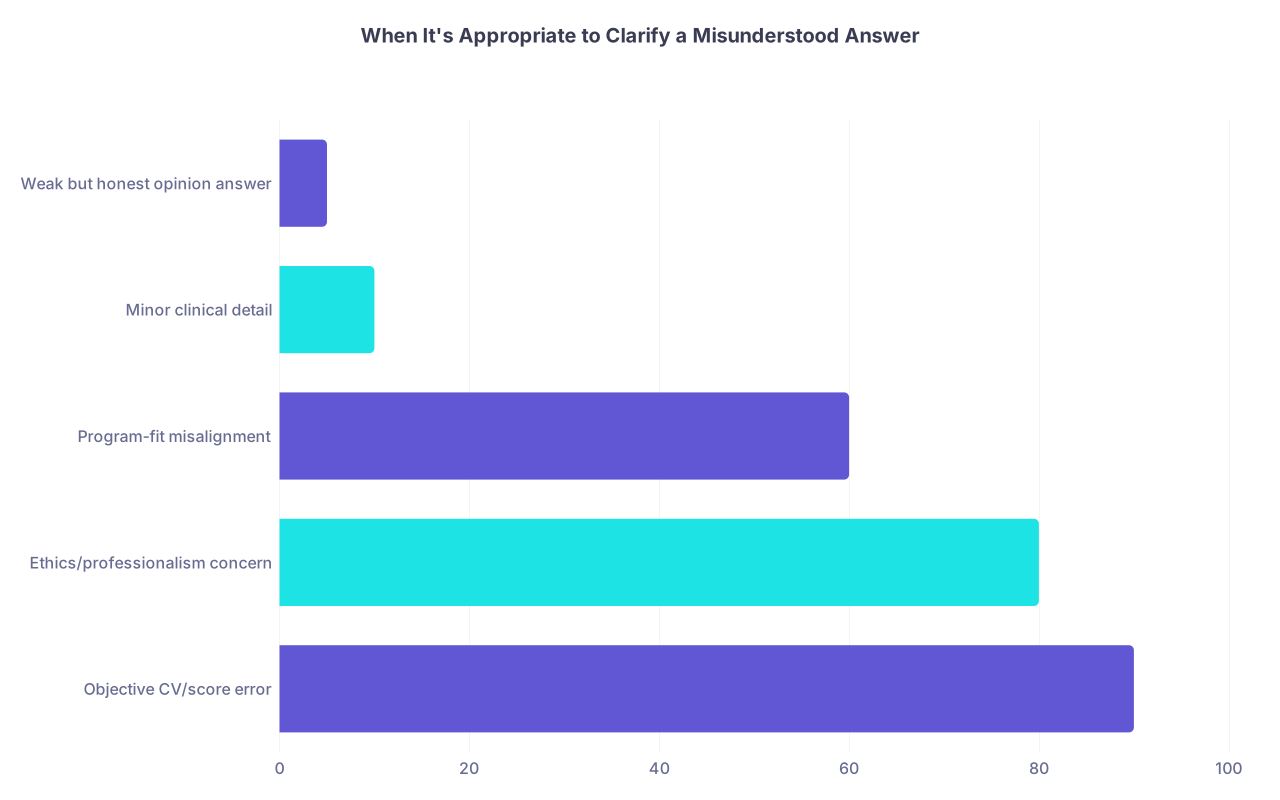
| Category | Value |
|---|---|
| Objective CV/score error | 90 |
| Ethics/professionalism concern | 80 |
| Program-fit misalignment | 60 |
| Minor clinical detail | 10 |
| Weak but honest opinion answer | 5 |
(Think of those numbers as “appropriateness scores” out of 100. Top three = usually worth considering. Bottom two = usually leave alone.)
9. Final Thoughts: What Programs Actually Remember
Residents often imagine that faculty replay every answer in their heads for days. They do not. I have watched debriefs.
They remember:
- How you made them feel
- Whether you seemed honest
- Whether you seemed like someone they trust with patients and colleagues
A precise, restrained clarification inside a professional thank‑you email signals all three:
- You care about accuracy.
- You are self‑aware.
- You can fix issues without drama.
That is exactly how you want to come across.