
It’s 11:47 PM. You just finished your interview day at a program you’d really like to match at. You’re exhausted, wired, replaying every awkward laugh and every moment you said “great question.”
Now you’re staring at a blank email draft labeled “Thank You – Interview Today.”
You think:
“If I say more, they’ll remember me.”
“If I add this extra update, they’ll know I’m serious.”
“If I clarify that answer, they won’t misjudge me.”
This is exactly where students start quietly tanking themselves. Not with anything dramatic. With a single email that makes a PD think:
“Yeah. This one’s going to be work.”
Let me walk you through what actually happens behind the scenes when your follow-up email hits a PD’s inbox—and the specific phrases, moves, and “updates” that make you look like a future problem resident, even if your scores and letters are stellar.
What Programs Really Do With Your Emails
First truth: most follow-up emails don’t help you. They just keep you neutral.
A normal, short, polite email? Nobody is ranking you higher for that. At 10:30 PM on a Monday, a PD is not thinking, “Wow, this is a strong candidate, but that eloquent thank-you note just bumped them above the Hopkins grad.”
Here’s the real workflow in a lot of programs:
- Coordinator screens most emails, forwards only a subset to PD or faculty.
- PD skims subject line and first 2–3 sentences. That’s usually it.
- Anything that smells like drama, demands, anxiety, or pressure? That gets remembered. And not in the way you want.
They’re not looking for reasons to love you in follow-up. They’re subconsciously scanning for reasons you’d be a pain at 2 AM when an ICU family is yelling, the ED is paging nonstop, and now they have to deal with your “urgent clarification.”
So you need to understand the quiet red flags. Because no one tells you these, but they absolutely move people down on rank lists.
The Hidden Red Flags in “Normal” Follow-Up Emails
Everyone worries about being too informal or forgetting to send a thank-you. Those are not the things that get you labeled as a future problem resident.
Let’s talk about the stuff that does.
1. The Needy Clarifier: “I Just Wanted to Follow Up On…”
This is the email that tries to retroactively edit the interview.
It usually sounds like:
- “I wanted to clarify my answer about my leave of absence.”
- “I realized I didn’t fully explain my research experience.”
- “I hope I didn’t come off as uninterested when I mentioned I’m applying broadly.”
On your side: you think you’re fixing something.
On their side: they see someone who can’t let things go, can’t tolerate ambiguity, and will send 8 MyChart messages for a sore throat.
What PDs and faculty read between the lines:
- Poor distress tolerance
- Tendency to ruminate
- Likely to over-email attendings, chiefs, and program leadership every time something feels “off”
One PD I know in IM literally said during ranking:
“Remember the one who sent that follow-up novel to ‘clarify’ their LOA? Too much maintenance. Down 10 spots.”
If you truly must clarify something serious (like a factual error about dates, exam status, visa), it should be:
- Short
- Factual
- Without emotion or apology spiral
Anything more than 2–3 sentences and it starts to smell like anxiety management rather than actual clarification.
2. The Rank-Pressure Gambler: “If You Rank Me Highly, I Will…”
This one gets talked about more, but students still do it every year.
Variants include:
- “If I match at your program, I will definitely stay as faculty.”
- “If you rank me highly, I will definitely rank you #1.”
- “Your program is my first choice and I will rank you #1.” (Sent to three programs.)
Here’s the part you don’t see: PDs talk. Especially in small to mid-sized specialties.
I’ve been in the room where two PDs laughed and said, “Yeah, he told us we were his absolute #1. Apparently he said the same thing at your place.”
Result? Both dropped him. Not because he broke some official rule; because he showed poor judgment and dishonesty before even starting residency.
Also, the tone matters. Programs don’t like to feel cornered. Any email that even subtly implies:
- I’ll do X if you do Y
- You’re my #1, please confirm I’m ranked highly
- I hope my strong interest is reflected in your rank list
…feels like you don’t understand how the Match actually works. They don’t need the pressure. They remember the pressure.
If you love a program, the safe version is:
“I would be thrilled to train at [Program].”
or
“[Program] is one of the places I’d be most excited to match.”
Still true, still positive, no pressure, no transactional vibe.
3. The Oversharer: “I Just Want to Be Completely Transparent…”
Big red flag. And you think it’s honesty.
Common pattern:
- Long paragraphs about mental health, relationship issues, family drama, conflict with a prior program, detailed explanations of “toxic” environments
- Story of how they were “mistreated” at a previous institution
- Emotional disclosures way beyond what’s needed
The issue is not that you sought help or had struggles. That by itself is not the problem.
The problem is judgment about audience, timing, and level of detail.
Program directors ask themselves two questions:
- Will this person handle stress and conflict professionally?
- Will this person overshare with patients, nurses, staff, and then blame others when it backfires?
The moment your email starts to feel like a therapy note or a venting session, you’ve crossed into “future problem resident” territory.
Faculty will literally say:
“If this is what they put in writing to a PD they just met, what are they saying to nurses on night float?”
If you have a red flag that must be explained (LOA, remediation, prior career, major gap), that belongs in the application or in a concise in-person or virtual conversation—not a post-interview emotional essay.
4. The Boundary-Blurrer: “Here’s My Cell, I’d Love to Grab Coffee Sometime”
Another one that programs silently dislike but don’t tell you about.
You send:
- “Here’s my personal number if you ever want to chat more about the program!”
- “If you’re ever in [City], I’d love to grab coffee and talk about your research.”
- Overly familiar sign-offs: “Warmly,” “Fondly,” “With appreciation and admiration”
Faculty are not looking for new friends. They’re not auditioning mentees in the follow-up inbox.
When your email feels like you’re trying to establish a more personal relationship right away, it reads as:
- Blurry boundaries
- Poor understanding of hierarchy and professionalism
- Potential for “too close” later—oversharing, favoritism concerns, high emotional dependency
One surgery PD told me flatly:
“I love enthusiasm. I do not love ‘Let’s get coffee and keep in touch!’ from someone I met for 20 minutes. That’s not judgment I trust in the ICU at 3 AM.”
Use professional tone. Normal sign-offs. Keep it under control. They favor the applicants who can be warm and appropriately distant.
5. The Demanding Planner: “Can You Tell Me Where I Stand?”
Every year there’s a subset of Type A folks who can’t handle uncertainty. So they try to solve it with… emails.
Examples:
- “I was wondering if you could share any sense of where I stand on your list.”
- “Will I be ranked to match?”
- “I’m trying to finalize my rank list and would really appreciate some insight into your plans so I can decide.”
Internally, this lands very badly.
Programs are legally and ethically not supposed to disclose rank list position or pressure your ranking. When you ask them to do something in that gray zone, you’re asking them to compromise professionalism—for you.
That’s not what they want in an intern.
They also see something else: the resident who will constantly need reassurance. Reassurance about evaluations, fellowship prospects, letters, rotations. A steady drip of “How am I doing? Where do I stand?” that exhausts faculty and chiefs.
So when you email like this, they read:
High maintenance. Low tolerance for uncertainty. Possibly oppositional if they don’t get the answer they want.
That’s a quiet “move down the list” moment.
6. The Serial Updater: “Quick Update Since Interview Day…”
A single, meaningful update? Fine.
Multiple updates of marginal significance? You’re flagged.
Here’s the kind of thing that gets circulated in a group text between PD and APDs with an eye-roll:
- “Since we spoke two weeks ago, I’ve submitted a manuscript to a mid-tier journal.”
- “Just wanted to update you that I received a small departmental award for my poster.”
- “I have now completed my Sub-I with high marks.”
They read these in context:
- You’re one of 800+ applicants.
- They are in the middle of budget meetings, schedule drama, and resident crises.
- Your incremental CV updates create more inbox clutter than signal.
The underlying question they ask is:
“If this is how they treat program leadership now, what will it be like when they’re trying to angle for letters or fellowships?”
One PD in peds finally said in a meeting about a serial-updater applicant:
“He’s great on paper, but he’s already exhausting me and I’ve never supervised him. I just don’t want that for three years.”
If you have one major update (accepted first-author, actually published work, Step 2 score, significant life change affecting start date/visa), send it exactly once, short, no embellishment. That’s it.
7. The Subtle Complainer: “I Wanted to Share Some Concerns…”
You think you’re being “honest” and “constructive.” They think you’re going to be the resident who CC’s GME on every annoyance.
Examples:
- “I was surprised residents weren’t more enthusiastic when talking about call.”
- “I did notice some tension between faculty during the conference and wanted to ask about that.”
- “I was hoping to see more diversity among the faculty and was a bit disappointed.”
Are these valid observations? Sometimes yes. Does your email change anything? No. It only gives them a preview of how you’ll handle dissatisfaction.
Programs love residents who care about culture, wellness, diversity. They do not love applicants who use a post-interview thank-you email to critique the program.
When they want feedback, they send real surveys. Anonymous. Aggregated. Through GME. That’s the protected channel.
Your 1:1 email critique signals:
- You’re comfortable putting complaints in writing
- You might weaponize email later when unhappy
- You may not understand power dynamics or self-protection in a training environment
Quiet red flag. Easy to move you below the similarly qualified but less complicated candidate.
What a Non-Problematic Follow-Up Actually Looks Like
Now, here’s what programs secretly consider “ideal”: they basically forget your follow-up email even existed.
That sounds harsh, but it’s the truth. They want the interaction to be smooth, polite, brief—and then gone.
A strong follow-up email usually has:
- Simple subject line: “Thank you – [Your Name], [Specialty] Interview”
- 3–6 sentences. Not more.
- No new emotional content, no requests, no “I forgot to mention” paragraphs
- Specific nod to something from the day (optional, but nice)
- Professional closing
Something like:
“Dear Dr. [Name],
Thank you for the opportunity to interview at [Program] on [date]. I appreciated our discussion about [brief, specific topic] and enjoyed learning more about [program feature].
I would be excited to train at [Program] and contribute to the resident community you’ve built.
Best regards,
[Full Name]
AAMC ID: XXXXXXX”
That’s enough. You’ve checked the professionalism box. You haven’t raised any red flags. You haven’t created work for them.
And to answer the quiet question in your head:
No, they are not ranking you higher because you mentioned that one resident’s dog’s name or your shared love of hiking. That’s not how this game is played once the door closes.
What Happens When an Email Raises a Red Flag
Let me tell you what you don’t see.
You send a slightly intense email. Maybe long. Maybe emotional. Maybe pressuring. You feel relief because you “explained yourself.”
On the program side:
- PD reads it on their phone between cases, glances up, frowns slightly.
- Forwarded to APD or coordinator with a “?” or “Thoughts?”
- Maybe screenshotted into a group chat with “This is that applicant with strong research, right?”
- Short discussion: “This gives me pause.” “Yeah, same.” “Drop them a bit.”
You don’t get an email back that says, “Your message made us concerned.” They just… move you down. Quietly. And then never think about it again.
By the time rank day comes, nobody even remembers why you’re lower. They just remember a vibe:
“Something about their post-interview communication felt off.”
And that’s all it takes when they’re splitting hairs among 40 extremely similar applicants.
To visualize how this plays out across a whole class:
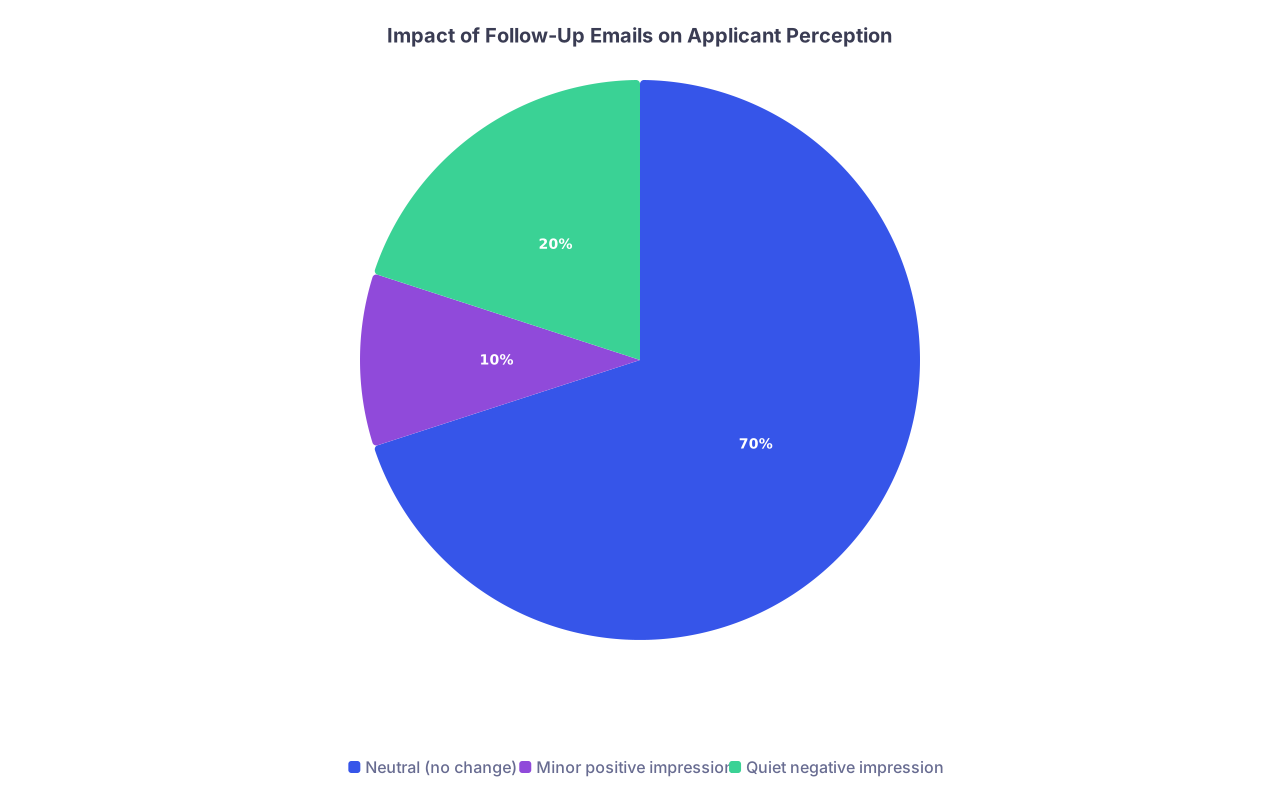
| Category | Value |
|---|---|
| Neutral (no change) | 70 |
| Minor positive impression | 10 |
| Quiet negative impression | 20 |
That 20% “quiet negative impression”? That’s the territory you never want to be in.
Timing, Frequency, and the “Too Much” Line
Another pattern programs notice: how often you contact them and when.
I’ve watched coordinators roll their eyes seeing the same name pop up again and again.
- Thank-you email to PD
- Separate thank-you to every interviewer
- Follow-up with “forgot to mention”
- Update email about manuscript
- Another update about a poster
- Final “just wanted to reiterate my interest” near rank deadline
Here’s how this looks from the inside:
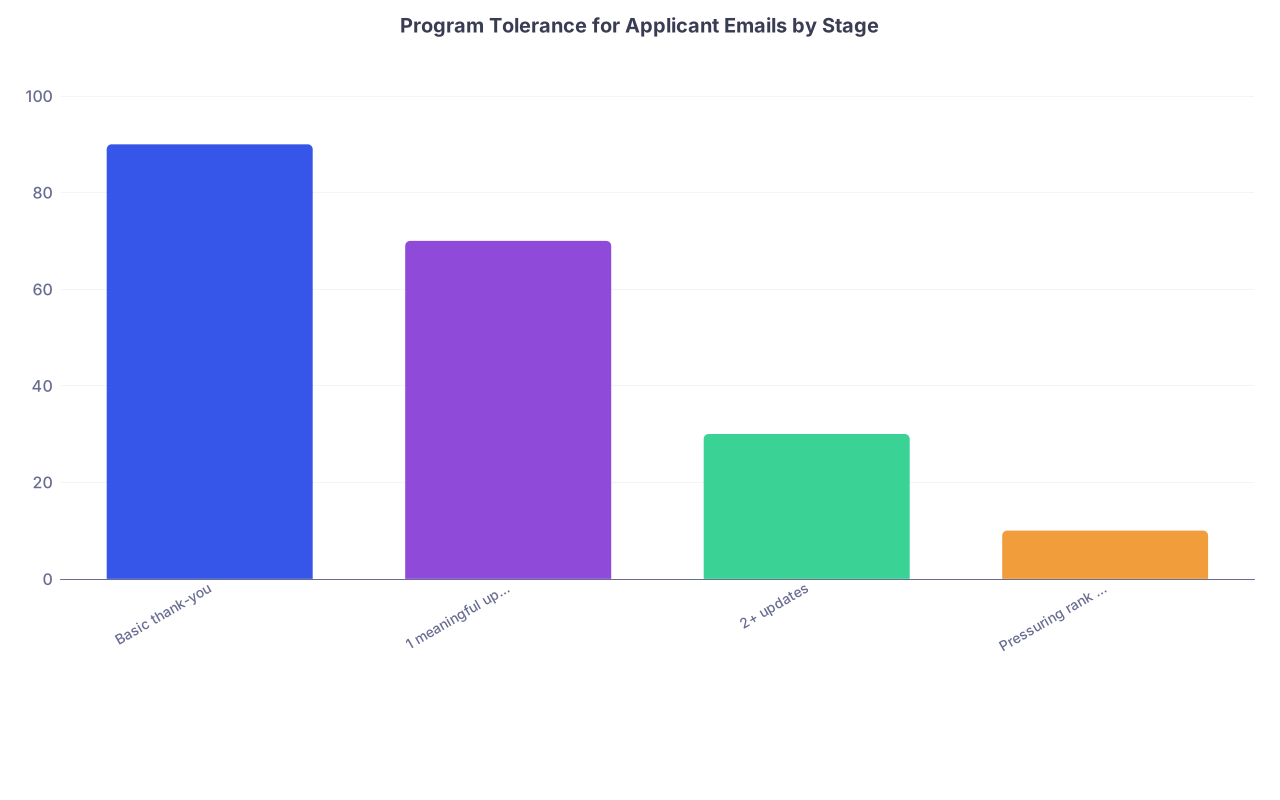
| Category | Value |
|---|---|
| Basic thank-you | 90 |
| 1 meaningful update | 70 |
| 2+ updates | 30 |
| Pressuring rank email | 10 |
By your third or fourth email, the content barely matters. The volume itself becomes the red flag.
You want your communication footprint to be small and clean.
Reasonable pattern:
- One thank-you email to PD (and maybe one combined to your interview panel if you really must)
- One actual important update, if it exists
- Optional: One brief, non-pressuring “still very interested” email late in the season if you truly love them—but only if it’s not hedgy and not sent to multiple programs with copy-paste language
That’s plenty. And yes, some PDs don’t care at all whether you send thank-yous. You won’t know which is which. But nobody penalizes you for a single short thank-you. They absolutely do for swirl of anxious emails.
If You Already Sent a Bad Email
Let me be blunt: if you already sent something cringey, the worst thing you can do is send another one to “fix” it.
Stop. No more.
The saving moves:
- Do not reference the bad email again.
- Do not apologize for “over-emailing.”
- Do not try to re-explain whatever you over-explained.
The best possible recovery is to let the memory fade. People are busy. They’re moving through hundreds of names. The more you stay out of their inbox, the more likely your file gets judged on your application and interview—not your spiral.
You don’t control their reaction. You do control when you stop digging.
The Quiet Profile of a “Problem Resident” in Their Heads
Understand the pattern they’re trying to avoid, because your email is data.
A “future problem resident” in a PD’s mental model is not always incompetent. Often they’re smart, driven, even impressive on paper. The issue is:
- High email volume when stressed
- Difficulty tolerating uncertainty or imperfection
- Tendency to escalate complaints in writing
- Blurry boundaries with faculty
- Oversharing personal distress in professional channels
- Pressuring behavior around evaluations, opportunities, or ranking
Your follow-up tone, content, and frequency either align with that model or not.
One short, blandly professional thank-you? You’re not on that radar.
A long, emotional, pressuring, or clarifying novel? Now you’re in the “might be work” category.
And in a stack of strong applicants, “might be work” is enough to slide you down a tier.
A Simple Mental Check Before You Hit Send
Before you send any post-interview email, ask yourself bluntly:
- Am I sending this to manage my anxiety or because it genuinely conveys essential information?
- If this email were screenshot and shown in a PD group chat, would I feel comfortable with their unfiltered reaction?
- Does this create work, pressure, or emotional labor for the recipient?
If the honest answers are:
- Mostly about your anxiety
- You’d cringe at it in a screenshot
- It requires them to comfort, reassure, or navigate awkward boundary/ethical issues
Delete. Start over. Make it shorter. Make it colder than you think it needs to be.
Professional beats passionate in email. Every time.

| Step | Description |
|---|---|
| Step 1 | Want to send email |
| Step 2 | Keep it 3-6 sentences, send once |
| Step 3 | Do not send |
| Step 4 | Send one concise update |
| Step 5 | Is it a basic thank-you? |
| Step 6 | Is there truly new, important info? |
| Step 7 | Can it fit in 2-3 factual sentences? |