
It’s 10:47 p.m. You’re back in the hotel after a full residency interview day. Your suit is on the chair, your name tag is in the trash, and you’ve got three thank-you emails half-written and sitting in your drafts.
The real problem isn’t what to say in the body. It’s that stupid subject line.
Do you write “Thank you”? “Great to meet you”? “PGY-1 Applicant Follow-Up”?
You know they’re getting 40 of these. You also know PDs and interviewers barely have time to eat, let alone read 40 generic thank-yous.
Let me tell you what actually happens on the other side of that inbox. And more importantly—what makes yours get opened instead of skipped.
What PD Inboxes Actually Look Like After Interview Day
Here’s the part nobody tells you during those warm, polished pre-interview Zooms.
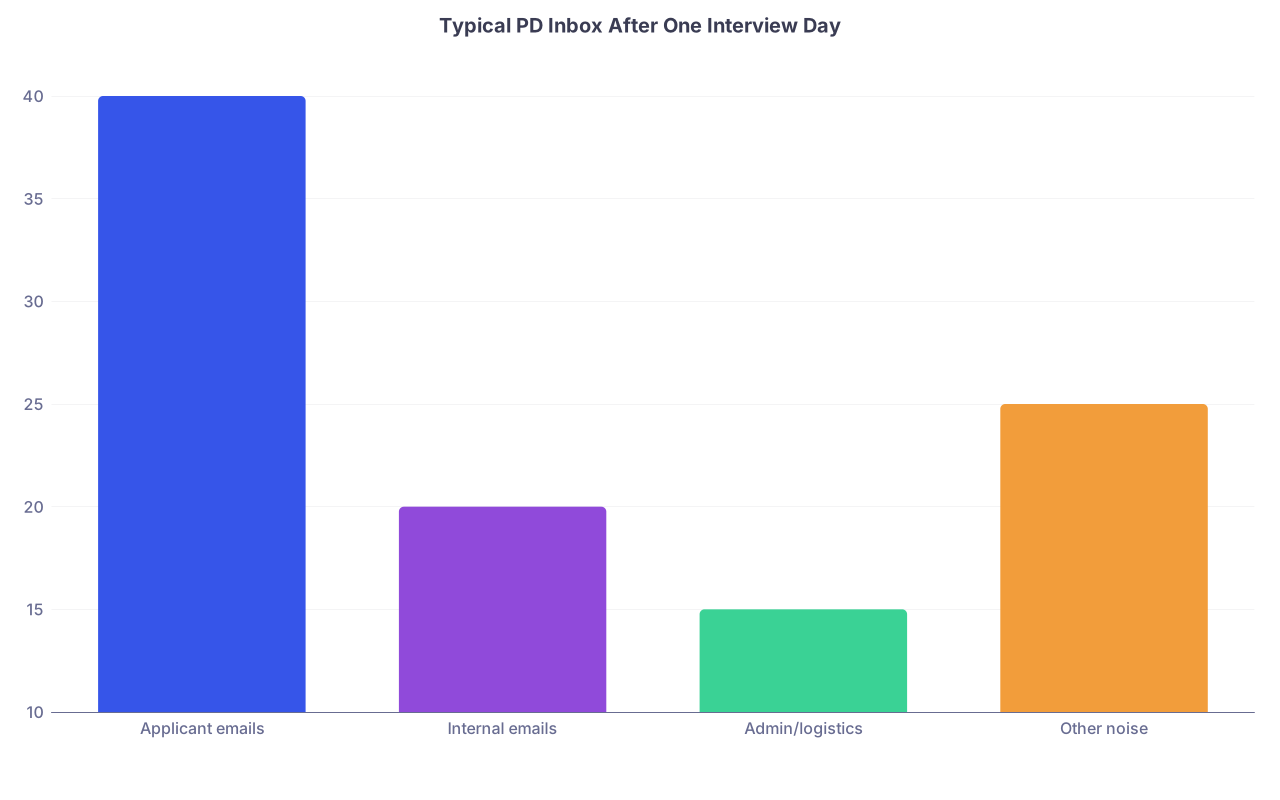
After a typical interview day, this is what hits a program director’s inbox between 5 p.m. and midnight:
| Category | Value |
|---|---|
| Applicant emails | 40 |
| Internal emails | 20 |
| Admin/logistics | 15 |
| Other noise | 25 |
Forty-ish applicant emails is normal at a mid-sized IM or EM program. More at big-name places. And they’re basically carbon copies:
- Subject: “Thank you for the opportunity to interview”
- Subject: “Thank you!”
- Subject: “Thank you for your time today”
- Subject: “Thank you – [Your Name]”
I sat with a PD once—large academic IM program—while she triaged post-interview thank-yous on her phone.
Her thumb did this:
- Open any that looked like they might contain something important (clarification, update, red flag, strong tie to program)
- Skim a few that had slightly interesting subject lines
- Mass-mark the rest as “read” without ever opening
Her exact words: “If the subject line looks like a form email, I assume the inside is a form email.”
So stop obsessing about the first line of your email body. Your subject line decides whether your email gets 5 seconds of real human attention or 0.7 seconds of thumb-scroll.
What PDs Secretly Look For In Subject Lines
They will not tell you this on the website. Or at the pre-interview social. But here’s the filter in their head when they scan subjects.
Three things matter:
- Can I quickly identify who this is?
- Is this just generic politeness, or is there a real signal here?
- Is there something here I might need to remember or act on?
So a subject line has to do a few jobs:
- Anchor you to the program and your role
- Signal that this is not just copy-paste fluff
- Hint that there’s some substance or specificity inside
If your subject line fails at #2 and #3, your beautifully crafted thank-you paragraph might as well not exist.
Let’s make this concrete. Here’s how subject line types usually perform in real life.
| Subject Type | Example | Likely PD Reaction |
|---|---|---|
| Generic “Thank you” | "Thank you for interviewing me" | Skim or ignore |
| Vague follow-up | "Great meeting you today" | Open only if bored |
| Specific program hook | "Thank you – loved discussing [Clinic X] at [Program]" | Much higher open likelihood |
| Clear identity/program | "[Your Name] – [School] applicant, thanks for today" | Usually opened |
| Signal + specificity | "[Your Name] – Appreciated our ICU staffing discussion" | Very likely opened |
The last two categories are where you want to live.
The Subject Line Formula That Actually Works
Let me spare you the guesswork. The subject lines that consistently get opened share the same backbone:
[Your Name] – Brief, specific hook tied to their program or your conversation
The key pieces:
Your Name
Because nobody wants to open “Thank you!” and then have to scroll to see who you are. PDs and interviewers are scanning their inbox; your name front-loads recognition.A dash (or colon)
Visually separates your identity from the hook. Clean. Scannable. Not cute.A concrete hook
That could be:- Something you discussed
- Something unique to their program that you reference
- A very brief signal about your fit/interest
Not: “Thank you again for the opportunity to interview at your excellent program.”
That screams copy-paste.
Here’s how it plays out across different scenarios.
Real Subject Line Examples That Get Opened
I’m going to give you exact phrases I’ve seen applicants use that made PDs say: “Oh, I remember this one.”
1. Standard clinical interview, nothing special… or so you think
You interviewed with PD, APD, and one faculty. You talked about ICU, teaching, maybe a research project.
Bad subject lines:
- “Thank you for the interview today”
- “Thank you – [Your Name]”
- “Great to meet you”
Versions people actually opened:
- “John Smith – Appreciated our ICU rotation discussion today”
- “Priya Patel – Thank you for sharing your vision for the new clinic”
- “Alex Nguyen – Enjoyed discussing resident autonomy at [Program Name]”
See the pattern? Your name + a short, specific callback to something they said or something clearly tied to their program.
2. You had a strong geographic/personal tie
PDs perk up when they see signs you’re actually likely to rank them high.
Avoid:
- “Thank you – I loved [City Name]”
- “Thank you, I hope to return to [Region]”
Better:
- “María López – Thank you, as a [State] native this felt like home”
- “Daniel Kim – Grateful to interview close to family in [City]”
- “Sarah Cohen – Thank you, excited about training back in [Region]”
This works especially well if you mentioned that tie during the interview. It cues their memory of, “Oh right, that’s the one whose parents live here.” PDs file that under “more likely to rank us realistically.”
3. You connected over a specific interest
Maybe you talked EM ultrasound, quality improvement, global health, med-ed.
Weak:
- “Thank you for discussing research today”
- “Great talking about global health”
Strong:
- “James Li – Appreciated our ED ultrasound workflow discussion”
- “Ananya Rao – Thank you for sharing your global health elective path”
- “Michael Johnson – Loved hearing about your QI work on handoffs”
Notice these are still short. The subject line is a hook, not a paragraph. But the specificity signals: this isn’t a mail merge.
4. You’re clarifying something or adding a relevant update
Subject line needs to make it obvious this isn’t just courtesy.
- “Emma Davis – Thank you & brief Step 2 score update”
- “Rahul Desai – Appreciated today; one clarification about my visa status”
- “Nina Park – Thank you, attaching requested writing sample”
These get opened because they imply there’s actual operational content inside.
5. You’re reaching out to multiple interviewers at the same program
You do not need a wildly different subject line for each faculty, but you should avoid obvious copy-paste.
For PD:
- “Kevin Martinez – Thank you, enjoyed discussing resident leadership at [Program]”
For core faculty:
- “Kevin Martinez – Thank you, appreciated your insights on [Subspecialty] training”
For chief resident (if you’re emailing them):
- “Kevin Martinez – Thanks for your perspective on intern year at [Program]”
Same spine. Slightly different hook to match the conversation.
Subject Lines That Look Innocent But Backfire
Some emails quietly hurt you. Not because you meant anything wrong, but because PDs read between the lines.
Let me walk through a few landmines.
1. Anything that looks like a mass template
Subject: “Thank you for the opportunity to interview at your program”
I’ve literally watched a PD scroll and see 9 emails with the exact same subject wording from 9 different applicants. Guess what: they all got lumped together as noise.
You think you’re being professional. It actually screams: “This is what my friends used; I did zero original thought.”
2. Overly emotional or desperate
Subject: “This program is my absolute top choice!!!”
Subject: “I will rank you #1”
Two problems:
- Post-interview communication rules: Many programs explicitly say “Do not send us ranking statements.” Some must ignore them. Others quietly resent them.
- It can feel manipulative or naive. PDs know students sometimes send that same message to multiple programs.
If you want to signal interest, do it with mature language in the body, not hype in the subject line. Keep the subject line grounded.
3. Vague flattery
Subject: “Inspired by your incredible program”
Subject: “Honored to meet such an amazing team”
This reads as generic. Every applicant could write this to every program. And some do.
Faculty roll their eyes at this more than you think. They already believe their program is good; they don’t need breathless validation from someone who spent 5 hours there.
4. “Re:” games
Do not fake a reply chain.
Subject: “Re: Interview at [Program Name]” (when there was no prior thread)
This is how you get instantly categorized as “tries too hard” or “a little shady.” I’ve seen faculty forward these to each other with, “What is this?”
How Subject Lines Interact With Program Culture
Not all programs behave the same, and you need to know that.
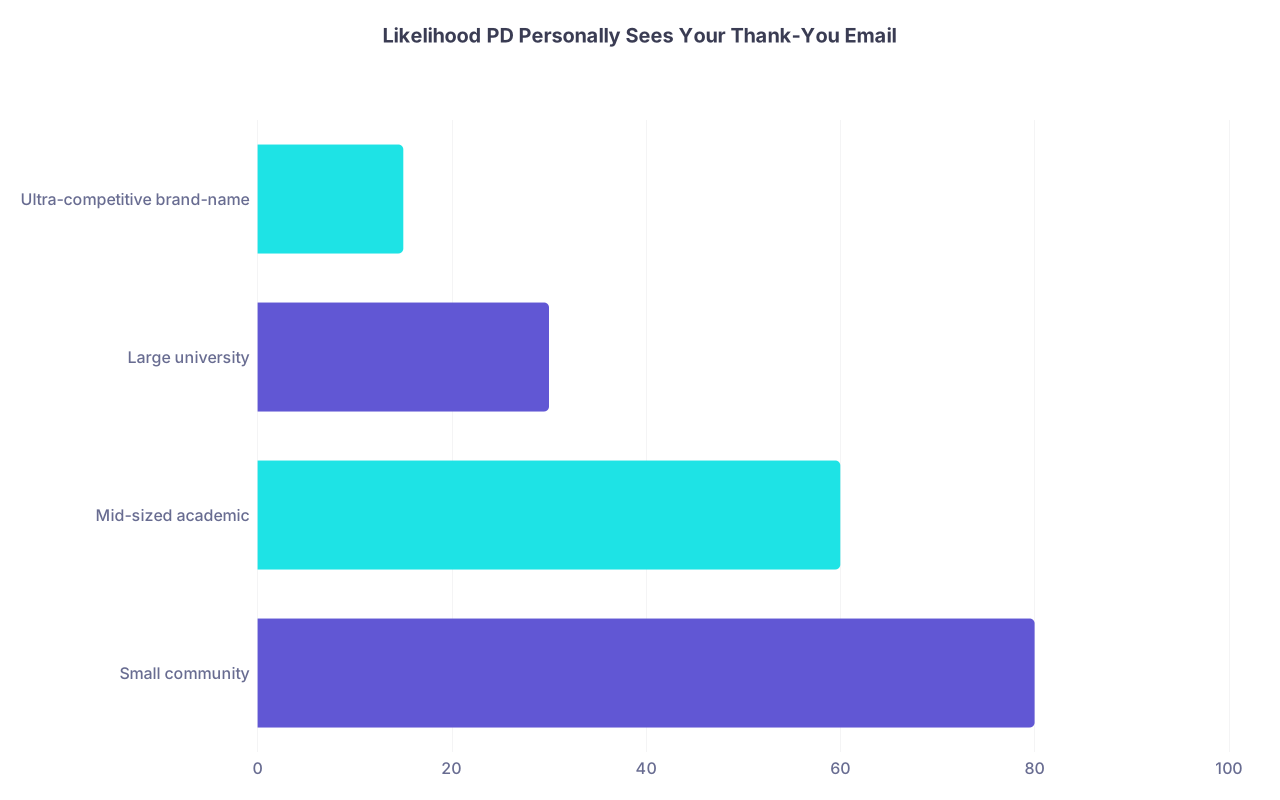
At some community or smaller academic programs, the PD personally reads almost every applicant email. At massive university programs, PD might barely see any; coordinators filter.
Here’s roughly how different program types react.
| Category | Value |
|---|---|
| Small community | 80 |
| Mid-sized academic | 60 |
| Large university | 30 |
| Ultra-competitive brand-name | 15 |
So do subject lines matter less at big-name powerhouse programs? Sort of. But not zero.
What actually happens:
- Coordinators scan for anything that looks like it needs forwarding to PD/APD: clarifications, serious interest, updates, issues.
- Faculty interviewers at those places do see your emails directly, and they talk.
I’ve been in rank meetings where an attending said:
“She was the one who emailed me about that ICU expansion we talked about. Seemed genuinely interested.”
That came from a well-crafted subject line plus a specific body.
So even when the PD isn’t personally surfing their inbox, your subject line can still:
- Make an interviewer actually open and register your name
- Trigger a memory when they see your name again at rank time
How to Write Your Subject Lines Step-by-Step (In 60 Seconds)
You finished the interview. You’re tired. You don’t want a 10-step system. Fine. Do this:
Jot down 1–2 specific things you talked about with each interviewer
A project. A patient population. A new rotation. Something they said that stuck with you.Decide which bucket the email is in:
Just a thank-you, or thank-you + update/clarification?Use this skeleton and plug in:
Basic thank-you:
“[First Last] – Thank you, enjoyed discussing [specific topic]”
or
“[First Last] – Appreciated your insights on [specific thing] at [Program]”Thank-you + update:
“[First Last] – Thank you & brief update on [Step 2 / research / etc.]”
or
“[First Last] – Appreciated today; one clarification re: [issue]”
Stop tweaking. Send it within 24 hours of the interview.
Do not spend 30 minutes wordsmithing the subject line. Spend 3–5 minutes getting it specific and honest, then move on.
How Much Do Thank-You Emails Actually Matter?
This is the dirty little secret:
Most PDs will tell you, flat out, that thank-you emails don’t move you from the middle of the list to the top. They’re not going to rescue a weak interview.
But here’s where they do matter, and subject lines are the front door:
- Breaking ties between otherwise similar candidates
- Nudging a “borderline positive” impression to a clean “yes, good fit”
- Cementing you in an interviewer’s memory with a clear story or interest
- Reassuring them that you’re normal, professional, and actually interested
I’ve watched PDs say:
- “I don’t care if they sent a thank-you, but if they send something weird or super unprofessional, that I remember.”
Which means: the floor is lower than the ceiling is high. You’re not going to win the match with your subject line. But you can absolutely hurt yourself with something tone-deaf, desperate, or blatantly templated.
So your goal is simple:
Clear, specific, non-cringey. Enough to get opened, read, and filed mentally under “solid.”
Quick Reference: Strong vs Weak Subject Lines
Let’s line them up side by side so you can see the difference in seconds.
| Weak / Generic | Strong / Specific |
|---|---|
| Thank you for the interview | John Smith – Appreciated our ICU staffing conversation |
| Thank you! | Priya Shah – Thank you, enjoyed hearing about resident clinic autonomy |
| Great to meet you today | David Lee – Grateful for your perspective on EM ultrasound at [Program] |
| Thank you for the opportunity | Sara Ahmed – Thank you, this program aligns with my interest in [niche] |
| This program is my #1 choice!!! | Miguel Torres – Thank you, very interested in training long-term in [City] |
Pattern is consistent: identity + hook, not hype.
FAQs
1. Do I really need to send thank-you emails to every interviewer?
Yes, unless a program explicitly tells you not to. Not sending one won’t usually kill you, but it’s a small, low-risk signal of professionalism. Where people get into trouble is sending bad ones—overly long, needy, or obviously mass-produced. Short, specific, and sent within 24 hours is fine.
2. Is it better to send one email to the PD or separate emails to each interviewer?
Separate emails to each interviewer, with tailored subject lines and 2–4 sentences in the body, is standard. For some smaller programs, you can CC the coordinator if that’s the culture. One giant email to “The Interview Committee” feels impersonal and is easy to ignore. PDs and faculty remember the ones who treated them as individuals, not as a group inbox.
3. Can I mention my rank intentions in the subject line or body?
Do not put rank statements in the subject line. It comes off as pushy or naive, and some programs are not allowed to factor that in. If you’re going to indicate strong interest, do it carefully in the body with language like, “I will be ranking your program very highly,” not “You are my #1 and I swear it on my cat.” And only do that for a very small number of programs, and only once you’re sure.
4. How long should the subject line be?
Aim for 60–80 characters. Long enough to include your name and one concrete hook. Short enough that it doesn’t get chopped on mobile. If it looks like a run-on sentence, it is. If it looks like “Thank you,” it’s too short and too generic. You want that middle ground: compact but informative.
5. What if my interview felt flat and I have nothing specific to reference?
You always have something. The structure of the program, a particular rotation, resident culture, a case they mentioned, their approach to didactics, anything. If it truly felt like talking to a brick wall, go one level more general but still anchored: “Appreciated learning about your night float system,” or “Thank you, your description of the new ED spaces was very helpful.” If all you write is “Thank you for your time,” it reads like you were half-asleep the whole day.
Two things to walk away with:
- Your subject line is not decoration; it’s the gatekeeper. Make it: Your Name + specific hook.
- You’re not trying to be clever. You’re trying to be memorable, honest, and easy to recognize in a sea of “Thank you for the opportunity” clones.
Do that consistently, and your emails will actually get opened by the people who decide your fate—rather than dying, unread, in a bloated inbox.