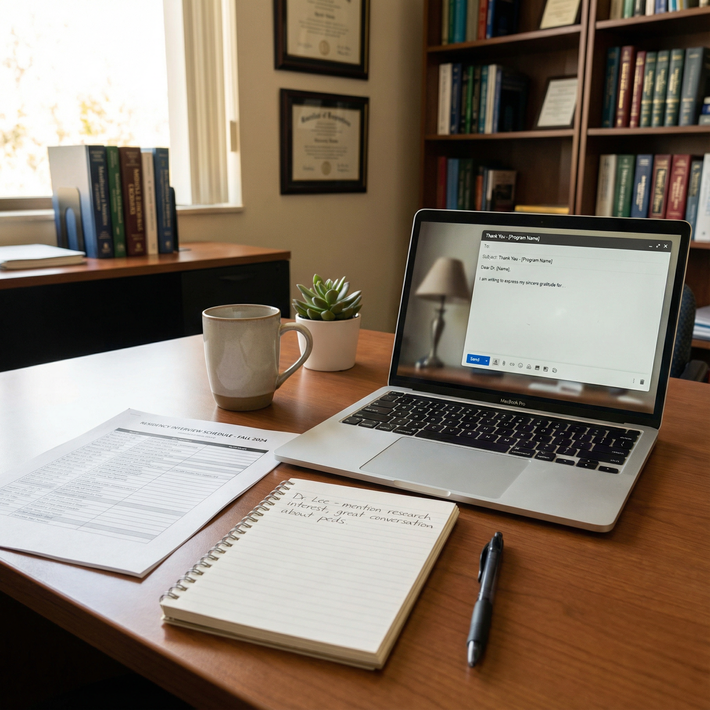
Why Thank You Notes and Follow-Up Still Matter in Residency Applications
In the residency application process, what you do after the interview is almost as important as what you do during it. A thoughtful thank you email after an interview and strategic post interview follow up won’t rescue a disastrous interview, but they can:
- Reinforce a strong first impression
- Show professionalism and maturity
- Demonstrate genuine interest in the program
- Clarify or highlight key aspects of your application
Program directors are clear: thank you notes alone rarely make or break a rank decision. However, a well-crafted, personalized message can tip the scales in close calls, strengthen your reputation, and help programs remember you positively when they finalize their lists.
This guide breaks down exactly how to write a strong residency thank you note, how to follow up later in the season, and what to avoid so you stay within NRMP rules and professional norms.
Understanding the Role of Thank You Notes in Residency
Thank you notes in residency applications are different from those in traditional job searches. They’re shaped by:
- NRMP rules and Match ethics
- Program-specific policies on communication
- The huge volume of applicants each program sees
Are Thank You Notes Required?
No, they aren’t required. Many programs explicitly state that thank you notes do not affect rankings and are not expected. Others still appreciate them and consider them a sign of professionalism and interest.
Think of a residency thank you note as an optional professional courtesy that can:
- Briefly reinforce fit and enthusiasm
- Clarify a misunderstanding or highlight something that didn’t come up
- Keep you fresh in the interviewer’s mind
What Program Directors Say
Surveys of program directors across specialties generally show:
- Many read thank you emails, but relatively few say they significantly impact ranking.
- Notes that are generic, copy-pasted, or obviously mass-produced are ignored.
- Personalized, concise messages that clearly reference the conversation are viewed more positively.
Your goal is not to “win” the program with a single email. Instead, your goal is to:
- Express genuine gratitude and courtesy.
- Reiterate one or two specific reasons you’re excited about the program.
- Leave a polished final impression.
Writing an Effective Thank You Email After Your Residency Interview
Your thank you email after interview should be:
- Timely
- Personalized
- Professional in tone
- Short and easy to read
Most thank you notes should be 3–8 sentences. Long, essay-style messages are rarely helpful and often go unread.
When to Send Your Thank You Note
General guidance:
- Within 24–48 hours of your interview day
- Send on a weekday during normal business hours if possible
- If you had a multi-day or second-look visit, within 24–48 hours of the last contact
If a program explicitly asks you not to send thank you notes (some do this in their pre-interview or interview day materials), respect that request. Ignoring it makes you look inattentive to instructions.
Who Should Receive a Thank You Email?
Prioritize:
- Each individual faculty member who interviewed you one-on-one
- Your program director (PD) (if you interviewed directly with them)
- The associate program director or key faculty you spoke with substantially
- Optionally, the chief resident or resident host who spent significant time with you
If you had a large panel interview and don’t have everyone’s contact information, sending one email addressed to the panel via the coordinator is acceptable:
“Dear Dr. Smith and the Internal Medicine Interview Panel, …”
The program coordinator is often your best resource if you’re missing someone’s email.

Subject Lines That Work
Keep subject lines clear and professional. Examples:
- “Thank you – [Your Name], [Specialty] Interview [Date]”
- “Thank you for the interview – [Program Name]”
- “Appreciation for today’s interview – [Your Name]”
Avoid vague subject lines like “Hello” or overly casual ones like “Thanks!!”
Professional Structure and Tone
Your residency thank you note should follow standard professional email etiquette:
- Use a formal greeting: “Dear Dr. [Last Name]”
- Use complete sentences and proper grammar
- Avoid slang, emojis, or overly casual language
- Close with “Sincerely,” “Best regards,” or “Thank you,” + your full name
Core Elements of a Strong Residency Thank You Note
Most successful emails include these elements:
Direct expression of gratitude
- “Thank you for taking the time to speak with me today about your residency program.”
Personalized reference to the conversation
- Mention a topic you discussed, a unique aspect of the program, or their advice.
Brief restatement of your interest + fit
- One or two clear reasons you feel you’d be a good match.
Optional clarifying point or additional information
- A research interest, a particular career goal, or something you forgot to mention.
Polite closing
- Appreciation and well wishes.
Sample Thank You Email Templates
1. Classic Faculty Thank You Email
Subject: Thank you – Jane Doe, Internal Medicine Interview 11/15
Dear Dr. Smith,
Thank you very much for taking the time to interview me yesterday and for sharing your perspective on resident education at [Program Name]. I especially appreciated our discussion about longitudinal continuity clinic and how your program supports residents in developing strong relationships with their patient panels.
Our conversation reinforced my impression that [Program Name] offers exactly the kind of supportive, academically rigorous environment I am seeking for my training in internal medicine. I am particularly excited about the opportunities for resident scholarship within the quality improvement curriculum that you described.
Thank you again for your time and for helping me better understand your program.
Sincerely,
Jane Doe, MS4
[Medical School]
2. Thank You to a Program Director
Subject: Thank you for the opportunity to interview
Dear Dr. Patel,
Thank you for the opportunity to interview at the [Program Name] Family Medicine Residency and for leading such an informative interview day. I enjoyed hearing your vision for the program’s role in the community and was impressed by how intentionally you have built a curriculum around continuity of care and resident well-being.
I left the interview even more enthusiastic about the prospect of training at [Program Name], particularly given my interest in community-based primary care and behavioral health integration. The emphasis on longitudinal community partnerships aligns strongly with my career goals.
I appreciate the time you and your team dedicated to the interview day and to meeting applicants.
Best regards,
John Smith, MS4
[Medical School]
3. Thank You Email to a Resident
Subject: Thank you for sharing your experience at [Program Name]
Dear Dr. Lee,
Thank you for taking the time to speak with me during the resident breakout session on Friday. I appreciated your honest insights into the culture of the program and your experiences with mentorship and operative autonomy.
Hearing how supported you feel in balancing a high surgical volume with strong faculty teaching made a strong impression on me and confirmed my interest in [Program Name]. I am grateful that you were willing to answer our questions candidly during a busy rotation.
Thank you again for your time and perspective.
Sincerely,
Alex Rivera, MS4
Personalization: The Key to Standing Out
Program leaders can immediately see when a note is generic. To personalize effectively:
- Reference a specific case, project, or topic you discussed
- Mention a shared interest (e.g., underserved care, a certain subspecialty, a research focus)
- Reflect on a particular moment from the interview day (“The resident noon conference on heart failure management gave me a helpful glimpse into your educational style.”)
A practical strategy: right after you finish each interview, jot down 2–3 bullet points about that conversation. Use those notes to write your thank you email the same evening or the next day.
Strategic Post-Interview Follow-Up: Beyond the Thank You Note
The initial residency thank you note is just one kind of post interview follow up. There are other points in the cycle where communication may be appropriate and helpful—if done thoughtfully and ethically.
Types of Post-Interview Follow-Up
- Initial thank you email (within 24–48 hours)
- Update email later in the season
- Communication about second looks (if applicable)
- Post-interview interest or “love” letters (with caution)
Each serves a different purpose. The most universally appropriate and lowest-risk is the initial thank you email.
Staying Within Ethical and NRMP Guidelines
The NRMP’s Code of Conduct prohibits:
- Asking applicants or programs to disclose ranking preferences
- Making any commitments that contradict the matching process
You may express genuine interest or enthusiasm, but avoid implying any binding promises or pressuring the program.
Avoid writing:
- “You are my #1 choice and I will rank you first no matter what.”
- “If you rank me highly, I promise to rank you first.”
Safer alternatives:
- “Your program is one of the top programs I am considering.”
- “I remain very interested in training at [Program Name].”
- “I believe [Program Name] would be an excellent fit for my goals.”
Mid-Season Update Emails
An update email may be appropriate if:
- You have new accomplishments since your interview (e.g., publication acceptance, new leadership role, significant award).
- You want to reaffirm your interest in a program that is truly among your top choices.
- You need to clarify something about your application that has changed (e.g., Step score release, completed sub-internship evaluation).
Generally:
- Send only one focused update email per program, if at all.
- Address it to the program director or coordinator.
- Be concise; highlight 1–3 meaningful updates.
Sample Update Email
Subject: Application update – Jane Doe, Internal Medicine Applicant
Dear Dr. Nguyen,
I hope you are doing well. I wanted to share a brief update to my application since our interview on November 10. My manuscript on transitions of care in older adults was recently accepted for publication in the Journal of Hospital Medicine, and I have attached the updated citation for your records.
This project deepened my interest in hospital medicine and quality improvement, and it further solidified how well your program’s strengths in patient safety and systems-based practice align with my career goals.
Thank you again for the opportunity to interview at [Program Name]. I remain very interested in your program and greatly appreciated meeting your faculty and residents.
Sincerely,
Jane Doe, MS4
“Love Letters” and First-Choice Communications
There is a longstanding tradition of applicants emailing one or a few programs later in the season to express that they are a top choice or even their first choice. This is controversial and not required.
If you choose to send such a message:
- Do it only for one program if you use the phrase “first choice.”
- Be honest—misrepresenting your intentions is unethical and unnecessary.
- Use careful, non-coercive language; you don’t need to state exact rank order.
Example of cautious wording:
“After reflecting on my interview experiences, I wanted to let you know that [Program Name] remains one of the top programs I am strongly considering for my residency training. I feel that the combination of your patient population, educational structure, and collegial culture fits my goals particularly well.”
Some programs explicitly discourage or ignore these kinds of letters; others may appreciate them as another data point in borderline decisions. Always follow the program’s stated communication guidelines.
Practical Tips, Common Mistakes, and Special Situations
Practical Tips for Managing Thank You Emails Efficiently
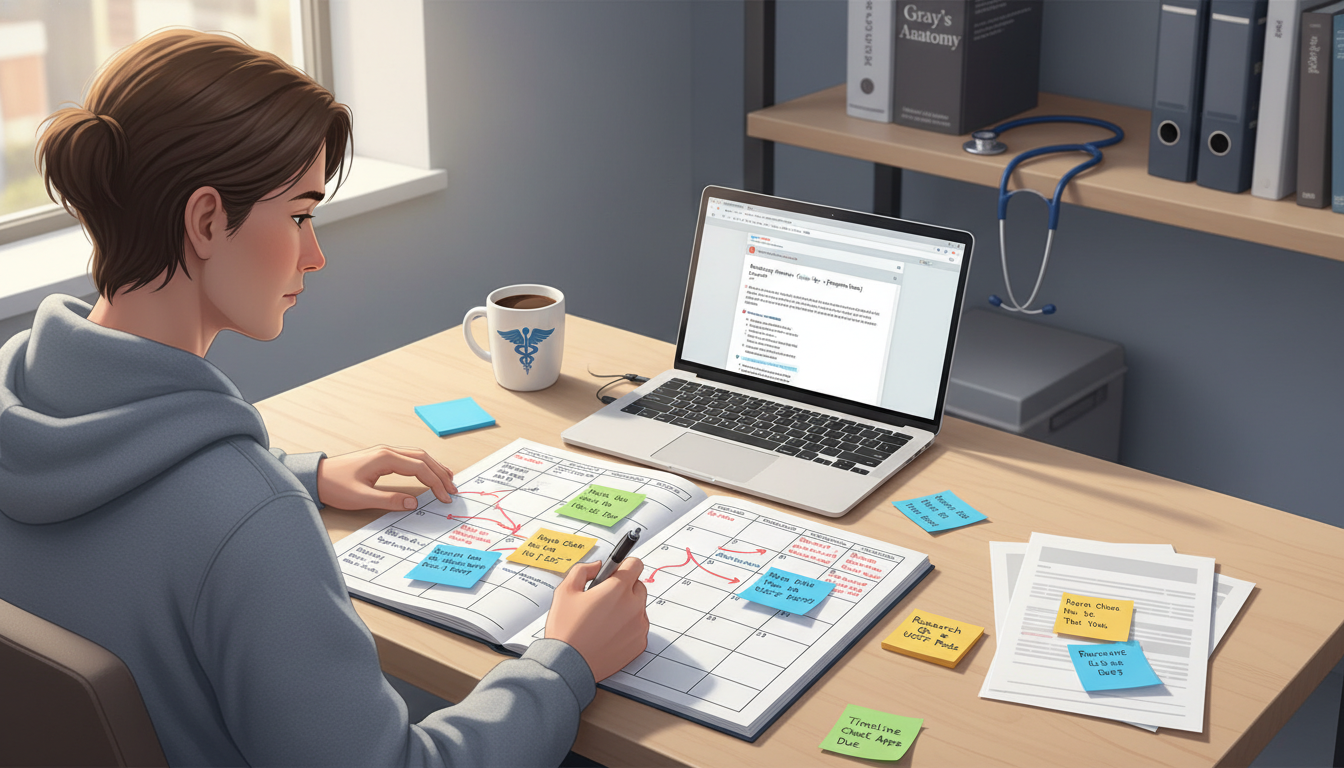
Residency season is busy and you may interview at many programs. To keep your post interview follow up organized:
- Create a simple tracker (spreadsheet or note) with columns for:
- Program name
- Interview date
- Interviewer names and emails
- Date thank you sent
- Notes from interview
- Draft a basic template, then customize 2–3 sentences for each person.
- Proofread carefully, especially names, pronouns, and program names.
- Aim to send all notes within 1–2 days so they don’t pile up.
Common Mistakes to Avoid
Copy-paste errors
- Calling a program by the wrong name is worse than sending no note at all.
- Double-check every instance of the program and interviewer name.
Overly long or emotional messages
- Avoid multi-paragraph essays or declarations like “I know in my heart I belong here.”
- Keep the tone professional and focused.
Re-sending when you get no reply
- Program directors are busy and may not respond; that’s normal.
- Avoid “bumping” your thank you emails just to get a response.
Violating program requests
- If a program explicitly says “no post-interview communication,” respect it.
Discussing ranks directly
- Never ask, “Where will you rank me?”
- Don’t press programs for information they cannot ethically share.
Special Situations
Virtual Interviews
With virtual interviews:
- Your thank you emails become even more important for conveying warmth and professionalism, since there are fewer casual in-person interactions.
- Consider referencing something unique about the virtual day: breakout sessions, virtual tour, or group Q&A.
Couples Match
If you’re in the couples match:
- You may briefly mention this context, especially if it affects your geographic or program preferences.
- Example: “As part of a couples match with my partner, who is applying in pediatrics, I particularly value your strong pediatrics department and the collaborative environment between services.”
Clarifying Concerns or Misunderstandings
If something significant went wrong or was unclear during the interview:
- A short, calm explanation in your follow-up email may help.
- Avoid sounding defensive; focus on clarification and additional context.
Example:
“I realized after our conversation that I may not have fully explained the gap in my CV between second and third year. I took a formal leave of absence for health reasons, received appropriate care, and have since completed my clinical rotations without interruption and with strong evaluations. I thought this additional context might be helpful.”
FAQs: Thank You Notes and Follow-Up in Residency Applications
1. Do programs actually care about thank you emails after interviews?
Many program directors say that thank you emails rarely change rank lists in a major way, but they can be helpful in close decisions and for building a positive impression. Even when they don’t influence rankings, thank you notes are seen as a professional courtesy and an opportunity to express genuine interest. They are not required, but when done well, they’re low-cost and can offer modest benefits.
2. What if I forgot to send a thank you note and it’s been over a week?
Send it anyway if you still want to. You don’t need to apologize extensively; a simple message like, “Thank you for the opportunity to interview at your program last month…” is sufficient. Programs understand that applicants are busy. It’s better to send a late, thoughtful note than not send one at all—unless the program has clearly stated they prefer no post-interview communication.
3. Is it okay to tell a program they are my first choice?
You are allowed to express strong interest, but you must be honest and avoid implying any binding promise or pressuring them. If you choose to say “first choice,” do so for only one program and use appropriate language that doesn’t contradict NRMP rules. Many applicants prefer wording like “one of my top choices” to remain accurate and flexible.
4. Should I send physical handwritten cards instead of emails?
Email is the standard and preferred method for residency-related communication. Physical cards may arrive late, may never reach the specific faculty member, and are harder to store or respond to. A professional, well-written email is more timely, reliable, and acceptable across virtually all programs.
Thoughtful, concise thank you notes and measured post interview follow up won’t guarantee a match at your dream program—but they can reinforce your professionalism, highlight your fit, and leave faculty with a clear, positive impression. Treat them as a small but meaningful part of your overall residency application strategy.