
It’s 11:47 p.m. Your phone is on 2% because you keep refreshing Gmail instead of plugging it in. You sent that carefully worded, slightly over-edited thank-you email to your residency interviewer two days ago. Not a peep back. No “Great to meet you.” No “Best of luck.” Nothing.
Your brain is already there:
“They hated me.”
“They saw my email and decided to drop me down the rank list.”
“They replied to everyone else and not me.”
“I knew I shouldn’t have made that stupid joke about work-life balance.”
Let me be blunt: you are absolutely not the only one spiraling over this. I’ve watched people obsess over a missing thank-you reply more than over their Step 2 score. And I’ve done the same thing.
Let’s untangle what this silence actually means—and what you should do next—without pretending you’re suddenly going to be calm and rational. You won’t. But at least you can be anxious with accurate information.
What a Non-Response Actually Means (And What It Doesn’t)
Here’s the uncomfortable truth: in residency world, thank-you emails occupy roughly the same importance as the free pens at interview day. Nice. Expected-ish. Not deciding the Match.
Programs and interviewers fall into a few basic camps when it comes to responding:
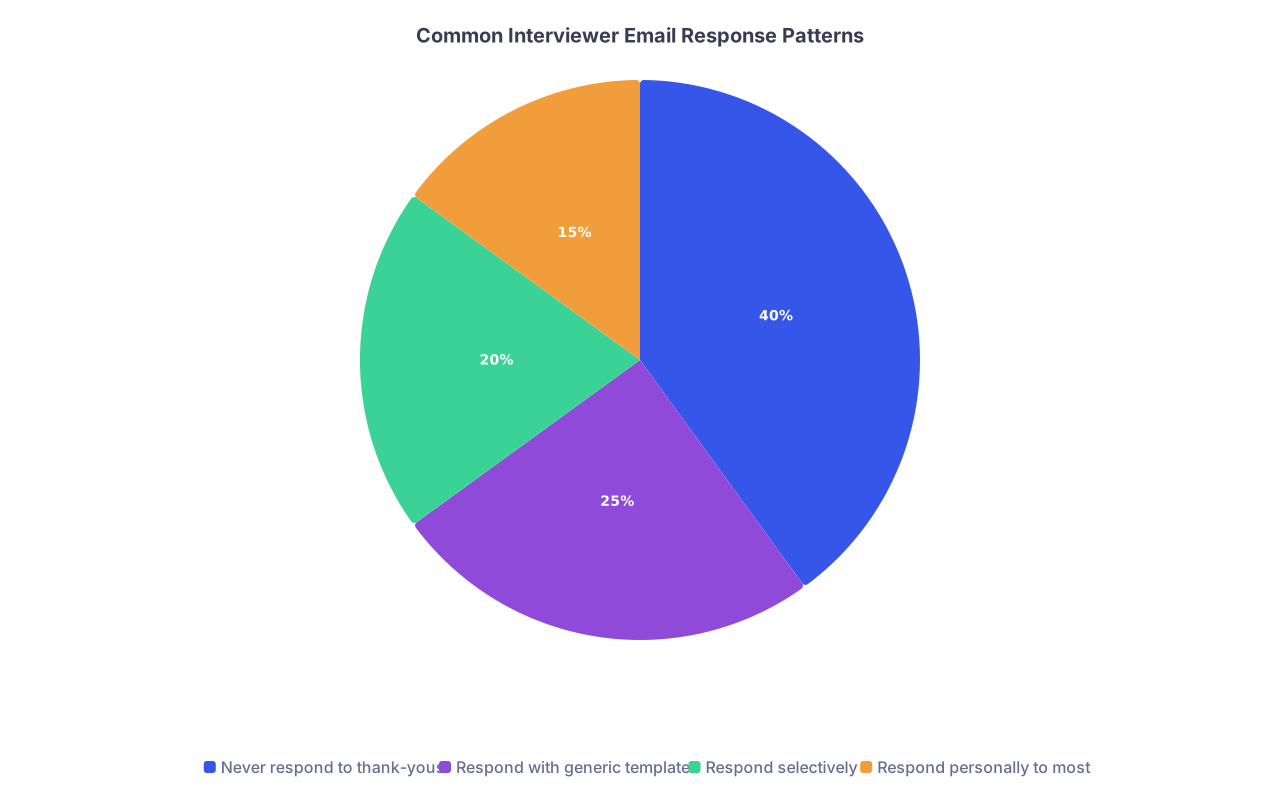
| Category | Value |
|---|---|
| Never respond to thank-yous | 40 |
| Respond with generic template | 25 |
| Respond selectively | 20 |
| Respond personally to most | 15 |
So odds are very high that your silence is about their habit, not about you.
What a lack of reply does NOT mean:
- It does not mean they ranked you low. Rank lists aren’t built out of email etiquette. They’re built from the interview day evaluation forms, notes from the day, and committee discussions.
- It does not mean they disliked you. Some of the kindest interviewers I know never respond to thank-yous. Not because they’re rude. Because they’re drowning.
- It does not mean they replied to “all the good candidates” and ghosted you. That narrative is in your head, not in their policy.
What it usually means:
- They have an explicit rule not to reply to candidate emails.
- They’re behind on email and yours is buried.
- They read it, smiled, mentally checked “professional,” and moved on.
I’ve seen applicants who got zero replies to any thank-you emails… and then matched at their #1 where not a single person had written back.
So no, silence is not code for “you’re off the list.”
How Programs Actually Think About Thank-You Emails
Here’s what nobody tells you when you’re refreshing your inbox like a lab rat hitting a dopamine lever.
Programs are buried. Faculty are getting:
- Clinical messages
- Resident issues
- Medical student emails
- Administrative chaos
- Their own research deadlines
Your thank-you is somewhere between “nice” and “irrelevant” in that pile.
A more realistic picture of what happens when you send that email:
- They skim it while walking between clinic rooms.
- They think, “Oh yeah, that was the [your school] student, seemed solid.”
- They do one of three things:
- Archive it and move on.
- Star it with vague intent to reply someday (they won’t).
- Hit a generic “Thanks, great to meet you too” if they’re the 15% who respond to everything.
None of that changes your numerical ranking score.
In many institutions, the rank list is:
- Generated from standardized forms filled out immediately or soon after the interview
- Reviewed by a committee that looks at those scores, not your thank-you email history
- Locked in days or weeks later, often before they’d ever get around to sorting their inbox
That panicked thought you’re having—“They re-opened their rank list just to drop me after seeing my awkward email sign-off”—that’s fantasy. Nobody is scrambling a carefully debated list because you said “Best regards” instead of “Warmly.”
When Silence Might Mean Something (And Still Not What You Think)
Let’s be honest. Sometimes you’re not just worried about silence. You’re worried you said something weird in the email.
You’re replaying:
- Did I ramble?
- Did I sound desperate saying “This is my top choice”?
- Did I mis-spell their name? (you checked 9 times but still don’t trust yourself)
- Did I come off as too informal / too formal / too generic?
Almost always, the answer is: no one cared that much.
The only times a thank-you email ever really “matters” in a bad way:
- You sent something wildly unprofessional.
- You tried to push for promises about rank.
- You violated Match communication rules in a way that made them nervous.
Examples of what actually raises eyebrows:
- “If you rank me highly I’ll definitely rank you #1.”
- “I expect to match at a top program so I hope you recognize that.”
- Answering “What are your weaknesses?” in the email because you feel like you “forgot” something in the interview and now you’re overexplaining your life story.
If your email was a normal, polite thank you? You’re fine. Even if it was slightly awkward. Everyone is slightly awkward.
Should You Follow Up Again If They Don’t Reply?
Short answer: almost always, no.
And I say that as someone who has written, deleted, and re-written the “just bumping this to the top of your inbox!” email in drafts more times than I care to admit.
You send:
- One thank-you email within 24–72 hours of the interview.
- To each interviewer (or one combined, if that’s what the program said they prefer).
- Done.
If they don’t reply:
- You don’t send a second “just checking that you received this.”
- You don’t apologize for some imaginary offense you think you made.
- You don’t start sending “updates” every week hoping for a response.
The only reasonable follow-ups:
A single, clear “I will rank you highly / I intend to rank you #1” email later in the season if:
- The program allows post-interview communication (check what they said!).
- You genuinely mean it. Not as a game.
- You’re not violating anything they specifically told you not to do.
A logistics question you genuinely need answered (rank list deadline, visa issues, couples match confusion, etc.), preferably sent to the program coordinator, not the random faculty interviewer.
But that second “just making sure my last email didn’t get lost” message? Looks needy. And not in the cute way. In the “I don’t understand boundaries” way.
Program Policies: The Part You’re Probably Ignoring While Spiraling
A lot of programs are now very explicit:
“We do not respond to post-interview thank-you emails”
or
“Thank-you notes are neither required nor expected and will not influence our rank list.”
They say this in pre-interview emails, during the pre-interview presentation, in ERAS, or on their website. You probably heard it and ignored it. Because we all think we’re the exception.
Let me put it in a simple snapshot:
| Program Style | Policy on Thank-Yous | Typical Behavior |
|---|---|---|
| Old-school, smaller program | Appreciated but not required | PD may reply personally to many |
| Large academic center | Officially “no impact” | Most faculty don’t respond at all |
| Strict NRMP-compliant | Prefer no post-interview contact | Silence even to very nice emails |
| Community-heavy interview load | Completely overwhelmed | Random and inconsistent replies |
You could have done “everything right” and still get silence, simply because of the type of place you interviewed at.
How to Stay Sane While Your Inbox Is Empty
You’re not going to stop feeling anxious. But you can at least stop feeding it.
Here’s what you can do today instead of refreshing Gmail for the 400th time:
Decide a rule: you’ll only check email at specific times.
For example, morning, lunch, and evening. No more scrolling every 6 minutes.Re-read any pre-interview or post-interview materials.
Look for any line about communication policies. You’ll probably find the sentence where they told you not to expect a reply. You just didn’t believe them.Put “thank-you replies” in the correct mental bucket: nice, not decisive.
Your interviews, letters, scores, and experiences built your application. Not the inbox.Start drafting your rank list based on:
- Where you felt you’d fit.
- Training quality.
- Geography, support system, lifestyle.
Not based on: who replied to what email.
Honestly? One of the worst mistakes I see every year is people letting email vibes sway their rank list. You know who often sends the sweetest “we loved you” messages? Programs that didn’t get the applicant pool they wanted. Meanwhile, powerhouse programs say nothing and just quietly rank you highly.
Quick Reality Check: Stories From the Other Side
I’ve seen:
- A student who got warm, personalized replies from 4 programs… and didn’t match at any of those 4.
- Another who sent a single generic thank-you to a huge academic IM program, got zero faculty responses, assumed she was dead there… and matched there at #2.
- A PD who literally never responds to applicants’ emails because they’re terrified of violating match communication rules, but then advocates furiously for people they loved on interview day.
The common theme: email feedback is noise, not signal.
Your perception:
- “They replied, so they love me.”
- “They didn’t reply, so they hate me.”
Their reality:
- “I was on call.”
- “Clinic ran late.”
- “I meant to respond and forgot.”
- “Our department policy is to ignore everything, just in case.”
You’re trying to decode a message that just isn’t there.
Okay, But What If I Already Sent a Second Email?
Then you stop at two. Do not turn it into a thread.
If you already:
- Sent a normal thank-you
- Then a second “just checking” or “I forgot to mention…”
Fine. You can’t undo it. The world doesn’t end.
Worst case? They think you’re a little anxious. Which… you are. Welcome to residency applications. That alone won’t tank you. Just don’t keep escalating. No double-down. No third follow-up. Let the silence sit there and move on.
FAQ (Exactly the Stuff You’re Afraid to Ask Out Loud)
1. What if my friend got a reply from the same interviewer and I didn’t? Does that mean they liked them more?
Not necessarily. Some interviewers respond randomly during a short burst of free time. They might have had your friend’s email open in front of them when they had 5 minutes, replied, and then got called away. Or your friend wrote earlier in the day. Or the subject line caught their eye. It’s not a reliable ranking signal. People get different email responses from the same program all the time and still match there.
2. I realized I made a typo / wrong program name in my thank-you. Am I doomed?
Cringe? Yes. Doomed? No. Everyone knows you’re sending a lot of messages during interview season. Unless you called them the wrong specialty (“I loved your surgery program” to a psych PD), it’s usually a non-issue. Do not send an apology email just for a minor typo. That only draws more attention to it. Let it go.
3. The program explicitly said “don’t send thank-you emails,” and I already did. Will that hurt me?
If you sent one short, respectful message, odds are they’ll just ignore it and move on. They’re not running a blacklist of “people who didn’t follow the slide deck instructions perfectly.” Just don’t keep sending more. The real red flag is repeated contact after they told you not to.
4. Can a strong post-interview email actually help me get ranked higher?
Very rarely, and not in the way you probably think. A “you are my clear #1 choice” email to a smaller or mid-size program can sometimes reinforce enthusiasm they already had for you. But it usually just breaks ties at best. It won’t rescue a bad interview. And a great interview doesn’t need it. Use that kind of email very sparingly, and only when you’re sure.
5. They did reply to my thank-you with something nice. Does that mean they’ll rank me high?
Unfortunately, no. Programs are extremely careful with wording for that exact reason. “It was great meeting you” or “Best of luck in the Match” is just polite. Even “we think you’d be a great fit here” doesn’t guarantee anything. They say similar things to many people. Don’t move a program up or down your rank list solely because they seemed warm over email.
Open your sent folder right now and look at one of your thank-you emails. Ask yourself: was it polite, professional, and on-topic? If yes, your work there is done. Close the tab, step away from your inbox, and spend 10 minutes sketching a rough draft of your rank list based on where you’d actually want to train—not on who did or didn’t hit “Reply.”