It’s 11:47 PM. You’re in bed, phone three inches from your face, re-reading the follow-up email you sent to that residency program…for the 14th time.
You see every awkward phrase. The weird compliment. The typo you somehow missed. The line that sounds way too desperate. Your brain: “Cool. I have just single-handedly unmatched myself with one email.”
So now you’re wondering: did I actually tank my chances? Are they all sitting around a conference table tomorrow reading my email out loud and laughing?
Let me say this bluntly: almost definitely not.
Let’s walk through what actually happens with follow-up emails, what’s truly harmful vs just cringe in your own head, and what to do if you really think you messed up.
What Program Directors Actually Do With Your Follow-Up Emails
Here’s the part nobody tells you when you’re spiraling at midnight: your email is not the main character in their world. Their main character is their rank list.
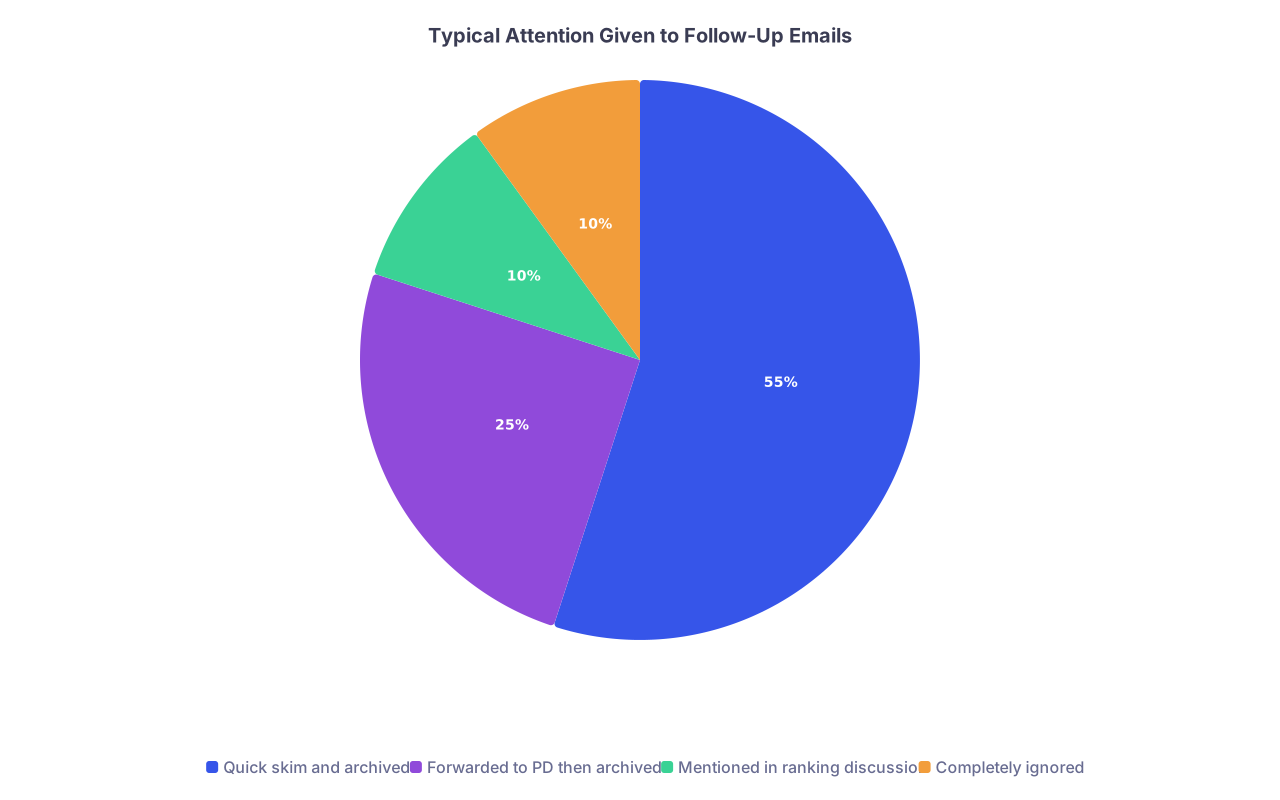
Most follow-ups get:
- Skimmed by the coordinator
- Maybe forwarded to the PD or faculty who interviewed you
- Briefly looked at, then filed or ignored
| Category | Value |
|---|---|
| Quick skim and archived | 55 |
| Forwarded to PD then archived | 25 |
| Mentioned in ranking discussion | 10 |
| Completely ignored | 10 |
So where does your “cringey” email fall? Depends what you did. There are three tiers.
Tier 1: Harmlessly Awkward (You’re Fine)
These are things that feel awful to you but barely register to them:
- Slightly overeager tone (“This is my dream program and I’d be honored…”)
- Too long and rambly, but polite
- Trying too hard to compliment the program
- Mildly cheesy lines (“I felt a true connection with your residents”)
- One or two minor typos (“Thank you again for you’re time”)
Programs see this every year, from tons of applicants. It doesn’t tank you. At worst it’s neutral, at best they think, “Cute. They care.”
If your email was:
- Respectful
- Not attacking anyone
- Not clearly unprofessional
You’re almost certainly in this bucket.
Tier 2: Mildly Problematic (Still Usually Recoverable)
This is the “ugh, that was not ideal but still not the end of the world” zone:
- Accidentally implied they were your #1 but you’ll tell someone else the same
- Mentioned another program by mistake in one line
- Slightly complained about something on interview day (“I wish there’d been more time with residents”)
- Came across as a little pushy (“I look forward to hearing where I’ll fall on your rank list”)
Is this ideal? No.
Is your application going in the shredder? Also no.
Worst case they roll their eyes and move on. Programs are used to awkwardness. Applicants are stressed, trying to say the “right” thing, and sometimes overshoot.
Tier 3: Actually Damaging (This Is Where People Get Burned)
This tier is rare. You’d know if you were here because your email would have been clearly:
- Aggressive or entitled (“Given my scores and research, I expect to be ranked highly”)
- Disrespectful about other programs or specialties
- Inappropriately personal with a resident or faculty member
- Sharing confidential info about another program or applicant
- Creepy or boundary-crossing in any way
This kind of email absolutely can affect your rank. I’ve watched programs move people down or entirely off the list for behavior like this.
If your follow-up email was just cringe-y, emotional, or overenthusiastic? That’s not this.
The Part That’s Torturing You: The Specific Mistakes
Let’s get into the “oh no, I did THIS” stuff. Because that’s what’s actually biting at you.

“I Said They Were My #1…But They Aren’t”
You wrote something like: “I will be ranking your program #1” … and then realized you might want that flexibility. Or you already told another program something similar.
Reality check:
- Lots of applicants overstate interest. Programs know this.
- Some programs literally assume “you’re my top choice” = “you’re in my top 5–10.”
- Unless your specialty or region is small and people talk a lot, the chance they find out you said that to another place too is low.
The real ethical rule: don’t blatantly lie to a huge number of programs. Telling 10 programs “you’re my #1” is bad. Telling 1–2 programs you’re “ranking them very highly” or that they’re “a top choice” is more honest and safer.
If what you did is already done, don’t send a “correction” email. That just magnifies the weirdness. Move on, be more careful with future follow-ups, and remember: your rank order list is private. The NRMP police are not going to kick down your door for one overenthusiastic line.
“I Made a Dumb Typo”
You wrote “resident’s” instead of “residents.” Or misspelled the PD’s name. Or wrote “internal medcine.”
Annoying? Yes. Catastrophic? No.
You’re not applying to be a copy editor. You’re applying in the middle of a burnout-inducing process where you’re churning out emails while on rotations or sub-I’s. They know.
I’ve seen:
- An email that started with “Dear Dr. [insert name here]” because they forgot to change the template
- A follow-up addressed to the wrong program name
- A “I love your program at [different city]” because they mixed up locations
Embarrassing. Did they unmatch solely because of that? No. It might have nudged them a little if they were already lukewarm. But if they really liked you from your interview, one typo doesn’t erase that.
Should you send a second email to fix a small typo? No. You’ll just call more attention to it.
“I Sounded So Desperate”
You’re replaying lines like:
- “I would do anything to match at your program.”
- “I haven’t received many interviews, and this opportunity means everything to me.”
- “I’m so nervous about the Match this year.”
Here’s the thing: PDs already know applicants are terrified. They live this every cycle.
Will they rank you higher just because you’re panicking? No. But will they punish you for sounding anxious? Almost never. If anything, they may feel a bit protective.
If there was no boundary crossing, no begging for promises about rank positions (that’s what freaks them out more, actually), you probably just sound like an anxious human. Which, newsflash, you are.
What Actually Matters More Than Your Cringe Email
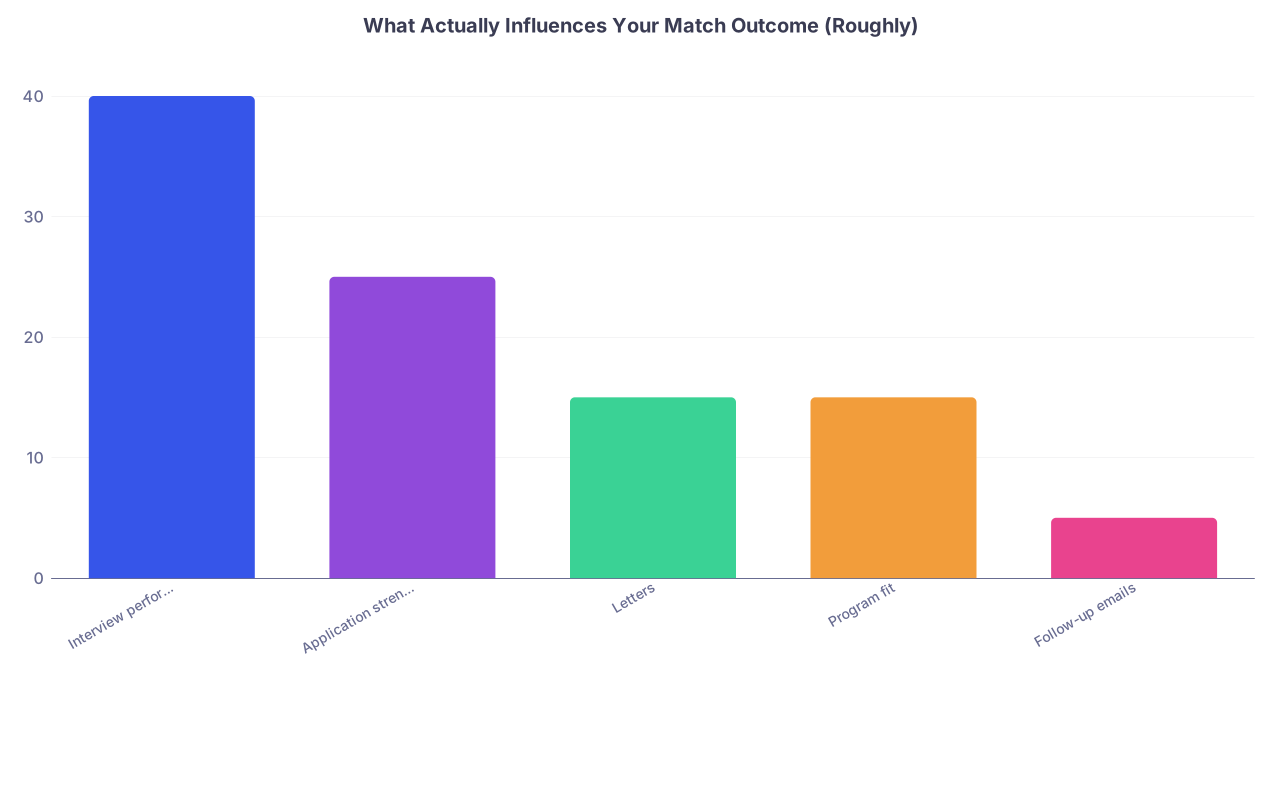
Let me be brutally honest: your follow-up email is background noise. Here’s what actually drives your position on the rank list:
| Factor | Rough Impact Level |
|---|---|
| Interview performance | Very High |
| Letters of recommendation | High |
| Application strength | High |
| Program fit / resident vibe | High |
| Follow-up emails | Low |
If they already loved you on interview day:
- Good follow-up: nice little plus
- Awkward follow-up: mild “eh” but they probably still rank you well
- No follow-up: also fine, honestly
If they were neutral on you:
- Strong, thoughtful follow-up might bump you a tiny bit
- Cringe-ish email might keep you neutral or slightly lower, but it’s rarely the deciding factor
If they didn’t like you from the start:
- You could send the most poetic, flawless email ever. It won’t save you.
This is the depressing and also freeing truth: your power to change their minds post-interview is limited. Which also means your power to totally destroy your chances with one slightly awkward email is also limited.
Should You Send a Second Email to Fix It?
This is everyone’s next thought: “Should I send another email and explain? Or apologize? Or clarify?”
Usually: no. Let me break it down.

| Step | Description |
|---|---|
| Step 1 | Did I insult or offend anyone? |
| Step 2 | Send brief apology |
| Step 3 | Was there a major factual error? |
| Step 4 | Consider one short clarification email |
| Step 5 | Do NOT send another email |
When You Should Send Another Email
Only in these scenarios:
- You said something that could reasonably be taken as offensive, dismissive, or rude.
- You shared incorrect concrete information (like your visa status, degree, etc.) that affects your candidacy.
- You accidentally broke a clear rule (e.g., you promised rank info or asked them to promise you something) and want to clean it up.
Then send a very short, calm note. Example:
Dear Dr. Smith,
I wanted to briefly clarify my previous email. I realized my wording about [X] could have come across differently than I intended. I’m very appreciative of the opportunity to interview and I’m genuinely excited about your program.
Thank you again for your time and consideration.
Best,
[Name]
Then you stop. No over-explaining. No essay-length apology.
When You Definitely Should Not Send Another Email
- To apologize for being “awkward” or “nervous”
- To correct a basic typo
- To explain your desperation
- To send a new, longer version of the same sentiment
All of that just cements you in their mind as the applicant who…kept emailing. You want to be remembered for being thoughtful on interview day, not for a 3-part email series.
If You Haven’t Emailed Yet: How to Not Cringe in the First Place
If you still have other programs you haven’t followed up with, good. You can course-correct there.

General rules that don’t make you look desperate or robotic:
- Keep it short. 1–2 short paragraphs, tops.
- Be specific: mention 1–2 concrete things you liked (a resident interaction, a teaching conference, a unique feature).
- Don’t promise more than you mean. Use “rank you highly” or “you’re one of my top choices” if true, instead of hard “#1” language unless you’re absolutely sure.
- Don’t ask for anything weird: no rank intel, no special treatment.
Template that’s safe and normal:
Dear Dr. [Last Name],
Thank you again for the opportunity to interview at [Program Name] on [date]. I really enjoyed speaking with you and the residents, especially learning more about [specific thing].
I was particularly drawn to [1–2 program strengths that genuinely matter to you], and I can see myself thriving in your program. I plan to rank [Program Name] very highly.
Thank you again for your time and consideration.
Best regards,
[Your Name], [Medical School]
That’s it. Clean. Respectful. No cringe.
How to Actually Calm Down About the Email You Already Sent
You can’t unsend it. So the only thing left is what you do with your brain now.
| Category | Value |
|---|---|
| Interview performance | 40 |
| Application strength | 25 |
| Letters | 15 |
| Program fit | 15 |
| Follow-up emails | 5 |
Here’s what I’d do if I were you:
- Re-classify your email honestly. Is it Tier 1 (harmlessly awkward), Tier 2 (mildly problematic), or Tier 3 (truly bad)? Ninety percent of the time it’s Tier 1.
- Decide if a second email is genuinely needed. If not, hard stop.
- Redirect your anxiety to something you can control:
- Draft better, cleaner emails for future programs
- Double-check your rank list strategy
- Make sure your ERAS and NRMP stuff is clean and final
And then accept this: every applicant has at least one thing they look back on and cringe at.
The rambly answer they gave in an interview.
The awkward joke that didn’t land.
The email that sounded too much like a love letter to a program.
You’re not uniquely doomed. You’re just…in the process.

FAQ (Exactly What You’re Afraid to Ask)
1. Can one bad follow-up email make a program move me way down their rank list?
Only if it’s truly unprofessional, disrespectful, or concerning. Normal awkwardness, small typos, or overeager language won’t tank you. They might roll their eyes and forget it 10 minutes later. Your interview performance and overall application matter far more.
2. What if I told two programs they’re my “top choice”? Am I in trouble?
You’re not going to prison. Ethically, you should avoid telling multiple programs they’re your clear #1, but this happens every year. Programs assume some exaggeration. Don’t send “correction” emails now—just be more precise going forward (“rank you highly,” “top choice”) and set your real rank list the way you actually want.
3. I addressed the email to the wrong program/name. Is that an automatic rejection?
It’s not great. But it’s also not an automatic death sentence. If they loved you, they’ll probably shrug it off as a rushed mistake. If they were neutral on you, it might hurt a bit. Do not send a second email drawing more attention to it unless there was truly offensive content attached, which there probably wasn’t.
4. I didn’t send any follow-up emails. Did I hurt my chances?
No. Lots of applicants never follow up at all. Some PDs barely read emails; some don’t care either way. A strong follow-up might help on the margins, but no program is saying, “We loved them…but since they never emailed, let’s not rank them.” You’re judged overwhelmingly on your interview and file, not your email habits.
Key points to walk away with:
- Most “cringey” emails feel ten times worse to you than they do to programs.
- Only truly unprofessional, aggressive, or boundary-crossing emails seriously hurt your rank.
- You can’t unsend anything, but you can stop making it bigger in your head than it is—and do better with the next email.