
It’s late January. You’re post‑call tired, sitting at your kitchen table with a half‑cold coffee and your laptop open. You’ve finished almost all of your interviews. Your rank list is a mess of half‑remembered pre‑interview dinners and vague “good vibes.”
And now the group chat is blowing up with people asking:
“Should I tell my #1 they’re my #1?”
“Do I send ‘thank you’ emails or a formal ‘love letter’?”
“My advisor says everyone does it. Is that true?”
You’re about to pour your heart into a “You’re my top choice, I will definitely rank you #1” email. Maybe a few of them. Because it feels like you have to do something.
Let me tell you what actually happens to those messages on the other side of ERAS. In the PD’s office. In the Zoom debrief. In the behind‑closed‑doors email threads you never see.
What Program Directors Really Think About “Love Letters”
I’ve sat in those meetings. I’ve seen the inboxes. I’ve watched PDs scroll through a folder literally titled “Post‑Interview Nonsense.”
Here’s the unpolished truth:
Most “love letters” are either ignored, mildly resented, or used only as a tie‑breaker when everything else is equal. And sometimes they actively hurt you.
Not always. But enough that you should stop treating them like a magic trick.
There are really three types of post‑interview communications in PD world:
- Basic thank‑you notes
- “You’re in my top group” / “strong interest” messages
- Explicit “You are my #1 and I will rank you to match” love letters
Programs treat each of these very differently. And they remember who lies.
Let’s break it down.
The Safe Zone: Simple Thank‑You Notes
Plain thank‑you emails almost never hurt you. They’re boring. Predictable. Fine.
Most PDs and faculty read them like this:
- Open.
- Scan for any red flags.
- Close.
- Move on.
They are not ranking you based on whether you wrote a perfect Hallmark message. Honestly, most places have already built a preliminary rank list before your thank‑you hits their inbox.
Where thank‑you notes actually help:
- When they’re specific enough to show you were awake during the interview.
- When they reinforce something positive already said about you.
- When they arrive in a normal timeframe and tone (not desperate, not performative).
A solid thank‑you might say:
“I appreciated hearing about your 4+2 schedule and the autonomy residents have on night float. It lines up with what I’m looking for in training.”
That’s it. Short, specific, normal.
Where people get weird:
- Sending multi‑paragraph emotional essays to each interviewer.
- Re‑stating their entire CV in the thank‑you.
- Fishing for reassurance: “I really hope I did well and that you will consider ranking me highly.”
That last one gets noticed. And not in the way you want.
Bottom line: thank‑yous are fine. They rarely move you up. They can move you down if you come across as needy, boundary‑blind, or unprofessional.
Where It Starts to Backfire: Vague “Strong Interest” Emails
The middle category is messy.
These are the “You’re one of my top programs” or “I will rank you very highly” messages without a clear promise. Students think this is sophisticated. PDs call it what it is: hedging.
Behind the scenes, these get interpreted in a few ways:
- If you were already near the top of the list, it might bump you a hair if someone in the room likes you.
- If you were in the middle, it usually does nothing.
- If your message sounds like obvious copy‑paste sent to multiple places, it can hurt.
Faculty are not idiots. They talk to each other across programs. Especially in smaller specialties.
Yes, they really do say things like:
- “We got a ‘you’re in my top tier’ from her.”
- “Funny, we got the same email. Word for word.”
I watched a PD at a solid mid‑tier IM program in the Midwest literally pull up three screenshots of identical “you’re one of my very top choices” emails that a single applicant had sent to three different programs in the same city. He didn’t blacklist them. But he rolled his eyes, closed the email, and someone in the room said, “Well, that answers the sincerity question.”
The bigger issue isn’t the content. It’s what it signals:
- You’re trying to game them.
- You think they don’t talk to other programs.
- You’re comfortable being ambiguous in a way that benefits only you.
Program leadership get a constant stream of half‑truths every January. They’re tired of parsing them. When you sound like everyone else, you become background noise.
If you’re going to send a “strong interest” email, it needs to:
- Be specific to the program.
- Align with how you actually plan to rank them.
- Avoid trying to be too clever with wording.
“I will be ranking your program highly” is code they’ve seen a thousand times. It translates in PD‑speak to: “This person may or may not rank us high. We cannot use this as a data point.”
The Nuclear Option: “You Are My #1” Love Letters
This is where things get serious. And where people quietly wreck their reputation.
There’s a big difference between:
“I really enjoyed meeting your team and could see myself thriving at your program”
and
“You are my number one choice and I will rank you to match.”
Programs treat that second one like a verbal contract. ETHICALLY they should not, but psychologically they do.
Here’s the part almost nobody tells applicants:
Programs remember who lied last year. And they talk about it the next year.
I’ve witnessed conversations like this in rank meetings:
- “She told us we were her number one.”
- “Where did she match?”
- “Oh, she went to [different program across the country].”
- Silence. Then someone: “Okay, so her advisor’s word doesn’t mean much.”
That applicant never hears that discussion. But her home school’s credibility just dropped.
How often do “#1 love letters” help?
When they’re honest and when the program cares about them, they can help more than anything else you send.
Examples where they genuinely matter:
- A borderline candidate at a community program that values “fit” and wants people who actually want to be there.
- A strong candidate at a mid‑tier program who would otherwise be worried they’ll lose you to “bigger name” places.
- A regional program where your letter confirms you’re staying close to family/spouse, and they believe you.
In those cases, a sincere “You are my #1 and I will rank you to match” can bump you up several spots. I’ve seen it take someone from the 20s into the top 10 on a mid‑size list.
But. Only when they believe you.
How often does it backfire?
More than students think.
The problems:
- People send that message to more than one program.
- PDs compare notes at conferences, through WhatsApp groups, in casual calls.
- They remember institutions and letter‑writers that are consistently “creative” with the truth.
I know of an applicant who told three anesthesia programs they were #1. One PD literally said, “We’re not changing anything for that. If she comes, great. If not, I’m not shocked.”
You lose the benefit of the letter and you damage your credibility. You can’t fix that later.
There’s also the subtler backfire: if your letter arrives too late, too polished, or too obviously manipulative, it makes you feel less authentic and more transactional.
A PD at a competitive EM program once showed me a “#1” email that included this line:
“I am confident I would be an exceptional fit for your program and am prepared to commit to ranking you #1 in order to support your high match percentage and maintain your competitive standing.”
His reaction: “This is someone who thinks we’re dumb. Next.”
What Actually Moves You On a Rank List
Here’s the part nobody wants to admit:
By the time you’re agonizing over love letters, a lot of the rank list is already set.
Most programs build their preliminary list based on:
- Interview impression (huge)
- Faculty and resident feedback
- Application metrics (scores, grades, letters, research)
- Obvious fit factors (geography, couples match, visa issues)
Post‑interview communication fits here:
| Factor | Relative Impact |
|---|---|
| Interview performance | Very High |
| Faculty/resident feedback | Very High |
| Application strength | High |
| Genuine geographic/fit factors | Medium |
| Post‑interview emails/letters | Low–Medium |
| Thank‑you notes alone | Low |
A sincere, honest “you are my #1” can act as a tie‑breaker between two similar candidates. Or nudge you up a small amount. But it rarely takes a weak candidate and suddenly makes a program ignore all their concerns.
What does happen more often:
- Programs use your letter to justify moving you down if something else already feels off.
- Or they ignore it entirely because they’ve been burned by previous classes.
Timing, Tone, and Volume: The Things You Don’t See
There are unwritten rules that nobody writes in the handbook.
Timing
Too fast and you look impulsive. Too slow and it clearly feels strategic.
Most PDs expect:
- Basic thank‑yous within 24–72 hours.
- Strong interest / “#1” messages in late January or early February, closer to when rank lists are being prepared.
If you email them ten minutes after logging off Zoom with “You’re my #1!!” they don’t believe you. They know you’re still interviewing other places. It reads as performance.
Tone
Programs pick up on desperation faster than you think.
Red flag phrases:
- “I am begging you to rank me.”
- “Your program is my only hope to become a doctor.”
- “If I do not match at your program, I don’t know what I will do.”
I’ve seen messages like this forwarded to the program’s wellness director out of concern. Not as a reason to rank someone higher.
On the other hand, confident but humble works:
- You express strong interest.
- You show you understood what makes the program unique.
- You do not sound entitled to a spot.
Volume
Sending:
- One appropriately targeted “#1” letter: normal.
- 3–4 “very strong interest” emails to various programs: normal.
- Weekly “just checking in” messages to the PD: not normal.
There is a quiet blacklist for “over‑communicators.” Nobody emails you back and says, “Please stop.” They just move you mentally into the “high maintenance” bucket. Then they quietly ask themselves if they really want to deal with that for three years.
How Programs Catch Double‑Dipping and Gamesmanship
Let’s be blunt. You’re not the only person trying to outsmart the system. A lot of applicants lie. Programs are used to it.
Here’s how they catch you:
PD network gossip
PDs know each other. Many trained together. They’re on WhatsApp and email chains. Especially in smaller specialties: ENT, Rad Onc, Derm, EM, Ortho. A casual, “Hey, did anyone else get a #1 letter from X?” is not rare.Coordinators talk too
Coordinators see every email. They see patterns you don’t realize you’re leaving. Some of them keep informal notes like, “Mass emailer, sent the same message to our prelim and categorical tracks.”Your advisor’s reputation follows you
If a particular school or advisor has a pattern of telling programs “this student will rank you #1” and then that student repeatedly lands elsewhere, PDs stop believing that school’s “signals.”Obvious mismatches
You tell a top‑10 academic powerhouse they’re your #1, and you’re a strong candidate for that type of program. Then you match at a smaller community site out of state. They know exactly what happened: you told multiple places they were #1 and went where the algorithm took you.
Do they hunt you down and punish you? No. They don’t have time.
Do they record in their heads that your promises don’t mean much? Absolutely.
So What Should You Actually Do?
Let’s cut the fluff. Here’s a sane, ethical, and actually effective approach.
1. Thank‑You Notes: Keep Them Short and Real
Send a brief thank‑you to:
- PD
- PC (program coordinator)
- Maybe 1–2 key interviewers you genuinely connected with
Make it:
- 3–6 sentences
- Specific to something you discussed
- Free of ranking promises or manipulative language
That’s it. Then stop.
2. Decide If You Truly Have a #1
This is the hard part for a lot of people. But you need to decide.
Ask yourself:
- If every program ranked me first, where would I actually want to go?
- If my ego and prestige chasing were not involved, where would I be happiest waking up on a random Tuesday in January as a PGY‑2?
- If my partner/family situation matters, which place actually works?
Once you know your real #1, then you consider sending a true “#1” letter.
3. If You Choose to Send a #1 Letter, Make It Honest and Specific
A good #1 letter:
- Explicitly says they are your number one
- Indicates you will rank them to match
- Explains why, in concrete program‑specific terms
- Keeps the tone professional, not romantic or desperate
Example structure (not to be copied verbatim):
- Open with genuine appreciation for the interview and specific features you liked
- One clear sentence: “I want you to know that your program is my first choice, and I will be ranking [Program Name] #1.”
- A short paragraph linking your goals to their strengths
- A brief closing line thanking them for their time and consideration
You send this to the PD (and optionally cc the PC). Once. You do not send the same line to anyone else.
4. For Other Programs You Like, “Strong Interest” Without Lies
You can still express interest without claiming they’re your top choice.
Language that works:
- “I was very impressed by [specific feature], and your program will be ranked highly on my list.”
- “I left the interview even more excited about the possibility of training with your team.”
Programs understand that “ranked highly” means “somewhere in my top group,” and they take it for what it is: soft data.
5. Then Stop Emailing
You are not winning points by checking in again, asking if they saw your email, or sending extra “updates” unless they specifically invited them.
Silent confidence always looks better than chronic inbox tapping.
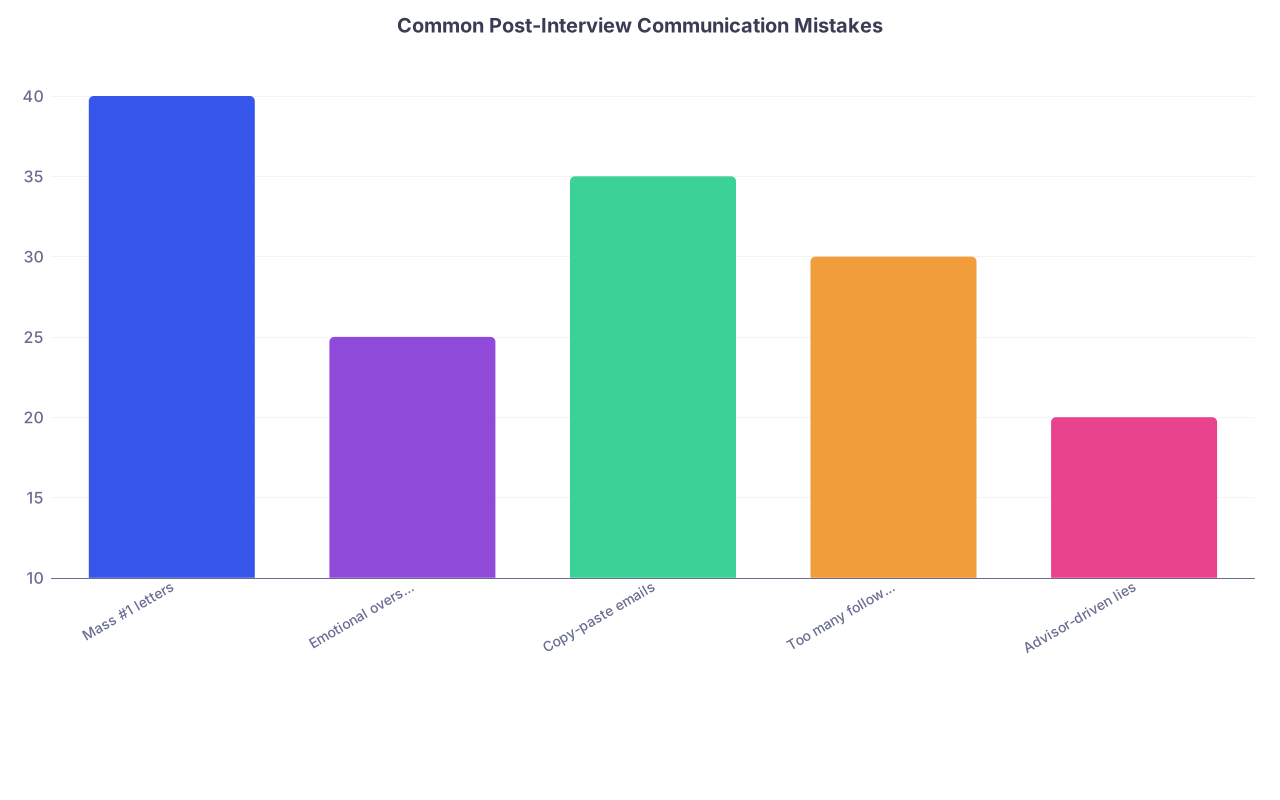
| Category | Value |
|---|---|
| Mass #1 letters | 40 |
| Emotional oversharing | 25 |
| Copy-paste emails | 35 |
| Too many follow-ups | 30 |
| Advisor-driven lies | 20 |
Special Situations: Couples Match, Late Updates, and Red Flags
There are a few edge cases where reaching out is actually smart and expected.
Couples Match
Programs know couples match is messy.
If you’re couples matching:
- Be transparent about it during interviews when possible.
- After interviews, it’s reasonable to send a short note explaining your geographic constraints and pair situation.
What works:
- “My partner is applying in [specialty] and also interviewed at [Program X] across town. Training in the same city is extremely important to us, and this region is our top choice geographically.”
Programs use this to coordinate informally with the other specialty sometimes. Not guaranteed, but it happens.
Genuine Updates
There are only a few “updates” that are worth emailing about after interviews:
- A major publication accepted at a strong journal (especially if research‑heavy specialty).
- A significant award/honor that truly changes your application profile.
- A material change in your situation (e.g., partner matched to their prelim in that city, visa approval if that was a concern).
What doesn’t count as meaningful update:
- Another poster at a small conference.
- “I continue to be very interested in your program” every week.
- A long essay about how you’ve reflected more on fit.
If Something Went Wrong in the Interview
If you genuinely bombed one answer, or you feel like you came off poorly, can you address it? Yes—but carefully.
A short follow‑up like: “I realized after our conversation that I did not fully answer your question about [topic]. I wanted to briefly clarify [1–2 sentences].”
Then stop. You get one shot. Do not send a novel.

| Step | Description |
|---|---|
| Step 1 | Finish Interview Season |
| Step 2 | Send Single Honest #1 Letter |
| Step 3 | Skip #1 Letter |
| Step 4 | Send Brief Thank-You Notes |
| Step 5 | Optional Strong Interest Emails to Top Tier |
| Step 6 | Stop Emailing and Certify Rank List |
| Step 7 | Identify True #1? |
How Often Do Love Letters Truly Change Outcomes?
Let me be blunt: they matter less than your anxiety tells you, but more than the “NRMP communications don’t matter” purists claim.
From what I’ve seen over multiple cycles:
For top‑tier applicants at mid‑tier or “safety” programs:
A sincere #1 letter can absolutely help those programs justify bumping you up, because they’re afraid you’ll go elsewhere.For mid‑tier applicants at very competitive programs:
A #1 letter might make them feel good about you, but rarely overcomes a significantly weaker application.For on‑the‑bubble applicants near the middle of the list:
A well‑timed, honest letter can be the difference between “just outside our usual range” and “okay, let’s slide them up a bit.”
But the cold truth:
If you were already in the “we really like this person” bucket, the letter is a gentle tailwind.
If you were in the “probably not” bucket, it’s usually not strong enough to pull you out.
The real killer is not that letters don’t work. It’s that people weaponize them, lie with them, and then get surprised when programs start discounting them altogether.
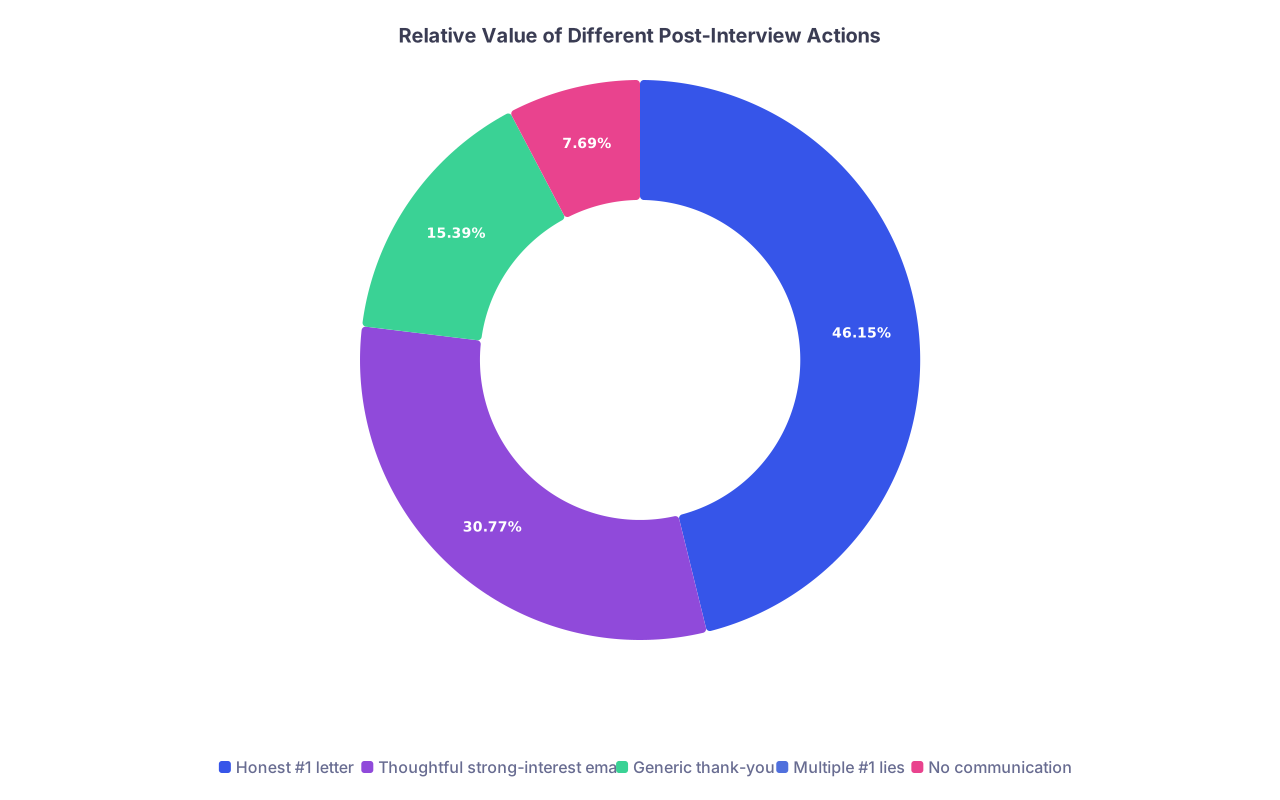
| Category | Value |
|---|---|
| Honest #1 letter | 30 |
| Thoughtful strong-interest email | 20 |
| Generic thank-you | 10 |
| Multiple #1 lies | -20 |
| No communication | 5 |
The Quiet Reputation You’re Building
One last thing you need to understand. You’re not just matching into a program. You’re entering a profession with a very small rumor mill.
The way you handle this phase—how honest you are, how you communicate, how you respond to uncertainty—sticks with people longer than you think.
I’ve seen PDs say:
- “She told us we were #1, then ranked somewhere else. I will remember that if she ever applies back for fellowship here.”
- “Their school always ‘signals’ everyone as #1. I ignore their ‘commitment’ emails now.”
Your name, your school, your advisor—they’re all part of that mental ledger.
Tell one program they’re your #1 if it’s true. Treat everyone else with respect without playing mind games. You might not feel the benefit immediately, but it pays off later—in fellowships, jobs, recommendations, back‑channel calls you’ll never know were made.
Years from now, you won’t remember the exact wording of some anxious email you almost sent at 1:00 a.m. But you will remember whether you handled this part of the process with integrity or with short‑sighted panic.
And so will they.