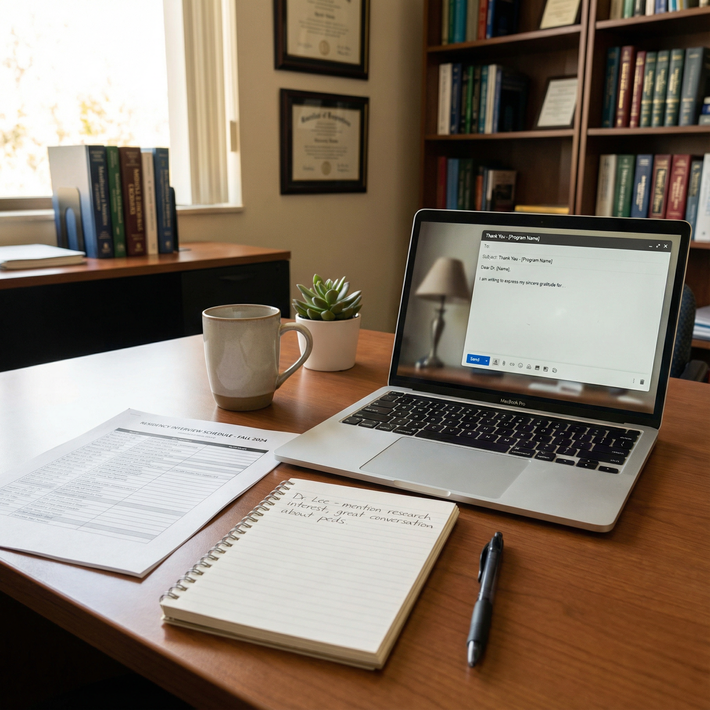
The panic you feel when you realize you never sent a thank-you email is completely overblown—and fixable.
For residency interviews, no thank-you note almost never kills your chances. But a smart, well-timed follow-up can absolutely help you. The trick is not to flail, not to over-apologize, and not to make it weird.
Let me walk you through a clean, step-by-step recovery plan that works whether you forgot yesterday or three weeks ago.
1. First, Stop Guessing How Bad This Is
You are probably catastrophizing. Most applicants do.
Here is the reality from program side conversations:
- Many programs barely track thank-you emails.
- Some explicitly ignore them by policy.
- A minority care “a little” if they are personalized and professional.
- Almost nobody is ranking applicants lower because of a missing thank-you.
So forgetting is:
- Not ideal.
- Not fatal.
- Definitely fixable.
Where it does matter is at the margins:
- borderline vs. slightly-above-borderline candidates
- close internal debates where any positive professional impression can tilt things
Your goal now is not to “undo disaster.” Your goal is to add one more professional touchpoint in your favor, without drawing attention to the delay.
2. Decide If You Should Still Send Something
Short answer: yes, in almost all cases, you should still send a follow-up. Even if it is late.
The question is what kind of follow-up and how you frame it.
Use this decision structure.

| Step | Description |
|---|---|
| Step 1 | Finish interview day |
| Step 2 | Write 3 quick notes on program & people |
| Step 3 | Open thank-you template draft |
| Step 4 | Customize for each interviewer |
| Step 5 | Send within 24-48 hours |
| Step 6 | Log sent in your spreadsheet |
Let’s break those down.
If it has been 0–7 days
You are still in the normal window. This is completely fine.
Action:
Send a regular thank-you email. No apology. No mention of delay. You are not late in any meaningful way.
If it has been 8–21 days
You are slightly late, but not absurdly so.
Action:
- Send a short, direct thank-you.
- You can either:
- Ignore the delay entirely, or
- Add one brief clause like “Apologies for the delayed note” and move on
Avoid any long-winded explanation. No one cares that you had “a very busy stretch of interviews.”
If it has been more than 3 weeks
Now you are outside the usual thank-you window. But you are inside the normal window for:
- A brief “continued interest” email
- An update about a new publication, rotation, exam result, or leadership responsibility
So reframe the goal.
Instead of: “I’m late with a thank-you”
You are doing: “Short update + renewed appreciation for the interview.”
If you have no updates and it has been:
- Over 4–6 weeks
- And this is not a top-choice program
Then sending a random, very late thank-you is more likely to look awkward than helpful. Skip it and focus on programs where you can still move the needle.
3. Who To Email (And What If You Lost Their Info)
Ideal:
You email each individual interviewer.
Acceptable:
You email:
- The program coordinator, asking them to forward, or
- The general program email (often listed on the website)
If you:
- Do not remember every interviewer
- Or never got direct email addresses
Do this:
Check:
- The interview invite email
- The interview day schedule PDF
- ERAS messages
- Any post-interview info packet
If still nothing, send a single email to:
- Program coordinator, or
- “Program Administrator” / “Residency Office” address
Subject line ideas:
- “Thank you for the interview – [Your Name]”
- “Follow-up from interview day – [Your Name]”
- “Appreciation for my interview – [Your Name]”
Then write something like:
I appreciated the opportunity to interview for the [Program Name] [Specialty] residency position on [date]. I would be grateful if you could share my thanks with the faculty who interviewed me, including Dr. [Name] and the rest of the team.
Do not send multiple separate “broadcast” thank-yous to the same program office. One email is enough.
4. Exact Email Templates You Can Copy
You want concrete text. Good. Here it is.
A. Standard thank-you (0–7 days)
Subject: Thank you for the interview – [Your Name]
Body:
Dear Dr. [Last Name],
Thank you for taking the time to speak with me during my interview for the [Program Name] [Specialty] residency on [interview date]. I appreciated learning more about [specific feature: e.g., “your night float structure,” “the critical care exposure in PGY-2,” “your approach to resident autonomy”].
Our conversation about [brief, specific topic you discussed] reinforced my interest in [Program Name]. I would be excited to contribute to your resident team and grow under the mentorship of faculty like you.
Thank you again for your time and consideration.
Sincerely,
[First and Last Name]
AAMC ID: [#########]
Done. No drama.
B. Slightly delayed (8–21 days), simple version
Subject: Thank you – [Your Name]
Dear Dr. [Last Name],
Thank you again for speaking with me during my interview for the [Program Name] [Specialty] residency on [date]. I enjoyed our conversation about [specific topic] and have been thinking further about [brief mention of how it influenced you—one line].
I remain very interested in [Program Name] and would be grateful for the opportunity to train there.
Sincerely,
[Name]
AAMC ID: [#########]
No reference to timing. In most cases, that is enough.
C. Slightly delayed (8–21 days) with one-line acknowledgment
Subject: Follow-up and thanks – [Your Name]
Dear Dr. [Last Name],
I wanted to thank you for speaking with me during my interview for the [Program Name] [Specialty] residency on [date], and I apologize for the delayed note. I appreciated hearing your perspective on [specific topic] and the culture of the program.
Our discussion about [brief, concrete detail] has stayed with me, and I remain very interested in [Program Name].
Thank you again for your time and consideration.
Sincerely,
[Name]
AAMC ID: [#########]
One apology line. Then move on.
D. Very late (3+ weeks) but with a real update
Use this if:
- It has been several weeks
- You have a meaningful update (publication accepted, strong shelf/rotation evaluation, leadership role, Step 2 score if requested, etc.)
- You want to pair that with a quick expression of gratitude and interest
Subject: Update and appreciation – [Your Name]
Dear Dr. [Last Name],
I hope you are well. I wanted to thank you again for the opportunity to interview for the [Program Name] [Specialty] residency on [date]. My visit further confirmed that [Program Name] would be an excellent fit for my training goals, particularly given [specific detail from interview/program].
Since we spoke, I [brief update: e.g., “had a manuscript accepted to the Journal of…,” “completed my MICU rotation and received strong evaluations, particularly for communication and teamwork,” “received my Step 2 CK score of [###]”]. Experiences like these have further solidified my interest in [specific type of training you discussed during the interview].
Thank you again for your time and consideration.
Sincerely,
[Name]
AAMC ID: [#########]
This does two jobs at once: gratitude and small bump in your file.
E. Very late, no update, but top choice program
Use this sparingly. Only for top 1–3 programs.
Subject: Continued strong interest – [Your Name]
Dear Dr. [Last Name],
I wanted to thank you again for the opportunity to interview for the [Program Name] [Specialty] residency. Since our conversation, I have reflected further on what I am seeking in a training program, and [Program Name] stands out as a particularly strong fit, especially because of [1–2 specific elements].
I would be truly excited to train at [Program Name] and to contribute to the resident team. Thank you again for your time and for considering my application.
Sincerely,
[Name]
AAMC ID: [#########]
Notice: this is not groveling about lateness. It is a “continued interest” note that also implicitly carries appreciation.
5. How Many Emails And To Whom Per Program
You do not need to send 7 separate, unique essays per program. That screams “trying too hard.”
General approach:
- 1 email per interviewer you actually spoke with
- 1 email to the program coordinator if:
- They were especially helpful, or
- You want them to share your thanks with all interviewers
Avoid:
- Mass copying multiple faculty in the same thread
- CC’ing the Program Director on every email unless they personally interviewed you
If you interviewed with:
- PD
- One APD or core faculty
- One resident
Then 2–3 short, individualized emails are totally reasonable.
6. Timing Strategy: When To Hit Send
Stop over-optimizing, but do be intentional.
What matters
- That it is sent.
- That it is professional.
- That it is not obviously copy-paste generic.
What does not really matter
- Exact hour of the day.
- Whether it is day 2 vs. day 3.
If you are late:
- For 0–7 days after: send next business day morning if you can.
- For 1–3 weeks after: send within 24 hours of reading this and being ready.
- For >3 weeks with update: send within 48 hours of having the update in hand.
If you are dealing with multiple programs, map them out:
| Interview Day | Normal Window | Still Reasonable | Suggested Email Type |
|---|---|---|---|
| Yesterday | Day 1–3 | Day 4–5 | Standard thank-you |
| 1 week ago | Day 2–5 | Day 6–10 | Standard or slight delay |
| 2 weeks ago | Day 2–7 | Day 8–21 | Delayed thank-you |
| 4+ weeks ago | N/A | With update only | Update + appreciation |
If you are behind on several programs, prioritize:
- Programs where you felt you fit best
- Programs in geographic areas you actually want
- Programs in your realistic competitiveness range
Do not waste 3 hours writing perfect emails to 18 “courtesy” programs you know you would never rank highly.
7. What NOT To Do (Where Applicants Sabotage Themselves)
Here is where people turn a non-problem into a small red flag.
1. Do not over-apologize
Bad:
I am extremely sorry for the very delayed note. I have been overwhelmed with interviews and family issues and…
This makes you sound disorganized and fragile under stress. And it draws attention to the delay.
Acceptable:
…and I apologize for the delayed note.
One clause. Then move on.
2. Do not mention ranking explicitly
This is where many applicants cross into NRMP violation territory.
Bad:
- “I will be ranking your program #1.”
- “You are my top choice and I will absolutely rank you first.”
NRMP rules allow “sincere expressions of interest.” They do not want explicit quid pro quo or guaranteed rank statements.
Better:
- “Your program is among my top choices.”
- “I would be very excited to train at [Program Name].”
- “I remain strongly interested in your program.”
That is how you show enthusiasm without creating problems.
3. Do not send daily or weekly follow-ups
Thank-you email.
Maybe one later update / continued interest email.
That is it.
Anything beyond that starts looking needy and unprofessional.
4. Do not reuse the same generic paragraph verbatim everywhere
I have seen program directors read three thank-you notes in a row that all said:
I appreciated hearing more about your excellent program and its commitment to resident education and research.
Same sentence. Same structure. Same adjectives.
They laugh. Then they ignore them.
You can reuse a skeleton, but change:
- Specific detail about the program
- Specific detail from your conversation
- One sentence about why it fits your goals
That is enough for it to feel real, not robotic.
8. How Thank-You Emails Actually Affect Your Rank (Reality Check)
Let us be blunt.
Programs do not sit down and say:
“Applicant A: excellent Step 2, strong letters, amazing fit, but… no thank-you email. Rank them lower.”
That is fantasy.
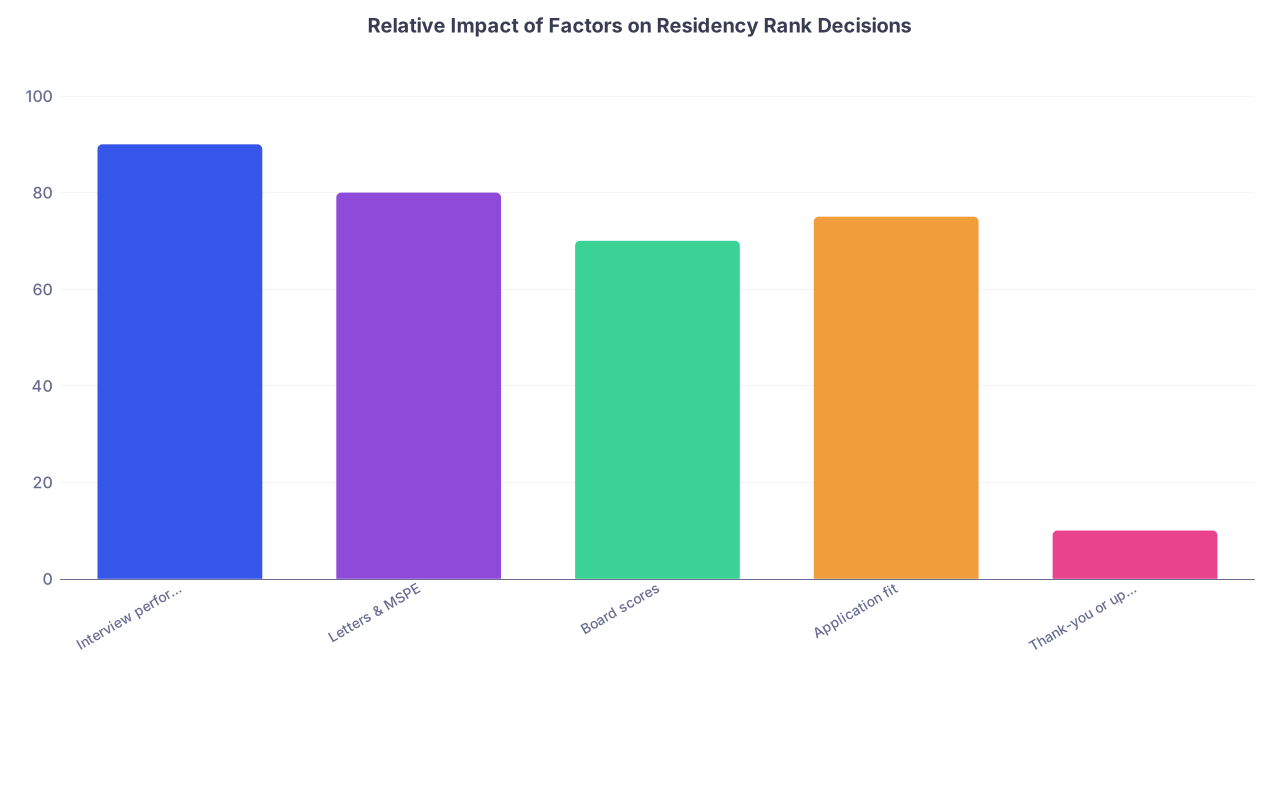
What actually happens looks more like this:
| Category | Value |
|---|---|
| Interview performance | 90 |
| Letters & MSPE | 80 |
| Board scores | 70 |
| Application fit | 75 |
| Thank-you or updates | 10 |
Rough qualitative idea:
- Interview performance: Huge impact
- Letters / MSPE: Big
- Scores, class rank, CV: Significant
- Perceived fit / professionalism: Significant
- Thank-you email: Small tiebreaker, sometimes
Where thank-you or follow-ups help:
- You are on the bubble. Two similar candidates. One clearly engaged and thoughtful, replied professionally post-interview. That one may get the small bump.
- You used the follow-up to highlight a specific fit: “My long-term goal in academic cardiology matches your program’s strengths in…”
- You attached a meaningful update (publication, powerful eval, strong Step 2 CK).
So you send these not because they are magical. You send them because in a high-noise, high-competition system, small, professional signals accumulate.
9. A Simple Recovery Checklist You Can Use Tonight
Here is the exact process I would use if I were in your shoes and realized I had sent zero or few thank-yous.
Make a list of all programs + interview dates.
Quick spreadsheet or even a sheet of paper.Mark each as:
- Top 1–3 choice
- Mid-range but realistic
- Backup / unlikely to rank high
For each program, note:
- Days since interview
- Do you have any real updates? (yes/no)
- Do you have interviewer contact info? (yes/no)
Assign email type by the timing framework:
- 0–7 days: standard thank-you
- 8–21 days: delayed thank-you
- 3+ weeks: “update + appreciation” or “continued interest” if top choice
- 3+ weeks, not top choice, no update: no email needed
Draft one base template for each type.
Then personalize per program with:- Specific program feature
- Specific topic you discussed
Send in this order:
- All top-choice programs first
- Then mid-range realistic programs
- Then anyone else you still care about
Stop after you have:
- Sent one thank-you per interviewer (where you have info)
- Possibly one program-wide note via coordinator
No need to “catch up” perfectly. The goal is “good enough and done.”
10. Future-Proof Yourself For The Rest Of Interview Season
You can avoid this particular stress spiral next time.
Set up a simple structure:
- Create a “Thank-you – TEMPLATE” email draft in your email program.
- After each interview:
- Jot 3 bullets during or right after:
- Faculty names
- One thing that stood out about the program
- One specific conversation detail per interviewer
- Jot 3 bullets during or right after:
- That night or next morning:
- Duplicate the template
- Insert those specifics
- Send
If you like visual structure, build yourself a small flow:
| Step | Description |
|---|---|
| Step 1 | Finish interview day |
| Step 2 | Write 3 quick notes on program & people |
| Step 3 | Open thank-you template draft |
| Step 4 | Customize for each interviewer |
| Step 5 | Send within 24-48 hours |
| Step 6 | Log sent in your spreadsheet |
You are not trying to impress with literary brilliance. You are demonstrating:
- Professionalism
- Attention to detail
- Ability to follow through
The same traits people want in a resident on call at 3 a.m.
FAQ (Exactly 3 Questions)
1. I never sent any thank-you emails for any programs. Should I bulk-send them all now?
No. Do not panic-broadcast. Prioritize. Identify your top 5–8 programs and send appropriately timed emails based on how long it has been (standard, slightly delayed, or update + appreciation). For programs that are now many weeks out, where you have no real updates and they are not top choices, skipping the thank-you is acceptable. Focus on quality, not universal coverage.
2. Can a late thank-you email hurt my chances?
It can hurt only if you make it awkward—long explanations, excessive apologies, or obvious copy-paste generic content. A brief, professional, slightly delayed note is neutral-to-positive at worst. The real damage comes from coming across as disorganized, overly emotional, or oblivious to boundaries, not from the date stamp itself.
3. Should I send a handwritten card instead of email?
For residency, handwritten cards are usually unnecessary and sometimes logistically problematic. Programs are busy, physical mail can get lost, and decisions are often made before your card even arrives. Email is the standard, expected, and easily documented form of follow-up. If you already sent a card, fine. But do not rely on it alone; an email is still wise if you want to share updates or clearly state your interest.