The way most applicants “follow up” after a residency interview is sloppy, needy, or both.
You are going to do it differently. Even when you do not have your interviewer’s contact info.
This is fixable. There is a clean, professional path that:
- Respects program boundaries
- Gets your message to the right person
- Does not make you look desperate or clueless
Let me walk you through the exact playbook.
Step 1: Decide if You Actually Need to Reach Them
First filter. Do you even need to contact this person?
You do not need to reach the interviewer when:
- You just “feel like” you should say thank you
- The program explicitly told you: “No post‑interview communication is expected or required.”
- ERAS portal or interview info said: “Please do not contact individual interviewers.”
In those cases:
- A thank‑you to the program’s main contact is enough
- Or nothing at all, if they clearly discourage follow‑up
You should try to reach someone (not necessarily that exact interviewer) if:
You have a major correction or update that affects your application
- Big new publication
- Step 2 score released and stronger than Step 1
- Rank‑changing life event (partner matched in the same city, serious health or family situation, visa status change)
You need a clarification that affects your rank list
- Schedule flexibility (e.g., child care needs, serious medical condition)
- Visa sponsorship details (J‑1 vs H‑1B)
- Need to confirm something they said about fellowship opportunities, call structure, or moonlighting that will shape where you rank them
You had a technical problem
- Dropped connection mid‑interview
- Zoom crashed
- Audio so bad you barely communicated
There was a serious misunderstanding
- You misspoke about something critical (e.g., “I failed a course” when you meant “I withdrew and passed later”)
- You realized later that an answer could have been misinterpreted in a problematic way
What you are not doing:
- Fishing for compliments or trying to “boost” your rank with flattery
- Cold‑emailing faculty to say they are your #1 when the program says “no post‑interview communications will be used in rank decisions”
If your reason does not fall into one of those buckets, stop. You do not gain points by forcing unnecessary contact.
Step 2: Check Every Official Channel Before You Panic
You do not start by hunting someone’s personal Gmail. You start with the tools the program already gave you.
Work through this checklist, in order:
Your interview invitation email
- Look for:
- Coordinator name and email
- Program administrator
- “Questions? Email X” line
- Ninety percent of the time, that is your main contact.
- Look for:
Interview day packet or PDF
- Programs often include a section like:
- “Post‑interview questions can be directed to…”
- Or they list all faculty with titles but not emails. That still helps later.
- Programs often include a section like:
Your ERAS/Thalamus/VidCruiter/Interview Broker portal
- Many systems have a “Contact program” button or show the coordinator’s email on the schedule page.
Program website – “Contact Us” / “Current Residents” / “Meet Our Faculty”
- Find:
- Program coordinator/manager
- Program director (PD)
- Associate program director (APD)
- Some sites list direct emails, others have a generic residency inbox.
- Find:
Any post‑interview follow‑up email
- Often sent same or next day:
- “Thank you for interviewing… For questions, please contact…”
- Often sent same or next day:
You are not looking for the interviewer’s personal address yet. Your primary target is:
The official residency coordinator or program office email.
That is the correct, professional gatekeeper. Use it.
Step 3: Use the Coordinator as Your Primary Route
If you cannot email the interviewer directly, you go through the coordinator. That is their job. They are not annoyed by this if you do it correctly.
Template: Professional Message via Coordinator
Subject line options:
- “Follow‑up from Interview with [Program Name] – [Your Name]”
- “Question Following [Specialty] Interview – [Your Name]”
- “Post‑Interview Clarification – [Your Name]”
Body template:
Dear [Mr./Ms./Mx./Dr.] [Coordinator Last Name],
I interviewed with the [Program Name] [Specialty] residency on [date]. I had the opportunity to speak with [Dr. First Last] during my interview day.
I wanted to [briefly state purpose: clarify one point from our conversation / share an important update to my application / ask a specific question about X]. I do not have Dr. [Last Name]’s contact information and did not wish to contact them directly without going through the appropriate channel.
Would you be able to either:
– Forward a brief note from me to Dr. [Last Name], or
– Let me know if there is a preferred way to address this question/update?[1–3 sentences with the actual question or update – concise, specific, no rambling.]
Thank you very much for your time and for all the work you and the team put into the interview day.
Sincerely,
[Your Full Name, Degree]
AAMC ID: [#######]
ERAS ID (if IMG/appropriate): [if applicable]
Phone: [optional]
You are:
- Respecting boundaries
- Keeping it short
- Making it easy to help you
If the program has a generic residency email instead of a named coordinator, same message, just address it to “Dear Residency Program Coordinator” or “Dear [Program Name] Residency Team”.
Step 4: When the Program Says “No Contact with Interviewers”
This happens more and more, especially in competitive specialties. The policy might be explicit:
- “Please do not contact faculty or interviewers directly.”
- “Post‑interview communication will not be used in ranking decisions.”
- “We request that you direct all communication to the residency office only.”
Here is how you handle it.
Respect it literally.
Do not try to be clever or circumvent via social media, LinkedIn, or faculty hospital emails you dig up yourself. That looks immature.Route everything through the main office.
You can still:- Send a necessary update
- Ask program‑level questions
- Clarify major issues
As long as you are messaging the program office, not individual faculty.
Adjust expectations.
Your message is for:- Clarifying your file
- Avoiding misunderstandings
Not for “boosting” your rank. Programs with strict policies are intentionally ignoring post‑interview flattery.
Template tweak:
I understand from the interview day materials that applicants should not contact individual interviewers directly. I am therefore reaching out to the residency office to [state purpose briefly]. If this type of question/update is not appropriate at this stage, please feel free to disregard this message.
This sentence signals two things:
- You read and respect their policy
- You are not trying to manipulate the process
That matters.
Step 5: If You Truly Need That Interviewer’s Input
Sometimes you really do need that specific person:
- They are the only one who understood your niche research area
- They are the fellowship director you clicked with
- They invited you to reach out, but no contact info was provided
Still, you start with the coordinator, not a detective hunt. Use a version of:
I had a particularly helpful discussion with Dr. [Last Name] about [X]. I have a brief follow‑up question that would be best directed to them specifically. If appropriate, would you be willing to forward a short email to Dr. [Last Name], or let me know if there is a different faculty member I should contact instead?
You give them an easy out. If the culture is “no direct contact,” they will redirect you. Accept that without pushing.
Step 6: What If You Really Have Zero Contacts?
This is rare, but I have seen it:
- You only have an automated [email protected] address
- No coordinator name
- Website is terrible
- No obvious residency email
Here is the exact sequence.
1. Re‑scrub the program website
Specifically look for:
- “Residency Program Coordinator”
- “GME Office”
- “Medical Education Department”
Often it is buried on a PDF or on the sponsoring hospital site, not the academic “Department of X” page.
2. Use the hospital’s general switchboard
Yes, old‑school phone. Call the hospital’s main number.
Script:
“Hi, this is [Your Name]. I recently interviewed for the [Specialty] residency program. I have a brief follow‑up question and I am trying to find the correct email for the residency program coordinator. Could you please connect me with the GME office or the [Specialty] residency office?”
You are not asking to be connected to the PD. You are asking for the coordinator contact.
3. Use the GME office
If you get GME, do the same:
- Ask for the residency coordinator’s email
- Or the generic residency office email for that program
Then send the email from Step 3.
What you are not doing:
- Cold‑calling the faculty office and asking for Dr. X’s email to “follow up on my interview”
- Telling random staff you want to “thank the PD personally”
Professionalism > enthusiasm.
Step 7: What to Actually Say (Concrete Scripts for Common Situations)
You need wording that sounds like an adult physician, not a panicked applicant. Use these as starting points.
A. Thank‑You When You Do Not Have Interviewer Emails
If the program did not forbid follow‑ups but you lack contact info, send a global thank‑you to the coordinator.
Subject: Thank You – [Program Name] Interview on [Date]
Dear [Mr./Ms./Mx./Dr.] [Last Name],
Thank you for organizing the interview day for the [Program Name] [Specialty] residency program on [date]. I appreciated the opportunity to learn more about the program and to meet with the residents and faculty.
I would be grateful if you could extend my thanks to the program leadership and faculty on my behalf.
Sincerely,
[Name]
Short. Polite. Done.
B. Clarifying a Misstatement
Example: You accidentally implied you failed a rotation when you actually took a leave and passed later.
Subject: Brief Clarification Following Interview – [Your Name]
Dear [Coordinator],
I interviewed with the [Program Name] [Specialty] residency on [date]. During one of my interviews, I discussed my third‑year [clerkship name]. On reflection, I realized that I may have described this experience in a way that could be misleading.
To clarify: I did not fail the rotation. I took a leave of absence for [brief reason – 1 line max], then returned and successfully completed the clerkship with a [grade if relevant]. This is reflected accurately in my MSPE and transcript, but I wanted to ensure that my verbal explanation did not create confusion.
If appropriate, I would appreciate it if this clarification could be shared with the relevant interviewer or added to my file.
Thank you very much for your time.
Sincerely,
[Name]
That is how you fix a potential landmine.
C. Important Update (Scores, Publications, Visa)
Subject: Application Update – [Your Name], [Specialty] Applicant
Dear [Coordinator],
I interviewed with the [Program Name] [Specialty] residency on [date]. I wanted to share a brief update to my application:
– [Step 2 CK: I received my Step 2 CK score on [date]; my score is [###].]
– [Publication: My manuscript titled “[Title]” was accepted for publication in [Journal] on [date].]
– [Visa: My visa status has changed from [X] to [Y] as of [date].]I understand that your rank list process may already be well underway, but I wanted to ensure that my file reflects the most current information.
Thank you again for the opportunity to interview.
Sincerely,
[Name]
No fluff. Just facts.
D. Program‑Level Clarification That Affects Ranking
Subject: Question Regarding [Specific Topic] – [Your Name]
Dear [Coordinator],
Thank you again for the opportunity to interview with the [Program Name] [Specialty] residency on [date]. I had a question regarding [specific topic: e.g., childcare support for residents on nights; call schedule for residents with medical accommodations; H‑1B eligibility].
Before finalizing my rank list, I want to be certain I understand how the program handles [topic] because of [brief reason – e.g., “a chronic medical condition that requires consistent follow‑up care,” “my spouse’s work visa,” “our child’s daycare schedule”].
Would you be able to let me know [specific question, 1–2 lines]? If there is someone else (e.g., PD or chief resident) who is better suited to answer this, I am happy for you to forward my question.
Thank you for your time.
Sincerely,
[Name]
The key: you are not asking vague things like “How supportive is your program?” Ask for concrete policy or structure.
Step 8: What Not To Do (The Stuff that Hurts You)
I have seen applicants sink themselves by trying too hard after interviews. Do not do these:
- Do not send LinkedIn connection requests to interviewers to say thanks.
- Do not DM faculty or residents on Instagram/Twitter/Threads with “I loved your program so much!”
- Do not email random departmental faculty you found on PubMed because they work in your niche and “might put in a word.”
- Do not send multiple follow‑ups if you get no reply. One well‑constructed message is enough.
- Do not hint or pressure: “This program is my #1 and I hope that influences my rank.” Many programs are not allowed to consider that and they resent the attempt.
If you are not sure if a message is over the line, assume the PD will read it out loud in a room of 15 faculty and residents. If you would cringe hearing it in that setting, do not send it.
Step 9: Timing – When to Send What
You are still in the residency match calendar. Timing matters.
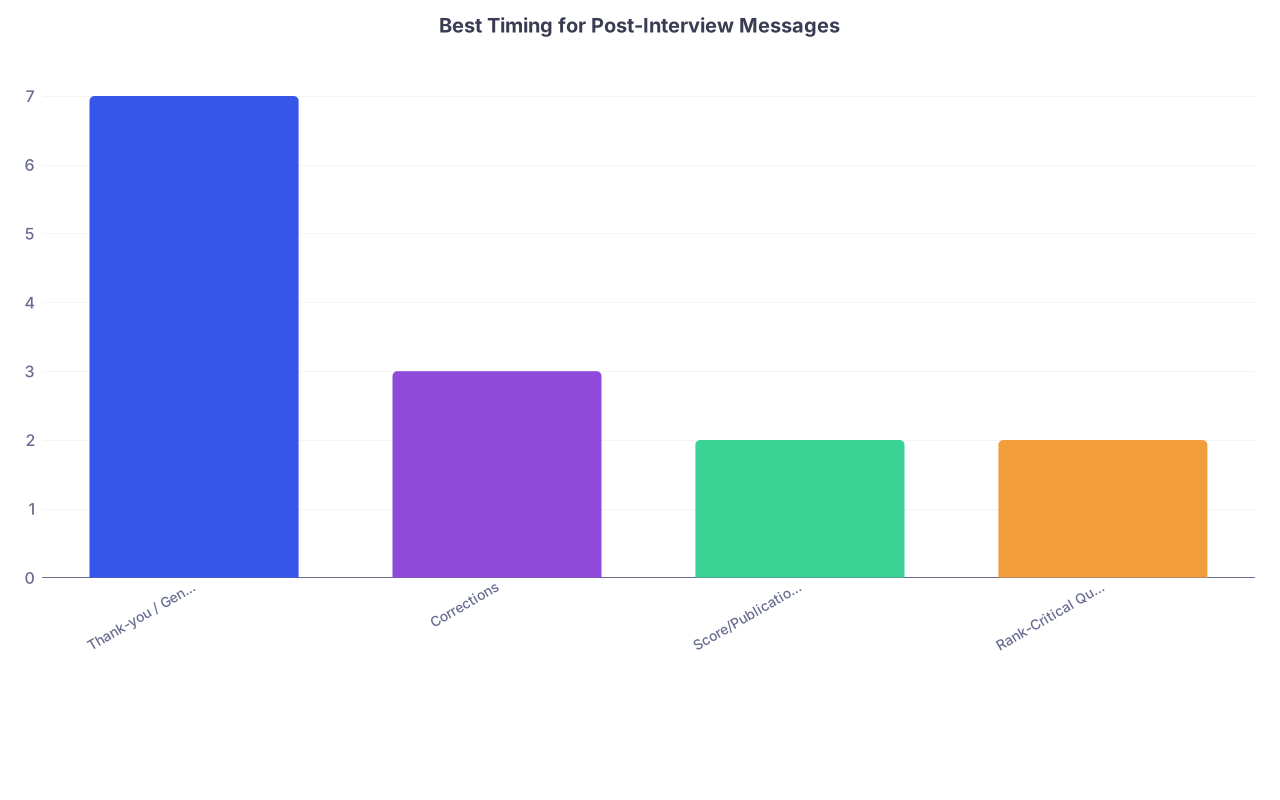
| Category | Value |
|---|---|
| Thank-you / General | 7 |
| Corrections | 3 |
| Score/Publication Updates | 2 |
| Rank-Critical Questions | 2 |
Legend (days after interview or after event):
- Thank‑you / General: within 7 days
- Corrections: within 24–72 hours (the sooner, the better)
- Score/Publication updates: within 1–2 days of receiving the result
- Rank‑critical questions: ideally before programs start rank meetings (varies, but often late January–early February for most specialties)
If you are very close to the NRMP rank deadline:
- You can still ask critical clarification questions
- But you should not expect programs to remake their list around you
Send it anyway if it affects your ranking decisions. Do not frame it as “I hope this improves my rank at your program.”
Step 10: A Quick Visual of the Process
Here is the mental model you can keep:

| Step | Description |
|---|---|
| Step 1 | Need to contact interviewer? |
| Step 2 | Do nothing or general thank-you |
| Step 3 | Check program policies & contacts |
| Step 4 | Contact program office only |
| Step 5 | Email coordinator as gateway |
| Step 6 | Send concise update/question |
| Step 7 | Ask coordinator to forward note |
| Step 8 | Email interviewer directly cc coordinator if appropriate |
| Step 9 | One follow-up only, then stop |
| Step 10 | Is it necessary? |
| Step 11 | Policy allows post-interview contact? |
| Step 12 | Have interviewer email? |
If you follow that flow, you stay professional and on the safe side.
Quick Comparison: Right vs Wrong Approaches
| Situation | Wrong Move | Professional Move |
|---|---|---|
| No interviewer email | Hunt personal email / DM on social media | Email coordinator and ask to forward |
| Program says “no faculty contact” | Email PD directly anyway | Route all questions through residency office |
| Need to fix misstatement | Ignore and hope they misheard | Send brief written clarification |
| Want to say thanks | Emotional multi-paragraph essay | Short thank-you to coordinator |
| New important update | Attach full CV + long narrative | 2–3 line factual update |
When You Can Email an Interviewer Directly
A few programs actually give you the interviewer’s card or email and explicitly say, “Feel free to reach out.”
In that case:
- Keep the email short
- Avoid any match‑violating content (no explicit rank discussions, no pressure)
- Optionally CC the coordinator if the culture seems to favor that
Template:
Subject: Thank You – [Program Name] Interview
Dear Dr. [Last Name],
Thank you for taking the time to speak with me during my interview for the [Program Name] [Specialty] residency on [date]. I appreciated our conversation about [specific topic – research, clinical interest, teaching philosophy].
Our discussion reinforced my interest in [specific aspect of the program]. I am grateful for the opportunity to learn more about the program and your work.
Sincerely,
[Name]
No ranking language. No hinting at promises. Just professional appreciation.
Final Point: Do Not Overestimate the Power of Follow‑Ups
One uncomfortable truth:
For most programs, one clean interview + solid file beats any number of follow‑up emails.
Your follow‑up can:
- Fix a misunderstanding
- Provide important updates
- Show you are a functional adult who can communicate professionally
It cannot:
- Rescue a truly bad interview
- Compensate for major score or performance gaps
- Vault you over significantly stronger candidates
So do what is necessary. Do it well. Then stop.
Core Takeaways
- You almost never need your interviewer’s direct email. Use the program coordinator or residency office as your primary contact and ask them to forward messages when appropriate.
- Follow‑up only for real reasons: corrections, meaningful updates, or specific questions that affect your rank list. Keep messages short, factual, and policy‑compliant.
- Respect program communication rules, avoid social media or back‑channel contact, and do not chase multiple replies. One professional message, sent through the right channel, is enough.