
It is late January. You have already finished most of your residency interviews. You thought the season was “done.” Then three things hit at once: a paper gets accepted, your sub-I attending tells you they will write a strong letter, and you just won a department award. You are staring at your email, cursor blinking, thinking:
“Should I tell programs? How? Will this help or annoy them? And how do I do it without sounding desperate?”
You are in exactly the right place. Let us fix this.
Below is a clear, tactical blueprint: when to update programs, what is actually worth sending, how to structure the message, and how to avoid the common mistakes that make programs roll their eyes and hit delete.
1. What Counts as a “Real” Update (And What Does Not)
Let me start bluntly: most “updates” applicants send are fluff. Programs are busy, many are already building rank lists, and they do not want noise.
An update should meet at least one of these criteria:
It changes the objective strength of your file
- Peer-reviewed publication accepted (not “submitted”)
- Major poster/oral presentation at a recognizable regional/national meeting
- New leadership position with real responsibility (chief of a large group, new QI lead, etc.)
- Significant award or honor (departmental, institutional, national)
- Step 2 CK or COMLEX 2 score that clearly strengthens your application or fills a missing data point
It clarifies your level of interest in a specific program
- TRUE “this is my number one choice” email (only if honest)
- Substantive reflection tying your new experience to what you saw at that specific program
Things that usually are not worth a dedicated “update” email:
- New shadowing experience
- Minor volunteer activity (another afternoon clinic, a single event)
- Small local poster at a student research day
- “I’m still very interested” with no new information
- Re-sending your personal statement in different words
Rule: if you would not put it in the “honors/awards” or “publications” section of your CV without hesitation, it is probably not strong enough for a standalone mid-season email.
2. When To Send Updates (Timing vs. Rank List Reality)
Programs do not operate on your mental calendar. They have theirs.
Here is the rough reality for most specialties:
- December–early January: Many programs are finishing interviews, starting rank discussions.
- Mid-late January: Programs begin serious rank list meetings; some freeze ranks as early as late January.
- Early–mid February: Rank lists finalized and certified.
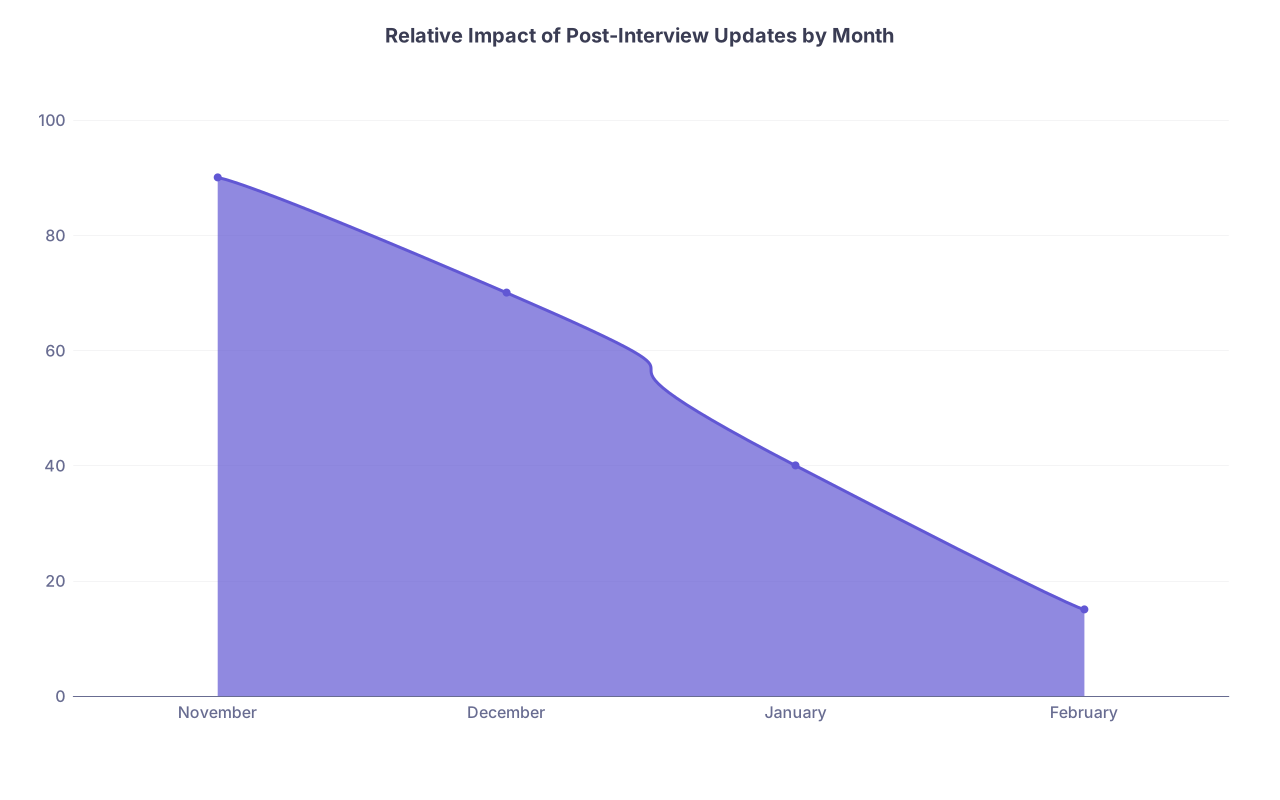
So the earlier your update, the more impact potential. But even late updates can matter, especially for very interested programs.
| Category | Value |
|---|---|
| November | 90 |
| December | 70 |
| January | 40 |
| February | 15 |
Interpretation: if you have a meaningful update in November–December, send it. January is still fair game. February is low-yield but can matter for genuine “#1 choice” communication.
Short timing rules:
- Within 1 week of the achievement
Send the update. Fresh is better. - If it is already February
Only send:- A genuine “this is my top choice” email, or
- A major achievement (e.g., first-author publication in a solid journal, major national award).
- Do not batch everything until the end
Drip reasonable, real updates as they occur, especially if they are impactful.
3. Who To Email (And How Many Emails Per Program)
You do not spam the whole department. You target.
Primary targets:
- Program Coordinator (always included)
- Program Director (PD)
- Occasionally: Associate Program Director (APD) or a faculty champion you connected well with — but only if it makes sense.
If the program provides a specific “update email” or portal, use that. Some ERAS-era programs will say “do not send post-interview updates.” If they explicitly say that, respect it. You are not the exception.
| Situation | Who You Email |
|---|---|
| Standard program, no guidance given | PD + Coordinator |
| You had strong connection with faculty | PD + Coordinator + That Faculty (CC, not separate) |
| Program has portal for updates | Use portal + optionally CC Coordinator |
| Program says “no post-interview emails” | Do not email; at most 1 true #1 note if allowed |
Limit yourself to:
- 1 update email per meaningful achievement type (e.g., one for publication, one later for a big award), max 2–3 total per program across the season.
- 1 “my #1 choice” email — ever. To one program. Not negotiable if you care about your integrity.
4. Core Email Blueprint: Structure That Actually Works
Programs skim. Your email has to be skimmable in 10–20 seconds and still make sense.
Here is the basic blueprint:
- Subject line
- Greeting
- Anchor (remind them who you are)
- The update (one or two key points, max)
- Connection to their program
- Close
Let me give you concrete templates and then tweak them by scenario.
5. Template 1: General Significant Achievement Update
Use this when you have a new publication, major award, or strong new leadership role.
Subject Line Options
- “Application Update – [Your Name], [Medical School], [Specialty]”
- “Update to Application: Recent Publication – [Your Name]”
- “Interviewed Applicant Update – [Your Name], [Interview Date]”
Do not get cute. Clarity beats creativity.
Full Template
Subject: Application Update – [Your Name], [Medical School], [Specialty]
Email body:
Dr. [Last Name] and [Program Name] Residency Team,
Thank you again for the opportunity to interview with the [Program Name] [Specialty] Residency on [interview date]. I appreciated learning more about your program’s [1 concrete detail you remember: e.g., “resident-led QI projects and the 4+1 structure”].
I am writing to share a brief update to my application. Since our interview,
- [Publication]: My manuscript entitled “[Title]” has been accepted for publication in [Journal].
- [or Award]: I was selected to receive the [Name of Award], given annually to [1 short clause describing award].
- [or Leadership]: I have been appointed [New Role] for [Organization], where I will be [1 short description of responsibility].
These developments further strengthen my commitment to [your field, e.g., Internal Medicine] and align with my interest in [link to something specific in their program – e.g., medical education, QI, community health].
[Optional, 1 sentence max] I remain very interested in [Program Name] and would be thrilled to train in a program that [specific attribute you saw there, not generic praise].
Thank you for your time and consideration of this update.
Sincerely,
[Full Name]
[Medical School, Expected Graduation Year]
AAMC ID: [XXXXX]
Phone: [XXX-XXX-XXXX]
6. Template 2: Step 2 CK / COMLEX Level 2 Update
If your Step 2 score helps you (or replaces a missing Step 2), you should send it. Programs like data.
Use this if:
- You had no Step 2 at time of interview and now you do.
- Your Step 1 was weak, and Step 2 is clearly stronger.
Subject: Step 2 CK Score Update – [Your Name], [Medical School]
Dr. [Last Name] and [Program Name] Residency Team,
Thank you again for the opportunity to interview with the [Program Name] [Specialty] Residency on [date]. I enjoyed hearing about [specific detail from interview day].
I am writing to update you that I have received my USMLE Step 2 CK score. I scored [###], which I hope further reflects my readiness for residency and addresses any concerns about my academic performance.
[Optional if true]: I have also attached an updated CV with this score added.
I remain very interested in [Program Name] and would be grateful for continued consideration in your ranking process.
Sincerely,
[Name, etc.]
If the score is only marginally helpful, keep it neutral, not apologetic. State it once, do not editorialize.
7. Template 3: “This Program Is My #1 Choice” Email
This one carries weight. Programs take genuine “#1” messages seriously. But they also assume some applicants are lying. Your job is to write one that does not sound like it was copy-pasted to ten programs.
Only send this after you have a stable sense of your rank list, usually mid-to-late February, and only to one program.
Subject: [Program Name] as My First Choice – [Your Name]
Dr. [Last Name] and [Program Name] Residency Team,
Thank you again for the opportunity to interview with the [Program Name] [Specialty] Residency on [date]. After completing my interviews and reflecting on what I am looking for in a training program, I wanted to share that [Program Name] is my first choice for residency.
Several aspects of your program stand out to me:
- [Point 1: something specific – e.g., “The balance of community and tertiary care through your two primary clinical sites.”]
- [Point 2: e.g., “The evident camaraderie among residents, especially during the noon conference.”]
- [Optional Point 3: e.g., “The robust mentorship structure for residents pursuing [research/education/underserved care].”]
If matched to [Program Name], I would be fully committed to contributing to the resident community, particularly through [something you actually do: education, QI, advocacy, wellness, research].
Thank you again for your time and consideration.
Sincerely,
[Full Name]
[School, etc.]
Do not promise they are #1 if they are not. That is not “strategy.” It is a reputational time bomb. PDs talk.
8. Template 4: Multiple Small Updates in One Message
If you have several modest but real achievements (e.g., one regional poster, a local award, and a new leadership role), batch them. Do not send three separate emails.
Subject: Application Updates – [Your Name], [Medical School]
Dr. [Last Name] and [Program Name] Residency Team,
I hope you are well. I am grateful for the chance to have interviewed with the [Program Name] [Specialty] Residency on [date]. I remain very interested in your program.
Since our interview, there have been a few updates to my application that I wanted to share briefly:
- I presented a [poster/oral] presentation titled “[Title]” at the [Conference Name].
- I received the [Name of Award] from [Department/Institution].
- I began serving as [New Role] for [Organization], where I [one clear responsibility].
I have attached an updated CV that includes these changes.
Thank you again for your consideration.
Sincerely,
[Name, etc.]
One email. Clean, short. Easy to forward into your file.
9. How To Connect Your Update To Their Program (The Part Most People Skip)
The “I did X” part is only half the value. The other half is “and this is why I am an even better fit for your program now.”
Programs care whether your trajectory matches what they offer. That is where many applicants write generic fluff.
Here is how to do it correctly:
- Identify 1–2 real features of their program:
- Strong QI / patient safety infrastructure
- Big emphasis on medical education / teaching
- Large underserved population
- Strong research mentorship
- Collegial resident culture
- Tie your update to that thing in 1–2 sentences.
Examples:
“This QI project, focused on reducing 30-day readmissions in heart failure, has deepened my interest in the kind of outcomes-driven work I saw emphasized in your morbidity and mortality conferences.”
“Presenting our work on community hypertension screening at a national meeting reinforced my goal of training in a program like [Program Name], where residents are engaged in longitudinal community outreach.”
“Stepping into a leadership role as our sub-intern coordinator has made me even more excited about programs like yours that prioritize teaching skills and resident-led education.”
If your “connection” sentence could be used verbatim for five different programs, it is probably too vague.
10. Formatting, Attachments, and ERAS Logistics
A few boring but critical details.
Attachments
- Updated CV: Good idea if you have multiple updates or one big one.
- Do not attach:
- Transcripts
- Screenshots of score reports
- 5 PDFs of posters
If they want official score reports, they know how to find them.
ERAS Updates
ERAS is simplified post-submission. You cannot re-send a fully updated application to everyone. However:
- Some programs have their own portal or email for updates.
- If you have a major publication, you can:
- Update your CV.
- Mention it clearly in your email so they can manually note it.
Do not torture yourself over whether it “shows up” in the ERAS section. The email is what matters now.
11. Common Mistakes That Make You Look Worse, Not Better
I have watched applicants sink their own stock with clumsy follow-up. Do not be that person.
Here is what sabotages you:
Emotionally loaded emails
- “I really need to match this year.”
- “I would be devastated not to end up somewhere like your program.”
Programs are not your therapist. Keep tone composed and professional.
Over-updating
- Sending 4–5 “small update” emails over two months.
You become noise. At best, they ignore you. At worst, they remember you for the wrong reasons.
- Sending 4–5 “small update” emails over two months.
Sounding generic and obviously copy-pasted
- “Your program’s commitment to excellence and diverse patient population is unmatched.”
That sentence could describe 180 programs. Worth nothing.
- “Your program’s commitment to excellence and diverse patient population is unmatched.”
Dishonest “#1 choice” emails
- People get caught. PDs compare notes. Future students from your school pay that price.
Grammatically sloppy, informal tone
- “Hi guys, just wanted to say thx again for the interview!! Also I have a new pub…”
You are asking them to make you their colleague. Write like one.
- “Hi guys, just wanted to say thx again for the interview!! Also I have a new pub…”
Angling for information about your rank position
- “I was wondering where I stand on your list.”
They cannot and will not tell you. Asking makes you look naive or entitled.
- “I was wondering where I stand on your list.”
12. How Strong Is The Impact Really?
Let me be blunt: a single update email will almost never drag you from “bottom 20%” to “top 10%” of their rank list.
Where updates matter most:
- You are in the middle third, and they are deciding between you and a similar applicant.
- You had a missing piece (Step 2, no publications) and now you have it.
- You are a strong candidate and the update is a signal of sustained performance and continued interest.
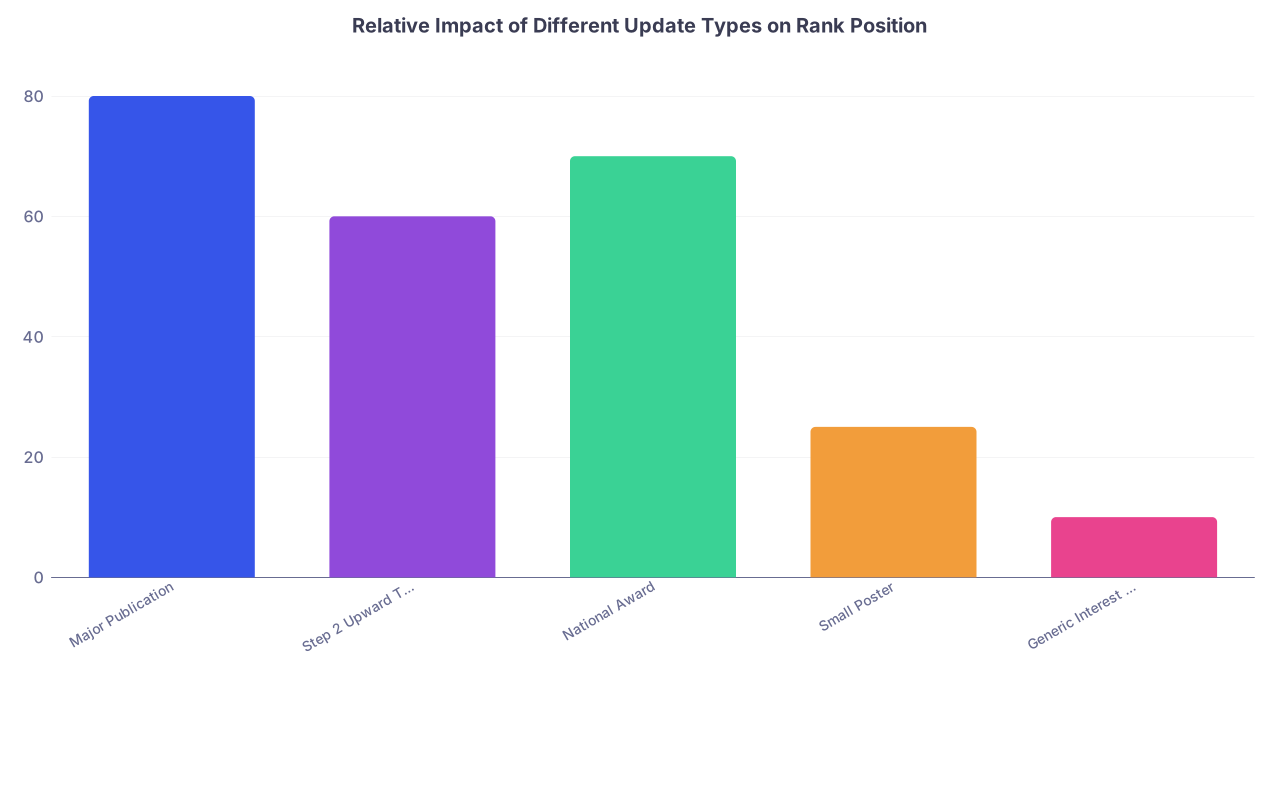
Think of updates as incremental nudges, not rescue missions.
| Category | Value |
|---|---|
| Major Publication | 80 |
| Step 2 Upward Trend | 60 |
| National Award | 70 |
| Small Poster | 25 |
| Generic Interest Email | 10 |
Decoded:
- Publication, Step 2, major award: These can shift perception.
- Small posters, generic “I’m still interested”: Minor impact at best.
13. Practical Workflow: How To Execute Without Losing Your Mind
You are probably juggling rotations, notes, exams, and your life. So here is a simple workflow.

| Step | Description |
|---|---|
| Step 1 | New Achievement Occurs |
| Step 2 | Do not email |
| Step 3 | List affected programs |
| Step 4 | Rank programs by interest |
| Step 5 | Draft core update paragraph |
| Step 6 | Customize to each program |
| Step 7 | Proofread once |
| Step 8 | Send within 7 days |
| Step 9 | Is it significant? |
Step-by-step:
Achievement happens
Publication, award, Step score, leadership role.Decide if it clears the bar
Use the criteria from Section 1. If the answer is no, let it go.List programs where it might matter
- Programs that interviewed you AND
- Where you could realistically see yourself going.
Write one master update paragraph
- “Since my interview, X happened…”
Then clone that into each email body.
- “Since my interview, X happened…”
Customize 2–3 sentences per program
- One about their program specifically.
- One about your fit or interest.
Send within a week
- Fast enough to be relevant.
- Not so fast you send typo-riddled nonsense.
14. Final Reality Check: What “Success” Looks Like Here
Measured expectations keep you sane.
Success is not:
- A PD emailing back “We just bumped you 20 spots!”
- A guaranteed match because you sent a beautiful update.
Success is:
- You communicated key new information clearly and professionally.
- You showed that you are thoughtful, reliable, and engaged.
- You gave yourself a reasonable chance to climb a bit in their internal discussions.
Do this cleanly across your top programs, and you have handled your side of the process correctly. That is all you control.