
The way most applicants send post-interview emails is exactly how they get ignored.
Let me tell you what really happens when you send that “thank-you note” that’s secretly a second-look pitch: program directors can see right through it. And they talk about it. Out loud. With their coordinators, with faculty, and sometimes with a little eye roll.
You are not subtle. But you can be smart.
What PDs Actually See When Your Email Hits Their Inbox
Here’s the part nobody tells you: by the time you’re obsessing over your “perfect” thank-you / second-look hybrid email, most PDs are buried under a massive wave of nearly identical messages.
On a typical interview season morning, a PD’s inbox looks like this:
“Thank you for the opportunity to interview…”
“It was an honor to learn more about your program…”
“I remain very interested in [PROGRAM NAME]…”
Copy-paste. Again and again.
Half of these are really second-look attempts disguised as gratitude. And yes, PDs can tell. They’re not confused about what you’re doing. The question is not whether they know you’re angling. The question is: do they find it helpful, neutral, or irritating?
Let me be blunt:
Most of these emails don’t move you up. A small number absolutely hurt you. A very small number help you.
Your job is to avoid being in the first two groups and give yourself a legitimate shot at being in the third.
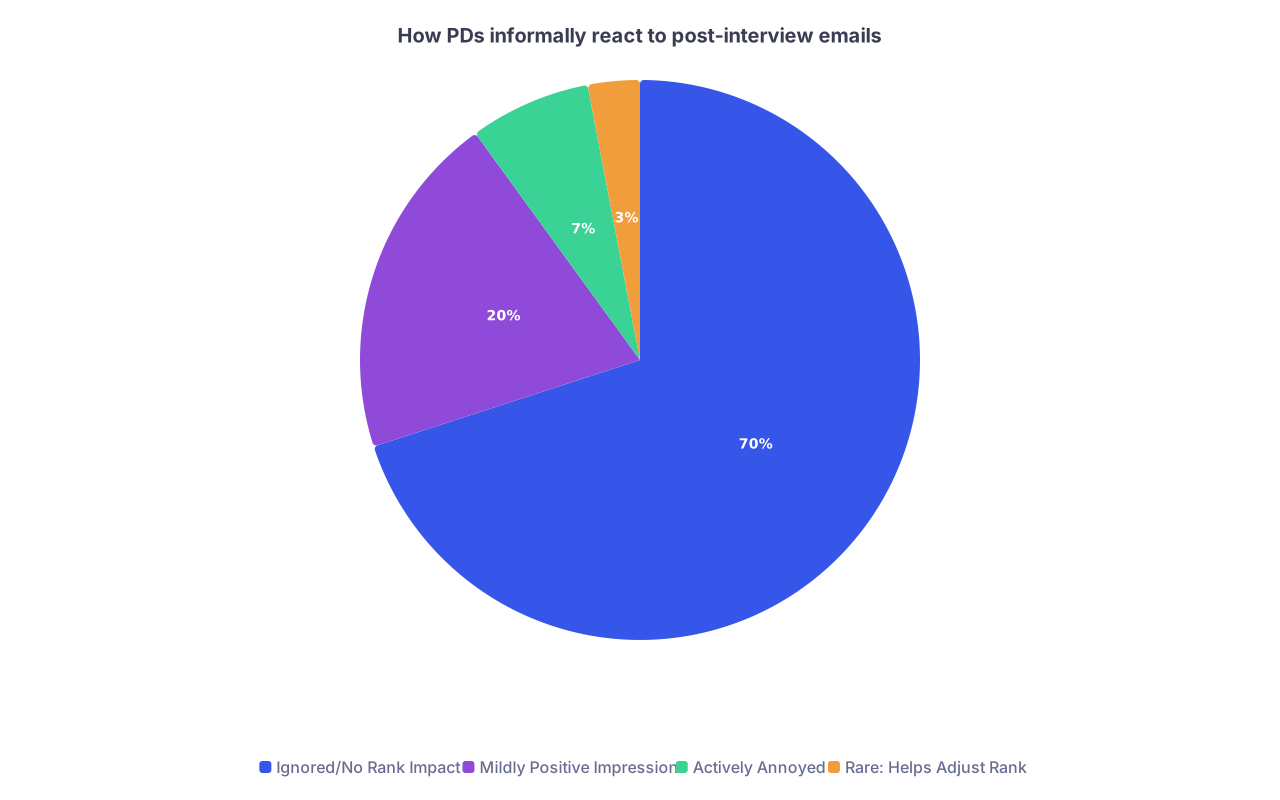
| Category | Value |
|---|---|
| Ignored/No Rank Impact | 70 |
| Mildly Positive Impression | 20 |
| Actively Annoyed | 7 |
| Rare: Helps Adjust Rank | 3 |
Those numbers aren’t from a formal study. They’re from what PDs say behind closed doors.
The Dirty Secret: PDs Know When You’re Trying to Game Them
Most students think they’re being clever:
“Thank you again… I especially appreciated hearing about your research track and would be thrilled to train at [PROGRAM].”
Translation to a PD: “Please notice I’m still interested. Maybe bump me up?”“I can really see myself thriving in your program and city.”
Translation: “Please rank me higher, but I won’t explicitly say it because NRMP rules scare me.”“I remain extremely enthusiastic about the chance to join your team.”
Translation: “This is me trying to say you’re in my top tier without committing.”
Here’s how faculty and PDs react when reading these live:
I’ve watched PDs scroll through a dozen of these during lunch and say things like:
“Yep, boilerplate, boilerplate, copy, copy… okay, nothing here changes anything.”
Or worse: “This one again. Didn’t even spell our program name right.”
They are absolutely parsing tone, content, and effort. But not the way you think.
What they’re actually asking, consciously or subconsciously, is:
- Is this person professional?
- Are they normal? (You’d be amazed how low this bar is.)
- Did they say anything that worries me?
- Did they say anything specific enough that I actually remember who they are?
- Did they break any ethical lines with ‘I will rank you #1’ type statements when they obviously sent the same to five places?
Your cute “second-look disguised as thanks” is not fooling anybody. But that doesn’t mean it’s useless. It just means you have to understand the game you’re actually playing.
What PDs Actually Like in Follow-Up Emails
Let me clear something up. PDs are not sitting around angry that you emailed.
Most are fine with a short, sincere thank-you. Some genuinely appreciate it. A few even add a tiny plus when someone clearly took the time to be thoughtful and specific.
They like:
- Brevity. Five to eight sentences. Not a manifesto.
- Specific recall. Mention a particular conversation, case, or detail from the day.
- Professional tone. Not dramatic, not clingy, not emotional blackmail.
- A clear but reasonable statement of interest. “I remain very interested” is acceptable if it matches your true feelings.
What they don’t like:
- Guilt-trippy lines. “Your program is everything I’ve dreamed of since childhood.”
- Over-selling. “I know I would be an outstanding addition to your residents.” (You don’t know that. And they don’t like arrogance disguised as enthusiasm.)
- Multiple follow-ups that escalate in intensity. The “just following up again to reiterate…” emails are death.
Let me give you a real pattern I’ve seen:
- Applicant A sends no follow-up. PD remembers them as “solid, normal,” ranks them based entirely on interview and file.
- Applicant B sends a brief, specific, grounded thank-you with a line of genuine interest. PD says, “Nice, they seem mature,” and maybe adds a minor positive impression.
- Applicant C sends a long, transparent “thank-you” that’s really a second-look essay with veiled ranking pressure. PD sighs, maybe flags them as “trying too hard,” and if the email is especially cringe, shares it in the group chat.
I’ve watched PDs literally read out loud the most over-the-top lines from these emails in their office with the door closed. If you’re theatrical, you become that applicant.
You do not want to be that applicant.
How PDs Handle Rank Lists vs. Follow-Up Emails
Here’s the brutal truth: by the time many of you send these pseudo-second-look thank-yous, the rank list is already mostly formed.
Not final maybe, but skeleton in place.
Real workflow, at a mid-size academic program I know very well:
- After each interview day: immediate scoring and rough internal ranking.
- After interview season: full-day rank meeting with faculty and chief residents.
- After that: PD tweaks around the edges for a couple of days.
- Then: list is basically set, minor adjustments only.
Your email doesn’t rewrite the list. At best it shifts you a few spots within your “tier.”
Where email can matter:
- You’re sitting on a tier boundary and the PD has a positive memory of your follow-up.
- You were quiet or flat on interview day, but showed thoughtful reflection in your note that makes them think, “Okay, actually more mature than we thought.”
- They’re comparing two nearly identical candidates and someone says, “That’s the student who wrote about the patient in the ICU during their sub-I, right? That was a good email.”
Is that common? No.
Is it possible? Yes.
Here’s how that really looks in practice:
| Scenario | Likely Effect on Rank |
|---|---|
| No email sent | No change |
| Short, generic thank-you | No change |
| Short, specific, professional note | Minor positive (1–3 spots) |
| Overly long, desperate, pushy email | Minor negative (1–5 spots) |
| Multiple “just checking in” messages | Larger negative (can drop a tier) |
Nobody is going from #85 to #10 because of a “thank-you” second-look. But going from #28 to #24? That can happen. And sometimes that’s the difference between matching and not when lists meet.
The Truth About “Disguised” Second-Looks
Let’s separate three things people keep mixing up:
- A pure thank-you note.
- A thank-you + statement of interest.
- A thank-you that’s really a second-look essay in costume.
PDs are mostly fine with #1 and #2. #3 is where people get into trouble.
Here’s what #3 looks like in the wild:
- Three or more paragraphs.
- Detailed re-selling of your CV and qualities.
- Re-arguing points from your interview.
- Phrases like “I hope you’ll strongly consider ranking me highly” or “I believe I’m an excellent fit for your program.”
I’ve seen PDs respond in their heads like this:
“We already considered you. That’s what the interview was for. Why are you auditioning again?”
What PDs do when they see an obvious disguised second-look:
- Skim quickly.
- Decide whether anything raises red flags.
- Occasionally make a marginal note: “Very eager, maybe a bit intense.”
- Almost never dramatically move you up because of it.
Some will downgrade you if the email feels manipulative, needy, or unprofessional. Especially in competitive specialties where they’re hypersensitive to resident drama potential.
If you want to show “continued interest,” fine. Just don’t write it like a closing argument in a trial.
How To Write a Follow-Up That PDs Don’t Hate
You want concrete guidance. So I’ll give it to you.
The best “second-look disguised as thank-you” is actually… not disguised. It’s just a strong thank-you with a clear, calm line of interest.
You keep it short. You show you listened. You sound like someone they’d want on rounds, not someone who would flood the group chat at 2 a.m.
Rough structure that works again and again:
Subject line:
“Thank you – [Your Name], [Specialty] Interview on [Date]”Open with genuine thanks, not drama.
“Thank you for taking the time to speak with me during my interview at [Program] on [date]. I appreciated the chance to learn more about your vision for the residency.”Mention something specific you remember.
A conversation about a rotation. A teaching philosophy. A unique clinic. Not a generic “I loved the collegial environment.”One, maybe two sentences of sincere interest.
“My conversation with you and the residents confirmed that [Program] aligns well with how I hope to train. I would be very excited to join your program.”Close and leave.
“Thank you again for the opportunity. Best regards, [Name, AAMC ID, school].”
That’s it. No ranking language. No “top choice” unless it’s 100% true and you are prepared to mean it.
The subtle second-look angle in this email is: “I took this seriously, I paid attention, I’m still interested, and I’m not unstable.” That’s the bar.

| Step | Description |
|---|---|
| Step 1 | Just finished interview |
| Step 2 | Draft short, specific thank-you |
| Step 3 | Accept no-contact strategy |
| Step 4 | Cut content, remove self-promotion |
| Step 5 | Send once, then stop |
| Step 6 | Send email? |
| Step 7 | Trying to re-sell myself? |
Red Flags That Make PDs Drop You Down
There are behaviors that reliably irritate PDs and rank committees. I’ve watched it happen in real time.
The worst offenders:
Multiple follow-ups
You send the initial thank-you. Then a “just wanted to reiterate my interest.” Then a “as rank lists approach, I remain extremely excited.”
By the third one, someone in the office is saying, “Okay, we get it,” and your name is getting an informal “needy” label.Over-sharing personal anxiety
“This process has been very stressful, and I’m really hoping to match at your program.”
Translation to PD: “This person might not handle stress well.”Playing the ranking game too hard
Telling a program they’re your “#1” when you’re telling multiple programs the same thing. Coordinators and PDs talk. Especially within a region and within competitive fields. When they catch a lie, your stock drops.Undermining other programs
Hinting that “other programs didn’t offer X” or “your program seems better than others I’ve seen…” makes you sound gossipy and unprofessional. Medicine is a small world. They assume you’ll talk about them that way later.
Remember: PDs are not just ranking your scores and CV. They’re ranking how much risk you bring as a future colleague. Your email is one of the few unstructured data points they see about that.
What Happens When a Follow-Up Actually Helps
I’ve seen maybe a handful of cases where a follow-up made a real difference. Not hundreds. A handful.
Here’s the pattern when it works:
- The applicant was already in the “solid” tier.
- The email was short, personal, and mature.
- It referenced something specific that resonated with the PD or faculty.
- It did not try to manipulate or pressure.
- It matched how they came across on interview day.
Examples:
A student who had been a bit reserved on Zoom wrote a brief note about a specific teaching comment the PD made about supporting residents through mistakes. The PD said in the meeting, “Their email was actually thoughtful, they might fit our culture better than we realized.” They nudged that applicant up a bit.
Another student wrote a very simple but striking line about wanting to train somewhere that “expects a lot but doesn’t confuse humiliation with education,” referencing a faculty anecdote from the day. That stuck. People remembered them.
Notice what’s missing: nobody got bumped up because they said “I will rank you highly.” Nobody got saved because they aggressively re-sold their research portfolio in the thank-you.
The rare winners use the follow-up to show judgment and alignment. Not desperation.
The Real Strategy: Decide What You’re Doing Before You Hit Send
Most of the mess comes from people not being honest with themselves about what the email is for.
You have three legitimate options:
- Send no email.
- Send a clean, sincere thank-you.
- Send a thank-you with one calm line indicating strong interest or top ranking.
All three are acceptable. What’s not acceptable is pretending you’re sending #2 while secretly writing #3 and packing it full of pressure and subtext.
If you truly know a program is your #1, and their PD culture is the kind that appreciates honesty, you can say something like:
“I want to be transparent that after my interviews, [Program] is my top choice, and I would be thrilled to match here.”
But only if:
- You mean it.
- You are not telling the same thing to multiple programs.
- You accept that it still might not change anything.
If you’re not 100% sure, then don’t play that card. You don’t need it. A clear “I would be very excited to train at [Program]” does the job without locking you into anything unethical.
Years from now, you won’t remember whether you used “excited” or “enthusiastic” in that email. You’ll remember whether you acted like a professional.