The worst email mistakes are usually fixable. The real damage comes from panicking and doing nothing, or doing the wrong thing fast.
You sent the wrong email to the wrong residency program. Maybe you:
- Addressed Program A but wrote about your “strong interest in Program B”
- Attached the wrong personal statement
- Replied to the wrong program coordinator with the wrong details
- CC’d or BCC’d something you absolutely should not have
I have seen every one of these. More than once. People still match.
This is a triage problem. You do not need feelings right now. You need a protocol.
Below is a step‑by‑step plan to contain the damage, fix what can be fixed, and move on without tanking your application.
Step 1: Stop typing. Diagnose the error precisely.
Do not start drafting apologies while your heart rate is 140. You will over‑explain, over‑apologize, and make it worse.
First, figure out exactly what happened:
- Open the Sent folder.
- Read the email as if you are the PD or coordinator:
- Who is it addressed to?
- Who is in To, CC, BCC?
- What subject line did you use?
- What text refers to the wrong program, person, city, specialty, or detail?
- What attachments did you include?
- Take a screenshot or save a PDF of the sent email for your records.
Then classify the error. This matters because the fix depends on the type.
| Error Type | Example |
|---|---|
| Wrong program name | Calling NYU “Columbia” in the first line |
| Wrong program entirely | Email for Program A sent to Program B |
| Wrong attachment | Personal statement for another specialty attached |
| Wrong recipient | Coordinator A received email intended for Coordinator B |
| Confidentiality breach | Shared internal evaluation, gossip, or sensitive info |
You are going to follow different paths depending on which category you are in.
Step 2: Decide if you must respond, and how fast.
Not every error demands an immediate apology. Some are minor “we all know this happens” mistakes. Some are serious.
Use this simple decision flow.

| Step | Description |
|---|---|
| Step 1 | Wrong email sent |
| Step 2 | High priority apology within 1-3 hours |
| Step 3 | Medium-high priority apology within same business day |
| Step 4 | Optional brief correction or ignore if trivial |
| Step 5 | Standard apology within 24 hours |
| Step 6 | Is there a confidentiality or professionalism breach? |
| Step 7 | Is another program named or obviously referenced? |
| Step 8 | Is it just a typo/minor error? |
High‑priority errors (respond within 1–3 hours)
These can actually hurt you if ignored:
- You mentioned another program by name in a love‑letter style email.
- You forwarded internal content (faculty comments, applicant gossip, group chat screenshot).
- You mis‑attached something obviously wrong (e.g., a personal statement for dermatology sent to an IM program, with explicit “Dermatology” references).
In these cases, you send a concise correction email the same business day. The goal: show professionalism, insight, and control.
Medium-priority errors (respond within the same business day)
Examples:
- You wrote: “I really enjoyed learning about your three‑year preliminary position,” but they only offer categorical spots.
- You used the wrong city or hospital system once.
- You wrote “University of Wisconsin” when applying to “Medical College of Wisconsin,” once or twice.
Still worth correcting, but not an emergency. A measured response is better than something frantic.
Low-priority / trivial (may not need any follow‑up)
Examples:
- One typo in the subject line.
- One misspelled faculty name.
- You wrote “Dear Program Coordinator” instead of their name.
You can ignore these. Program staff are not line‑editing your emails. Do not create a bigger issue by drawing attention to a tiny one.
Step 3: Who to email, and from which thread
You fix the problem through one clean, professional email. Not three. Not a chain of apologies.
General rules:
- Always reply to the same thread if the mistake was in an existing conversation. It keeps context clean.
- If no prior thread exists, send a new email to the program’s main contact or the coordinator you originally emailed.
- Only include people who already saw the mistake. Do not CC extra faculty “for transparency.”
If you sent an email:
- To a program director (PD): Reply in the same thread to the PD. Do not drag the coordinator in unless you originally involved them.
- To the coordinator: Reply in the same thread to the coordinator. They may quietly fix or ignore it. This is common.
- To a group list (PD + APD + coordinator): Reply to all, but keep the apology extremely brief.
Step 4: Use the right apology template (by scenario)
You do not need poetry. You need clear ownership, correction, and then silence.
Scenario 1: You referenced the wrong program by name
Example: You interviewed at Program A but wrote:
“Thank you again for the opportunity to interview at [Program B]. I was very impressed by your residents and curriculum.”
Here is how you fix it.
Subject: Correction – Thank you for the interview
Body:
Dear Dr. [Last Name] and [Program Name] team,
I wanted to send a brief correction to my previous email.
I was writing to thank you for my interview at [Correct Program Name] on [date] and to express my appreciation for the chance to learn more about your program. I apologize for the incorrect program name in my earlier message.
Thank you again for your time and consideration.
Sincerely,
[Full Name]
[AAMC ID]
Stop there. Do not write paragraphs about how tired you are, the volume of emails, ERAS stress, etc. Everyone already knows that.
Scenario 2: You sent a glowing “you are my top choice” email to the wrong program
This is worse, but still survivable if you are surgical about it.
To the program that received it by mistake:
Subject: Correction to previous email
Body:
Dear Dr. [Last Name] and [Program Name] team,
I am writing to correct my previous email. Parts of that message were drafted for a different program and were sent to you in error. I apologize for the confusion.
I appreciated the opportunity to interview with your program and remain very grateful for your time and consideration.
Sincerely,
[Full Name]
[AAMC ID]
You do not need to clarify where they rank on your list. Do not start managing their expectations. That only digs the hole.
To the intended program (if you had not yet emailed them correctly):
- Send the original (corrected) message separately.
- Do not mention the mishap.
Scenario 3: You attached the wrong personal statement / CV
If the attachment clearly belongs to another specialty or program, correct it immediately.
Subject: Corrected attachment – Thank you for the interview
Body:
Dear [Name or Program Name],
I realized that the attachment in my previous email was incorrect. I am attaching the correct [personal statement/CV] here.
I apologize for the oversight and appreciate your understanding.
Sincerely,
[Full Name]
[AAMC ID]
[Attachment: Correct file]
Do not overshare the details of the incorrect document. They can see it already. Do not ask them to delete it. They either will or they will ignore it.
Scenario 4: You hit Reply All with something unprofessional
This is one of the few where real damage can happen.
Example: You responded on an interview day planning email with something snarky or joking that ended up going to the whole committee.
You need to cleanly own it:
Subject: Apology for my previous email
Body:
Dear [Name/Committee],
I want to sincerely apologize for my previous email to this group. My message was unprofessional and inappropriate for this context.
I take full responsibility for the lapse in judgment and am sorry for any offense or concern it may have caused.
Sincerely,
[Full Name]
[AAMC ID]
Then you walk away. No follow‑up explanations unless they explicitly ask.
Does this hurt? Yes. Is it always fatal? No. I have seen programs roll their eyes, document it mentally, and still rank the applicant because the rest of the file was excellent.
Step 5: What not to do (this is where people wreck themselves)
Applicants often cause more damage trying to “fix” an email mistake than from the mistake itself.
Avoid these:
Do not send multiple follow‑up apologies.
One message. If they never acknowledge it, that is your answer.Do not write life stories.
“I have been working 80‑hour weeks, my grandfather is in the ICU, I typed that on no sleep…”
Stop. Programs are evaluating your professionalism under stress. Do not demonstrate that you crumble under stress.Do not blame technology.
“Gmail autofilled the wrong address.”
Everyone knows autofill is a tool, not a saboteur. You own what you send.Do not ask if this will affect your rank.
I have seen this question. It never helps. It puts PDs in a bad position and makes you look anxious and self‑centered.Do not loop in your dean, advisor, or anyone else to ‘vouch’ for you.
Unless a program explicitly requests a professionalism letter, dragging extra people into your mistake makes it bigger and weirder.
Step 6: Decide whether to tell your home school or advisor
Should you tell someone at your home institution? Usually: yes, but selectively.
Tell someone if:
- The mistake involved unprofessional content (sarcasm, gossip, screenshots).
- You breached confidentiality (shared other applicants’ details, internal comments, etc.).
- You suspect the program might escalate it (e.g., PD replied sternly, or mentioned “professionalism concern”).
Why? Because:
- Your dean’s office prefers to hear it from you first.
- They can give realistic feedback whether this might trigger a “red flag call.”
- They sometimes know the PD personally and can contextualize your track record if it somehow escalates.
You can probably keep it to yourself if:
- It was a basic wrong‑program‑name or wrong attachment issue.
- You sent a clean, professional correction.
- There was no unprofessional content.
If you are unsure, lean toward a brief, matter‑of‑fact disclosure to a trusted advisor:
“I sent a thank‑you email to [Program] and realized one sentence referenced another institution by name. I sent a short correction the same day. No unprofessional content, just a mis‑label. Wanted you to be aware in case anything comes back.”
Then move on.
Step 7: Protect yourself from doing this again
You are not going to keep making the same category of mistake if you fix your system. Right now your “email hygiene” is probably bad because you are exhausted and rushing.
Here is a simple protocol that works, even deep in interview season.
1. Create a stable email template library
Stop typing each email from scratch.
- Make 2–3 base templates:
- Generic post‑interview thank‑you to program
- Targeted “strong interest” email
- Update email (Step scores, new publication, couples match info)
- Save them in a document or email drafts folder.
- The top line of each template should have clear blanks to fill:
[PROGRAM NAME]
[CITY]
[INTERVIEW DATE]
[SPECIFIC DETAIL]
Fill those deliberately every time.
2. Use a short pre‑send checklist
Yes, like a pre‑flight checklist. It takes 10–15 seconds and saves your sanity.
Right before sending, glance at:
- To line: Is this the correct program email? Correct coordinator/PD?
- Subject line: Does it match the program and purpose?
- First line of body: Does it say the correct program name and city?
- Attachments: Do they match the email content and specialty?
You can even tape a small sticky note to your monitor with:
“TO / SUBJECT / NAME / CITY / ATTACH?”
It sounds trivial. It works.
3. Separate drafts by program
A lot of mistakes come from juggling multiple drafts for different programs at once.
- Do not have 10 open email drafts for different programs simultaneously.
- Work one program at a time:
- Open their ERAS listing or website.
- Draft your email.
- Run your checklist.
- Send.
- Then move on to the next.
This slows you down a little, but dramatically drops error rates.
4. Turn off aggressive autocomplete in your email client
If your email program aggressively auto‑fills addresses as you type, it will periodically betray you.
Options:
- Type at least the first 4–5 letters of each address before accepting the suggestion.
- Or, if possible, temporarily disable auto‑complete during interview season.
Autofill is built for speed. You need accuracy.
Step 8: Realistic expectations – how programs usually react
You are probably catastrophizing. “They will blacklist me. I am done.” Let me be blunt: usually, you are not that special.
Here is how programs usually handle this, based on what I have seen and heard from PDs and coordinators:
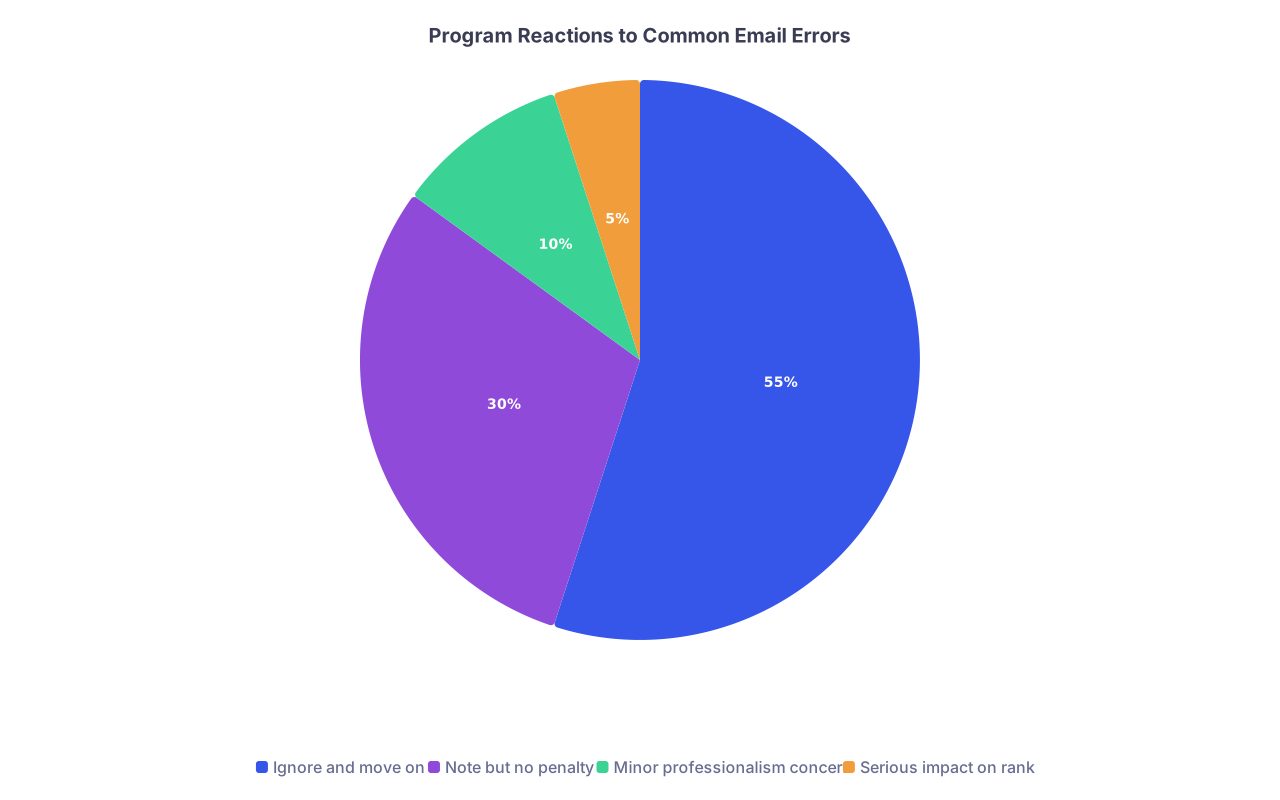
| Category | Value |
|---|---|
| Ignore and move on | 55 |
| Note but no penalty | 30 |
| Minor professionalism concern | 10 |
| Serious impact on rank | 5 |
Translation:
- More than half of the time, they ignore it entirely. People are busy.
- A big chunk of the time, they notice but do not care enough to change anything. Maybe a coordinator rolls their eyes and hits archive.
- Only when it is clearly unprofessional or repetitive does it shift you down or off a rank list.
Programs care far more about:
- Your interview performance
- Your letters
- Your track record in clinical settings
One sloppy email does not outweigh all of that unless it exposes a serious professionalism problem.
Step 9: Special cases that need extra care
A few edge cases deserve specific handling.
1. Couples match cross‑talk
You emailed Program A and mentioned details about where your partner is interviewing, but you accidentally sent it to Program B (your partner’s program).
Fix:
- If it revealed your rank intentions explicitly, send a brief correction similar to Scenario 2.
- Do not start explaining your entire couples strategy. Just acknowledge the mismatch.
2. Emailing the wrong specialty
Example: You interviewed in internal medicine but sent a “thank you for the opportunity to discuss my interest in anesthesia” email.
Fix:
Dear Dr. [Last Name],
I realized that my previous email incorrectly referenced another specialty. I apologize for this error. I am very grateful for the opportunity to interview with your internal medicine program and appreciated learning more about [specific detail from your interview day].
Thank you again for your time and consideration.
Sincerely,
[Name, AAMC ID]
They know you applied broadly. This will look sloppy, not fraudulent. Apologize once and move on.
3. Post‑rank list certification errors
If you send something wrong after rank lists are certified:
- Still correct in the same way.
- Do not mention rank lists at all.
- Remember: at that point, it may change exactly nothing. But you still want your professional record clean.
Step 10: Mental reset – how to actually move on
You need to function tomorrow. You still have interviews, thank‑yous, maybe a sub‑I. Wallowing over one email helps no one.
Practical reset:
Do the fix.
Draft the correction. Send it. Double‑check it once. Not five times.Write down the new rule that would have prevented this.
Example: “Never send more than one program email at a time.”
Or: “Always verify the program name and city before clicking send.”Tell one trusted person, then stop repeating the story.
Vent once. Not to your entire group chat every few hours. Replaying it in your head will not change the outcome.Focus on the next controllable task.
That might be preparing for tomorrow’s interview, finishing a note, or sleeping. You already did what could be done.
Key Takeaways
- Contain the damage fast, but not frantically. One concise correction email is almost always the right move. No life story, no excuses.
- Most honest mistakes are not fatal. Programs usually ignore or mentally note them and move on. Only truly unprofessional content seriously harms you.
- Fix your system so it does not happen again. Templates, a 10‑second pre‑send checklist, and one‑program‑at‑a‑time drafting will save you from repeat disasters.