
What do you say in a thank-you email when your interview included your parent’s death, your own depression, or getting reported to the professionalism committee?
You’re not wrong to be stuck here. The normal “thank you so much for your time” template feels tone-deaf. But writing three paragraphs about your trauma is obviously a bad idea. You need a middle lane.
Let’s build it.
1. First, get brutally clear on what you actually shared
Before you write anything, you need to know exactly what they heard.
Think back to the interview and answer these, in writing if you have to:
What was the sensitive topic?
- Mental health (your depression, anxiety, burnout, leave of absence)
- Family situation (death, divorce, abuse, caregiving burden)
- Academic/professional issue (remediation, professionalism concern, poor Step score)
- Immigration, financial strain, legal issues, etc.
How specific did you get?
- High level: “I had a personal health issue that required time away.”
- Moderate detail: “I went through a major depressive episode and took a leave.”
- Deep detail: “I was hospitalized after a suicide attempt during M2.”
What reaction did you see?
- Empathetic engagement (“Thank you for sharing that” / “I’m glad you got support.”)
- Neutral, moved on quickly
- Awkward pivot/change of topic
- They dug in with follow-up questions
Why this matters: your follow-up should match the depth and tone from the interview, not restart it or escalate it.
If you gave a high-level summary and they barely reacted, you don’t need to make it “a thing” in your email. If it became central to your story in that room, you can lightly acknowledge it—without re-opening the wound.
2. Core rule: you’re following up on the interview, not the trauma
Your thank-you/follow-up email after a residency interview has exactly three jobs:
- Thank them for their time.
- Reinforce your fit and enthusiasm.
- If needed, briefly clarify or anchor anything important you shared.
Notice what’s not on that list: “Re-explain your trauma in more detail” or “Convince them to feel sorry for you.”
Programs are deciding:
“Can we work with this person at 2 a.m. when the ED is exploding?”
You want them thinking: resilient, grounded, mature. Not: emotional spiral in my inbox.
So the default stance is:
- Do not introduce new graphic or intensely personal details.
- Do not sound like you’re apologizing for having a hard life.
- Do not make the sensitive topic the main point of the email.
Instead, if you reference it at all, it should be:
- Brief
- Framed in terms of growth, insight, or preparation for residency
- Directly tied to why you’ll be a good resident at their program
3. Three main scenarios and exactly what to do
Let’s walk the actual situations I see over and over.
Scenario A: You shared something sensitive but handled and stable
Example topics:
- Past depression/anxiety now well-managed
- A family death that shaped your values
- Growing up with financial hardship
- Being a primary caregiver to a family member
In the interview, you:
- Talked about it calmly
- Framed it in terms of resilience, maturity, empathy
- Did not describe current instability
In follow-up, your primary goal: normalize and re-anchor.
You can either:
- Not mention it at all (totally fine), or
- Briefly nod to it if it felt central to the conversation
Here’s what that looks like.
Option 1: Do not mention it
Dear Dr. Smith,
Thank you again for the opportunity to interview with the Internal Medicine Residency at University Hospital on January 5. I appreciated our conversation about resident autonomy in the ICU and your approach to graduated responsibility.
The program’s mix of strong clinical training and close-knit resident culture is exactly what I am looking for. I would be thrilled to train at University Hospital and contribute to your team.
Sincerely,
[Name], MS4, [Med School]
Clean. Professional. No need to reopen.
Option 2: Brief acknowledgment without re-explaining
Use this if, during the interview, the topic was clearly important—e.g., you spent 10–15 minutes on your mental health journey and they were engaged and kind.
Dear Dr. Patel,
Thank you again for the chance to interview with the Psychiatry Residency at City Medical Center last week. I especially appreciated your openness when we discussed my leave of absence and how that experience has shaped my approach to patient care.
I continue to feel strongly that City Medical Center’s emphasis on resident wellness and supervision would be an ideal environment for my growth as a psychiatrist. I would be honored to train with your team.
Best regards,
[Name]
Notice what this does not do:
- It doesn’t list symptoms.
- It doesn’t say “as you know, I was suicidal in M2.”
- It doesn’t beg for understanding.
It just signals: we talked about it, I’m comfortable with that, we’re good.
Scenario B: You overshared and now you regret it
This is the one that keeps people up at 2 a.m. replaying the exact wording and cringing.
Maybe you:
- Gave detailed descriptions of your mental health crisis.
- Broke down crying in the room or on Zoom.
- Ventilated about your school, an ex, or a supervisor.
- Admitted something that sounded more like an ongoing crisis than a resolved issue.
Can this hurt you? Yes. Programs worry about stability and professionalism. But you’re not powerless.
Your follow-up has one job: reframe and stabilize.
You are not sending a confession email. You are sending a calm, succinct, future-focused message that quietly repairs the impression.
Do not write:
- A long, apologetic essay (“I’m so sorry I got emotional…” in three paragraphs).
- A medical chart of your diagnosis/meds/therapy history.
- A justification attacking anyone else.
Instead, try something like this:
Dear Dr. Nguyen,
Thank you again for the opportunity to interview with the Family Medicine Residency at Riverside on December 14. I appreciated your thoughtful questions and the chance to share more about my path to medicine.
On reflection, I realize I became more personal than I intended when discussing that difficult period in my training. I want to reiterate that I am stable, have strong support systems in place, and feel fully prepared for the demands of residency. That experience ultimately strengthened my resilience and clarified my commitment to primary care and to supporting vulnerable patients.
Interviewing at Riverside reinforced how much I align with your program’s focus on community medicine and team-based care. I would be grateful for the opportunity to train with your residents and faculty.
Sincerely,
[Name]
What this does:
- Briefly acknowledges the overshare without turning it into a drama.
- Explicitly states stability and readiness (that matters a lot to PDs).
- Reanchors to: “This made me stronger, and I’ll use this to be a better resident.”
And if you got visibly emotional but don’t feel you overshared content, you can go even shorter:
I recognize that our conversation touched on some very personal experiences, and I became emotional. I appreciate your understanding and want to emphasize that those challenges are firmly in the past and have prepared me well for the rigors of residency.
That’s it. Then move on.
Scenario C: You disclosed a red flag that needed context
This is the LOA/remediation/low Step/professionalism report scenario. Programs have to take this seriously. Your goal is to show:
- Insight
- Responsibility
- Concrete resolution and systems in place
If you already covered it well in the interview, you do not need to restate the whole thing in writing. You can just thank them for the opportunity to discuss it.
But if you were flustered, rambled, or feel you didn’t clearly explain the resolution, the follow-up can do a quick, controlled cleanup.
Here’s the balance:
You’re not reopening the “case file.” You’re doing a brief clarification.
Example:
Dear Dr. Lopez,
Thank you for the opportunity to interview with the Pediatrics Residency at Children’s Health this week. I enjoyed learning about your advocacy curriculum and the mentoring culture among the residents.
I also appreciate the chance we had to discuss my professionalism concern from third year. I want to briefly clarify one point that I did not express clearly during the interview: since that incident, I have not had any further concerns raised and have received strong evaluations on all subsequent rotations. The experience made me more attentive to communication and reliability, and I have incorporated specific habits (like written end-of-day checklists and proactive updates to team members) into my daily work.
I remain very enthusiastic about the possibility of joining your residency and contributing to your team.
Sincerely,
[Name]
Key moves:
- Brief clarification, not a novel.
- Emphasis that the issue is past, specific habits now in place.
- Zero defensiveness or blaming.
If you already nailed the explanation in the interview and feel good about it, you can pare this down to one line:
I also appreciated the opportunity to discuss my leave of absence and to share how I’ve grown from that experience.
Then move on.
4. Concrete phrasing you can steal (and what to avoid)
Let me make this even more direct.
Here are phrases that work well when touching sensitive content concisely:
- “I appreciated your openness when we discussed…”
- “That period was challenging, but it ultimately strengthened my…”
- “Since that time, I have… [maintained stability / had no further issues / implemented specific habits].”
- “I feel fully prepared for the demands of residency.”
- “That experience shaped my commitment to…”
- “I’m grateful for the chance to have shared that part of my journey.”
Phrases that usually backfire:
- “I hope you don’t think less of me because…”
- “I know I’m a risk, but…”
- “I’ve always struggled with…”
- “Everyone at my school misunderstood…”
- “I know I talked a lot about my trauma, but…”
- Long explanations about meds, diagnoses, or therapy detail (“I switched from sertraline to venlafaxine in August…”)
You’re not writing a psychiatry consult note. You’re writing like a future colleague who’s been through things and is now solid.
5. What if you’re still in the middle of it?
This is the uncomfortable part.
If your “sensitive topic” is not past tense—ongoing depression with frequent episodes, current legal case, actively unstable housing—then your follow-up cannot magically erase a real concern.
So what do you do?
You focus on:
- Concrete stability measures (“I’m in regular care with…,” “I’ve built X, Y supports.”)
- How you’ve been performing recently (clerkships, sub-I, research, responsibilities)
- Your self-awareness and proactive management
Example:
I recognize that some of what I shared is ongoing rather than entirely in the past. I want to emphasize that I have established consistent care with my treatment team, have strong support from family and friends, and have successfully completed my recent sub-internships while managing these issues responsibly. I’m confident in my ability to meet the demands of residency and to seek support early if challenges arise.
You’re not pretending everything is perfect. You’re showing you’re an adult who manages reality.
Will some programs still shy away? Yes. But the ones that can handle nuance and human beings will read this more favorably than either:
a) silence that leaves them guessing, or
b) an emotional essay with no clear sense of control.
6. How much detail is “too much”?
Use this simple rule: If it wouldn’t belong in a patient handoff, it doesn’t belong in your email.
In a handoff, you say:
- “History of depression, currently stable on meds.”
- “Had a major ICU stay last year; recovered, good functional status.”
You don’t say:
- Every medication trial, every side effect, every fight with your ex.
Same here. Programs need the headline and the disposition, not the whole chart.
Think in this structure:
- Label of the issue (if needed): “a mental health leave,” “a family crisis,” “a professionalism concern.”
- Status: resolved / stabilized / actively managed.
- Outcome: what you learned, how you practice now.
- Fit: why that makes you a good resident for them.
If you’re going past 2–3 sentences on the sensitive topic in a follow-up email, you’re probably oversharing.
7. When should you not reference it at all?
There are times you just let it lie.
Do not bring it up in your follow-up if:
- It was mentioned briefly, and they didn’t dig in.
- It wasn’t central to your story or your file (e.g., casual reference to a tough year).
- You handled it cleanly and you don’t feel weird about it now.
- You’re only thinking of bringing it up because you’re anxious, not because there’s a clear benefit.
Your anxiety will tell you, “You need to fix this.”
Reality: sometimes the best fix is not re-highlighting the one thing you’re paranoid about.
Ask yourself: “If they re-read my email in 30 seconds during rank list, do I want them staring at this topic again?” If the answer is no, leave it out.
8. Quick comparison: different follow-up strategies
| Situation | Best Approach Summary |
|---|---|
| Handled sensitive topic well | Brief thank-you, maybe 1-line acknowledgment |
| Overshared and regret it | Short stabilization + growth, no long apology |
| Red flag with poor explanation | One-paragraph clarification + concrete changes |
| Ongoing issue, actively managed | Emphasize supports, recent performance, insight |
| Briefly mentioned, not central | Do not re-raise; standard thank-you only |
9. Timing, subject lines, and logistics
Use normal timing. Do not wait a week because you’re spiraling about the right words.
- Send within 24–48 hours of the interview.
- Subject line should be boring and clear:
- “Thank you – [Your Name], [Specialty] Interview”
- “Thank you for the interview on [Date]”
If you had multiple interviewers and only one conversation went into the sensitive territory, you can:
- Send standard thank-yous to the others.
- Use the slightly tailored version (with the brief nod, if needed) only to the person you actually discussed it with.
Keep the whole email to roughly 150–250 words. Max. If you need to stabilize a red flag, 250–300 is okay, but don’t write a manifesto.
Here’s a very simple structure you can copy-paste and customize:
- Greeting and thank you.
- One sentence on something you liked/learned about the program.
- Optional 1–3 sentence sensitive-topic clarification/acknowledgment.
- One sentence reaffirming enthusiasm/fit.
- Sign-off.
10. If you’re still overthinking it
Let me say this plainly: you will remember every awkward moment from that interview for the next year. They will not.
Program directors and faculty do dozens of interviews. They’re not cataloguing every pause in your voice. What they remember are patterns:
- Professional vs. disorganized
- Insightful vs. defensive
- Stable vs. chaotic
Your follow-up email is not a magic spell. It’s a nudge. Use it to show:
- You’re thoughtful enough to follow up.
- You’re mature enough to handle sensitive topics without drama.
- You’re genuinely interested in their program.
Then stop. Send the email. Close the tab. Do not reopen it five times “just to check.”
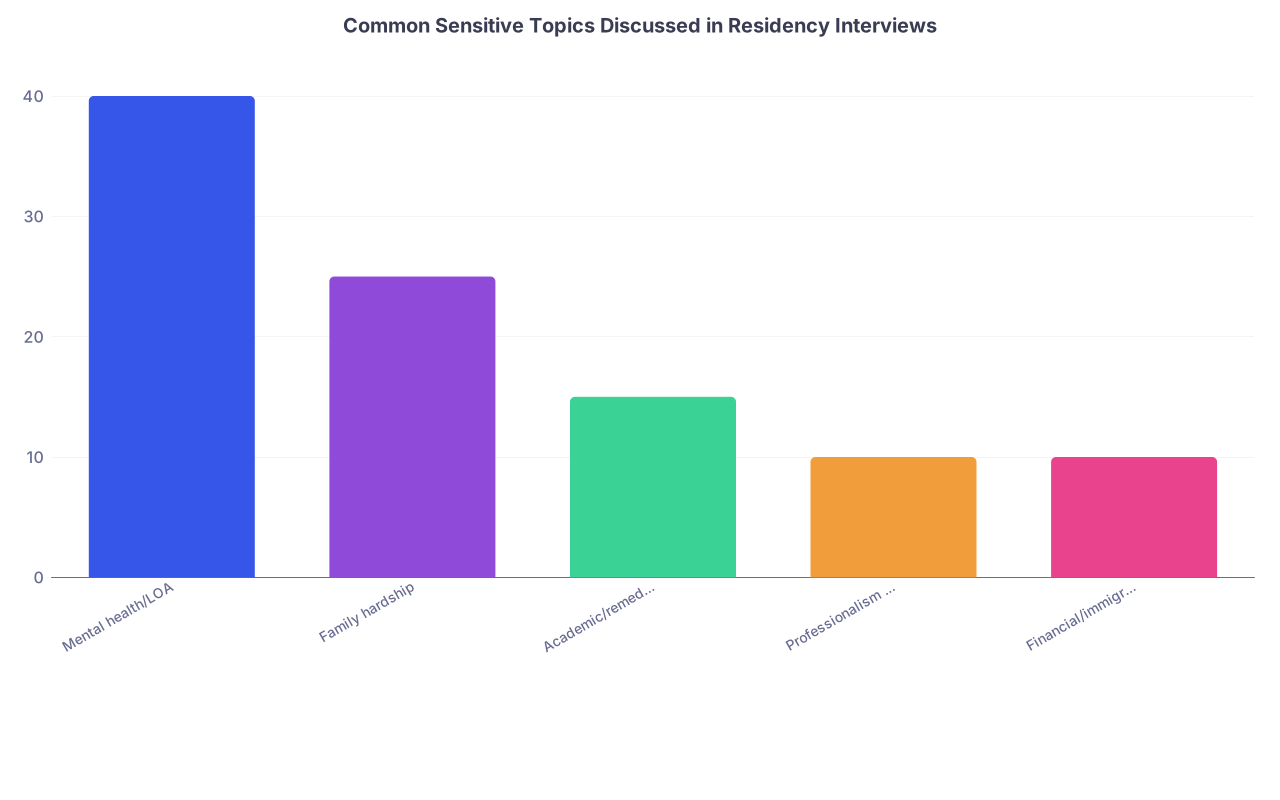
| Category | Value |
|---|---|
| Mental health/LOA | 40 |
| Family hardship | 25 |
| Academic/remediation | 15 |
| Professionalism concern | 10 |
| Financial/immigration | 10 |

| Step | Description |
|---|---|
| Step 1 | Had sensitive topic in interview |
| Step 2 | Standard thank-you, no mention |
| Step 3 | 1-2 sentence clarification in email |
| Step 4 | Short stabilization + growth statement |
| Step 5 | Optional 1-line acknowledgment only |
| Step 6 | Was it central and in-depth? |
| Step 7 | Handled it clearly? |
| Step 8 | Felt overshared or unclear? |
FAQ (exactly 5 questions)
1. Should I send a separate email just about the sensitive topic, apart from my thank-you?
No. That looks like you’re reopening a problem or confessing something new. Fold any brief clarification or stabilization into a single, normal-length thank-you email. Separate “issue-only” emails tend to magnify concern, not reduce it.
2. What if I cried during the interview—do I need to apologize in my follow-up?
You don’t need a full apology, and definitely not a self-flagellating one. A simple acknowledgment is enough if you want to address it: “I recognize that I became emotional when we discussed that period, and I appreciate your understanding.” Then quickly emphasize your stability and readiness. Over-apologizing makes it look like you’re not comfortable with your own story.
3. Could mentioning the sensitive topic again hurt my chances more than help?
Yes, which is why you only mention it if there is something concrete to clarify or stabilize. If the conversation was brief, well-handled, and you didn’t leave key facts unclear, skip it in your follow-up. Your anxiety is not a reliable gauge of what they’re worried about. Only re-raise it if you’re actually correcting a misunderstanding or clearly showing resolution and growth.
4. Is it ever okay to give more clinical/medical detail about my mental health in the email?
Very rarely, and only at a high level. “I’ve worked consistently with a therapist and my condition has been stable for over two years” is enough. Listing specific diagnoses, medications, or hospitalizations usually doesn’t help you and can invite unnecessary concern. Programs care about function and reliability, not your full diagnostic history.
5. Can a strong follow-up email actually repair a bad impression from oversharing?
It can’t erase everything, but it can absolutely upgrade you from “concerningly unstable” to “went through a lot but seems grounded now” in their minds. I’ve seen applicants who cried in interviews or rambled about crises still match well after sending calm, thoughtful follow-ups that emphasized stability, insight, and recent solid performance. It’s not magic, but it does move the needle.
Open your draft email to that program where you shared the sensitive story. Delete every sentence that re-explains what happened. Then add one clean sentence that focuses on what you’ve learned and how you’re ready for residency—and send it.