
The way most applicants follow up after disclosing a hardship is clumsy and emotional. You’re going to be deliberate and strategic instead.
You shared something real in your residency interview—illness, family crisis, burnout, financial strain, trauma, whatever it was. Now you’re wondering: Do I follow up? How? Do they think I’m “a risk”? Did I overshare?
Here’s the hard truth: how you follow up after disclosing a personal hardship can either:
- Cement you in their minds as resilient, self-aware, and reliable
or - Quietly move you into the “potential problem” bucket
I’m going to walk you through exactly what to do depending on what you shared, what you’re worried about, and what phase of the interview season you’re in.
1. Understand What the Program Actually Heard
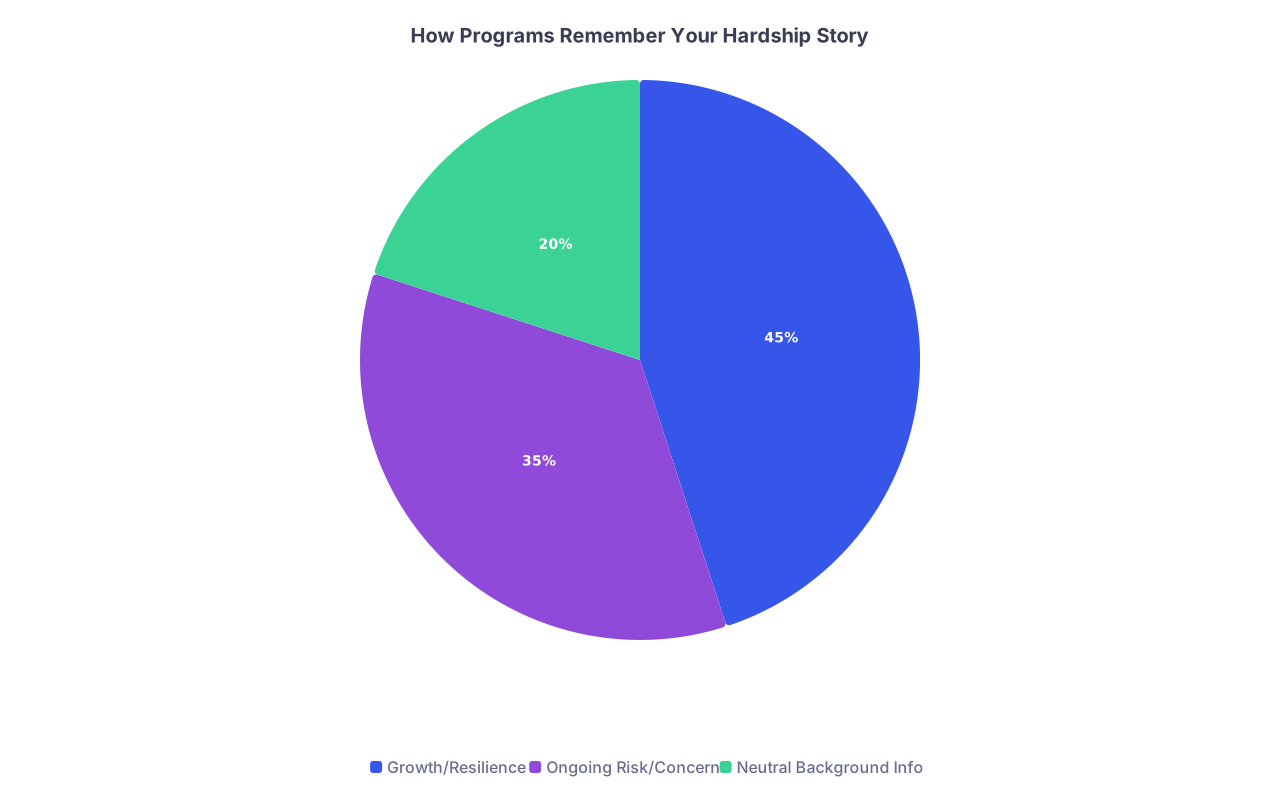
| Category | Value |
|---|---|
| Growth/Resilience | 45 |
| Ongoing Risk/Concern | 35 |
| Neutral Background Info | 20 |
You need to stop thinking about what you meant and think about what they heard.
Programs usually reduce your hardship disclosure to one of three mental labels:
- “Strong resilience story”
- “Ongoing risk / might need extra support”
- “Background context, not a big factor”
Your follow-up should push them hard toward #1 and away from #2.
Ask yourself bluntly:
- Did I emphasize what I learned and how I stabilized?
- Or did the story feel raw, emotional, and maybe unresolved?
If during the interview you:
- Teared up and struggled to regain composure
- Mentioned recent episodes (e.g., “I just had a depressive episode last month”)
- Talked vaguely about “health issues” without clear resolution
- Mentioned needing extended time off or multiple leaves
…then you must use your follow-up to add structure, stability, and reassurance.
If instead you:
- Clearly framed it as something in the past or well-managed
- Tied it to specific strengths (empathy, time management, maturity)
- Gave concrete examples of functioning at a high level afterward
…your follow-up can be lighter and more focused on gratitude and fit, with a short reinforcing line about stability.
2. Decide If You Should Follow Up About the Hardship At All
Not every hardship needs a post-interview memo.
Here’s the rule I use: if the hardship had any real impact on grades, Step scores, gaps, professionalism concerns, or leaves of absence, you should follow up briefly and cleanly.
If it did not affect performance and you mainly shared it as context or personal background, you may not need to reference it again. But you can still use it strategically.
When you should explicitly address it in a follow-up
- You had a leave of absence for health or family reasons
- You had course failures, repeats, or Step/COMLEX delays tied to the hardship
- You recently returned from a major event (hospitalization, bereavement, serious illness, major caregiving disruption)
- An interviewer seemed concerned or asked multiple probing questions like “Do you feel ready for the intensity of residency?”
In those cases, your follow-up should:
- Clarify stability
- Show a support structure
- Demonstrate current high functioning
When you don’t need to revisit the details
- The hardship was clearly in the past (e.g., childhood trauma, early college issues)
- You’ve had a long run of strong performance afterward
- They didn’t linger on it and quickly moved to other topics
- It didn’t connect to anything concerning in your file
You can still allude to it in one line emphasizing resilience or perspective, but you’re not sending a second personal statement about your trauma. That’s how you overshoot and make them nervous.
3. How to Structure a Thoughtful Follow-Up Email

| Step | Description |
|---|---|
| Step 1 | Interview with hardship disclosure |
| Step 2 | Follow up explicitly |
| Step 3 | Optional subtle reference |
| Step 4 | Thank interviewer |
| Step 5 | Reiterate fit/interest |
| Step 6 | Brief stability update |
| Step 7 | Offer availability |
| Step 8 | Hardship affected performance? |
You’re not writing a confessional. You’re writing a professional clarification with emotional intelligence.
Basic skeleton:
- Subject line
- Thank you + specific connection
- Fit and interest in the program
- Very short hardship reference (if needed) framed around stability and growth
- Professional closing
Let’s walk through real examples.
Example A: Recent health issue that caused a leave of absence
You disclosed: you had a significant medical issue that led to a 4-month leave, now resolved.
Your main goals:
- Reassure them you are stable and cleared
- Show recent strong functioning
- Avoid sounding defensive or fragile
Sample email:
Subject: Thank you for the interview – [Program Name]
Dear Dr. Patel,
Thank you again for the opportunity to interview at [Program Name] on [date]. I appreciated our conversation about your program’s emphasis on early autonomy and the longitudinal clinic experience—especially your description of how residents are supported when stepping into supervisory roles.
I also wanted to briefly follow up on the medical leave we discussed. I am fully recovered, have been cleared without restrictions by my treating physicians, and have successfully completed my recent sub-internships without any limitations in schedule or duty responsibilities. Going through that experience has pushed me to be more proactive about health maintenance and time management, which I believe will serve me well during residency.
I remain very enthusiastic about [Program Name] and would be grateful for the opportunity to train there. Please let me know if I can provide any additional information.
Sincerely,
[Name], [Med School]
Notice what this does:
- One paragraph only on the hardship
- Uses words like “fully recovered,” “without restrictions,” “successfully completed”
- Connects to positive behavior (“more proactive about…”)
- No medical details. No dramatic narrative.
Example B: Mental health hardship, currently well-managed
You disclosed: depression/anxiety during preclinical years that affected performance, now treated and stable.
Your goals:
- Normalize it without minimizing
- Emphasize treatment, follow-up, and functioning
- Show insight and growth
Subject: Thank you for the interview – [Program Name]
Dear Dr. Nguyen,
Thank you for the thoughtful conversation during my interview at [Program Name] on [date]. I especially appreciated hearing about your program’s culture of open communication and the way faculty actively check in with residents during busy rotations.
I wanted to briefly follow up on the mental health challenges I mentioned from early in medical school. I continue to work closely with my treating clinician, and my symptoms have remained well-controlled for the past [X] years while I have carried a full clinical schedule, taken on leadership roles, and completed my sub-internships. That period taught me how to seek help early, set boundaries, and maintain healthy routines—skills that I believe will help me sustain performance during residency.
I remain very excited about the possibility of training at [Program Name]. Please let me know if any further information would be helpful.
Best regards,
[Name]
You are not apologizing. You are demonstrating maturity.
4. Timing: When to Send This Kind of Follow-Up
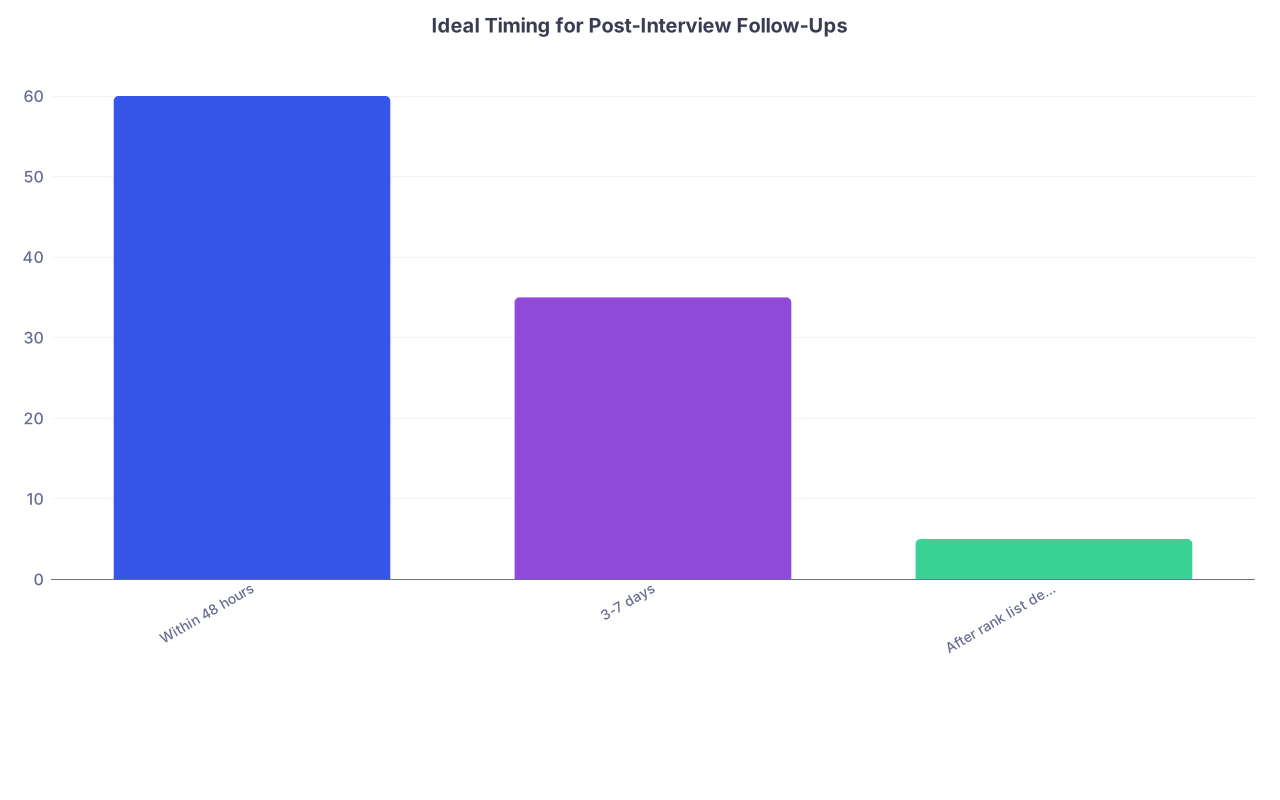
| Category | Value |
|---|---|
| Within 48 hours | 60 |
| 3-7 days | 35 |
| After rank list deadline | 5 |
If your hardship disclosure raised questions, earlier is better—before group memory fades and before they have their first big ranking discussion.
General rule:
- Standard thank-you / follow-up: within 24–72 hours
- Hardship clarification add-on: ideally in that same window
If you walked out of an interview thinking “I did not explain that well” or “They seemed worried,” send a short clarification as part of your thank-you. Not a week later, once they’ve already logged their notes.
If you’re reading this weeks later and already did the interview? Still okay. You can send a “brief clarification” email:
Dear Dr. ___,
I hope you are well. I wanted to briefly clarify one point from our interview on [date] regarding [X]. Since our conversation, I realized I may not have clearly expressed that [stability statement + current functioning].
I appreciate your time and consideration.
Sincerely,
[Name]
Do not send multiple follow-ups about the same hardship. One well-crafted message is enough.
5. Handling Specific Hardship Types
Different hardships trigger different concerns in program directors’ minds. You need to counter the specific worry.

A. Serious personal/family illness
Their worry:
Will this lead to frequent absences? Is the situation still unstable? Will this applicant be distracted or pulled away often?
You respond with:
- Concrete statements: “treatment plan is now stable,” “caregiving responsibilities are now shared,” “no anticipated interruptions in my ability to meet residency duties”
- Evidence of recent reliability: sub-Is, away rotations, leadership roles you completed fully
- Short, not dramatic
B. Financial or housing instability
Their worry:
Will this trainee struggle to afford living here? Will they have reliable transportation? Will there be crises mid-year?
You respond with:
- Clear stability statements: secure housing, verified funding, plan for covering moving costs
- Evidence of planning: budget, partner’s job, family support
- Optional line about how this experience sharpened your resource management skills
C. Academic struggles tied to hardship
Their worry:
Is this a one-time event or a pattern? Can they handle board exams, ICU nights, running a service?
Your follow-up should:
- Draw a hard line in time: “Since [date], my performance has shown…”
- Point to objective data: shelf scores, Step 2, sub-I evals, letters of recommendation
- Emphasize what changed: new study habits, diagnosis/treatment, support systems
D. Trauma, abuse, or highly sensitive events
Their worry:
Is this still raw? Could exposure to certain rotations (ED, OB, psych) retrigger things? Are there accommodations they need?
You respond with:
- Emphasis on current stability: whether or not you mention treatment, make clear you have coping strategies and support
- Boundaries: You do NOT need to share graphic details to be believed
- Short acknowledgement that you’re ready for the full range of residency experiences
6. Things You Should Not Do in Your Follow-Up

Let’s avoid some landmines I see every year.
Do not:
- Rewrite your trauma story in the follow-up. They already heard it. Now they need clarity, not more emotion.
- Ask, “Did my hardship hurt my chances?” You’ll never get an honest answer and it makes you look insecure.
- Attach medical records, therapy notes, or long letters from doctors. Overkill and a bit alarming.
- Promise things you cannot guarantee: “I will never need time off,” “I will never struggle again.” Unrealistic.
- Send multiple clarifications that contradict each other. One solid, consistent message.
If you’re tempted to write more than two sentences about the hardship itself in the email, stop. You’re processing feelings, not helping your candidacy. Talk to a friend, mentor, therapist. Not your program director’s inbox.
7. How to Use Future Correspondence Without Oversharing
You might stay in touch with a PD or faculty after interview season—updates, second looks, thanks, etc. Here’s how to avoid turning yourself into “the hardship applicant.”
You can:
- Occasionally reinforce your stability indirectly
- Mention accomplishments that show stamina and reliability
- Avoid leading every email with your personal story
Example of an update that subtly reinforces stability:
I also wanted to share that I recently completed my ICU sub-internship, including a stretch of 12 consecutive days on service, and received very positive feedback on my work ethic and ability to handle the clinical load.
That quietly answers the question: “Can they handle residency pressure?” without you writing, “See, my depression is fine.”
8. Quick Reference: What To Emphasize
| Scenario Type | 1–2 Key Concepts to Emphasize |
|---|---|
| Health-related leave | Recovery status, no restrictions |
| Mental health condition | Ongoing care, stable functioning |
| Family caregiving/illness | Stable plan, shared responsibilities |
| Academic impact (failures/gaps) | Upward trend, specific improvements |
| Financial/housing hardship | Current stability, concrete planning |
This is the mental checklist I’d run for myself before I hit send:
Am I showing:
- Stability?
- Support?
- Functioning at a residency level?
If yes, you’re good.
9. If You Regret Disclosing the Hardship at All
Sometimes the real situation is: “I said too much. I panicked and overshared.”
Happens more often than people admit.
What you do not do is send an email saying, “I’m so sorry I overshared.” That just draws a highlighter over it.
Instead:
- Use your thank-you note to show composure, professionalism, and insight.
- Focus heavily on your clinical performance, fit with the program, and concrete strengths.
- If you mention the hardship, keep it to a single, very composed line:
“I’m grateful for the lessons that experience taught me about resilience and seeking support when needed.”
Then you stop. Let the rest of your file (letters, scores, evaluations) do the heavy lifting.
10. Mental Reframe: You’re Not Begging for Forgiveness

You’re not writing these follow-ups as an apology tour.
You disclosed something meaningful about your life. That’s not wrong. Programs are not looking for robots. They are, however, looking for people who can handle stress, ask for help appropriately, and show up consistently.
Your follow-up’s real job:
- Translate hardship into evidence of readiness
- Move them from “Is this a risk?” to “This is a mature adult I can trust at 3 a.m.”
- Remind them you’re more than the hardest thing that happened to you
Once you’ve done that in one clean, respectful email, stop refreshing your inbox and move on to the next program.
FAQs
Should I send a follow-up like this to every interviewer at the program or just the PD?
Send it to the person with whom you actually discussed the hardship—often a faculty interviewer—and CC the program’s generic residency email if they encouraged that. If the PD was your interviewer, send to them directly. Do not blast the entire faculty list.What if my hardship is still ongoing but well-managed (e.g., chronic illness)?
Then you don’t pretend it’s over. You emphasize predictability and management. One sentence acknowledging that it is chronic, followed by clear evidence that you’ve been able to train, work, and meet obligations reliably under this already-established routine.Could following up about the hardship hurt me by reminding them of it again?
If your follow-up is short, calm, and focused on stability, it usually helps or is neutral. The only time it hurts you is when you re-open emotional details, sound unstable, or seem like you’re trying to argue them into ranking you higher based on sympathy.Is it ever appropriate to ask a program if a hardship disclosure will affect my rank?
No. They will not answer you honestly even if they wanted to, and you put them in an awkward position. Use your follow-up to strengthen their perception of you, then let the rest go. Their rank list rules and biases are not something you can extract by email.What if I realized I should have disclosed something (like a leave or diagnosis) but didn’t mention it?
That’s a different situation. You may need to send a proactive clarification to the program, especially if it’s in your official record and could be seen as deceptive not to mention. In that email, be factual, concise, and emphasize that you’re sharing this to be fully transparent, then briefly describe your current stability and functioning.