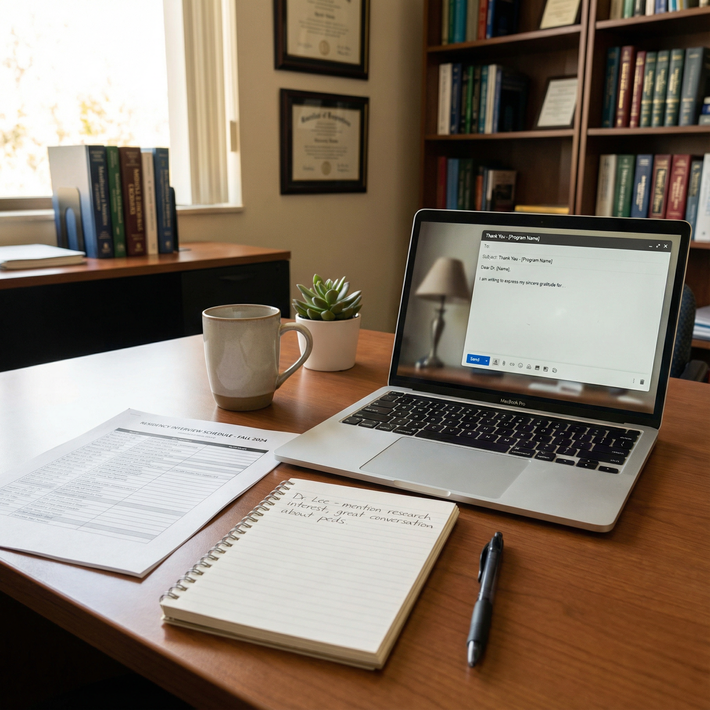
You just finished a residency interview that wasn’t on the main schedule. Maybe it was a one-off Zoom squeezed in at 7:30 pm. Maybe you flew in for a solo in‑person day because someone canceled and they “fit you in.” Everyone kept saying things like, “Thanks for being flexible,” and “We’re glad this worked out last minute.”
Now you’re on the plane home or back in your car, and the question hits:
Was that good? Bad? Neutral? And how on earth do you follow up so you do not vanish into the chaos of their process?
This is that situation. Here’s how to handle it.
1. Understand What an Off‑Schedule Interview Really Signals
First, decode what just happened so you know what you’re playing into.
Off‑schedule / last‑minute interviews usually fall into a few buckets:
- You were a late add they genuinely wanted to see (committee delay, late Step 2, late app review).
- You’re filling a spot from a late cancellation or no‑show.
- You’re a “borderline but interesting” candidate they didn’t want to waste a full day slot on.
- They’re expanding their interview pool because something changed (weak recruitment year, increased positions, someone dropped out).
The follow‑up strategy is similar across all four, but your expectations should differ.
If they:
- Mentioned specific parts of your application they liked
- Took time to tailor questions to you
- Introduced you to multiple faculty or leadership
…you’re likely in bucket #1 or #4. That’s better than you probably think.
If it felt:
- Rushed
- Disorganized
- Like no one knew your name until you logged on
…you’re likely filling a cancellation or are in bucket #2 or #3. Still not dead. But you do need to follow up more surgically.
Here’s the key: off‑schedule doesn’t automatically mean “plan B.” It means “you are outside their usual workflow.” Which means if you do not follow up correctly, you are easier to forget.
Your job now: make yourself easy to remember and impossible to ignore—without being annoying or desperate.
2. The First 24 Hours: What To Do Immediately
You’re tired, your brain is fried, and you’d like to not think about this program tonight. Tough. The first 24 hours after an off‑schedule interview matter more than usual because your interaction wasn’t part of a standard interview group.
You need three things in that first day:
- A tight thank‑you structure
- A personal anchor
- Documentation for yourself
A. Same‑Day Notes (Before You Forget Everything)
Before you even touch your email:
- Open a notes app or spreadsheet.
- Write:
- Program name / city
- Date and time of interview
- Who you met (names, roles)
- 3–5 concrete things you remember (case they mentioned, specific clinic, call schedule detail, a resident’s comment)
- Your gut ranking tier right now (top / mid / back‑up / no)
It takes 5–10 minutes. You will thank yourself in February when programs blur together.
B. Thank‑You Email Timing
Same day or next morning is ideal. For off‑schedule interviews, I lean hard toward within 12–18 hours. You want to land in their inbox while your name is still fresh.
Who gets an email?
- Every faculty who directly interviewed you (1:1 or 2:1).
- The PD if you did not already email them directly and they were involved.
- The coordinator sometimes gets a brief thank‑you if they did extra work to arrange your off‑schedule slot.
Do not send a mass email to a group address and call it done. That’s lazy and forgettable.
C. What the Thank‑You Should Actually Say
Most thank‑you emails are terrible. They all sound like the same template. You’re not doing that.
You need four parts:
- Clear subject line
- Specific memory anchor
- Explicit appreciation for the off‑schedule nature
- One line that positions you as genuinely interested
Example for a PD:
Subject: Thank you – off‑schedule interview yesterday
Dear Dr. Lopez,
Thank you again for taking the time to meet with me yesterday afternoon outside your usual interview schedule. I appreciated hearing how your program is expanding its community ICU rotation and the emphasis you place on residents managing complex patients with appropriate supervision.
Our conversation reinforced my strong interest in [Program Name], particularly the combination of high-acuity training with the supportive culture you described. I’d be grateful for the opportunity to train with your team.
Best regards,
[Your Name], MS4 – [Your School]
AAMC ID: [#######]
For a faculty interviewer:
Subject: Thank you for the off‑schedule interview
Dear Dr. Shah,
Thank you for taking the time to speak with me yesterday outside the regular interview days. I enjoyed our discussion about resident autonomy on night float and your approach to teaching procedures systematically during the first year.
Hearing about how residents progress from supervised to independent management at [Program Name] made the program even more appealing. I hope to have the chance to be part of that learning environment.
Sincerely,
[Your Name]
AAMC ID: [#######]
Notice what’s not there: no fake over‑the‑top flattery, no generic “I was deeply impressed by your exceptional program.” Just specific, grounded, and mature.
3. Handling the Weirdness: “Am I Being Evaluated Differently?”
You’re wondering if they’ll compare you fairly to the candidates who came on the regular days. They might. They might not. You do not control that.
What you can control: making sure the right people remember you and can advocate for you when rank meeting happens.
Here’s what you do over the next 2–4 weeks, depending on timing.
A. One Targeted Check‑In (If Timing Justifies It)
This is not mandatory. But if:
- Your interview was very early in the season, or
- Your interview was very late (January/February) and you worry they’ve mostly “decided”
…a single, well-timed check‑in to the PD or APD can help.
When?
- 3–4 weeks after your interview
- Or 1–2 weeks before rank list certification if you know the date window
What it can sound like:
Subject: Continued interest in [Program Name]
Dear Dr. Lopez,
I wanted to briefly thank you again for arranging the off‑schedule interview last month and to reiterate my strong interest in [Program Name]. After completing several additional interviews, the strengths we discussed—particularly the robust ICU exposure and the supportive resident culture—stand out to me even more.
I’d be very excited to train at [Program Name] and hope to have the opportunity to work with your team.
Best regards,
[Your Name]
AAMC ID: [#######]
Short. No questions. No demands. Just a reminder ping.
B. If You’re Making Them Your #1 (Post‑Interview Communication)
Different specialties and programs have different rules about signaling. I’m not going to litigate the ethics of that here. Reality: signaling serious interest helps at some programs.
If the program where you had the off‑schedule interview is truly your top choice, and you’re comfortable with it, a single explicit signal (late in the season) is reasonable:
Dear Dr. Lopez,
I wanted to let you know that [Program Name] is my top choice for residency, and I plan to rank it first. My off‑schedule interview day confirmed that your program’s combination of high-acuity training, strong mentorship, and resident camaraderie is exactly what I’m looking for.
I would be thrilled to join your incoming class.
Sincerely,
[Your Name]
Send that once. Late January or early February. Do not send “you are my top choice” to multiple programs. That’s how you create email trails that bite you later.
4. What If the Interview Felt Rushed or Odd?
Last‑minute interviews can be awkward. Maybe:
- They shortened it from full day to 1–2 hours.
- You barely met any residents.
- You got fewer questions and more “sorry, I have to run to clinic.”
You’re thinking: “Did I just get a courtesy interview?” Possibly. But you can still salvage something.
Here’s how to follow up when the experience was clearly not standard.
A. Call Out the Abbreviated Format (Briefly, and Positively)
You can acknowledge it without sounding bitter.
Example:
Thank you again for making time for a brief off‑schedule interview last week. I know it was outside the usual interview day format, and I appreciated the chance to learn about [X, Y specific program elements].
This tells them:
- You noticed the difference.
- You’re still grateful.
- You’re not whining.
B. Use Follow‑Up to Fill in the Gaps
If you had limited time with residents, ask for more interaction—but through the right person.
Email the coordinator or chief resident, not the PD:
Dear [Coordinator Name],
Thank you again for helping coordinate my off‑schedule interview with [Program Name]. Because the schedule was abbreviated, I didn’t have as much time to speak with current residents. If possible, I’d appreciate the chance for a brief conversation with a resident (even by phone or Zoom) to better understand the day-to-day workflow and culture.
I understand everyone is busy, so if this isn’t feasible, I completely understand. Thank you again for your help.
Best,
[Your Name]
If they set this up and you connect well with a resident, you’ve just created another potential advocate.
5. The Line Between Assertive and Annoying
You’re right to worry about overdoing it. Programs are drowning in emails.
Here’s a simple framework for follow‑up volume after an off‑schedule interview at a program you’re legitimately interested in.
| Timing | Email Type |
|---|---|
| Within 24 hours | Thank‑you to PD and interviewers |
| 2–4 weeks later* | Brief continued interest email |
| Late Jan / early Feb** | Single “top choice” email (if true) |
| After Match | Optional thank‑you if you matched |
* Only if you’re seriously considering ranking them
** Only to one program (your true #1), if you choose to signal
Outside of that pattern, most additional emails are unnecessary.
Red flags that you’re crossing the line:
- Asking for “feedback” on your interview. They can’t give this.
- Asking if you’re “still under consideration.” They won’t tell you.
- Emailing more than once a week. No.
- CC’ing random faculty who never met you. Also no.
6. Special Situations You Might Be In
Now let’s get more granular. These are real scenarios I’ve seen.
Scenario A: You Got the Interview Invite 24 Hours Before
You scrambled, rearranged a rotation or clinic, maybe begged for a flight. And it’s done.
Your follow‑up should:
- Highlight appreciation for the short‑notice opportunity.
- Make clear that you prioritized them.
Example line to add:
I’m grateful you were able to offer a last‑minute interview slot, and I was glad to rearrange my schedule to speak with your team.
Programs pick up on this. Someone pushed to get you in. Show that you valued it.
Scenario B: You Interviewed After Their “Last Official Day”
Maybe they tell you, “You’re actually after our scheduled interview days, but we wanted to find a way to meet you.”
Translation: someone advocated for you. PD, APD, faculty, or coordinator.
Your job is to:
- Make that person look smart for pushing you in.
- Be extra clear, if true, that you’re seriously interested.
In your thank‑you:
I understand my interview was after your main interview dates, and I’m grateful you still made time to meet with me. After speaking with you, I’m even more interested in [Program Name] and believe it would be an excellent fit for my training goals.
Scenario C: You’re a Couples Match Candidate Slotted Late
Programs sometimes do off‑schedule interviews for couples trying to align geography.
You should:
- Explicitly (but briefly) mention the couples match context in your follow‑up to the PD.
- Connect it to your genuine interest, not as a pure logistical move.
Example:
As I mentioned during our interview, my partner and I are participating in the couples match. We were both impressed by our respective programs at [Institution], and the possibility of training together at the same institution is very important to us. Combined with the strengths of your program, this makes [Program Name] one of my top choices.
Not a sob story. Just clear context.
7. How to Follow Up If You Realize You Don’t Like the Program
Off‑schedule or not, sometimes you walk out thinking, “Absolutely not.”
You still send thank‑you emails. You stay professional. You never know when you’ll cross paths again in fellowship, jobs, or conferences.
But you do not need to:
- Send continued interest messages.
- Signal rank position.
- Keep pinging them.
If you are 100% sure you will rank them low or not at all, here’s the rule: minimum professional courtesy, then move on.
Simple thank‑you, no “strong interest” language, no follow‑up unless they directly ask you something.
8. Emotional Side: Feeling “Second Tier” After a Last‑Minute Invite
This part is real, and people don’t say it directly, but I’ve heard the hallway versions:
- “They only talked to me because someone canceled.”
- “If they really wanted me, I’d have gotten one of the main days.”
- “I feel like I just got a pity interview.”
Sometimes that’s true. Often it isn’t.
Here’s what I’ve seen:
- Some programs are disorganized and review apps unevenly. Late interviews may be their best candidates.
- Some PDs don’t wake up to your file until a faculty or resident emails “Hey, look at this one.” That can happen in December.
- Some “last‑minute” invites are because of internal politics or schedule changes, not about you at all.
Your follow‑up cannot fix their internal chaos. But it can do this:
- Make it easy for the PD to pull your name up in rank discussions and say, “Oh yeah, I remember them. Strong candidate. Good fit.”
- Nudge you from the middle of the rank list toward the higher middle, or occasionally higher than that.
That’s all you’re aiming for. Not magic. Just a nudge.
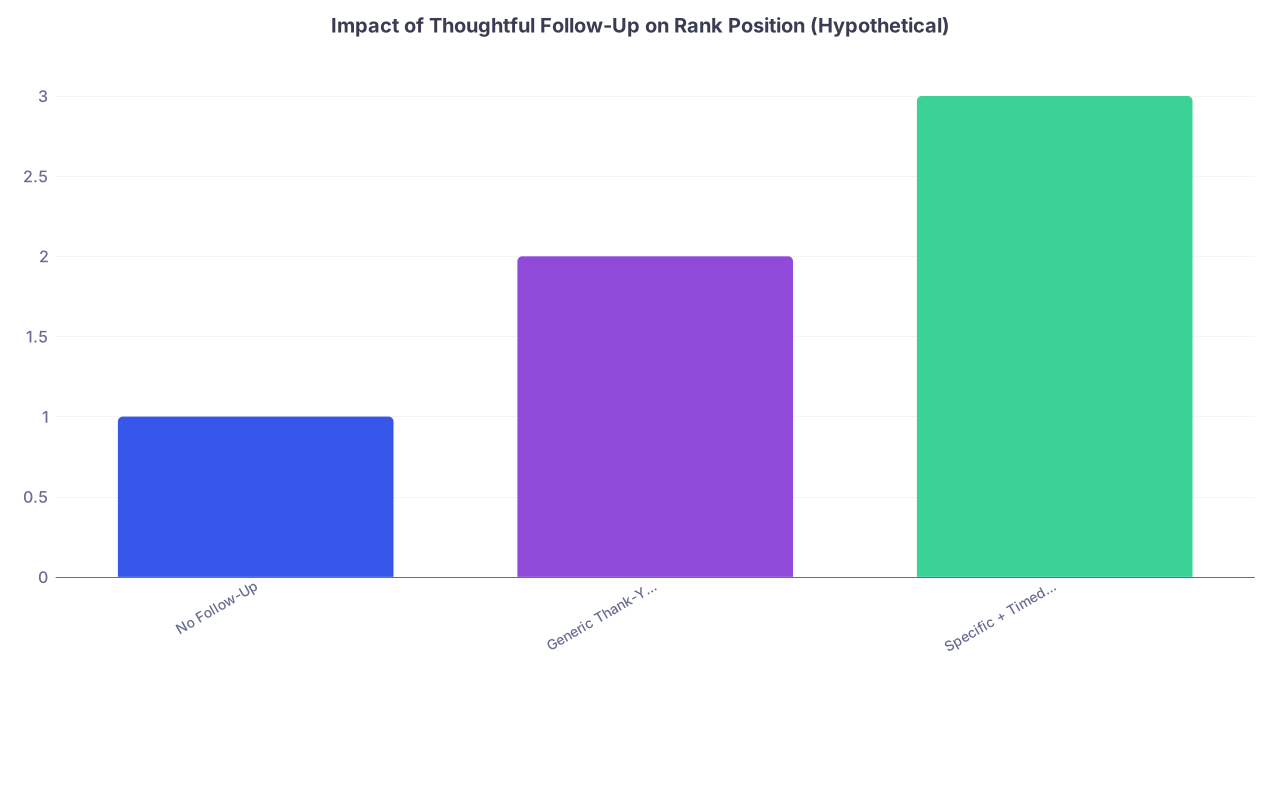
| Category | Value |
|---|---|
| No Follow-Up | 1 |
| Generic Thank-You | 2 |
| Specific + Timed Follow-Up | 3 |
Interpretation: do not obsess over the exact numbers—conceptually, thoughtful, specific follow-up usually helps more than it hurts, especially when you’re not in their normal interview queue.
9. Quick Flow: What To Do, Step‑By‑Step
Here’s the blunt cheat sheet. You had an off‑schedule or last‑minute interview. Do this:

| Step | Description |
|---|---|
| Step 1 | Off-schedule interview done |
| Step 2 | Same day notes |
| Step 3 | Thank-you emails in 24 hrs |
| Step 4 | No further outreach needed |
| Step 5 | 2-4 week brief interest email |
| Step 6 | Stop unless program contacts you |
| Step 7 | Late season single top-choice email |
| Step 8 | Rank as planned and move on |
| Step 9 | Interested in program? |
| Step 10 | Top choice? |
FAQs
1. Should I mention that my interview was off‑schedule in my emails?
Yes, briefly and positively. A line like “Thank you for arranging an interview outside your usual interview days” is enough. It shows you noticed the extra effort without sounding needy or resentful.
2. Can following up too much hurt my chances?
Yes. One thank‑you, one later interest email, and possibly one “top choice” signal (if appropriate) is enough. Multiple check‑ins asking for updates or reassurance just makes you look anxious and creates more work for people who are already overwhelmed.
3. If I don’t send a “you’re my #1” email, will I be ranked lower?
At most programs, no. Programs rank based on your interview, application, letters, and perceived fit. A sincere, well‑timed signal can help at some places if you’re already in the “maybe” group, but it does not rescue a weak interview, and lack of a signal doesn’t automatically hurt you.
4. What if I realized a key thing I forgot to mention during my interview?
You can briefly incorporate it into your thank‑you or your later interest email—but keep it short and tied to why you fit their program. For example, “I didn’t have a chance to mention this during our interview, but my experience as a night float sub‑I reinforced how much I value…” Do not send a long essay or bullet‑point update. One or two sentences is enough.
Two things to remember:
- Off‑schedule or last‑minute doesn’t mean doomed. It means you’re outside their usual routine, so your follow‑up has slightly more value than average.
- Professional, specific, minimal communication beats silence and beats over‑eager inbox flooding.
Hit those, and you’ve done your part. The rest is ranking, chaos, and the Match algorithm.