
It’s 10:30 p.m. You’re back in your hotel room or your apartment after a long interview day. The pre-interview dinner was…awkward. Morning report felt flat. Residents made a few comments that did not sit right. The PD said the words “this is a very malignant program” with a laugh that did not feel like a joke.
You’re staring at your laptop, ERAS open, email open, wondering:
“Do I send a thank-you anyway? Do I tell them I’m not interested? Do I ghost? What if I’m wrong and I end up needing this place on my list? What does a professional follow-up look like when I’m 90% sure I don’t want to go there?”
You’re in the gray zone between “being polite” and “protecting my future self from misery.” Here is exactly how to handle this.
Step 1: Decide What You Actually Want From This Program
Before you type a single word, get honest with yourself.
You’re in one of three situations:
| Situation | What It Means |
|---|---|
| Hard no | You would rather SOAP, reapply, or take a year than train there |
| Soft no / fallback | You probably do not want it, but you might keep it low on your list “just in case” |
| Confused | Mixed signals; not sure yet if it's bad fit or just different |
How to know which bucket you’re in:
Hard no
Picture yourself opening your Match email and seeing this program’s name. If your gut reaction is “I would cry,” that is a hard no. I have seen people convince themselves “I can tolerate anything for three years” and regret it by October of intern year.Soft no / fallback
If your reaction is, “I’d be disappointed but I could live with it; I just prefer my other options,” that’s soft no. You’re not excited, but you’re not in existential dread either.Confused
If the day was weird but you cannot separate your own anxiety from the red flags, you’re not ready to write the place off yet.
Why this matters:
Your follow-up strategy is different for each category. Do not send a “you’re my top choice” email to a soft-no program. That is how people trap themselves.
Take 5 minutes. Literally set a timer. Label the program: hard no, soft no, or confused.
Step 2: Understand Your Goals With Follow-Up
You only have three realistic goals here:
- Maintain professionalism and reputation.
- Avoid misleading the program about your true interest.
- Keep optionality if you are not 100% sure.
Notice what’s not on that list:
You do not “owe” a program an explanation for not ranking them. You also do not need to formally “withdraw” from every place you will rank low or not at all.
The match algorithm protects you. You ranking them low or not at all is enough. Programs do not get a list of “who ranked us and where.” They just get their matched list.
So what does follow-up actually do?
- It signals professionalism and basic courtesy.
- It prevents you from burning bridges with faculty who might cross your path later.
- It avoids the ethical mess of sending misleading “love letters.”
That’s it. Anything beyond that is ego management on their side or anxiety on yours.
Step 3: What to Do if It’s a Hard No
You are certain: you will not rank this program. Not at #1, not at #13, not at all.
Here is the clean, low-drama way to handle it:
3A. Send a Neutral, Professional Thank-You
Yes, still send a thank-you. No, it does not have to imply enthusiasm.
You’re not doing this “for the program.” You’re doing it because:
- Interviewers remember professionalism.
- You might encounter them at conferences, fellowship apps, or as faculty elsewhere.
- Burning bridges for no reason is dumb.
What this email looks like (1–2 days after interview):
Subject: Thank you – [Your Name], [Specialty] Interview
Body:
“Dear Dr. [Last Name],
Thank you for taking the time to speak with me during my interview at [Program Name]. I appreciated learning more about your work in [brief, specific area you discussed] and the training environment at [Hospital].
I am grateful for the opportunity to have interviewed with your program.
Sincerely,
[Your Name], MS4
[Medical School]”
Read that again. No “I’m very excited.” No “I hope to train at your program.” Just polite, factual, done.
Send a version of this to each interviewer or one combined email if that is the program’s norm.
3B. Do You Need to Tell Them You Won’t Rank Them?
No.
You are not obligated to say, “I’m no longer interested” or “I will not be ranking your program.” In fact, I recommend you do not:
- It rarely changes anything meaningful for them.
- It can come across as arrogant: “I have decided you are not good enough for me.”
- You do not gain anything except moral discomfort relief.
If a program directly emails you later with something like, “We hope you will rank us highly,” you can still respond without lying.
Example:
“Thank you again for the opportunity to interview at [Program]. I remain grateful for the chance to have learned more about your program and wish you and the residents all the best this Match season.”
Again, no ranking promises.
3C. Edge Case: If You Promised Them Something You Now Regret
Sometimes during the day, under pressure, you blurted out: “I could definitely see myself ranking this program highly.” Now you’ve seen other places and realized…no.
You do not need a special confession email. Just do not double down in writing.
If they send you a post-interview message fishing for commitment, respond with something neutral like above. The Match is built to handle this human messiness.
Step 4: What to Do if It’s a Soft No / Fallback
This is more common than people admit. You’re not excited, but you might need them as insurance. Here, your posture is:
- Courteous.
- Non-committal.
- Open to keeping them on the list, just not near the top.
4A. Send a Warm but Honest Thank-You
Your thank-you can show appreciation and mention positives without overstating your interest.
Example:
“Dear Dr. [Last Name],
Thank you for the opportunity to interview at [Program Name]. I enjoyed meeting the residents and hearing about their experiences with [specific feature – e.g., community continuity clinic, ICU autonomy, research time]. I also appreciated your insights on [something you discussed].
I’m grateful for the chance to consider [Program Name] as I build my rank list.
Best regards,
[Your Name]”
The key sentence: “grateful for the chance to consider” — not “eager to rank highly.”
4B. Handling Post-Interview Outreach (Love Letters, Phone Calls)
Some programs send heavy-handed signals: “You’re ranked very highly” or “We sincerely hope you will rank us #1.” Some even call.
You do not have to mirror that energy.
You can respond:
“Thank you for your message and for your support. I truly appreciated my interview day at [Program] and I’m giving my rank list careful thought.”
Stop there. No promises. No “top choice” language.
If you’re tempted to lie “you’re my top choice” to feel safer — do not. I’ve seen people matched into a program they lied to and then hated feeling stuck because they “did this to themselves.” The algorithm already protects you if you rank your real top choices above them.
Step 5: What to Do if You’re Confused or Torn
Sometimes a place feels off because:
- You were exhausted.
- One resident was negative but others seemed happy.
- You had a clash with one interviewer but liked the rest.
- The vibe was different from your home institution, and different feels scary.
Here’s the strategy if you’re not sure.
5A. Debrief in Writing Immediately
Same day or next morning, write down:
- 3 things that appealed to you.
- 3 things that bothered you.
- Any specific quotes or moments that felt like red flags.
Do it now while it’s fresh. Your brain will revise history later, especially if you start panicking about “number of programs ranked.”
5B. Reality-Check With Someone Who Knows the Field
Talk to:
- A resident you trust in that specialty.
- A faculty advisor.
- A recent grad who just matched.
Be specific. Not “I didn’t like the vibe.” Try:
- “Two PGY-2s said they wouldn’t choose the program again.”
- “The PD bragged about 80-hour weeks every week and said ‘we don’t coddle people here.’”
- “Residents seemed tense when faculty entered the room.”
Ask:
“Is this normal for [specialty] or is this a real red flag?”
Many things that freak applicants out are actually standard for certain specialties. Others are truly bad. Someone seasoned can separate signal from noise.
5C. Use a Simple Ranking Framework
Don’t endlessly stew. Use a quick scoring approach.
| Factor | Question | Score 1–5 |
|---|---|---|
| Resident culture | Do I see myself working with these people at 3 a.m.? | |
| Training quality | Will I graduate competent/confident? | |
| Geography/support | Can I live here for 3–7 years without imploding? | |
| Gut “ugh” factor | How much dread do I feel picturing matching here? |
If the “ugh factor” is 4–5, don’t ignore that. Training is long.
For follow-up, while you’re still sorting, behave like the soft-no category: polite, open, but non-committal.
Step 6: Email Templates for Different Scenarios
Here’s what you actually type, so you are not staring at a blank screen.
Scenario 1: Hard No – Basic Thank-You
“Dear Dr. [Last Name],
Thank you for the opportunity to interview at [Program Name] on [date]. I appreciated hearing more about the residency structure and your perspective on [specific topic].
I’m grateful for the time you and the team devoted to the interview day.
Sincerely,
[Name]”
Scenario 2: Soft No – Courtesy + Small Positives
“Dear Dr. [Last Name],
Thank you again for the chance to interview at [Program Name]. I enjoyed speaking with you about [topic] and learning about [specific feature].
I appreciate your time and consideration and feel fortunate to have had the opportunity to meet the team and learn more about the program.
Best regards,
[Name]”
Scenario 3: Program Sends You a Strong “We Want You” Email, But You’re Not Interested
“Dear Dr. [Last Name],
Thank you for your kind note and for sharing your thoughts. I truly appreciated my interview experience at [Program Name] and getting to know the residents and faculty.
I’m grateful for your consideration and wish you and the program continued success this Match season.
Sincerely,
[Name]”
Notice: you neither confirm nor deny interest.
Step 7: When (and Whether) to Officially Withdraw
People always ask, “If I know I’ll never rank them, should I tell them so they don’t waste a rank spot on me?”
Here’s the truth from watching this for years:
- Withdrawing is optional, not expected.
- Programs rank more people than they will ever match; your one slot is not make-or-break.
- Withdrawing can be appropriate in a few cases:
- You matched early somewhere else (e.g., military, early match specialty).
- You accepted a different specialty.
- The program explicitly asks you to let them know if you do not plan to rank them at all.
If you do withdraw, keep it brief and respectful.
“Dear Dr. [Last Name],
Thank you again for the opportunity to interview at [Program Name]. After careful consideration of my personal and professional priorities, I’ve decided not to rank [Program Name] on my list this year.
I’m very grateful for your time and for the chance to learn about your program, and I wish you and the residents all the best.
Sincerely,
[Name]”
You don’t owe more explanation than “personal and professional priorities.”
Step 8: How to Handle Red Flags Without Starting a War
Sometimes you don’t just feel “not a fit”; you see serious problems:
- Overt discrimination or inappropriate comments.
- Patient safety issues casually brushed off.
- Residents describing actual abuse.
You might feel torn: stay silent vs. blow it up.
Here’s a middle path:
- Protect yourself first. Do not feel obligated to “fix” a broken program.
- You can choose to:
- Say nothing and simply not rank them.
- Share concerns privately with a trusted advisor at your home institution.
- In rare cases, if it affects others broadly, contact your dean’s office or GME leadership at your school; they may already be tracking patterns.
What I would not do:
Write a long, angry email to the PD trying to reform the program. It will not change them. It might follow you.
Your best power is your rank list and quiet word-of-mouth to people you trust.
Step 9: Manage Your Own Guilt and Second-Guessing
A lot of this angst isn’t about etiquette. It is about guilt.
- “They were so nice; I feel bad not ranking them.”
- “They told me I was a top candidate.”
- “What if I misread the vibe?”
Here’s the blunt truth:
You are not choosing a brunch spot; you’re choosing years of your life. You’re allowed to prioritize your own well-being over a program’s feelings.
Programs will fill. They always do. They are not emotionally devastated that you did not rank them; they barely know.
You, on the other hand, will feel the consequences daily. 5 a.m. prerounds. 28-hour calls. Holidays. Code blues. You do not owe anybody three miserable years to avoid an awkward email.
Use the algorithm the way it was designed:
Rank programs in your true order of preference.
Send follow-ups that are honest, polite, and do not overpromise.
Then stop obsessing over managing every PD’s interpretation.
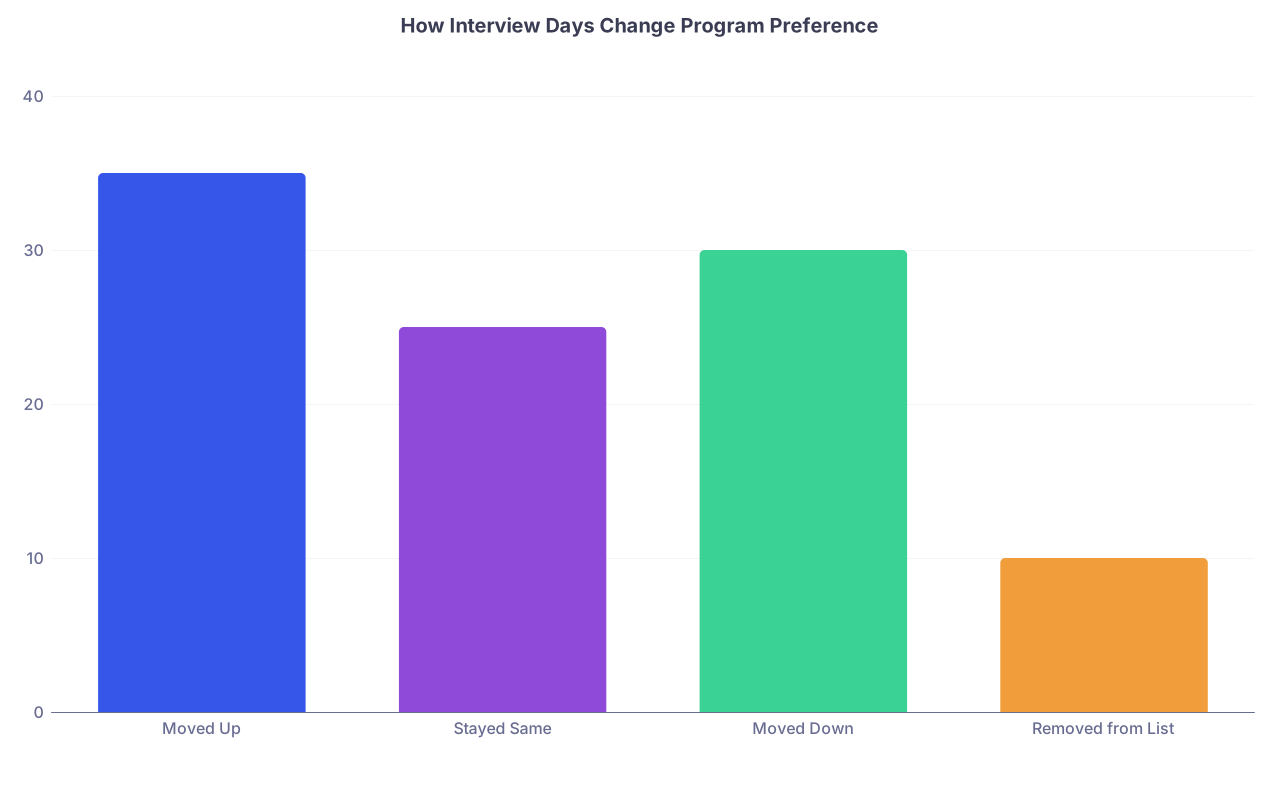
Visual: How Often Applicants Change Their Mind After Interview Days
| Category | Value |
|---|---|
| Moved Up | 35 |
| Stayed Same | 25 |
| Moved Down | 30 |
| Removed from List | 10 |
You’re not abnormal for deciding a program is not a fit after seeing it. A big chunk of your classmates are doing the same mental reshuffling.
Step 10: A Quick Decision Flow You Can Use Tonight
When in doubt, run through this simple mental flow:

| Step | Description |
|---|---|
| Step 1 | Finished Interview Day |
| Step 2 | Hard No |
| Step 3 | Soft No |
| Step 4 | Confused |
| Step 5 | Send Neutral Thank-You |
| Step 6 | Do Not Promise Interest |
| Step 7 | Send Warm but Non-committal Thank-You |
| Step 8 | Rank Below True Favorites |
| Step 9 | Debrief + Get Second Opinion |
| Step 10 | Would I be OK Matching Here? |
Put your last program into that flow. Be decisive. Then move on to your next application task.
FAQ (Exactly 3 Questions)
1. If I do not send any thank-you email, will that hurt me?
Probably not in any measurable algorithmic way, but it makes you look less professional. Programs rarely dock you explicitly for no thank-you, but I have heard faculty say, “I remember who followed up thoughtfully.” It is low effort to send a short, neutral note. I’d do it for every place you interview, even the hard no’s.
2. Can I tell more than one program “you’re my top choice”?
You can, but you should not. It is unethical, and it can backfire if people talk (they do). Also, it creates mental chaos for you. Pick one true top choice if you must say it at all. For everyone else, keep it honest: “I’m very interested” or “I’m strongly considering your program” without false “#1” language.
3. What if I panic close to rank deadline and decide I actually do want that program I wrote off?
No one cares what you wrote in your thank-you emails at that point. The only thing that matters is how you order your rank list. You can move a previously “soft no” program up if you genuinely prefer it to others. Do not email them with dramatic reversals; just fix your list. The algorithm uses your final certified list, not your past emails.
Open your email drafts right now.
Pick the one program you already know is not a good fit.
Write a 3-sentence, neutral thank-you using the hard-no template above. Send it. Then close that tab and put your energy where it matters: ranking the places where you can actually see yourself showing up at 5 a.m. without hating your life.