The etiquette people give you for residency interviews does not cover when your interviewer just…doesn’t show up. But it happens. A lot more than programs will admit.
You’re not overreacting by worrying about it. But you are at risk of handling it badly if you just guess what to do.
Here’s exactly how to email after an interviewer cancels last minute or completely no‑shows—and how to protect your candidacy while you do it.
First: Understand What Just Happened (And What It Means For You)
Most no-shows or last‑second cancellations are not about you. Common reasons I’ve seen:
- Attending got pulled into an emergent case or rapid response
- Resident is stuck in signout, cross-cover disaster, or admissions surge
- Program coordinator double-booked, missed a time zone, or mis-sent a link
- Interviewer forgot. (Yes, it happens. Especially on big interview days.)
What it does not mean:
- They secretly decided to reject you
- Your application is now doomed
- You should just wait quietly and hope they remember
You need to do three things quickly and cleanly:
- Document what happened
- Prompt the program to fix it
- Stay unfailingly professional on paper, even if you’re furious in your head
Let me walk you through the scenarios.
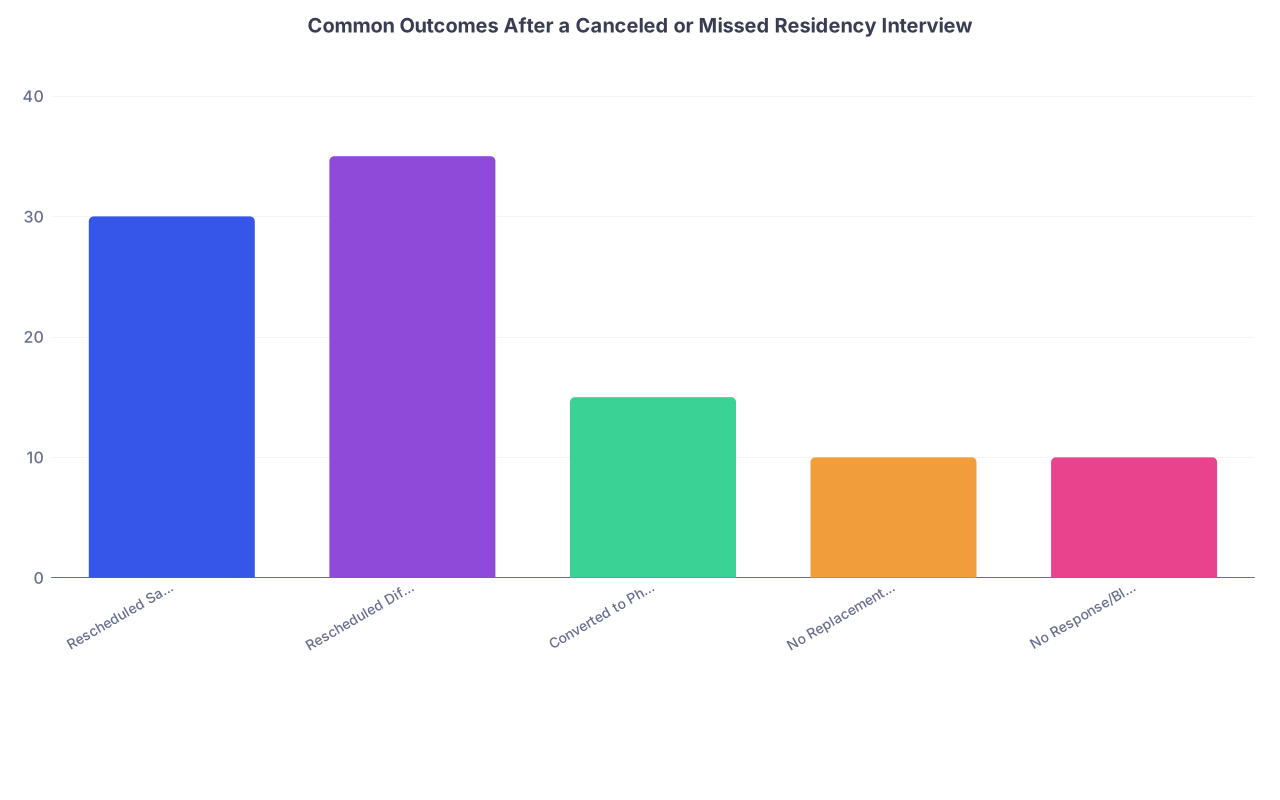
| Category | Value |
|---|---|
| Rescheduled Same Day | 30 |
| Rescheduled Different Day | 35 |
| Converted to Phone/Short Zoom | 15 |
| No Replacement, Told "Complete" | 10 |
| No Response/Black Hole | 10 |
Scenario 1: Interviewer Canceled Before the Meeting
Example: You get an email at 7:40 AM for an 8:00 AM Zoom:
“So sorry, something urgent just came up. I’m unable to interview you today.”
Or the coordinator pops into the virtual room and says your faculty had an emergency and they’ll “be in touch.”
In this case, your job is to:
- Be gracious in the moment
- Immediately create a paper trail
- Nudge towards a specific reschedule rather than a vague promise
Step 1: Reply Same Day
If the interviewer emailed you directly to cancel, respond to them and CC the coordinator (if you have their email from invites). If only the coordinator spoke to you, email the coordinator.
Here’s the template:
Subject line options (pick one):
- “Interview with Dr. [Name] – Reschedule Request”
- “[Program Name] Interview – Missed Session with Dr. [Name]”
- “Follow-up on Canceled Interview – [Your Name]”
Email body template:
Dear Dr. [Last Name],
Thank you for letting me know about the change in today’s schedule. I hope everything is alright on your end.
I remain very interested in [Program Name] and would be grateful for the chance to reschedule our interview if possible. I’m flexible and happy to accommodate any time that works for you or another faculty member.
For convenience, I’m available [list 3–5 concrete windows over the next 7–10 days, with time zone]. I’m also happy to adjust outside those times if needed.
Thank you again for your time and consideration.
Best regards,
[Your Full Name], [Current PGY or MS4, School]
AAMC ID: [########]
Phone: [###-###-####]
If the coordinator is your main contact, change the salutation to “Dear [Ms./Mr./Mx./First Name] [Last Name],” and change the second line to:
Thank you for letting me know that Dr. [Last Name] was unavailable for today’s interview.
Step 2: If They Promise They’ll “Follow Up”
If during the day someone says, “We’ll email you to reschedule,” and then nothing happens by the end of the next business day, you email. Do not wait a week. You’re not being pushy; you’re reminding a very busy coordinator who is juggling 200 applicants.
Use:
Dear [Coordinator Name],
I wanted to follow up regarding my interview with Dr. [Last Name], which was canceled on [date] due to [their emergency/clinic needs/etc.]. I’m still very interested in [Program Name] and would appreciate the opportunity to complete the interview if possible.
I remain flexible with timing and can make myself available on short notice. Some convenient times for me include:
– [Day, date, time, time zone]
– [Day, date, time]
– [Day, date, time]Thank you again for your help with this.
Best regards,
[Name]
[Info]
Scenario 2: Interviewer Completely No-Showed (Virtual or In‑Person)
This is the messy one. The clock hits 10:15 for a 10:00 interview. Zoom room still empty. Or you’re sitting in a conference room on-site while everyone walks by and no one seems to know who owns you.
Here’s how to handle it without looking unprofessional.
Step 1: Give a Reasonable Buffer
Virtual: wait 10–15 minutes before acting.
In-person: after 10 minutes, gently flag someone—anybody with a name badge who looks like they belong to the program.
Never log off exactly at the scheduled end time without touching base. You want a record that you showed up and tried.
Step 2: Live-Day Escalation
If they sent a Zoom link or meeting invite, you almost always have either:
- A coordinator’s email
- A “day-of” contact phone number
- A general program email
Use them.
For virtual:
Send a short email at ~10–15 minutes past start:
Subject: “Checking in – Interview with Dr. [Last Name] at [Time]”
Dear [Coordinator Name],
I’m currently logged into the Zoom link for my interview with Dr. [Last Name] scheduled for [time, time zone], but it appears we have not been able to connect yet. I just wanted to check in and make sure I’m in the correct place.
I’ll remain available on this link and by phone at [###-###-####].
Best,
[Name]
In-person, say to the coordinator/resident hosting:
“I’m scheduled with Dr. [Last Name] at 10:00 in [Room]. I’ve been waiting since then, and I just wanted to make sure I’m still in the right place or if there’s been a schedule change.”
Do not joke about them forgetting you. Do not show irritation. Save it for the group chat later.
Step 3: If It Never Happens That Day
Sometimes the coordinator will scramble and plug a different faculty in later. Sometimes they’ll say, “We’ll sort this out” and it never gets sorted.
By that evening or next morning at the latest, send a clear follow-up.
Subject: Follow-up – Missed Interview with Dr. [Last Name] on [Date]
Dear [Coordinator Name],
I wanted to follow up regarding my interview with Dr. [Last Name] scheduled for [date, time]. I remained present on the Zoom link from [start time] to [end time], but it seems we were unable to connect.
I’m very interested in [Program Name] and would be grateful for the opportunity to reschedule this interview or meet with another faculty member if that’s easier. I’m flexible with scheduling and can be available on:
– [Day, date, time]
– [Day, date, time]
– [Day, date, time]Thank you again for your help, and please let me know if there’s any additional information you need from me.
Best regards,
[Name]
[Info]
Notice what you don’t say:
- You don’t accuse them of forgetting
- You don’t complain about your time
- You don’t hint at legal/NRMP anything
Gracious, factual, and forward-looking. That’s the lane.

| Step | Description |
|---|---|
| Step 1 | Scheduled Interview Time |
| Step 2 | Wait 10-15 Minutes |
| Step 3 | Proceed with Interview |
| Step 4 | Email/Contact Coordinator |
| Step 5 | Rescheduled or Alternate Interview |
| Step 6 | Send Follow-up Email That Evening/Next Morning |
| Step 7 | Interviewer Arrives? |
| Step 8 | Same-Day Fix? |
Scenario 3: Interviewer Canceled Last Minute AND They Say “We’ll Count It As Complete”
This one is sneaky. I’ve seen applicants get burned by it.
Example: A PD or coordinator says on Zoom chat, “We’ll consider your interview day complete even though you missed Dr. X,” and then later it feels like you had half the face time everyone else did.
You still email.
Your goal here isn’t to argue. It’s to:
- Express appreciation
- Reaffirm interest
- Politely signal you’re available if they want to add something
Something like:
Subject: Appreciation and Follow-up – [Program Name] Interview Day
Dear [Dr. Program Director Last Name] and [Coordinator Name],
Thank you again for the opportunity to interview with [Program Name] on [date]. I appreciated speaking with [list the interviewers you did meet] and learning more about your program.
I understand that Dr. [Last Name] was unavailable due to [clinic/clinical emergency/scheduling issues], and I appreciate your reassurance that my interview day is considered complete. If at any point it would be helpful to schedule an additional brief conversation—whether with Dr. [Last Name] or another faculty member—I’d be more than happy to make myself available.
The day reinforced my strong interest in [Program Name] because [1–2 specific reasons you liked the program].
Thank you again for your time and consideration.
Sincerely,
[Name]
[Info]
You’ve:
- Locked in your interest
- Shown you’re reasonable
- Left the door open for them to “fix” it if they feel guilty later
That is about as good as it gets.
How Pushy Is Too Pushy?
Programs are disorganized. Coordinators are drowning. PDs are clinically overloaded. You must advocate for yourself, but you have to do it in a way that doesn’t get instantly labeled as “high maintenance.”
Here’s the line.
| Situation | Reasonable Action | Too Pushy |
|---|---|---|
| No reply 2 business days after your reschedule email | Send 1 polite follow-up | Call the main hospital line multiple times |
| Coordinator says “we’ll be in touch in a few days” | Wait 3–5 days, then email | Email daily asking for updates |
| They say “we’ll count it as complete” | 1 thank-you + availability email | Argue that it is unfair / demand another slot |
| Interviewer emails apology | Reply same day with short, gracious note | Ask them directly about your ranking chances |
Sample “Second Ping” Email (If They’ve Gone Quiet)
If you emailed about a missed/canceled interview and heard nothing for 3–5 business days, send:
Subject: Second Follow-up – Missed Interview with Dr. [Last Name]
Dear [Coordinator Name],
I hope you’re doing well. I wanted to briefly follow up on my interview with Dr. [Last Name] that did not take place on [date]. I know this is an extremely busy time of year, but I remain very interested in [Program Name] and would appreciate any update regarding the possibility of rescheduling or next steps for my application.
I’m still flexible with timing and can be reached at [phone] or via email.
Thank you again for your time.
Best regards,
[Name]
After this second ping, stop. If they do not respond, that’s your answer. Continued pestering will not save it; it will just annoy them.
How This Affects Your Rank List (The Harsh Truth)
You’re not just emailing to be polite. You’re also quietly deciding: “Do I still want to rank this place?”
Here’s how I’d think about it.
Single no-show, clearly explained, program seems mortified and makes it right
- People get sick. Codes happen. This is not a red flag by itself.
- Focus on how the rest of the day felt.
Multiple chaotic issues: wrong links, lost you in the schedule, no one apologizes
- That’s a culture signal. Disorganization in interviews often mirrors disorganization in training.
- You do not need to “punish” them, but you’re allowed to move them down.
Program dismisses your concern or seems annoyed you followed up
- That’s a big problem. If they treat you like that when they’re recruiting you, imagine how responsive they’ll be when you’re an intern.
Do not rank a program highly “because reputation” if their behavior made your gut say, “They don’t value residents’ time.” You’re the one who has to live there for 3–7 years.
Common Email Mistakes That Quietly Hurt You
I’ve seen versions of all of these:
Passive-aggressive jabs
“I waited for 30 minutes without anyone bothering to show up.”
Translation to the reader: this applicant might be a headache.Oversharing frustration
“I had to cancel other things and take time off for this, so I hope it can be prioritized.”
They already know they inconvenienced you. Pointing it out doesn’t help you.Sounding like a lawyer
“Under NRMP guidelines I trust my candidacy will not be adversely affected by this situation.”
You just tripped every defensive wire in the PD’s brain.Neediness
“I haven’t heard from you and I’m very worried about my chances.”
They’re not your therapist.
Just keep your emails:
- Short
- Factual
- Respectful
- Forward-looking (“I’d appreciate the opportunity to…”)
If you’re tempted to send something spicy, write it in your notes app, send it to a friend, and then send the professional version.
If The Interviewer Themselves Emails an Apology
Sometimes a faculty will email you after the fact:
“I’m so sorry I missed our interview—clinic ran over. If you’re still available, I’d be happy to reschedule.”
Respond quickly and make it easy for them to say yes.
Dear Dr. [Last Name],
Thank you so much for your message. I completely understand how unpredictable clinical responsibilities can be.
I’d still be very grateful for the chance to speak with you. I’m available on:
– [Day, time, TZ]
– [Day, time]
– [Day, time]If none of those work, I’m happy to adjust to any time that’s convenient for you.
Thank you again for taking the time.
Best regards,
[Name]
Do not try to get information about how they’ll rank you, whether this hurt your file, etc. Treat this like a normal professional interaction.
Timing Recap: When to Email, Step by Step
Just to pull this together into a timeline you can glance at quickly.
0–15 minutes after start time:
Wait. Refresh email/Zoom. Double-check link/time zone.10–15 minutes past start:
If still no one: email/call coordinator or day-of contact.Same day (evening) or next morning:
If the interview never happened: send the “missed interview” follow-up asking to reschedule.3–5 business days later:
If no response: send one short “second follow-up” email.After second email:
Stop. You’ve done your part. Focus on other programs.