
The myth that a residency thank‑you email can make or break your entire career is exaggerated. A lot.
You’re not crazy for obsessing over it, though. I’ve seen people spend more time wordsmithing a single thank‑you note than they spent prepping for the actual interview. Rereading the same sentence 20 times. Googling, “Is ‘Best regards’ too formal?” at 1:47 a.m. Wondering if saying you’re “very interested” sounds desperate.
Let’s walk straight into the anxiety instead of pretending it’s not there.
The Blunt Truth: Thank‑You Emails Are Low-Stakes, but Not No-Stakes
Here’s the hierarchy of what programs care about after an interview:
| Factor | Rough Impact Level |
|---|---|
| Your actual interview | Very High |
| Letters of recommendation | High |
| Application (scores, CV, PS) | High |
| How you fit the program vibe | High |
| Communication professionalism | Low–Moderate |
| Thank-you email content/style | Very Low |
Are thank‑you emails required? No.
Can a good one slightly reinforce a positive impression? Yes.
Can a bad one sink you? Only if it’s truly unprofessional or bizarre.
Programs don’t sit down with your email on a projector going, “Let’s all analyze whether ‘sincerely’ sounds authentic from this person.” They’re usually:
- Skimming on their phone between cases
- Glancing at it while charting
- Filing it mentally as: “Nice, they followed up” or “Huh, weird tone” or “Oh, a red flag”
They’re not grading your word choice like Step 2 CS.
So how polished does it really need to be?
Polished enough that:
- It’s clear
- It’s polite
- It’s not riddled with errors
- It doesn’t contradict something important you said
That’s it. That’s the bar.
What Programs Actually Notice (And What They Don’t)
Let me be very specific, because vague reassurance just makes anxious brains worse.
Things programs DO notice
Whether you send it at all (sometimes)
Some interviewers care. Some don’t. Some remember the sweet student who sent a thoughtful note. Almost no one remembers “the one who didn’t send a thank‑you.”Tone: professional vs. weird
Not “are you a literary genius,” but:- Did you sound respectful?
- Did you sound like a reasonable adult?
- Did you avoid being creepy or overly familiar?
Major mistakes that hint at carelessness
- Wrong program name
- Wrong specialty (yes, I’ve seen this—“Thank you for the opportunity to interview for your radiology program” sent to a pediatric program)
- Wrong interviewer’s name
- Massive typos that change meaning
If you say something strongly about ranking
“I will rank your program #1” is legally sticky. They do notice that. And they usually remember who said it.
Things programs DO NOT care about
- Whether you used “thank you again for your time” vs “I appreciated the opportunity”
- Whether you put your phone number under your signature
- Whether you used “Best,” “Sincerely,” or “Kind regards”
- Whether your email was 3 sentences vs 6 sentences
- Whether you sent it at 6 p.m. or 11:30 p.m.
They’re not judging you for not being a poet.
They just want to see: “Is this person normal? Appreciative? Not a walking HR complaint?” That’s the real subtext.
A Simple Template (So You Stop Rewriting the Same Line 14 Times)
You don’t need to reinvent your voice from scratch at 2 a.m. Use a basic template and then tweak slightly for each person.
Here’s a solid, safe structure:
- Subject line
- Greeting
- Quick thank you
- One specific thing you appreciated or connected with
- Brief re-affirmation of interest (without making promises you don’t mean)
- Professional sign-off
Example you can literally steal and edit:
Subject: Thank you for the opportunity to interview
Dear Dr. [Last Name],
Thank you for taking the time to speak with me during my interview for the [Program Name] [Specialty] residency. I really appreciated hearing about [specific topic you actually discussed—e.g., the resident autonomy on night float, the curriculum changes, your work in addiction medicine].
Our conversation reinforced my strong interest in [Program Name]. I’d be excited to train in an environment that [briefly mention 1–2 things you liked—supportive culture, diverse patient population, emphasis on teaching].
Thank you again for your time and for sharing your perspective on the program.
Best regards,
[Your Name]
[AAMC ID (optional)]
[Phone number (optional)]
Is it thrilling? No. Is it safe? Absolutely.
Safe is what you want here.
You can reuse 80–90% of this and just change the details. Nobody’s cross‑referencing thank‑you emails between faculty to see if you reused a sentence.
Timing, Length, and All the Tiny Things You’re Overthinking
When should you send it?
You’re probably spinning over this: “If I send it too fast, do I look desperate? If I send it too late, do I look disinterested?”
Here’s the actual reality:
- Best window: within 24–72 hours of the interview
- Same day: totally fine
- After 3–5 days: still okay, especially if you were on a busy rotation
- Weeks later: doesn’t help much, but not catastrophic
Nobody is timestamp‑sorting thank‑you emails and correlating them with rank list positions. They’re barely keeping up with service, teaching, and their inboxes.
How long should it be?
Aim for:
- 3–7 sentences
- One short paragraph or two small paragraphs
Too short:
“Thanks for the interview. I liked your program. –[Name]”
That’s… not fatal, just kind of nothing.
Too long:
Four dense paragraphs, your full life story, long emotional sections about your childhood? That raises an eyebrow. They don’t want another personal statement. They want confirmation that you’re polite and not unhinged.
Time of day panic
“Is sending at 1:32 a.m. bad? Will they know I’m neurotic?”
They will know you’re in medicine. Everyone is awake at weird hours.
If it makes you feel better, you can schedule send for 7–8 a.m. the next day. But that’s for your peace of mind, not because programs care.
Common Panic Scenarios (And What Actually Happens)
Let’s walk through the “oh no I ruined it” situations you’re probably replaying in your head.
1. “I spelled their name wrong.”
Yeah, this one’s rough. Depends how wrong:
- One missing letter or misplaced vowel? They’ll live.
- Called Dr. Patel “Dr. Peters” and they’re clearly not? Worse.
If it happens and you notice:
Send a brief correction ONLY if it’s a major identity mistake.
Dear Dr. Patel,
I just realized I misspelled your name in my earlier email—my sincere apologies. I appreciated our conversation and didn’t want that error to distract from my gratitude.
Best,
[Name]
They’ll probably appreciate the correction and move on.
2. “I sent the wrong program name.”
This happens more than you’d think. Especially if you’re blasting 10 emails in a row.
If you wrote “Thank you for the interview at [Other Hospital]”:
- Yes, that can hurt. It signals carelessness.
- No, it usually doesn’t automatically drop you to the bottom unless you were borderline already.
If you catch it quickly, you can send:
Dear Dr. [Last Name],
I just noticed an error in the email I sent—my apologies for mistakenly writing [wrong program]. I truly meant to thank you for the opportunity to interview with the [correct program name] [specialty] residency. I’m grateful for your time and our conversation.
Best regards,
[Name]
Will it erase it completely? Not always. But owning it is better than silence.
3. “I said I’d rank them highly… but I’m not sure anymore.”
Don’t lie in these emails. And don’t promise things you’ll feel guilty about later.
You can safely say:
- “I will be ranking your program highly.” (if true)
- “Your program remains one of my top choices.” (if it really is)
- “I remain very interested in your program.” (safe and non-committal)
You should avoid:
- “You are my #1 choice” unless you mean it
- Saying that to more than one place
- Trying to game the system with manipulative language—people can smell that
If you already over‑committed in an email, don’t keep sending follow‑ups to walk it back. Just be more careful going forward. Programs know applicants are stressed and not always perfectly strategic word‑machines.
4. “I never sent a thank‑you at all.”
Worst-case fantasy: They loved you, then realized you didn’t send a thank‑you, and someone said, “Actually, let’s drop them to the bottom.”
Reality: That basically never happens.
If you forgot:
- If it’s been 1–2 weeks: you can still send a brief “belated thank you.”
- If it’s been a month and rank lists are basically done: sending it is more for your own sense of closure.
But no, you didn’t nuke your chances just by skipping a thank‑you. Programs have matched plenty of applicants who never sent one.
Follow-Ups vs. Pestering: Where’s the Line?
Sometimes the thank‑you email is also where you want to:
- Ask one more question
- Clarify something about the schedule or curriculum
- Mention a new update (publication accepted, AOA, etc.)
That’s okay. One short question inside a thank‑you is fine. It looks engaged, not annoying.
But:
Don’t send multiple follow‑ups if they don’t respond. They don’t owe you replies. Often they literally can’t say anything specific about your chances because of policy.
Reasonable follow-ups:
- One thank‑you + 1 question
- A later update email if you have a meaningful change (new score, publication, award)
- One signal of strong interest if the program is truly at the top of your list
Not reasonable:
- Emailing every 1–2 weeks “just checking in”
- Asking, “Where am I on your rank list?”
- Sending a multi-paragraph plea about how much matching there would “mean to you and your family”
I promise: nobody bumps people up the rank list because they sent five emotional emails.
How to Stop Obsessively Editing (Or At Least Contain It)
Here’s a system so you don’t lose entire evenings rewriting the same paragraph.
Create one base template. Use the one above or your own.
Make a quick list of 5–6 “specific things” you liked about programs in general:
- Resident camaraderie
- Diverse pathology
- Strong teaching culture
- Autonomy early on
- Research support
- Wellness and reasonable call
For each faculty email:
- Plug in their name, program name, and 1–2 specific things you actually talked about.
- Choose one from your list to connect with.
- Read once out loud. Fix only glaring issues.
- Send. Close the tab. Don’t reopen.
If you’re the type to spiral and re‑read sent emails:
Write them in a notes app first, have a friend glance at your template once, then trust the template.
You’re not trying to win a Pulitzer. You’re trying to sound like a decent human who’s grateful for someone’s time.
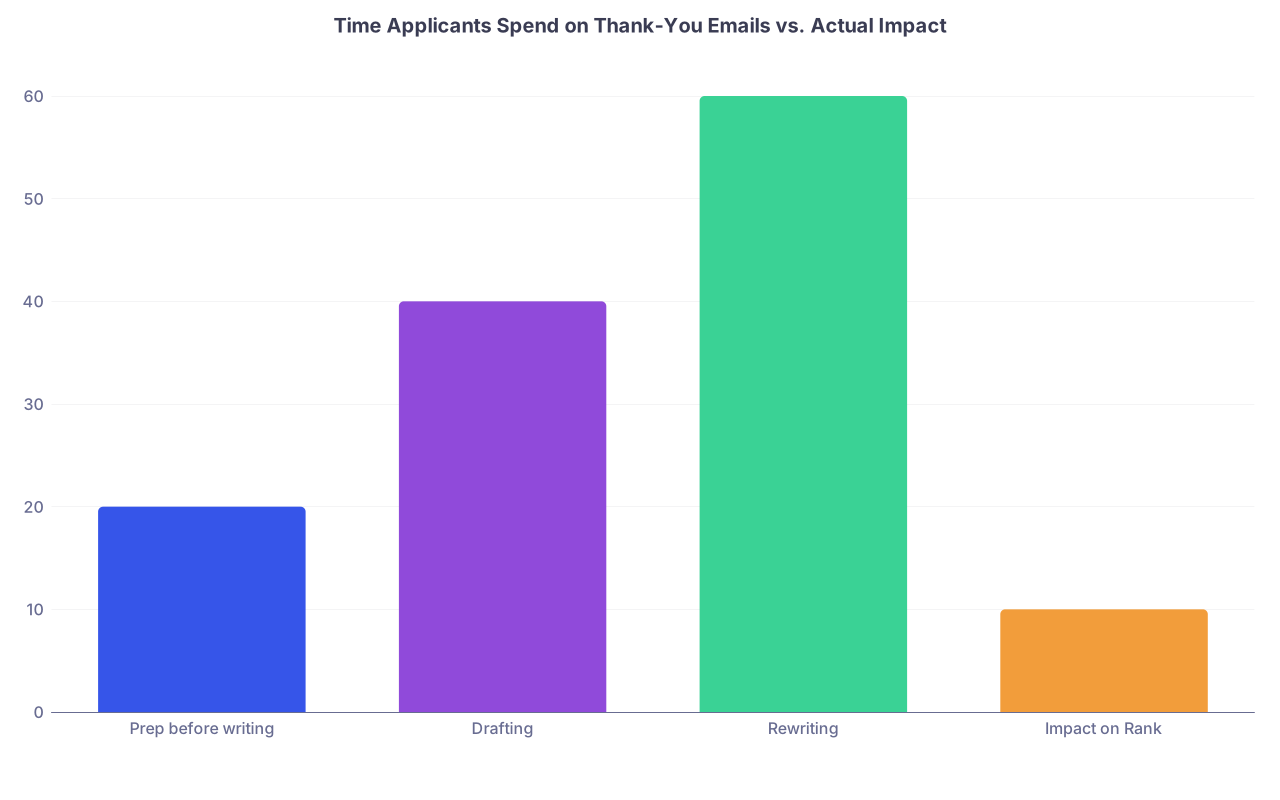
| Category | Value |
|---|---|
| Prep before writing | 20 |
| Drafting | 40 |
| Rewriting | 60 |
| Impact on Rank | 10 |

| Step | Description |
|---|---|
| Step 1 | Finish Interview Day |
| Step 2 | Create/Reuse Template |
| Step 3 | Customize with 1-2 Specific Details |
| Step 4 | Proofread Once |
| Step 5 | Send Within 24-72 Hours |
| Step 6 | Stop Re-reading & Move On |
| Step 7 | Any Major Errors? |
FAQ: Six Questions You’re Probably Still Stressing About
1. Do I have to send a thank‑you email to every single interviewer?
You don’t have to, but it’s common to send to at least your main interviewers and sometimes the program director. If you had 8+ interviews in one day, you can prioritize the PD, APD, and anyone you had a particularly strong interaction with. It’s okay to send fewer, more thoughtful notes instead of mass‑producing 10 generic ones.
2. What if I already sent a slightly awkward or too-formal email?
Leave it. Don’t send a follow‑up just to “fix the vibe.” Faculty will not remember your exact wording. At worst they’ll think, “A little stiff, but polite.” That’s not going to hurt your rank. Over-correcting with another email usually calls more attention to something they barely noticed.
3. Should I mention where I’m ranking them in the thank‑you?
Only if you’re certain and you mean it. If you’re truly ranking them #1 and you want to say so, you can—but you don’t have to. If you’re still deciding, use softer language: “I remain very interested in your program and could see myself thriving there.” Don’t play games trying to “signal” multiple #1s. That’s how people end up feeling gross and anxious.
4. Is it okay to copy-paste the same thank‑you and just change names?
It’s okay to reuse structure. It’s not great to send a totally generic message with zero specific reference to the conversation. Have a reusable skeleton but change at least 1–2 lines that reflect something unique about that interview: a patient population they serve, a rotation you discussed, a project they mentioned. They can tell when something is totally canned.
5. What if I’m not actually that interested in the program—should I still send a thank‑you?
You can, but you’re not obligated. If you’re 99% sure you won’t rank them, sending a thank‑you becomes courtesy, not strategy. If you do send one, keep it polite and neutral. Don’t say “I’m very interested” if you’re not. “Thank you for your time and for sharing more about your program” is sufficient.
6. Honestly—can a thank‑you email ever really save or sink my chances?
Save? Almost never. Nudge slightly in your favor if they liked you already? Yes. Sink you? Only if it’s egregiously bad—wildly unprofessional, offensive, obviously copy-pasted wrong, or packed with lies. A normal, mildly awkward, overly formal, or slightly bland email? That’s totally fine. Nobody matches—or doesn’t match—purely because of a thank‑you note.
Key points:
- Your thank‑you email needs to be clear, polite, and specific—not perfect.
- Use a simple template, personalize 1–2 details, proof once, and send.
- The interview, not the email, carries the real weight. Don’t let a low-impact task steal high-impact energy from the rest of your application or your sanity.