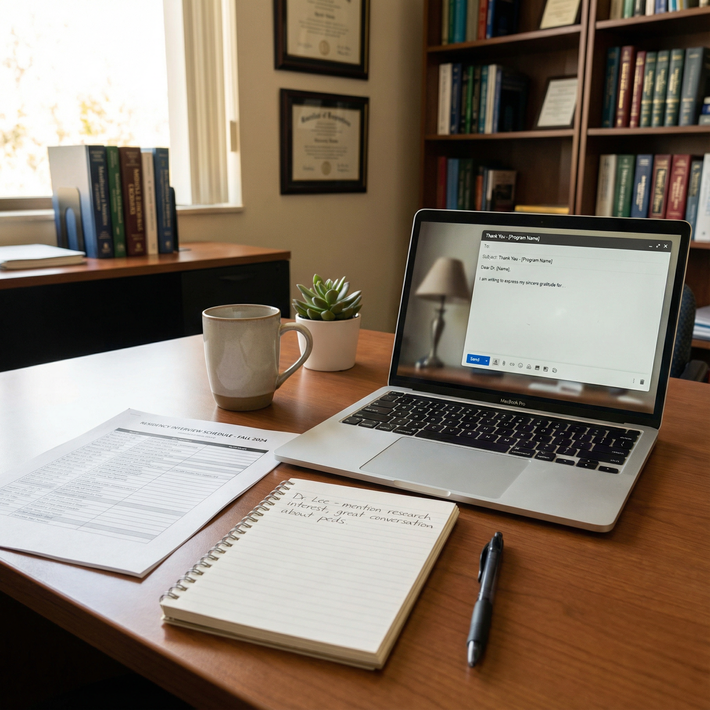
What if you had a great interview, felt a real connection… and then realized on the plane home that you cannot remember your interviewer’s name at all?
Welcome to the oh‑no‑oh‑no‑oh‑no part of residency season. I’ve been in that exact spiral. You stare at your laptop, try to start “Dear Dr…?” and your brain gives you absolutely nothing.
Let’s walk through this like two people who both overthink everything.
First: Are You Screwed If You Don’t Remember Their Name?
Short answer: no. Not even close.
Programs are chaotic. Faculty are chaotic. Interview days almost never go exactly as planned. Lost names, mixed‑up schedules, last‑minute swaps—this is normal for them. They do dozens of these days. You remember every second; they barely remember what lunch was.
I’ve seen all of the following happen:
- A PD calls an applicant by the wrong name. Twice.
- A coordinator sends the wrong interviewer list, then changes it the morning of.
- An attending no‑shows and another faculty jumps in last minute.
So yeah, the expectation that you perfectly track every name, title, and subspecialty? Unrealistic. And admissions people know it.
- Send a thank‑you that sounds specific and sincere
- Avoid obviously careless mistakes (like guessing the wrong name)
- Don’t draw attention to the fact that you forgot
Notice what’s not on that list: “Flawlessly remember every name and title.”
You’re not being evaluated on your photographic memory.
Step 1: What Info Do You Actually Have?
Before you panic-type a disaster email, squeeze everything you can out of what you do know. You probably have more than you think.
Check:
- The interview day email from the coordinator – often lists scheduled interviewers.
- ERAS / Thalamus / Interview Broker – sometimes shows who you were assigned.
- The program’s website – look at faculty photos and names; you might recognize someone.
- Your notes – even “cards guy, did fellowship at Mayo, likes teaching” is useful.
- The Zoom/Teams calendar invite – sometimes the meeting title has the interviewer’s name.
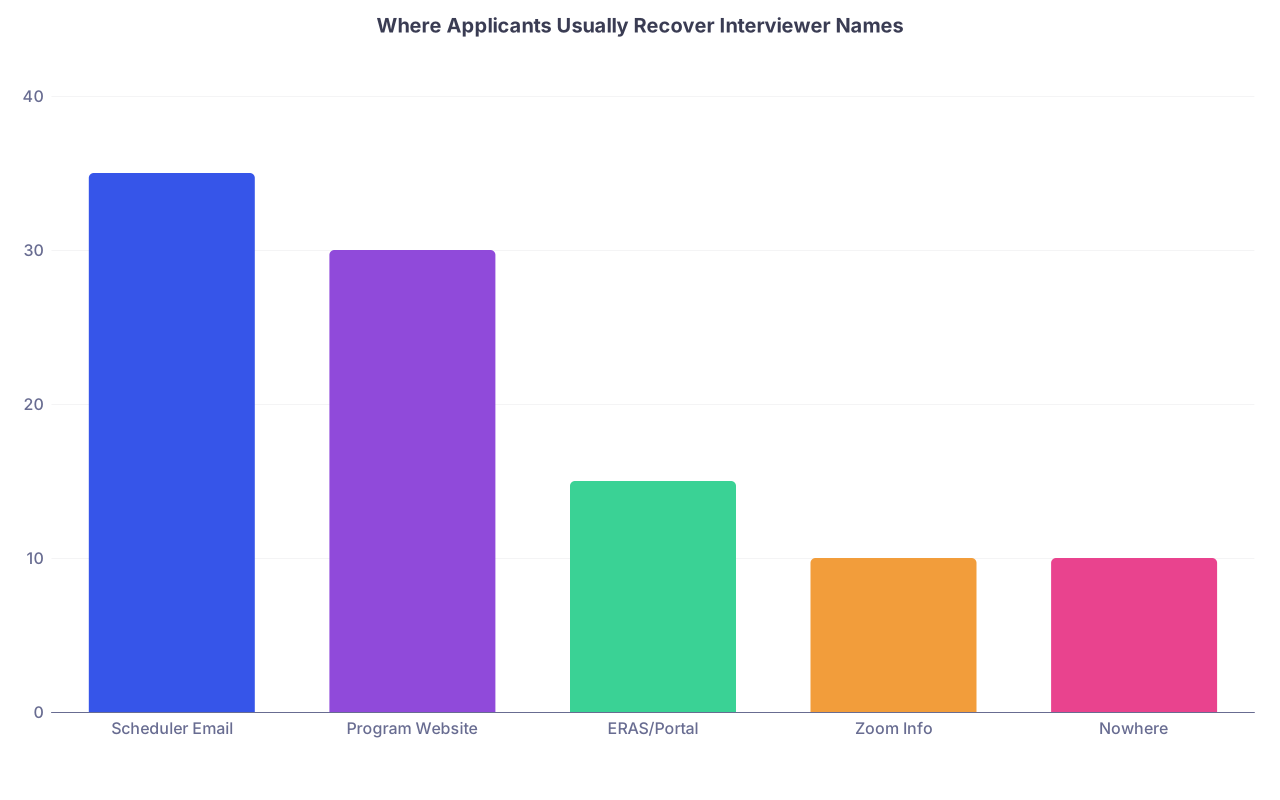
| Category | Value |
|---|---|
| Scheduler Email | 35 |
| Program Website | 30 |
| ERAS/Portal | 15 |
| Zoom Info | 10 |
| Nowhere | 10 |
If you can piece it together from these, amazing. Use their full name, spell it correctly, done.
But let’s say you hit the worst‑case scenario: you truly cannot figure it out. Nothing matches your memory. Website photos all blur together. The email list doesn’t look like who you actually met.
Now what?
Step 2: Decide Who You’re Actually Emailing
The good news: thank‑you emails almost never live in some sacred “personal inbox” directly curated by each faculty member.
Here’s what usually happens:
- You send emails to the program coordinator or central residency email.
- They forward them (sometimes in bulk) to the PD/APD/faculty.
- Or they just drop them in your file as “Applicant sent thank-yous.”
So if you’re missing a name, your safest move is this: write to someone you do know (usually the coordinator or PD) and let them route it.
You are not required to individually track every attending who smiled at you between 10:03 and 10:27 am. That’s not the test.
Step 3: How To Thank Someone When You Don’t Know Their Name
Let’s do the exact phrasing because this is where people freeze.
Scenario A: You Know the Coordinator’s Name, But Not the Interviewer’s
Subject line options (pick one, don’t overthink it):
- “Thank you for today’s interview”
- “Thank you for the interview day – [Your Full Name]”
- “Grateful for the interview – [Program Name]”
Email body:
Dear [Coordinator’s First Name/Last Name],
Thank you again for organizing such a thoughtful interview day. I really appreciated the chance to speak with several members of the faculty.
In particular, I had a great conversation with one of the faculty in [subspecialty or role if you remember it, e.g. “infectious diseases,” “medical education,” “night float,” “ultrasound”]. We talked about [something specific you remember: “the resident‑run morning report,” “your curriculum changes,” “how you support residents interested in global health,” etc.]. Our discussion reinforced how well this program aligns with what I’m looking for in residency.
If possible, I’d be grateful if you could pass along my thanks to them, as well as to the rest of the team involved in the interview day.
Best regards,
[Your Full Name]
AAMC ID: [###]
Notice what you didn’t do:
- You didn’t guess a name.
- You didn’t say, “I forgot their name.”
- You didn’t over‑apologize and make it awkward.
You just… described them and the conversation. That’s more than enough for the coordinator to figure out who it is or just file “this person liked their interviews” in your favor.
Scenario B: You Remember the PD’s Name But Not a Specific Faculty
Same idea, different addressee.
Dear Dr. [PD Last Name],
Thank you very much for the opportunity to interview at [Program Name] and to learn more about your residency. I especially enjoyed speaking with several of the faculty about [specific things: “your night float system,” “opportunities in QI,” “the balance between autonomy and supervision,” etc.]. Those conversations made it clear how invested the faculty are in resident education.
If appropriate, I’d appreciate it if you could pass along my thanks to the faculty and residents who took the time to speak with me during the day.
Best regards,
[Your Full Name]
AAMC ID: [###]
Again, no drama about the missing name. They’re not running a quiz on whether you can list all faculty by last name.
Step 4: What You Absolutely Should Not Do
Here’s where people turn a small issue into an actual problem.
Don’t:
- Guess the name. If you email “Dear Dr. Johnson” and it was Dr. Jackson? That looks way worse than omitting the name.
- Confess the whole thing: “I’m so sorry, I forgot your name…” Just… don’t. You turn something they didn’t notice into a thing they can notice.
- Send a second “corrected” email if you realize your mistake later. One clean email is better than a trail of frantic corrections.
- Over‑apologize. A single line of “sorry for any confusion” is fine if you messed up, but paragraphs of apology scream anxiety, not professionalism.
You want them thinking: “Nice applicant, thoughtful email.”
Not: “Wow, this person is spiraling over a minor detail.”
Step 5: What If You Half‑Remember the Name?
You’re 60% sure it was Dr. Patel. Or maybe Dr. Shah. Same department, similar vibe, your brain is mush.
In that case: play it safe. Don’t use the name at all.
You can write:
Dear Faculty Member,
or
Dear [Program Name] Faculty,
Yes, it feels generic to you. No, they don’t sit there grading your salutation.
And if you must be more specific, use the role instead of the name:
- “Dear Cardiology Faculty Member,”
- “Dear [Program Name] Hospitalist Faculty,”
- “Dear [Program Name] Interviewer,”
It’s not perfect, but it’s clean. You sound intentional, not careless.
Reality Check: How Much Do Thank‑You Emails Even Matter?
Annoying answer: it depends, but usually not as much as you think.
| Program Type | How They Treat Thank-Yous |
|---|---|
| Big academic IM | Mostly ignored, sometimes skimmed |
| Smaller community | Appreciated, may be noted as “professional” |
| Hyper-competitive specialties | Read by some faculty, rarely move the needle alone |
| PDs who like tradition | May genuinely care and remember thoughtful ones |
| Programs with no policy | Mixed; some faculty read, some delete |
I’ve watched PDs during ranking meetings. They talk about:
- Clinical performance (away rotation, if you did one)
- Letters of recommendation
- Interview impressions
- Red flags (professionalism, weird behavior, repeated issues)
Thank‑you emails usually come up like this:
“Oh yeah, I remember them—they sent a nice thank‑you.”
That’s it. At best, a small plus. At worst, unseen.
So you forgetting one person’s name? It’s not triggering some silent “unprofessional” label in your file.
What would look unprofessional is:
- Obvious copy‑paste errors (“I loved learning about your anesthesiology program” sent to IM)
- Wrong program name
- Wrong specialty
- Overly informal or flirty tone
- Complaining about travel, schedule, or other applicants
Your goal is “solid, specific, and error‑free,” not “perfectly individualized to every human you met.”
Step 6: If You Remember Details But Not the Person
Use the details. That’s actually the best leverage you have.
Let’s say you remember:
- They trained at UW
- They run the global health track
- You talked about parenting while in residency
But no name.
You can still write something like:
I especially appreciated speaking with the faculty member who leads your global health initiatives. Our conversation about balancing a passion for global work with the demands of residency—and about their own training experience at UW—really resonated with me. It made me feel that residents are well‑supported in pursuing non‑traditional paths.
Whoever reads that will know exactly who you’re talking about. They don’t need you to drop a last name to connect the dots.
And the nicest part? That email still feels personal. It doesn’t scream “I forgot who you are.” It says “I actually listened.”
Step 7: Timing – Are You Late Now Too?
Another anxious spiral: “I forgot their name, panicked for three days, now it’s too late to send anything.”
Nope. You’re fine.
General rule of thumb:
- Best: within 24–48 hours
- Totally acceptable: within 3–5 days
- Still okay, especially during heavy season: within a week
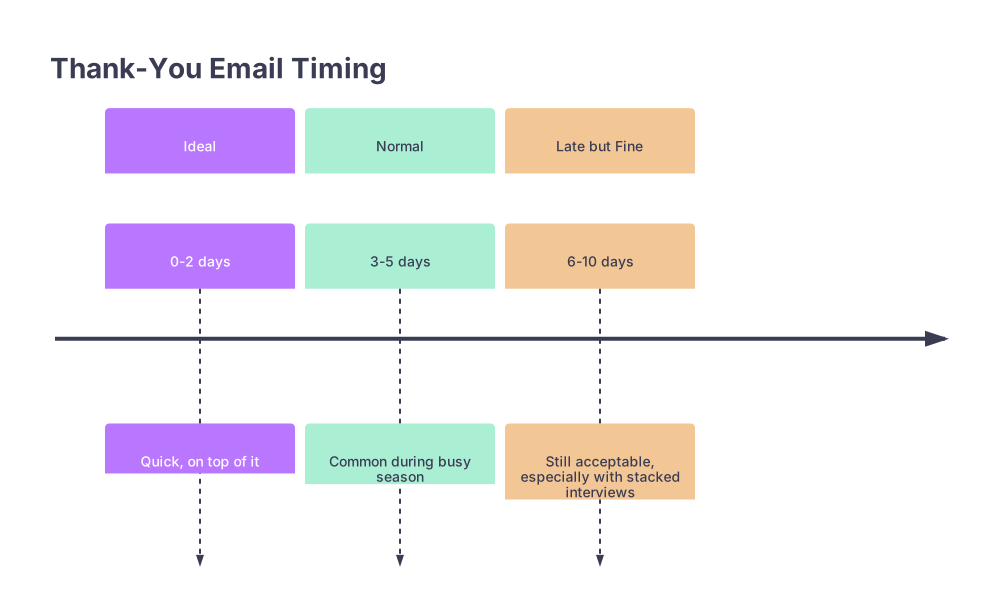
| Period | Event |
|---|---|
| Ideal - 0-2 days | Quick, on top of it |
| Normal - 3-5 days | Common during busy season |
| Late but Fine - 6-10 days | Still acceptable, especially with stacked interviews |
Programs know you might have interviews back‑to‑back, travel delays, actual residency shifts, life emergencies.
If it’s been more than a week, you can still send one. Just don’t make a big deal out of the delay. A simple:
Thank you again for the opportunity to interview at [Program Name] last week.
No explanation. No “I’m so sorry this is late, my cat swalled my laptop and then I lost Wi‑Fi.” Send it and move on.
Step 8: The Emotional Part – Getting Out of the Spiral
Let me guess what your brain is doing:
- “They’ll think I’m careless.”
- “If I can’t remember a name, they’ll assume I can’t remember meds.”
- “Other applicants probably sent perfectly tailored emails to every single person by 5 pm that same day.”
- “This one mistake just ruined my whole shot there.”
No. This is anxiety talking, not reality.
The people who interview you are used to residents and students functioning under cognitive overload. You did a full day of smiling, answering questions, absorbing program info, trying not to say something dumb, and maybe traveling in the middle of all that. Forgetting one name isn’t a moral failing. It’s exactly what a normal, stressed human brain does.
Also, remind yourself of this: they’re not ranking you on your performance in “post‑interview clerical tasks.” They’re ranking you on whether you’ll be a safe, teachable, reasonably pleasant resident.
A clean, sincere thank‑you—name or not—signals maturity. Sitting paralyzed and never sending anything because you’re afraid of doing it wrong? That’s what actually hurts you.
Hit send. Then get back to the rest of your life.
FAQ (Exactly 4 Questions)
1. Should I just skip the thank‑you entirely if I don’t know any names?
No. You can always send a general thank‑you to the program’s main/residency email or coordinator. Keep it simple: thank them for the opportunity, mention 1–2 specific things you liked, ask them to extend your thanks to the faculty and residents. A generic but polite email is better than radio silence.
2. What if I mixed up two programs in a thank‑you email?
If it’s a small thing (like referencing “case‑based morning report” instead of “chalk talks”), leave it. If you wrote the wrong program or specialty name, send a brief correction: “Dear [X], I realized I mistakenly referenced [Other Program] in my prior message—my apologies for the confusion. I very much appreciated my interview at [Correct Program] and the chance to learn more about your [specialty] residency.” Then stop. Don’t send a third email.
3. Do some programs actually hold it against you if you don’t send thank‑yous?
A few old‑school PDs and smaller community programs might quietly like thank‑yous and mentally mark it as “professional,” but I almost never see “no thank‑you” treated as a negative. Missing one specific faculty email? Definitely not a big deal. If you’re worried, send at least one general thank‑you to the PD or coordinator and you’ve covered yourself.
4. Is it weird to ask the coordinator, “Who did I interview with?” after the day is over?
A little, yeah. It unintentionally highlights that you didn’t keep track. Instead, phrase it more naturally if you truly need clarity: “Could you please confirm the faculty I met with today so I can properly thank them?” But honestly, you rarely need that level of precision. A single well‑written email to the coordinator or PD, asking them to pass along your thanks to the faculty you spoke with, accomplishes the same thing without exposing your memory lapse.
Key takeaways:
You’re not doomed because you forgot an interviewer’s name. Send a thoughtful, specific thank‑you to the coordinator or PD, ask them to pass it along, and don’t guess or over‑confess. Then stop rewriting it in your head and move on to the next interview—because that’s what programs are already doing.