
It is late November. You had three residency interviews this week. Your inbox is a mess, ERAS feels like a second job, and now you are staring at a blank email draft addressed to a program coordinator. You want to follow up. You also do not want to sound desperate, annoying, or clueless about the Match rules.
This is where people either look polished and professional, or… like they have no idea how the system works.
Let me break it down specifically: what you can email a program coordinator about, exactly how to phrase it, when to stop, and where the boundaries are so you do not hurt yourself in a process that is already opaque and stressful.
1. What Program Coordinators Actually Do (And Why It Matters For Your Emails)
If you do not understand their role, you will write the wrong email.
Program coordinators are the operational brain of a residency program. They:
- Manage interview scheduling and logistics
- Track applications and documents
- Coordinate between applicants, faculty, and GME
- Keep an eye on NRMP and ACGME rules
- Put out a thousand tiny fires that nobody else even notices
They are not:
- Your personal advocate to the rank committee (in most cases)
- The person deciding where you land on the rank list
- Your career coach
But they do have soft power. They hear how you interact, they know who is disorganized, rude, or pushy, and sometimes they are literally in the room when ranking is discussed. At minimum, attendings trust their judgment about whether someone was professional or a headache.
So your follow-up emails to the coordinator are not “just logistics.” They are part of your file’s shadow narrative: “easy to work with” vs “high-maintenance.”
Your goal with every email:
- Clear, specific purpose
- Respectful, efficient tone
- Minimal back-and-forth
- Zero pressure about ranking or promises
If your email creates work for them with no clear justification, you are already losing ground.
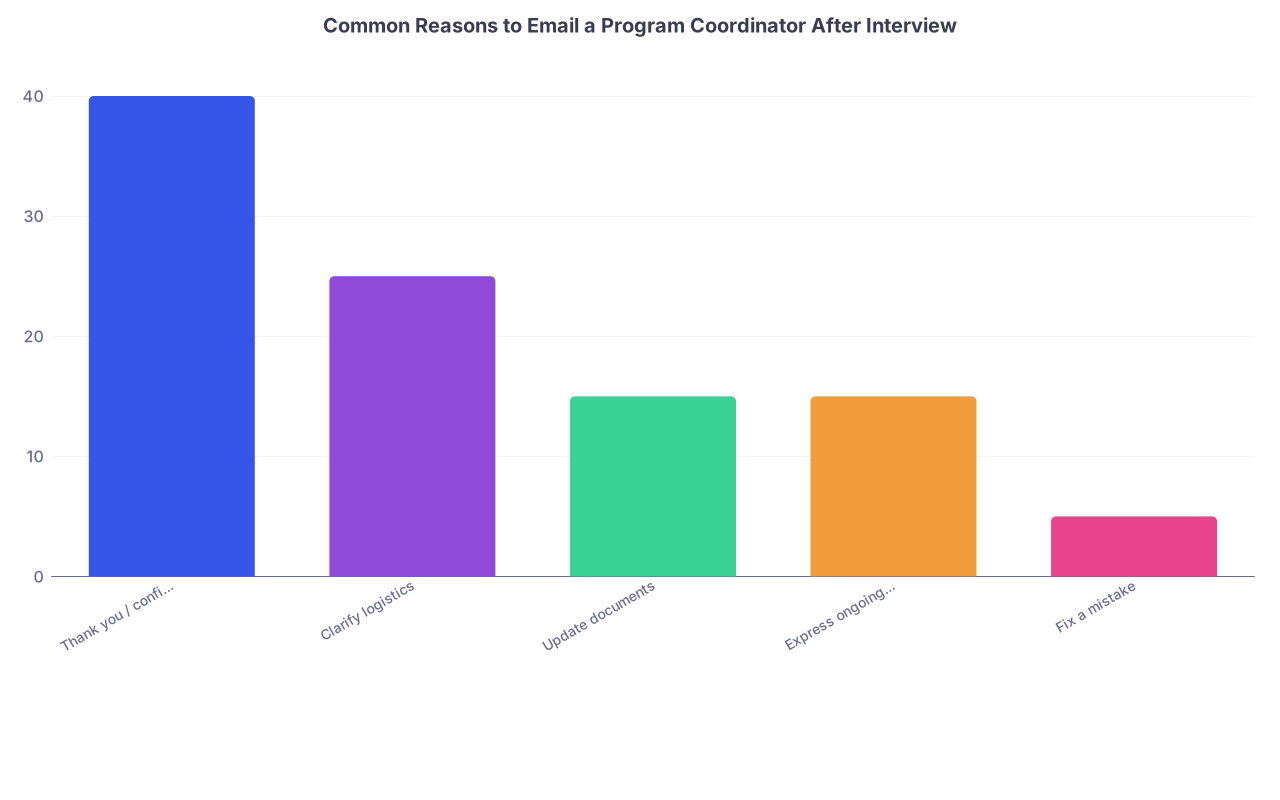
| Category | Value |
|---|---|
| Thank you / confirmation | 40 |
| Clarify logistics | 25 |
| Update documents | 15 |
| Express ongoing interest | 15 |
| Fix a mistake | 5 |
2. When It Is Appropriate To Follow Up (And When It Is Not)
There are only a handful of good reasons to email a coordinator after an interview. Most other follow-ups are noise.
Legitimate reasons to email
These are appropriate and normal:
Confirming or adjusting interview logistics
- Time zones, Zoom links, hotel info, parking, snow delays.
- Rescheduling because of illness or genuine conflict.
Fixing an actual error
- Wrong Step score in their file.
- Wrong name, wrong med school, incorrect visa status.
- Missing USMLE transcript that you know you released weeks ago.
Sending a post-interview thank you / clarification
- Very brief, focused gratitude, especially if the coordinator was very helpful.
- Clarifying something you forgot to ask about schedules, start dates, etc.
Updating something that materially changes your application
- New Step 2 CK score if it is strong and you know they want it.
- New publication accepted (not “submitted to 6 journals”).
- Major change in visa status or graduation requirements.
Addressing a significant issue that might affect your ability to start
- Graduation delay.
- Major personal or medical issue that changes your availability.
Bad reasons to email (and how programs perceive them)
These are the classic “do not be that person” situations:
- “Just checking in on my status”
- “Have you decided your rank list yet?”
- “I want to know where I stand compared to other applicants”
- “I am ranking you #1, can you tell me if I will match there?”
- “Can you share feedback from my interview?”
Those either violate NRMP spirit, put the coordinator in a bad position, or just mark you as someone who does not understand that programs are not allowed (and not willing) to do that.
If you are writing an email only to relieve your own anxiety, that is usually a sign it should not be sent.
3. Core Email Principles: Tone, Length, and Structure
Let me give you a simple rule set. If you stick to this, you will almost never cross a line.
- One screen, max. If they have to scroll on a laptop, it is too long.
- Single clear purpose. Do not combine three different asks in one email.
- Respect their time explicitly once; do not gush.
- Use formal but plain language. Not stiff, not chatty.
- No flattery. They do not need it and it reads as fake.
Basic structure:
- Subject line: concrete and specific
- Salutation: “Dear [Ms./Mr./Mx./Dr.] [Last Name],” (if in doubt, use “Dear [First Last],”)
- One sentence: context (who you are and when you interviewed / are scheduled)
- One to three sentences: your request or message
- One sentence: brief appreciation
- Signature: full name, AAMC ID (or ERAS ID), med school
You want them to be able to answer in one line if needed.
4. Professional Scripts: Exact Emails You Can Use
Now the part you actually came for. Scripts.
A. Simple post-interview thank you to the coordinator
Use this if the coordinator clearly worked hard on scheduling or helped you with logistics.
Subject: Thank you – [Program Name] Interview on [Date]
Dear Ms. Lopez,
Thank you for coordinating the [Specialty] residency interviews on [date]. I appreciated how organized the day was and how clearly the schedule and links were communicated.
Thank you again for your time and support throughout the interview process.
Sincerely,
Alex Nguyen
ERAS AAMC ID: 12345678
[Medical School]
Short, clean, no extra drama.
B. Clarifying logistics before the interview
Subject: Clarification Regarding Interview Time on [Date]
Dear Mr. Jackson,
My name is Priya Patel, and I am scheduled to interview for the [Program Name] [Specialty] residency on [Month Day]. I wanted to confirm that the interview day will begin at 8:00 a.m. Eastern Time, as I will be joining from a different time zone.
Thank you very much for your help.
Best regards,
Priya Patel
AAMC ID: 87654321
[Medical School]
Notice: one question, no rambling about excitement or ranking plans.
C. Rescheduling due to illness or unavoidable conflict
This one matters. You want to look responsible, not flaky.
Subject: Request to Reschedule Interview – [Last Name], [Date]
Dear Ms. Rivera,
My name is Daniel Kim, and I am currently scheduled to interview with the [Program Name] [Specialty] residency on [original date].
Unfortunately, I developed an acute illness and will not be able to safely participate in the interview on that date. If there are any alternate dates available, I would be very grateful for the opportunity to reschedule. I understand if options are limited at this point in the season.
Thank you for your understanding and for any consideration.
Sincerely,
Daniel Kim
AAMC ID: 11223344
[Medical School]
Two key points: you give a brief reason without oversharing, and you explicitly acknowledge they may not have flexibility.
D. Correcting an error in their records
Subject: Correction to Application Information – [Last Name]
Dear Ms. Thomas,
I hope you are well. My name is Maria Santos, and I interviewed with the [Program Name] [Specialty] residency on [date].
During the interview day, I noticed that my USMLE Step 2 CK score in the materials shown to faculty was listed as 232. My official score is 242, and the correct score appears on my ERAS transcript. I wanted to make you aware in case there was a local copy that needs updating.
Thank you very much for your attention to this.
Best regards,
Maria Santos
AAMC ID: 99887766
[Medical School]
You are not accusing them. You are flagging something specific, anchored to ERAS.
E. Sending a meaningful update (new Step 2 CK or publication)
First, only do this if it actually matters. A 230 to 231 update is not a meaningful change. A new, high Step 2 score or an accepted paper in their field is.
Subject: Application Update – New USMLE Step 2 CK Score
Dear Mr. Green,
My name is Jason Lee, and I interviewed with the [Program Name] [Specialty] residency on [date].
I wanted to share that my USMLE Step 2 CK score has recently been released and is now available in ERAS. My score is 255. Since your program requested Step 2 scores for final review, I wanted to ensure that you had the most up-to-date information.
Thank you for your time.
Sincerely,
Jason Lee
AAMC ID: 44556677
[Medical School]
Or for a publication:
Subject: Application Update – New Publication
Dear Ms. Collins,
I hope you are doing well. My name is Sarah Ahmed, and I interviewed with the [Program Name] [Specialty] residency on [date].
I wanted to share a brief update to my application. A manuscript for which I am first author, entitled “Outcomes of [brief topic],” was recently accepted for publication in [Journal Name]. The citation has been added to my ERAS application.
Thank you very much for your time and consideration.
Best regards,
Sarah Ahmed
AAMC ID: 33445566
[Medical School]
You are not asking, “Does this move me up your rank list?” You are simply updating your file.
F. Post-interview “continued interest” email to the coordinator
Some programs explicitly say, “Please direct all post-interview communication to the coordinator.” If they say this, do it.
Subject: Appreciation for Interview Day – [Last Name], [Interview Date]
Dear Ms. Ward,
Thank you again for organizing the interview day for the [Program Name] [Specialty] residency on [date]. I appreciated how smoothly the day ran and the opportunity to meet with residents and faculty.
I remain very interested in [Program Name] given the strong clinical training and the supportive culture that came through during our conversations. Please extend my thanks to the program director and faculty for the opportunity to interview.
Sincerely,
Michael Chen
AAMC ID: 22113344
[Medical School]
Notice what is missing: no ranking statements, no pressure, no “I will rank you first if you rank me.”
5. Clear Boundaries: What You Should Not Ask or Say
Here is where a lot of applicants go off the rails. They treat coordinators like backdoor shortcuts to rank information. That never ends well.
Things you should not ask coordinators
Do not ask:
- “Can you tell me where I am on your rank list?”
- “Have I moved up or down since my interview?”
- “How likely is it that I will match at your program?”
- “How many positions are left open?”
- “Did the faculty like me?”
- “Can you share my interview feedback?”
Coordinators cannot tell you this. If they are ethical and following NRMP rules, they will not. If they do, that is its own red flag.
You also do not:
- Argue about why they should rank you higher.
- Send multiple “just checking in” emails.
- Play games: “Program X said they will rank me to match; what about you?”
You will not strong-arm your way into a better rank. You might very well talk your way into the “do not rank” pile.
NRMP rules you are skirting if you push
Programs cannot:
- Ask you how you will rank them.
- Tell you how they will rank you in a binding or coercive way.
You, as an applicant, can express interest, but you cannot demand reciprocal ranking information. When you drag coordinators into that area, you are asking them to choose between professionalism and appeasing you. That is not a position you want to put anyone in.
6. Timing and Frequency: How Much Is Too Much?
You want actual numbers? Fine.
Reasonable email volume per program:
- Before interview: 0–2 emails (logistics/clarifications, genuine issues)
- Interview week: 1 thank-you to coordinator (optional but acceptable)
- After interview season: 0–1 update / continued interest email (if meaningful or invited)
Once you have sent:
- 1 thank you +
- 1 meaningful update (if applicable)
You are done. Anything beyond that becomes risk with almost no upside.
| Scenario | Max Emails That Still Look Reasonable |
|---|---|
| Pre-interview logistics questions | 1–2 |
| Post-interview thank you | 1 |
| Application update (score/publication) | 1 |
| Major issue affecting start (illness, visa) | 1–2 |
If you find yourself drafting email number four or five to the same coordinator and it is not about a concrete new problem, you have crossed into “self-soothing by email.” That helps your anxiety, not your application.
7. Special Situations: Couples Match, Visa Questions, and Rank Signals
There are a few borderline scenarios that need nuance.
A. Couples Match coordination
If you are in the Couples Match and both of you interviewed, you might want to at least put this on their radar.
Do this once. And sparse.
Subject: Couples Match Information – [Last Name]
Dear Ms. Bennett,
My name is Omar Hassan, and I interviewed with the [Program Name] [Specialty] residency on [date].
I wanted to share that I am participating in the Couples Match with my partner, [Partner Full Name], who interviewed with your [related program, e.g., Internal Medicine] residency on [date]. I understand that formal ranking decisions are made independently, but I wanted to make this information available in case it is helpful for your records.
Thank you very much for your time.
Best regards,
Omar Hassan
AAMC ID: 55667788
[Medical School]
You are not asking for special favors. You are giving relevant information once.
B. Visa and sponsorship questions
Do not wait until March to realize they do not sponsor your visa type.
If the website is unclear, one clean email is fine:
Subject: Question Regarding Visa Sponsorship
Dear Mr. Allen,
My name is Anjali Mehta, and I am an applicant to the [Program Name] [Specialty] residency. I am an international medical graduate currently requiring [J-1/H-1B] visa sponsorship.
I reviewed the program website but wanted to clarify whether your program sponsors [J-1/H-1B] visas for incoming residents.
Thank you very much for your time and clarification.
Sincerely,
Anjali Mehta
AAMC ID: 66778899
[Medical School]
Ask once. If they do not respond within 7–10 days and it is critical for your rank list, you can call the main GME office or program office briefly. Do not spam.
C. “I am ranking you highly” messages
Some programs explicitly say: “You do not need to send post-interview communication” or “We will not respond to messages about rank.” When they tell you the boundary, respect it.
If they do not say anything and you truly want to send a signal of strong interest, that should go to the program director, not the coordinator. The coordinator can be cc’d if the program uses that structure, but they are not the target.
If the program specifically said “direct all post-interview messages to the coordinator,” then keep it light:
Subject: Appreciation and Strong Interest – [Last Name], [Interview Date]
Dear Ms. Carter,
Thank you again for coordinating the interview day for the [Program Name] [Specialty] residency on [date]. I very much enjoyed meeting the residents and faculty and learning more about your program.
After reflecting on my interviews this season, I remain strongly interested in [Program Name] because of [one or two specific reasons: e.g., the robust critical care training and the culture of resident mentorship]. I am very grateful for having had the opportunity to interview.
Sincerely,
Emily Park
AAMC ID: 77889900
[Medical School]
That is as far as you go with a coordinator. No explicit “I am ranking you #1” through them. Save that for a PD email if you insist on sending one.
8. Red Flags and Self-Sabotage: Behaviors That Get Noticed
Coordinators talk. Not just inside one program, but sometimes across institutions and at national meetings. I have seen the same applicant name come up in multiple places for the wrong reasons.
Behaviors that stick:
- Repeatedly ignoring instructions (e.g., emailing coordinator when told not to send post-interview communication).
- Sending long, emotional essays about why you “deserve” a spot.
- Calling the office multiple times demanding updates.
- Being rude to staff when something goes wrong with Zoom or schedules.
- Arguing when they cannot accommodate a last-minute reschedule.
You might think “They will forget.” They usually do not.
On the flip side, what gets quietly appreciated:
- Clear, concise communication.
- Prompt replies when they need a form or confirmation.
- Owning mistakes cleanly: “I apologize for the confusion on my end; thank you for your patience.”
- Not creating unnecessary work or drama.
Your coordinator interactions are essentially a professionalism OSCE. Treat them that way.

| Step | Description |
|---|---|
| Step 1 | Think about emailing coordinator |
| Step 2 | Do not send |
| Step 3 | Draft brief, specific email |
| Step 4 | Consider calling once or accepting answer |
| Step 5 | Send email and wait patiently |
| Step 6 | Clear, necessary purpose? |
| Step 7 | Can question be answered by website/ERAS email? |
| Step 8 | Related to logistics, errors, or major updates? |
| Step 9 | Previously emailed about this issue? |
FAQ (Exactly 5 Questions)
1. Should I always send a thank-you email to the program coordinator after every interview?
No. It is optional, not mandatory. If the coordinator clearly did a lot (fixed a scheduling mess, helped with tech issues, responded quickly to questions), a brief thank you looks professional. If the day was routine and you are exhausted, you are not hurting your application by skipping it.
2. Can I tell the program coordinator that I am ranking the program #1?
You can, but you probably should not. Ranking communication, if you choose to do it at all, is better directed to the program director. Coordinators manage logistics, not rank lists. Looping them into ranking games just puts them in an awkward spot and adds zero real benefit to you.
3. What if I emailed a coordinator and they did not respond?
First, ask yourself if your email actually required a response. If it was a thank you or “continued interest,” silence is normal and fine. If you asked a concrete question (e.g., visa sponsorship, interview time) and there is no answer after 7–10 days, one brief follow-up is reasonable. Beyond that, stop. For urgent logistics close to your interview date, a short phone call to the program office is acceptable.
4. Is it okay to send a new Step 2 score or publication update late in the season (February)?
Yes, if it is a meaningful change and you are confident programs are still reviewing details for rank lists. Many programs finalize rankings in February, some earlier. A substantial Step 2 jump or an accepted publication in their field can matter. What you do not do is send trivial updates (“I submitted another abstract”) or multiple minor updates to the same program.
5. Can my emails to the coordinator actually hurt my chances of matching there?
Yes, if you cross certain lines. One or two clean, purposeful emails will not hurt you. But repeated, pushy messages about rank, emotional essays, or ignoring explicit communication policies can absolutely color how they talk about you internally. You do not want to be remembered as “the one who would not stop emailing us.”
Key takeaways:
Keep every coordinator email short, specific, and necessary. Use scripts like the ones above, then stop when your message is delivered. Do not use coordinators as back channels for rank information or reassurance; that is how you go from memorable to unrankable in one email thread.