The worst thank-you note after a residency interview is the one you send that looks exactly like everyone else’s.
You are not competing on whether you sent a thank-you. You are competing on whether the people in that room remember you, advocate for you, and can quote a specific moment from your interview day when they sit down at the rank meeting.
Your follow‑up is part of that memory. And the tactics change depending on four variables:
- Half‑day vs full‑day interview structure
- Virtual vs in‑person format
Let me break this down specifically.
The Real Point of a Thank‑You (That Most Applicants Miss)
Most applicants treat thank‑you notes as a politeness checkbox. That is lazy and wastes an opportunity.
A strong thank‑you after a residency interview should do three concrete things:
- Re‑anchor them to who you are
- Reinforce one or two program–applicant “fit” points they already liked
- Make it easy for them to speak in your favor during the rank discussion
If your email could be copy‑pasted and used by any other applicant, you have failed point #1.
You are going to adjust how you hit those targets based on:
- Time with each interviewer (half‑day vs full‑day)
- Breadth vs depth of contact
- Tech vs in-person environment
- Whether the program is large, mid-size, or small
Let’s draw the map before we dive into tactics.
| Dimension | Half-Day In-Person | Full-Day In-Person | Half-Day Virtual | Full-Day Virtual |
|---|---|---|---|---|
| Time per interviewer | Short | Variable/long | Short | Variable/long |
| # of contacts | Higher | High | High | Very high |
| Detail of interactions | Superficial | Deeper | Superficial | Mixed |
| Ideal email length | Short | Short–moderate | Very short | Short–moderate |
| Priority | Chair/PD + 1–2 key | Chair/PD + core | PD/PC mainly | PD/PC + 1–3 real connections |
You are not writing the same email for all four boxes. Or at least you should not be, unless you enjoy wasted effort.
Global Rules Before We Split by Format
There are a few rules that apply across the board regardless of half vs full day, or virtual vs in person. Ignore these and the details will not save you.
Timing: The 24–48 Hour Window
You have a tight but workable window:
- Ideal: Send within 24 hours
- Acceptable: Up to 48 hours
- Past 72 hours: Only send if you have something very specific to say or had a meaningful interaction
Email timestamps are real. I have watched PDs scroll and say, “She wrote back that same night; he wrote five days later; he probably bulk‑sent all at once.”
Do not batch a week’s worth of thank‑yous on Sunday night. They can see that pattern.
Who Actually Gets a Thank‑You?
Here is where people either under‑ or over‑shoot.
High priority for every program:
- Program Director (PD)
- Associate PDs who interviewed you
- Your primary interviewers (especially 1:1 or small‑group faculty)
- Program Coordinator (PC) – short and practical, but yes, they matter
Optional / situational:
- Chief residents you interviewed with one-on-one
- Residents you spent significant 1:1 time with (e.g., 30+ minutes, case-based discussion, tour leader who really connected with you)
- Chair – only if they interviewed you or clearly expect it at that institution
Do not send a thank‑you to every single resident in a 30-person virtual Q&A. That reads as spam.
Content Skeleton: 5 Sentences, Not a Novel
Most of your emails should live in the 4–6 sentence range:
- Direct thank‑you + context of the encounter
- Specific callback to a detail from your conversation or the day
- Tie-in to why that matters to your fit/interest
- Optional: Clarify or briefly add one relevant point you did not get to in the interview
- Closing with genuine (not hyperbolic) enthusiasm
You do not need your CV again. They already saw ERAS.
Half‑Day vs Full‑Day: How Depth Changes Your Tactics
The structure of the day strongly influences what you can reference and how much you should say.
Half‑Day Interviews: You Are Fighting Thin Interactions
Half‑day formats are designed for throughput. Quick series of 20–30 minute interviews, maybe a pre-recorded intro talk, brief resident session, and then you are done.
The problem: Everyone blurs together. Faculty will have 6–10 applicants in one morning or afternoon. By day 3, faces are a spreadsheet.
Your thank‑you’s job here is primarily differentiation through specificity.
Tactics for Half‑Day (In‑Person and Virtual)
Keep emails short and sharply anchored
- 3–5 sentences is fine.
- Every single note must contain one unmistakeable callback to your conversation.
Front‑load your anchor:
- “Thank you for taking the time to speak with me yesterday about your work with the inpatient cardiology service and resident autonomy on night float.”
This is not generic. This says: “I was the one who asked about cardiology and nights.”
- “Thank you for taking the time to speak with me yesterday about your work with the inpatient cardiology service and resident autonomy on night float.”
Use your notes aggressively
Right after your interviews, jot down:- 1–2 topics discussed
- Any joke, story, or program detail they seemed proud of
- Any project, clinic, or niche they mentioned
Then use exactly one of those per email. More feels forced.
Do not over‑explain yourself
You do not have space to re-argue your case. One tight clarification or one added point, maximum, such as:- “I realized I did not have time to mention that I have been working with our quality improvement office on a similar discharge-readmission project, which is part of why your QI curriculum resonated with me.”
That is enough.
Full‑Day Interviews: Now You Are Fighting Volume, Not Just Blur
Full‑day interviews are different. You had more contact: morning session, conferences, a tour, maybe meals, multiple residents, multiple faculty.
The problem is not “we did not connect.” The problem is “we connected with 20 people today, and you were one of them.”
Here you use your thank‑you to:
- Select the relationships you want to deepen
- Show that you processed the full scope of the program
- Embed yourself in their mental “shortlist” for fit
Tactics for Full‑Day (In‑Person and Virtual)
PD email: slightly longer, strategic
- 5–7 sentences is reasonable here.
- Reference 2–3 aspects of the day: morning overview, a specific rotation, a piece of culture or resident dynamic.
- Show that you saw the program in 3D, not just the glossy parts.
Key faculty: targeted and lean
- 4–6 sentences.
- Reference your shared interest, project idea, or career direction.
- If research or niche interests came up (“you mentioned global surgery”), mention one concrete way you see yourself engaging with that at their site.
Resident follow‑up: very selective
- One or two residents max, who clearly spent meaningful time with you or shaped your view of the program.
- Your angle here is: “You convinced me I could actually work here, and here is why.”
Virtual vs In‑Person: How Medium Changes the Message
Now layer on the format. Half vs full day dictates depth. Virtual vs in‑person dictates texture.
In‑person days give you physical anchors: the wards, morning report, the feel of the team room. Virtual days give you… slides, breakout rooms, and Zoom fatigue. Your thank‑you has to compensate.
In‑Person Interviews: Use the Senses They Remember
When you are physically in the building, you have more to work with. Most applicants waste this.
Full‑Day In‑Person: High-Impact Thank‑You Strategy
You probably had:
- Multiple formal interviews
- Observation of morning report or noon conference
- A tour (actual hallways, not a slideshow)
- Conversations walking between rooms
- Some micro-moments: the PD introducing you to a resident, someone mentioning a new ICU, etc.
These are gold for your emails.
PD Email – Example Structure
- Direct thanks
- 1–2 day highlights that align with your goals
- 1 program value or culture element they emphasized
- Brief restatement of fit
Model (internal medicine flavor):
“Dr. Smith,
Thank you again for hosting us on Tuesday and for the chance to learn more about [Program]’s internal medicine training. Watching morning report and seeing the interns run the discussion with real ownership of their patients lined up well with the level of autonomy I am looking for, and your emphasis on preparing residents for both academic and community practice resonated with my own uncertainty about my eventual practice setting. I was especially struck by your description of the ‘3 a.m. gut check’ philosophy and how that guides faculty supervision without micromanaging.
After meeting the residents on the MICU rotation and seeing the breadth of pathology coming through your ED, I can easily see myself growing into a confident, independent internist in your program. Thank you again for the opportunity to interview and for a very thoughtful interview day.”
Specific. Program‑focused. Zero fluff.
Faculty Email – In‑Person Edge
Use sensory details of the day to situate their memory.
“Thank you for speaking with me after morning report in the ICU workroom about your sepsis outcomes project…”
That line alone separates you from the generic:
“Thank you for taking the time to interview me yesterday.”
Same skeleton, but anchored to a place and moment.
Half‑Day In‑Person: Microscopic Precision
Half‑day in-person is quick: maybe you were there only 3–4 hours. But that also means the handful of micro-interactions matter more.
You probably had:
- 2–3 interviews
- A brief resident room session
- A compressed tour or hallway walk
Your emails should laser‑target those mini scenes.
For example:
“Dr. Lee,
Thank you for taking the time to speak with me yesterday and walking me through the cardiac step-down unit between interviews. Hearing how your team structures teaching on busy days—especially your approach of ‘one teaching point per patient’—gave me a concrete picture of how I would grow as a resident here.”
Specific, personal, and clearly derived from actual in-person experience.
Virtual Interviews: You Are Fighting Homogeneity and Fatigue
Virtual interviews flatten everyone. The background is the same: Zoom window, grid of faces, shared screen. Faculty meet 8 versions of you from the same angle at the same desk.
So you have two jobs:
- Use details of content (not space) to anchor their memory
- Compensate for the lack of informal interaction
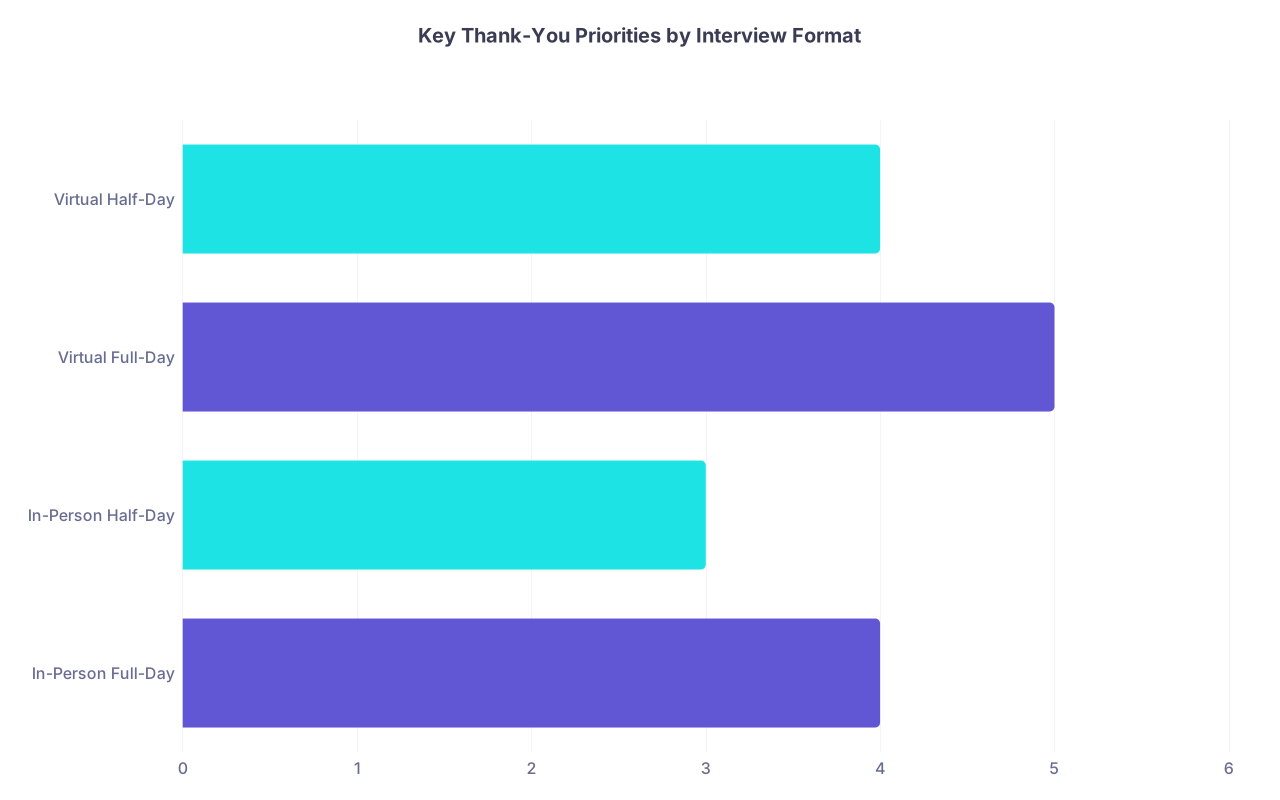
| Category | Value |
|---|---|
| In-Person Full-Day | 4 |
| In-Person Half-Day | 3 |
| Virtual Full-Day | 5 |
| Virtual Half-Day | 4 |
(Scale 1–5: how aggressively you must use email to differentiate yourself. Virtual full-day and half-day demand more precision.)
Full‑Day Virtual: Long Day, Shallow Imprint
You likely had:
- A full morning of presentations and interviews
- Breakout rooms with residents
- Maybe a virtual tour video
- Faculty cycling in and out of Zoom rooms
By 3 pm, everyone is tired. Faculty are jotting shorthand notes: “good fit,” “strong Step 2, interested in cards,” “FM interest, rural.”
Your follow-up must translate those shorthand notes into a narrative.
PD Email – Virtual, Full-Day
Here, pull heavily from structured sessions:
- Morning introductory talk
- Breakout resident discussion points
- Any Q&A about curriculum that you jumped into
- Specific slide or initiative that stuck with you
Example:
“Dr. Patel,
Thank you again for the comprehensive virtual interview day on Monday. Your overview of the program’s new X+Y schedule, especially the protected ambulatory weeks and embedded longitudinal clinic, matched exactly what I am seeking in family medicine training. I appreciated hearing how your residents use those weeks for procedures and community outreach, and the discussion with Dr. Johnson about the refugee clinic made it clear that residents are truly engaged with your patient population.
Speaking with the interns in the afternoon breakout room about their transition to residency, and how supported they felt on night shifts, reinforced my sense that this is a program where I could both work hard and feel well supported. I remain very interested in [Program] and can see myself thriving there.”
Virtual-specific cues: X+Y schedule, refugee clinic, breakout room with interns. All things that occurred on Zoom, but still concrete.
Faculty Emails – Virtual: Anchor to Content, Not Space
You cannot reference a hallway or workroom, but you can reference:
- A patient case they described
- A research project they mentioned
- A curricular component (clinic, elective, rotation) they lead
- Even a joke made during the session (“I was the applicant who…”)
Example:
“Thank you for our conversation during Monday’s virtual interview day about your work with the palliative care consult service and the communications workshop you lead for residents. Your description of guiding interns through their first serious illness conversations stayed with me, as this is an area I hope to grow in during residency.”
Very obviously not copy‑paste.
Half‑Day Virtual: Maximum Risk of Being Forgettable
This is the most dangerous format. Short, virtual, and often high volume.
Your defense: ruthless clarity and timing.
- Send thank‑you’s the same day if possible, or early next morning.
- One sentence in every email should be so specific it could not possibly have come from anyone else’s interview.
Good:
“I appreciated your advice about exploring combined EM/IM training paths and your suggestion to look into the XYZ fellowship for future critical care work.”
Better:
“I was the applicant who had worked as an EMT before medical school, and your comment that ‘our ED is messy in the best way’ actually made me more excited about training at a county hospital like yours.”
Do not be afraid to remind them who you were. You are not “the only applicant with an EMT background” they have ever met.
Resident vs Faculty vs Coordinator: Tone and Content Shifts
You do not write the same way to a PD, a PGY‑2 resident, and the program coordinator. If you do, you sound tone‑deaf.
Program Director vs Faculty
PD email is your broad “fit + vision” email. Faculty emails are “connection + content.”
PD:
- Emphasize program-wide features: curriculum, culture, patient population, case mix, support, outcomes.
- Show that you understand their stated priorities for graduates (academic vs community, primary care vs subspecialty, etc.).
- Do not explicitly mention rank order. “I remain very interested” is enough. Save explicit #1 language for a later, carefully chosen communication if appropriate.
Faculty:
- Emphasize shared clinical or academic interests.
- Do not oversell how much you will work with them if that is unlikely. Keep it plausible.
- One future-facing sentence is fine: “If I match at [Program], I would be excited to get involved in your ultrasound teaching sessions given my prior experience.”
Residents
Resident thank‑you notes should be lighter but still purposeful.
Focus on:
- Day-to-day realities they shared (call, night float, ICU culture, primary care clinic experience)
- How they made you feel about the program: welcomed, supported, challenged
- Matching their openness without being overly casual
Example:
“Thank you for taking the time to talk with us during the afternoon resident Q&A. Hearing how you felt comfortable calling your attendings overnight in your first month, and how the senior residents backed you up on busy cross-cover nights, made the program feel like a place where I would be supported while I gain confidence. Your description of the ‘debrief walks’ after tough cases was something I had not seen elsewhere and really appreciated.”
No emojis, no “lol,” no “you guys seem chill,” but also no rigid board-exam email cadence. Aim for professional but human.
Program Coordinator
You do not need an essay. But sending nothing is a mistake.
Two to four sentences:
- Thank them for logistical work and responsiveness.
- Acknowledge something that went smoothly (scheduling, tech, rotating rooms).
- Optional: note that you enjoyed meeting everyone and appreciated the structure of the day.
Example:
“Ms. Johnson,
Thank you for organizing yesterday’s interview day and for your help with scheduling. The transitions between the virtual interview rooms were seamless, and the detailed itinerary you sent in advance made the day much easier to navigate. It was a pleasure meeting everyone.”
They remember which applicants treat them like actual humans. Some coordinators sit in rank meetings. Many have the ear of the PD.
The Mechanics: Subject Lines, Length, and Common Mistakes
You can have excellent content and still get ignored if your email looks sloppy or spammy.
Subject Lines: Stop Being Cute
Subject line should be clean and searchable:
- “Thank you – [Your Name], [Specialty] Interview on [Date]”
- “Thank you for [Program] [Specialty] interview – [Your Name]”
Do not write: “Following up :)” or “Great to meet you!!!”
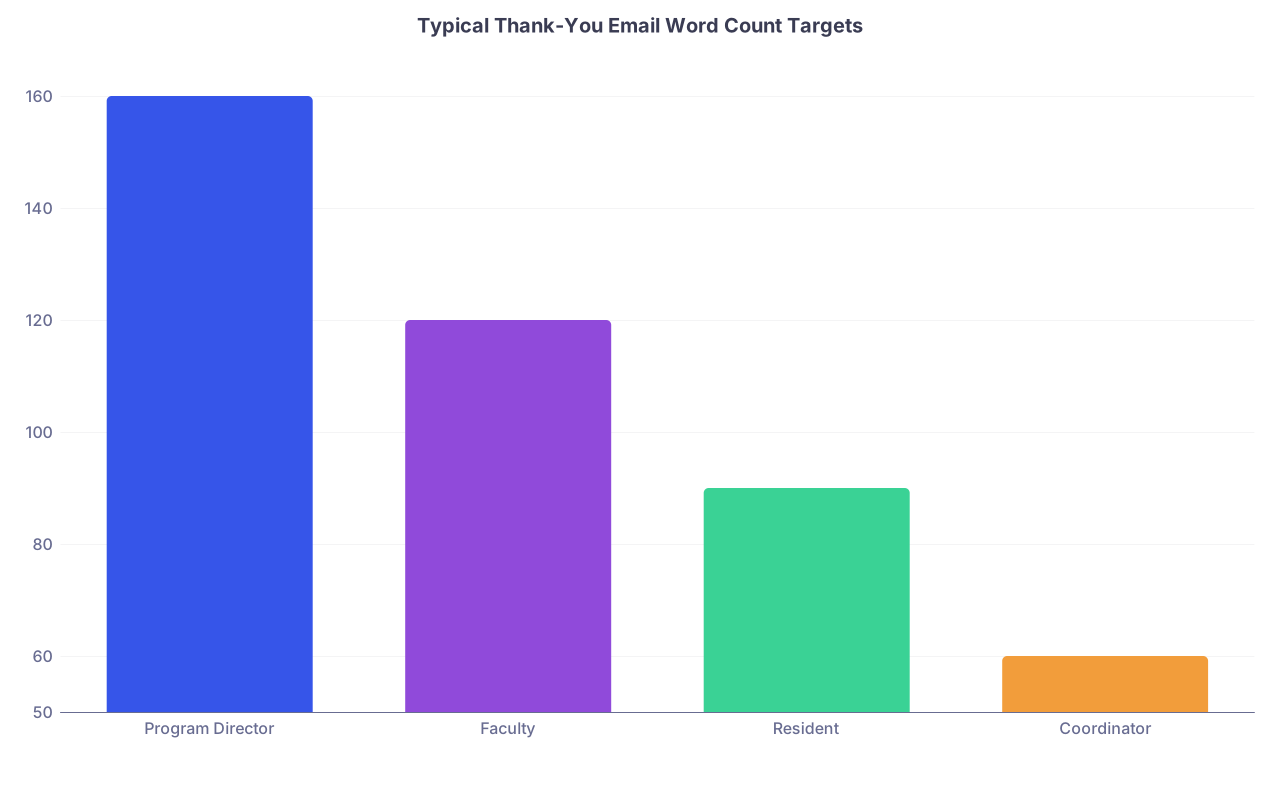
Length Discipline
Let me be blunt: if your email runs more than 200–250 words, almost no one is reading it closely. They skim.
Most faculty read these on their phone, between cases, or at 11 pm.
- PD: ~120–200 words
- Faculty: ~80–150 words
- Residents: ~60–120 words
- Coordinator: ~40–100 words
Reuse with Caution
You absolutely should have reusable scaffolds. You absolutely should not send identical emails.
The move:
- Keep a standard opening and closing sentence bank
- Customize the middle 2–3 sentences for each recipient
- Always include one hyper-specific reference to your interaction or the day
If you cannot come up with a specific detail, that tells you something: maybe you should not be emailing that person individually.
| Category | Value |
|---|---|
| Program Director | 160 |
| Faculty | 120 |
| Resident | 90 |
| Coordinator | 60 |
Strategy by Quadrant: Putting It All Together
Let us tie the four scenarios into concrete game plans.

| Step | Description |
|---|---|
| Step 1 | Interview Completed |
| Step 2 | In-Person |
| Step 3 | Virtual |
| Step 4 | Full-Day In-Person Plan |
| Step 5 | Half-Day In-Person Plan |
| Step 6 | Full-Day Virtual Plan |
| Step 7 | Half-Day Virtual Plan |
| Step 8 | Format? |
| Step 9 | Duration? |
| Step 10 | Duration? |
1. Full‑Day In‑Person: Deep but Manageable
Plan:
- Same day or next morning:
- PD email (program-wide fit, 5–7 sentences)
- 2–3 faculty emails (focused, 4–6 sentences)
- 1–2 resident emails (impactful conversations only)
- Coordinator email (brief thanks)
Anchor points:
- Morning report / noon conference
- Physical spaces (ICU, clinic, wards, call room)
- Live interactions: walking between sites, lunch table conversations
- Any procedure or patient you observed or discussed
2. Half‑Day In‑Person: Intense Precision
Plan:
- Within 24 hours:
- PD email (even if brief; they may not have formally interviewed you)
- Every faculty who interviewed you (probably 2–3)
- Coordinator email
- Maybe one resident if you had a standout chat
Anchor points:
- That cramped conference room where you did back-to-back interviews
- Micro-interactions: “quick tour of the ED,” “chat before we started,” etc.
- One concrete curricular or culture detail per email
3. Full‑Day Virtual: Broad but Thin
Plan:
- Within 24–36 hours:
- PD email (tie together several pieces of the virtual day)
- 2–4 faculty (prioritize research or career-aligned contacts)
- 1 resident (primary breakout group or 1:1)
- Coordinator email
Anchor points:
- Slides and initiatives: X+Y models, wellness resources, research tracks
- Zoom breakout room conversations, specific questions you asked or answered
- The “virtual tour” video content: ED volume, clinic setup, ancillary support
4. Half‑Day Virtual: Maximum Efficiency, High Specificity
Plan:
- Same day if possible:
- PD email
- Each of your 2–3 interviewers
- Coordinator email
- Skip broad resident-group thank‑yous unless you had a distinguishable resident host
Anchor points:
- Very specific questions from your interview: “You asked me about my sub‑I in the MICU,” “We spoke about your work on diabetes group visits.”
- Distinctives they highlighted quickly: “Our residents do their own procedures,” “We cover both hospital A and hospital B.”
What Not to Do: The Red Flag Behaviors
A quick, unapologetic list:
- Sending a single mass email to a group of faculty with everyone CC’d
- Addressing the PD as “Dear Program Director” because you did not bother to confirm their name
- Copy‑pasting identical text to 5 people in the same department who will inevitably compare notes
- Writing “I will be ranking your program highly” to 10 programs
- Asking logistical questions (like how to upload a document) inside a thank‑you to the PD instead of the coordinator
- Turning your thank‑you into a negotiation (“If I match, can I have the research track guaranteed?”)
- Sending multiple follow‑up emails “just to reiterate” your interest unless explicitly invited
This all reads as either careless or desperate. Neither helps you.
How This Fits Into the Bigger Match Strategy
Thank‑you notes are not magic. A beautifully crafted email will not save a disastrous interview. But a targeted, specific follow-up often nudges you from “generic good” to “memorable good,” and that matters when rank lists are granular.
The sequence looks like this:
- Do your homework before the interview.
- Take usable notes during and immediately after each encounter.
- Execute differentiated thank‑you emails based on half‑day vs full‑day and virtual vs in‑person realities.
- Later in the season, if a program genuinely rises to your top tier, you can consider one more intentional communication aligned with NRMP rules.
You have now moved beyond “polite applicant” to “applicant who understands this is a human process and writes like one.”
With your thank‑you tactics dialed in for every interview format, you are better positioned for the rank discussions you will never see. The next step is harder: deciding where you belong and crafting an honest, coherent rank list strategy. That, however, is a conversation for another day.