
Most residents waste their post‑interview thank‑you notes on vague flattery and generic “thank you for your time” nonsense. You can do better than that—even when you barely spoke to the person you are emailing.
Let me break this down specifically, because this is a very particular problem: you had a residency interview day, you had one or two real, substantive conversations…and then five or six other faculty whose “interaction” with you was a 3‑minute room rotation or a single question in a group session. Yet their names are on your contact sheet. Now what?
You are not wrong to feel stuck. Writing to an attending you barely interacted with is awkward. But it is fixable—if you stop trying to fake a deep connection and instead write like a competent future colleague who paid attention.
1. When You Should (and Should Not) Email People You Barely Spoke With
Most applicants over-send. They fire off thank‑yous to every PGY‑1, PGY‑2, PD, APD, and random research faculty they saw on Zoom. That is noise, not strategy.
Here is the honest hierarchy of who matters for follow‑up after a residency interview:
| Priority Tier | Who It Includes |
|---|---|
| Tier 1 | Program Director, APDs |
| Tier 2 | Your interviewers (faculty) |
| Tier 3 | Chief residents, key residents |
| Tier 4 | Other faculty from the day |
| Tier 5 | Casual resident contacts |
You are asking about Tier 4: “other faculty from the day” where the interaction was minimal.
My rule:
- Always email: PD, APDs, anyone who formally interviewed you one‑on‑one or in a small group.
- Strongly consider: Chief residents who clearly have influence, faculty who ran a session where you actually interacted (you asked/answered questions).
- Optional: Faculty whose only interaction was you sitting in the back of their didactic, a 1‑minute introduction in a group, or a wave in the hallway.
But “optional” does not mean useless. Well‑done short emails to faculty you barely met can still:
- Put your name in front of another voter in the rank meeting.
- Show professionalism and attention to detail.
- Reinforce your interest in a niche area (e.g., global health, quality improvement) that particular faculty is known for.
The mistake is pretending you had deep interaction when you did not. That is how emails get ignored or rolled eyes at.
2. Core Principles When You Barely Interacted
Before we get into templates, you need the underlying rules. There are four of them, and if you follow these you will stop sounding like a desperate MS4 copying Reddit drafts.
2.1 Anchor to something real, even if it is small
You must reference at least one specific thing tied to that person. But “you are the clerkship director” is not specific. That is just reading their title.
Better:
“I appreciated your comments about building a culture where interns feel comfortable escalating concerns during your discussion of the night float system.”
That tells the faculty you (a) were there, (b) were listening, and (c) actually cared about the substance.
If your contact with them was ultra‑minimal (they did a 10‑minute PowerPoint, you did not ask a question, they did not say your name), you can still pull a concrete detail:
- A phrase they used (“strong generalist training”, “autonomy with backup”, “no malignant hierarchy”).
- A specific component of the program they presented (X clinic model, Y conference, Z research track).
- A project they mentioned (quality metrics, social EM initiative, simulation curriculum).
2.2 Keep the length proportionate to the interaction
If you barely spoke, you do not get to send a 400‑word essay. It feels fake and try‑hard.
Rough guide:
- Deep 1:1 interview → 200–300 words is reasonable.
- Brief but real small‑group interaction → 125–200 words.
- Very minimal contact (what you are asking about) → 75–150 words.
Short, specific, and professional beats long and vague every single time.
2.3 Do not invent a connection that did not exist
Some applicants panic and start manufacturing a relationship:
- “Speaking with you confirmed my desire to pursue nephrology…” when you did not speak at all.
- “Our conversation about your research inspired me…” when you never talked research.
Faculty remember who they interviewed. They know who asked questions. They know who was in their breakout room. Exaggerating the interaction makes you look dishonest or oblivious.
If you only heard them speak in a group, say exactly that.
“I appreciated your comments during the resident panel…” is honest and professional.
2.4 Make it about fit and value, not flattery
If your email reads like:
- “You are clearly an amazing educator…”
- “Your prestigious work in the field is inspiring…”
you sound like a generic compliment bot.
Shift the focus from “you are great” to “this aspect of the program you described matters to me for reason X, and I can see myself contributing Y.”
That is where faculty start taking you seriously as a future colleague instead of another applicant fishing for a higher ranking.
3. What You Can Safely Reference When You Barely Spoke
You probably have more usable material than you think. Here is where to mine it.
3.1 The schedule and your own notes
After every interview day, I tell students to jot three quick things:
- People: names + roles + 1–2 keywords (e.g., “Dr. Singh – simulation, patient safety”).
- Themes: 2–3 repeated program ideas (autonomy, underserved care, research opportunities).
- Moments: small but specific details (resident joked about night float food; PD emphasized wellness half‑day, etc.).
If you did that, you now have hooks for follow‑up emails. If you did not, you are not doomed. You still have:
- The interview day schedule PDF.
- The program website.
- The brief intros faculty gave during the day.
You use those to reconstruct at least one genuine hook per person.
3.2 Three main “anchors” you can use
Let me categorize what you can reference, from strongest to weakest:
Direct interaction (even brief)
- You asked them a question in a large group.
- They answered one of your questions in the chat on Zoom.
- They responded to your comment during a discussion.
Content they presented
- Their slide deck about curriculum.
- Their explanation of night float, ED shifts, research tracks.
- Their comments on resident culture, feedback, evaluation.
Known role or project
- Program leadership (APD, site director, rotation director).
- A specific initiative they run (clinic, track, research group).
- A paper or topic you encountered while scoping the program (do not overdo this one).
If you have at least one of these for the person, you can write a credible email in under 150 words.
4. Email Structures That Actually Work (With Concrete Examples)
Now let us get brutally practical. You want ready‑to‑use patterns.
4.1 The “I heard you in a group session” email
Scenario: You did not speak directly to this faculty, but you watched them present the ICU rotation and discuss autonomy.
Goal: Show that you were paying attention and tie that detail to your own training goals.
Structure:
- Brief thanks for their role on the day.
- One specific reference to what they said.
- One line relating that to your own values/experience.
- Polite expression of interest in the program.
Example:
Subject: Thank you – [Program Name] Interview Day
Dear Dr. Patel,
Thank you for taking the time to speak with us during the ICU curriculum overview on interview day. I especially appreciated your description of how residents are given early autonomy in presenting plans, with attendings focusing feedback on clinical reasoning rather than just the final decision.
During my sub‑internships, the rotations I learned the most from had a similar approach, and I am looking for a program where that kind of structured independence is part of the culture. Your comments reinforced my sense that [Program Name] would be an excellent environment for my training.
Thank you again for your time and for sharing your perspective on the program.
Best regards,
[Your Name]
Notice what this does not do. It does not pretend “our conversation,” because there was none. It references one concrete teaching point and directly connects it to your training priorities.
4.2 The “micro‑interaction during interviews” email
Scenario: You had a 5‑minute segment with this attending in a rotating faculty room. They asked one question about your interests; you did not get to talk much.
Goal: Acknowledge the brief interaction and extend it slightly in writing.
Structure:
- Thank them for the brief conversation.
- Name the specific topic or question they raised.
- Add 1–2 sentences expanding on that topic from your side.
- Link to your interest in the program.
Example:
Subject: Thank you for our conversation
Dear Dr. Nguyen,
Thank you for speaking with me during the rotating breakout sessions on interview day. I appreciated your question about how I see myself balancing inpatient and outpatient work long‑term. Although we only had a few minutes to talk, I have given that a lot of thought, and I am drawn to programs like [Program Name] that provide strong generalist training with opportunities to maintain continuity in clinic.
Hearing how your own career evolved from broad training into a focused practice in [subspecialty] was particularly helpful as I think about my next steps. My visit to [Program Name] left me with a strong sense that it would be an excellent fit for my goals.
Thank you again for your time.
Sincerely,
[Your Name]
Here you are not inflating the interaction. You are using that one question as a hook to say something meaningful about how you think.
4.3 The “I only know your role, not your face” email
Sometimes the contact list includes people you never saw or do not remember at all. If you truly have zero recollection and nothing they did on the day is identifiable, you can still send a short, honest note, but do not pretend you remember specifics.
This is the weakest category and frankly optional. If you do it, keep it very short.
Structure:
- Acknowledge their role in the program, not the day.
- Tie their role to one specific aspect of the program that appeals to you.
- Express appreciation + interest.
Example:
Subject: Appreciation following interview day
Dear Dr. Lewis,
I recently interviewed with [Program Name] and wanted to thank you for your role in shaping the residency as [Associate Program Director / Clinic Director]. One of the aspects that stood out to me during the visit was the emphasis on resident development in ambulatory medicine, particularly the longitudinal clinic experience.
I am very interested in training in a program that prioritizes both strong inpatient skills and continuity of care, and my experience on interview day suggested that [Program Name] aligns well with those goals.
Thank you again for all you do for the residency.
Best regards,
[Your Name]
Is this going to rocket you to the top of the rank list? No. But it is clean, honest, and professional, and it will not hurt you.
5. Timing, Subject Lines, and Other Logistics People Get Wrong
You are not just judged on what you write. You are judged on when and how.
5.1 When to send these emails
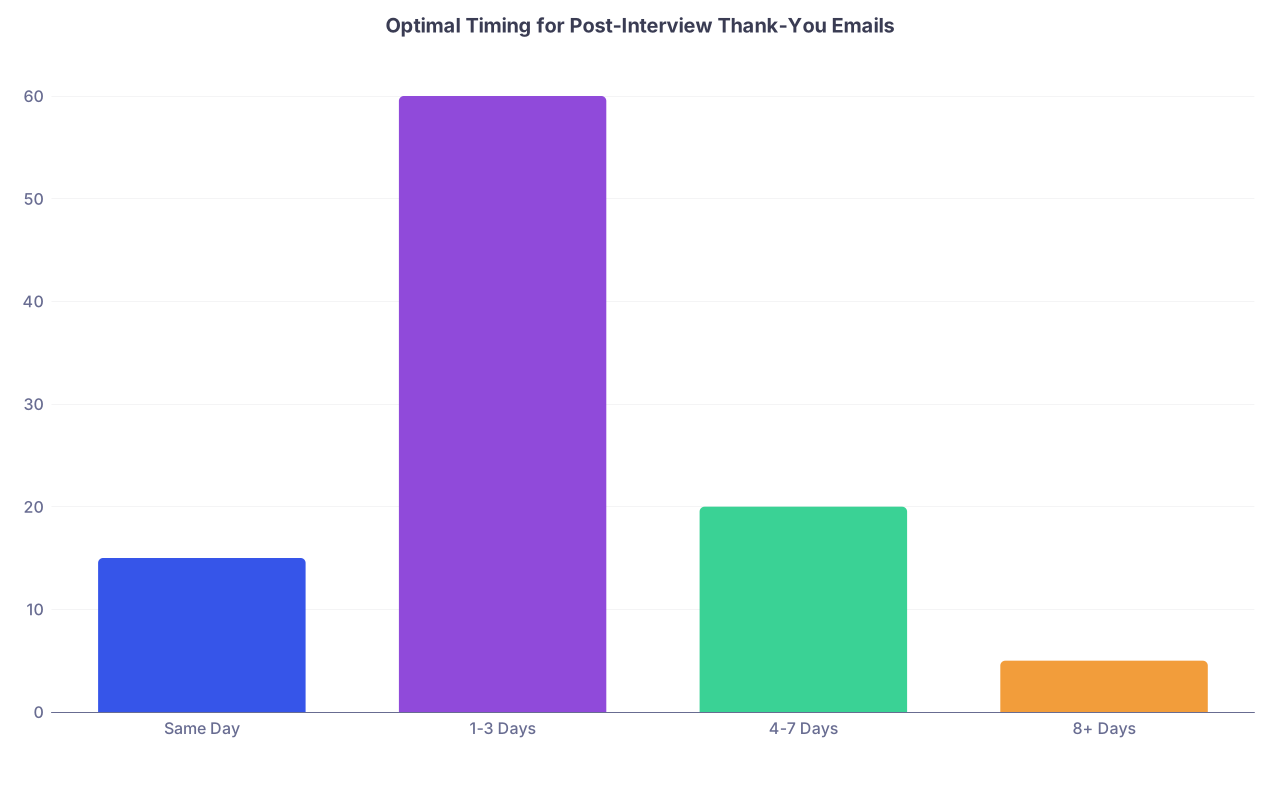
The window is tighter than most people think.
| Category | Value |
|---|---|
| Same Day | 15 |
| 1-3 Days | 60 |
| 4-7 Days | 20 |
| 8+ Days | 5 |
Ideal: 24–72 hours after the interview day.
Acceptable: Within 1 week.
Late but still okay: Up to 2 weeks, if life happened.
Past 2 weeks, you only email if:
- You have a genuine update (new publication, AOA, significant news).
- You are sending a later “this is my top choice” communication to the PD, not routine thank‑yous.
For the “barely spoke” faculty, aim for the 1–3 day window. They still remember the day; they may remember your face; they definitely remember what they presented.
5.2 Subject lines that do not look spammy
Keep subject lines boring but clear. You are not writing clickbait; you are writing to physicians who triage 200+ emails a day.
Good options:
- “Thank you – [Program Name] Interview Day”
- “Thank you for speaking with us on interview day”
- “Appreciation for [Program Name] interview day”
- “Thank you for our conversation on [Date]”
Avoid:
- “Following up after our inspiring conversation!!!”
- “Very interested in [Program Name] residency” (looks like a quasi‑LOI; save that weight for PD emails).
- Anything that looks like a newsletter subject line.
5.3 How many emails per program before you become “that applicant”
You are not running a drip marketing campaign. You are a candidate.
Reasonable volume:
- PD: thank‑you + possibly one later email if they are truly your #1 choice.
- Each APD / interviewer: one thank‑you.
- Other faculty you barely spoke with: at most one each, and only if you can write something genuine.
- Residents: maybe one follow‑up to the main resident contact if you had a substantial conversation or Q&A.
If you are sending more than 5–7 total emails to a single program (including all faculty, PD, residents) you are probably overshooting.
6. How Programs Actually Use These Emails (And What That Means For You)
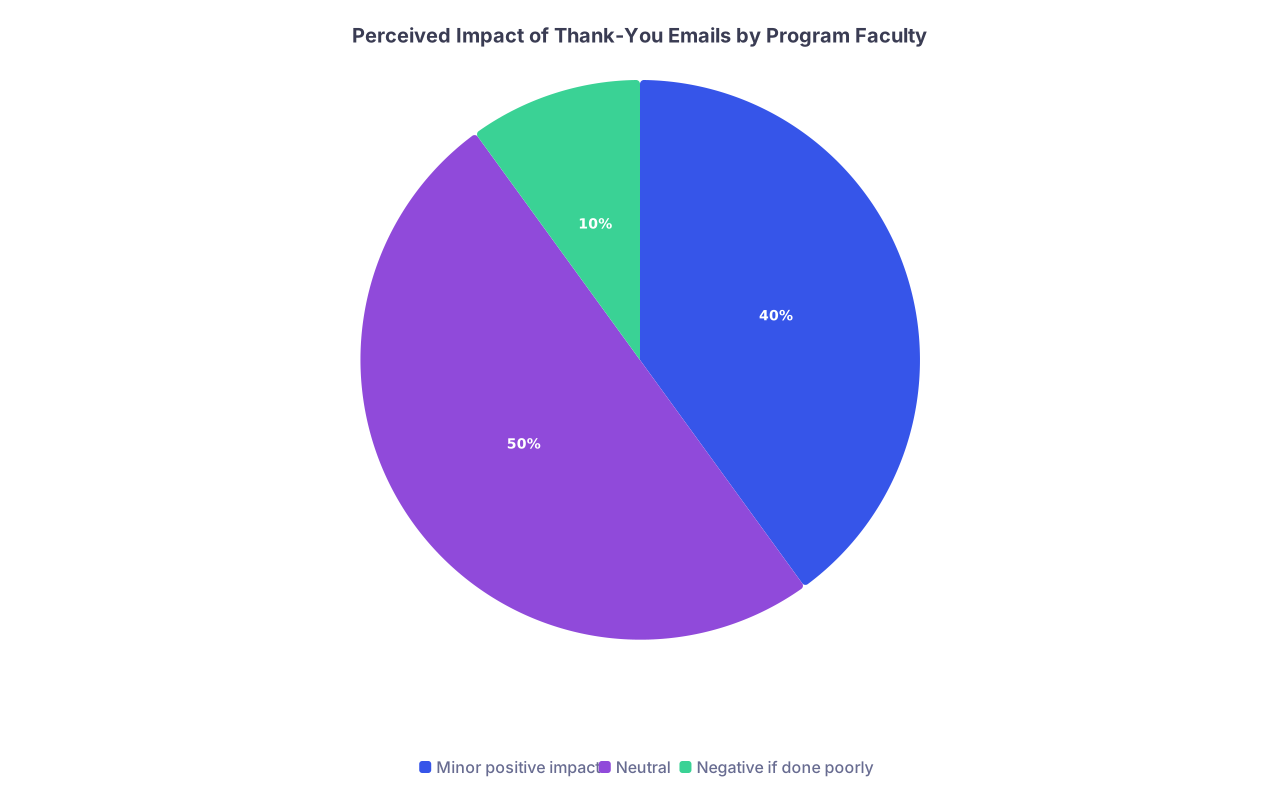
Let me be blunt. At many programs, thank‑you emails:
- Are skimmed quickly (if at all).
- Rarely move a candidate from the middle of the rank list to the top.
- Are more likely to hurt you if they are weird, excessively flattering, or dishonest.
So why bother, especially to faculty you barely met?
Because:
- Some programs still old‑school print or compile them before rank meetings.
- A strong, specific email can reinforce “this applicant pays attention and fits our culture.”
- A bad email can absolutely stick in someone’s mind—in the wrong way.
You are playing for small but real marginal gains. For this tier of faculty, the bar is mainly “do no harm” and “look like a thoughtful adult.”
| Category | Value |
|---|---|
| Minor positive impact | 40 |
| Neutral | 50 |
| Negative if done poorly | 10 |
7. Calibrating Tone: Respectful, Not Obsequious
There is a specific tone that reads well to academic physicians:
- Polite but not deferential to the point of worship.
- Confident but not entitled.
- Sincere but not gushing.
Here is a bad line I have seen more than once:
“It would be the greatest honor of my life to train under your esteemed guidance.”
No. That reads like a scholarship essay from 1997.
Better:
“I would be excited to train in an environment shaped by your approach to [X].”
Or even simpler:
“My interview day reinforced my sense that [Program Name] would be an excellent fit for my goals.”
If you would not say it out loud without cringing, do not put it in an email.
8. Handling Common Awkward Scenarios
You will run into some very specific edge cases. Let me walk through a few and show you exactly how to handle them.
8.1 You truly do not remember this faculty at all
You have their name. You have no memory.
Step 1: Check the schedule and website.
Step 2: See if they had an identifiable session or role.
Step 3: If yes, use the “I know your role” template from earlier.
Step 4: If you cannot link them to anything except a vague “core faculty,” you have two options:
- Do not email them.
- Or send a very short, honest note focused on your appreciation for the day as a whole.
Example of the second:
Dear Dr. Roberts,
I recently had the opportunity to interview with the [Program Name] Internal Medicine Residency and wanted to extend my thanks to you and the faculty for hosting us. Throughout the day, I was consistently impressed by the collegial atmosphere and the way residents spoke about being supported in their development.
My visit left me with a very positive impression of the training environment at [Program Name]. Thank you again for all that you do for the residency.
Best regards,
[Your Name]
Is it generic? Yes. But it is honest about its generality. That is fine.
8.2 You misheard their research/role during the day
Do not guess. If you are not sure they run the QI track, do not say they run the QI track.
Safer phrasing:
- “your work in quality improvement” instead of “as director of the QI track”.
- “your involvement with” instead of “your leadership of”.
You can still be specific without being wrong. For example:
“Your comments about integrating quality improvement projects into the ward rotations…”
You know they said that, even if you are not entirely sure of their exact title.
8.3 Zoom interview, large group, your camera was off half the time
You are worried they have no idea who you are. That is probably true. It does not matter much.
Email anyway if:
- You resonated with something they said.
- You want to mention an overlap in interests that is genuinely real.
But be honest about the interaction being one‑sided:
“Although we did not get to speak one‑on‑one, I appreciated your comments about…”
You are not the only applicant in this category. Faculty understand.
9. A Simple Workflow To Make This Efficient Instead of Miserable
If you interview at 15–20 programs, you cannot spend 2 hours per program on thank‑you notes. You will burn out or start copying nonsense from old drafts.
Here is a simple, realistic process.

| Step | Description |
|---|---|
| Step 1 | Finish Interview Day |
| Step 2 | 10-Min Debrief Notes |
| Step 3 | Identify Tier 1-3 Contacts |
| Step 4 | Draft PD & Interviewer Emails |
| Step 5 | Identify Tier 4 Faculty Hooks |
| Step 6 | Write 2-4 Short Notes |
| Step 7 | Send Within 1-3 Days |
Broken down:
Right after the interview (same day if possible), spend 10 minutes:
- Write names + 1–2 words about what each person did/said.
- Jot 2–3 things you liked about the program.
That evening or next morning:
- Draft PD email first (most important, most thought).
- Draft emails to your main interviewers.
Then look at the “barely spoke” faculty list:
- For each name, see if you have at least one concrete hook.
- If yes, draft a 75–150 word email as shown above.
- If no, decide whether to send a very generic short note or skip.
Send all within 72 hours.

You are done. No overthinking. No 2 AM editing loops.
10. Quick Examples By Specialty (Because Culture Varies)
One subtle point: tone shifts a bit by specialty. Let me show you.
10.1 Internal Medicine – slightly more academic, reflective
Dear Dr. Shah,
Thank you for your discussion of the [Program Name] inpatient rotations during interview day. Your description of how senior residents are expected to teach and coach interns, with structured feedback from attendings, resonated with my own experience as a sub‑intern and with my interest in medical education.
I am very interested in training in a program where that kind of layered, team‑based learning is the norm, and my visit reinforced my sense that [Program Name] aligns with those goals.
Best regards,
[Your Name]
10.2 Emergency Medicine – more direct, practical
Dear Dr. Alvarez,
Thank you for speaking with us about the ED schedule and trauma exposure at [Program Name]. I appreciated your straightforward description of how junior residents are given early responsibility in managing critical patients with close attending backup.
I am looking for a program where I can build confidence quickly in high‑acuity care while still having strong support, and your comments suggested that [Program Name] offers that balance.
Thank you again for your time.
Sincerely,
[Your Name]
10.3 Surgery – respectful, concise, no fluff
Dear Dr. Kim,
Thank you for your overview of the operative experience at [Program Name] during interview day. Your emphasis on residents gaining progressive autonomy in the OR, especially by the senior years, was encouraging to hear.
I am committed to training in a program that will challenge me clinically while preparing me to be an independent surgeon, and my visit reinforced that [Program Name] provides that environment.
Thank you again for your time.
Respectfully,
[Your Name]
You will notice the skeleton is the same. The language tilts slightly to match the culture.
11. What Actually Makes These High-Yield
Let me name the high-yield features explicitly, because that is what you care about.
High‑yield thank‑you emails to faculty you barely spoke with:
- Are proportionate: short notes for short interactions.
- Are specific: reference one real detail from the day or their role.
- Are honest: no invented “conversations,” no fake familiarity.
- Are aligned: connect that detail to your training goals or values.
- Are clean: no typos, no weird formatting, professional signature.
Low‑yield (or negative‑yield) emails:
- Are long generic essays that could be sent to any program.
- Flatter the person in overblown language.
- Get titles/roles wrong.
- Beg for ranking or make veiled promises (“I will rank you highly if…”).
- Reuse identical paragraphs across multiple faculty at the same program with only the name swapped. Yes, they sometimes compare.

The Bottom Line
Three points to keep in your head as you write:
- You do not need a deep conversation to write a credible, high‑yield thank‑you. You need one specific detail and an honest, concise email.
- Proportion and honesty matter more than volume. Short, tailored notes to a few faculty beat mass‑produced essays to everyone.
- These emails rarely rescue a weak interview, but a sloppy or insincere one can hurt you. Aim for “competent future colleague,” not “over‑eager applicant.”
Follow that, and even the awkward “we barely spoke” emails will work for you rather than against you.