
The fastest way to sabotage a strong residency interview is with a sloppy, tone-deaf subject line on your thank-you email.
Not the email body. The subject line.
I have watched excellent applicants get remembered for the wrong reason because the subject line they dashed off at midnight looked careless, entitled, or just bizarre. Programs may never say this out loud, but I have seen coordinators roll their eyes and faculty mutter, “Yikes,” while triaging email. You do not want to be in that pile.
Let me walk you through the subject line mistakes that quietly hurt you—and exactly how to avoid them.
Mistake #1: Treating the Subject Line Like a Text Message
If your subject line reads like something you would send your friend, you are already in trouble.
Subject lines I have actually seen or heard complained about:
- “Hey! Great talking to you”
- “Thanks!!”
- “Following up :)”
- “Yo thanks for the interview”
- “Today was awesome!!”
Residency programs are professional environments. Your email subject line is part of your professional signature. A casual, chatty, or juvenile subject line is a red flag for judgment and maturity.
Here is what goes wrong with “text message” subject lines:
- They tell the reader you do not understand hierarchy or professional norms.
- They make it harder to search and file your email later.
- They blend into the noise—coordinators see dozens of “Thank you!” emails a day.
You are not writing to a friend. You are writing to a future boss.
Avoid this trap by sticking to clear, formal, boring-on-purpose subject lines. Boring wins here.
Strong examples:
- “Thank you – Residency Interview, Internal Medicine, [Your Name]”
- “Appreciation for Interview – [Program Name], [Your Name]”
- “Thank you for the interview – [Your Name], [Specialty] Applicant”
If your instinct is to shorten it to “Thanks!”—fight that instinct. That is how people get mentally sorted into the “not ready” category.
Mistake #2: Making It All About You (and Not Searchable)
Program directors and coordinators live in their inboxes during interview season. They search. They filter. They forward.
If your subject line is just your name or something vague, you are creating work for them.
Bad examples:
- “From John Doe”
- “John Doe – PGY1”
- “Interview”
- “Question”
- “Thank you note”
These fail for two reasons:
- No context: They do not say what the email is about.
- No program or specialty identifier: They are almost impossible to quickly sort or find later.
This becomes a serious problem when faculty want to pull up your email weeks later while making rank lists and type “Thank you [Program Name]” or “Applicant thank you Internal Medicine” to find you. If your subject line is “From John Doe,” you vanish.
You want your subject line to contain three elements:
- The purpose (Thank you / Appreciation)
- The event (Residency interview / Interview date optional)
- Your name and specialty or program
For example:
“Thank you – Family Medicine Interview, [Your Name]”
or
“Appreciation for Interview – [Program Name], [Your Name], Pediatrics Applicant”
You are not just being polite. You are making sure they can find you when it matters.
Mistake #3: Using Desperate or Cringeworthy Subject Lines
If your subject line sounds like emotional begging, you are hurting yourself.
I have seen subject lines like:
- “My top choice program – thank you!!!”
- “I would love to match with you”
- “I will rank you #1”
- “This program is my dream!!!”
- “Please consider me strongly”
This looks needy, unsophisticated, and in some cases, ethically questionable. Many programs have explicit or implicit rules about “love letters” and post-interview communications. Throwing rank talk into a subject line is one of the worst ways to communicate that you do not understand boundaries.
Three specific problems here:
- Rank talk can put faculty in uncomfortable positions.
- Over-the-top emotion reads as immature and sometimes manipulative.
- It makes your entire message about your feelings, not your professionalism.
Use your thank-you email to express gratitude and highlight fit—not to declare undying loyalty or make promises about your rank list.
If you absolutely must communicate strong interest later in the season, that belongs in a separate, carefully worded email—not blasted in a subject line two hours after the interview.
Stick with neutral, professional subject lines. Let your content carry the nuance.
Mistake #4: Copy-Pasting the Same Subject Line to Everyone (and Messing It Up)
Program coordinators often see full email threads, especially when faculty forward messages. When every thank-you email across 10 programs has the identical, generic subject line, it screams “mass-produced.”
Worse, I have seen this exact scenario:
- Applicant interviews at University A.
- Writes thank-you subject line: “Thank you – Interview at University B, [Your Name]”
- Forgets to change “B” to “A” from the last email.
- Coordinator notices. Shows PD. Applicant is done.
That is not a small error. That is a “we can’t trust their attention to detail” error.
To avoid this, do two things:
Customize each subject line with the correct program name or at least specialty.
Not: “Thank you – Interview”
Instead: “Thank you – Interview at [Program Name], [Your Name]”Pause and double-check the program name before sending.
Especially dangerous: sending multiple thank-you emails at once late at night.
A simple tactic: write the thank-you bodies ahead in a draft, then, right before sending, manually type the subject from scratch for each email. Do not rely on “replace all” or auto-fill. That is how mix-ups happen.
Mistake #5: Being Vague, Cute, or Mysterious
This is not a marketing email. You do not need to “hook” them with a clever subject line. You need to respect their time.
Subject lines that try to be clever:
- “A quick note from today”
- “Following up on our conversation”
- “Something I forgot to mention”
- “A small favor”
- “From your interview today”
These annoy busy physicians. They look like clickbait. The coordinator opening 200+ emails a day has no patience for guessing what yours is about.
Your goal is zero ambiguity. When they see your subject, they should instantly know:
- This is a thank-you email.
- From an applicant.
- To this specific program.
If your subject line could just as easily be a complaint, a question, or spam, you wrote it wrong.
Clarity beats cleverness. Every time.
Mistake #6: Forgetting That Different Recipients See Different Contexts
One of the more subtle problems: people send the exact same subject line to the program coordinator, PD, and each interviewer.
That is not always wrong. But it can backfire.
Scenario I have seen:
- Subject: “Thank you – Interview Day at [Program Name], [Your Name]”
- Same subject and nearly identical body sent to:
- Program coordinator
- PD
- APD
- Three faculty interviewers
A coordinator then forwards one of them to multiple people with “FYI.” Everyone can see you basically cloned the same message 6 times, including the subject.
This is not fatal, but it makes you look lazy.
A better approach:
- Use a consistent structure but slightly tailored subject lines for different roles.
For example:
To coordinator:
“Thank you – [Program Name] Interview Day Coordination, [Your Name]”
To PD/APD:
“Thank you – Interview at [Program Name], [Your Name], [Specialty] Applicant”
To individual faculty:
“Thank you – Interview Conversation on [Date], [Your Name]”
Same core idea. Slightly different emphasis. It shows you recognized their specific role, not just spammed the same line six times.
Mistake #7: Technical Sloppiness That Makes You Look Disorganized
You would be shocked how often simple technical errors send the wrong message.
Things that make programs cringe:
- ALL CAPS SUBJECTS: “THANK YOU FOR THE INTERVIEW”
- no capitalization at all: “thank you for the interview – john smith”
- Emojis: “Thank you! 😊”
- Excess punctuation: “Thank you for the interview!!!!”
- Weird abbreviations: “Tx 4 the IV!” or “Thx for IM IV”
- Typos: “Thank you for the intervwe,” or “Thank you for the interveiw”
These errors signal one thing: poor attention to detail.
Residency programs do not want residents who will typo medication doses or misread lab results. An email is obviously not the same as an order entry, but humans generalize. They will connect your sloppy subject line to their mental model of how careful you are.
Give your subject line one last proofreading pass:
- Correct spelling
- Normal capitalization
- No slang, no emojis, no abbreviations
You get one chance to not look careless. Take it.
Mistake #8: Overloading the Subject Line With Your Entire Message
Some applicants cram half the email into the subject line, thinking more is better:
- “Thank you for taking the time to speak with me today about your Internal Medicine residency program and all the research opportunities”
- “I really enjoyed meeting with you today and learning about the amazing resident culture and ICU exposure at [Program Name]”
That is exhausting to read in an inbox preview. On a phone, it cuts off halfway anyway.
Your subject line is a label, not a paragraph.
A simple rule: if your subject line is more than about 8–10 words, you are probably overdoing it.
Let the body do the narrative work. The subject just needs to identify the email.
Mistake #9: Bad Timing + Bad Subject Line = Double Damage
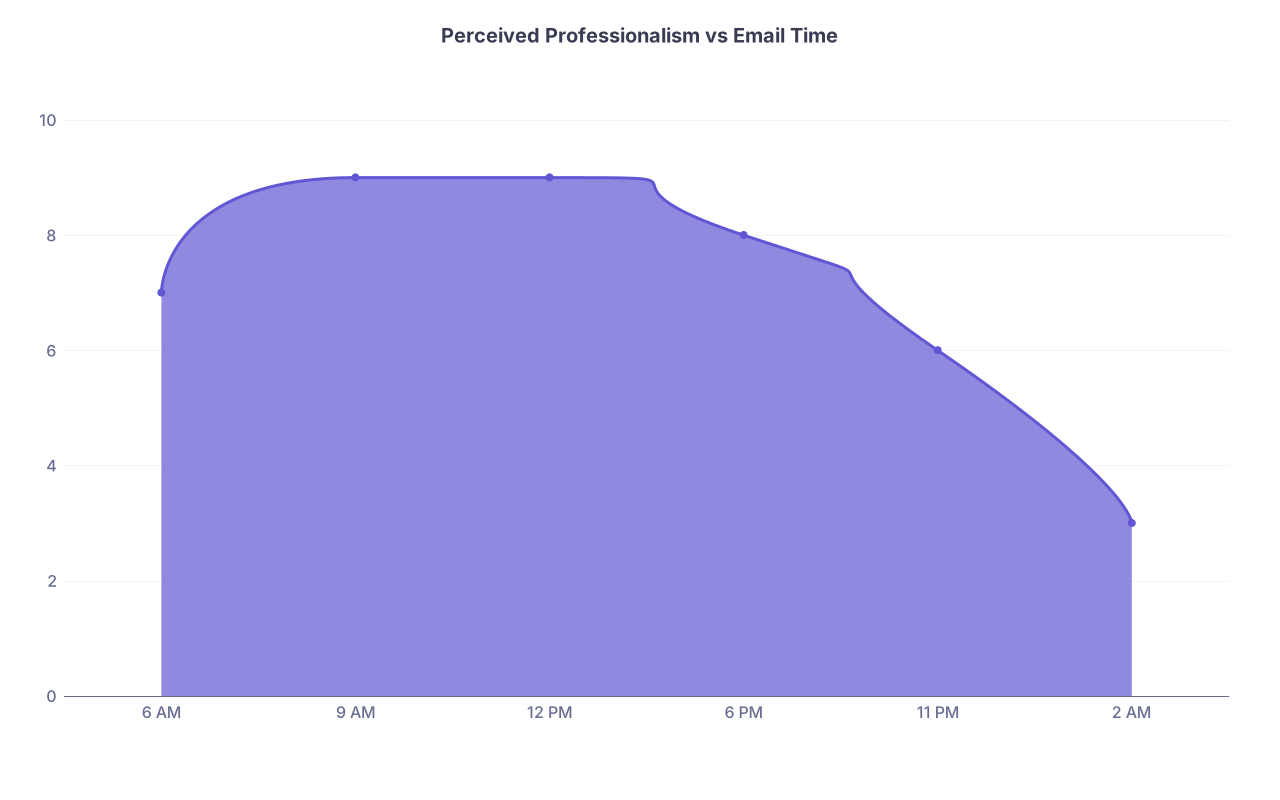
Sending thank-you emails at 2:37 a.m. and having a messy subject line is a bad combo. It tells programs you have poor boundaries, poor time management, or both.
Late-night times alone are not always disqualifying—some residents notice and forget. But pair that with a subject like “Just wanted to say THANK YOU SO MUCH!!!!!” and you look chaotic.
Reasonable plan:
- Draft your emails the same day, while details are fresh.
- Actually send them during daytime or early evening hours (roughly 7 a.m.–10 p.m. local program time).
- Use a clean, professional subject and do not over-explain why you are writing.
If your schedule forces late-night work, use delayed send. Most email clients have it. There is no bonus for being timestamped at 3:14 a.m.
To show you how timing interacts with subject quality:
| Category | Value |
|---|---|
| 6 AM | 7 |
| 9 AM | 9 |
| 12 PM | 9 |
| 6 PM | 8 |
| 11 PM | 6 |
| 2 AM | 3 |
The exact numbers are illustrative, but the general perception trend is real. Do not combine odd send times with sloppy, informal subjects.
Mistake #10: Using Misleading or Inaccurate Subject Lines
Some applicants try to game attention by writing subject lines that suggest urgency or administrative issues when it is just a thank-you.
For example:
- “Clarification about my application” (but inside is just a thank-you)
- “Follow-up regarding interview scheduling” (but it is just gratitude)
- “Question about ranking” (and then… no question, just thanks)
This is manipulative. Busy coordinators may open yours first, then feel mildly irritated that you hijacked their attention for something non-urgent. That feeling will stick to your name.
If your email is a thank-you, say it. Do not fake urgency.
You also must keep the program name, specialty, and date accurate. Do not send “Thank you – Surgery Interview, [Your Name]” to an Internal Medicine program because you copied the wrong template. That looks lazy at best, disorganized at worst.
Here is a simple comparison:
| Situation | Bad Subject Line | Better Subject Line |
|---|---|---|
| Generic thank-you | Thanks!! | Thank you – Residency Interview, [Your Name] |
| Specific program | Great talking today | Thank you – Interview at [Program Name], [Your Name] |
| Multiple same-day interviews | My interview today | Thank you – [Date] Interview, [Your Name], [Specialty] Applicant |
| Message to coordinator | Question about interview | Thank you – [Program Name] Interview Day Coordination, [Your Name] |
| Post-interview strong interest | I will rank you #1 | Appreciation for Interview – [Program Name], [Your Name] |
You do not need creativity. You need accuracy and honesty.
Mistake #11: Ignoring How Your Subject Line Fits the Whole Process
Your subject lines are not isolated events. They are part of a pattern programs see across your entire application:
- ERAS application name and email
- Initial contact emails
- Interview scheduling exchanges
- Thank-you notes
- Any later communications
If each of those has a slightly different version of your name, formatting, or tone, you look scattered.
Example of a messy pattern I have seen:
- ERAS name: “Alex J. Thompson”
- Email address: “ajthompson98@…”
- Scheduling email subject: “interview – Alex”
- Thank-you subject: “Thank you – A. Thompson”
- Another follow-up: “From Alex James”
When faculty search their inbox, they are not sure if those are the same person. That is a problem.
Aim for consistency:
- Use the same name format in your subject lines that appears in ERAS.
- Keep your specialty or “Residency Applicant” phrasing consistent.
- Use very similar structure across programs, with only the program name changed.
Something like:
“Thank you – [Program Name] Interview, [First Last], [Specialty] Applicant”
over and over. Clean, predictable, recognizably you.
To visualize how many small email details programs juggle:

| Step | Description |
|---|---|
| Step 1 | ERAS Application Submitted |
| Step 2 | Interview Invite Email |
| Step 3 | Applicant Reply - Scheduling |
| Step 4 | Interview Day Logistics Emails |
| Step 5 | Thank-You Emails |
| Step 6 | Rank List Discussion |
Your thank-you subject line sits right before rank discussions. Do not treat it like an afterthought.
Mistake #12: Not Matching the Program’s Formality Level (But Overcorrecting)
Some applicants see one slightly friendly email from a resident or coordinator and overcorrect into excessive informality:
Coordinator’s email subject: “Your interview day at [Program Name]”
Applicant reply: “Re: Your interview day at [Program Name] – Sounds awesome!!”
No. You match the professional baseline, not the most casual person you encounter.
At the same time, swinging in the opposite direction into stiff, archaic language makes you sound artificial:
- “Esteemed Program Director, my deepest gratitude”
- “Humbly thanking you for the honor of an interview”
Programs are not running a Victorian etiquette exam.
Target: neutral, modern, professional.
Subject lines that hit the right tone:
- “Thank you – Interview at [Program Name], [Your Name]”
- “Appreciation for Interview – [Specialty] Residency, [Your Name]”
If you are unsure, imagine the email printed and placed in your employee file. If the subject line would embarrass you in five years, change it.
Putting It All Together: A Simple Subject Line Template System
If you want to avoid 95% of mistakes, build a simple, consistent structure and stick to it.
One straightforward template:
“Thank you – [Program Name] [Specialty] Interview, [First Last]”
Examples:
- “Thank you – University of Chicago IM Interview, Priya Patel”
- “Thank you – Mayo Clinic Anesthesiology Interview, Daniel Nguyen”
- “Thank you – [Hospital Name] Pediatrics Interview, Sarah Kim”
For coordinators:
“Thank you – [Program Name] Interview Day Coordination, [First Last]”
For PD/APD when you did not meet them directly:
“Appreciation for Interview Day at [Program Name], [First Last], [Specialty] Applicant”
And then you stop tinkering. You do not chase cleverness. You do not rewrite on the fly when you are tired and emotional after a long interview day.
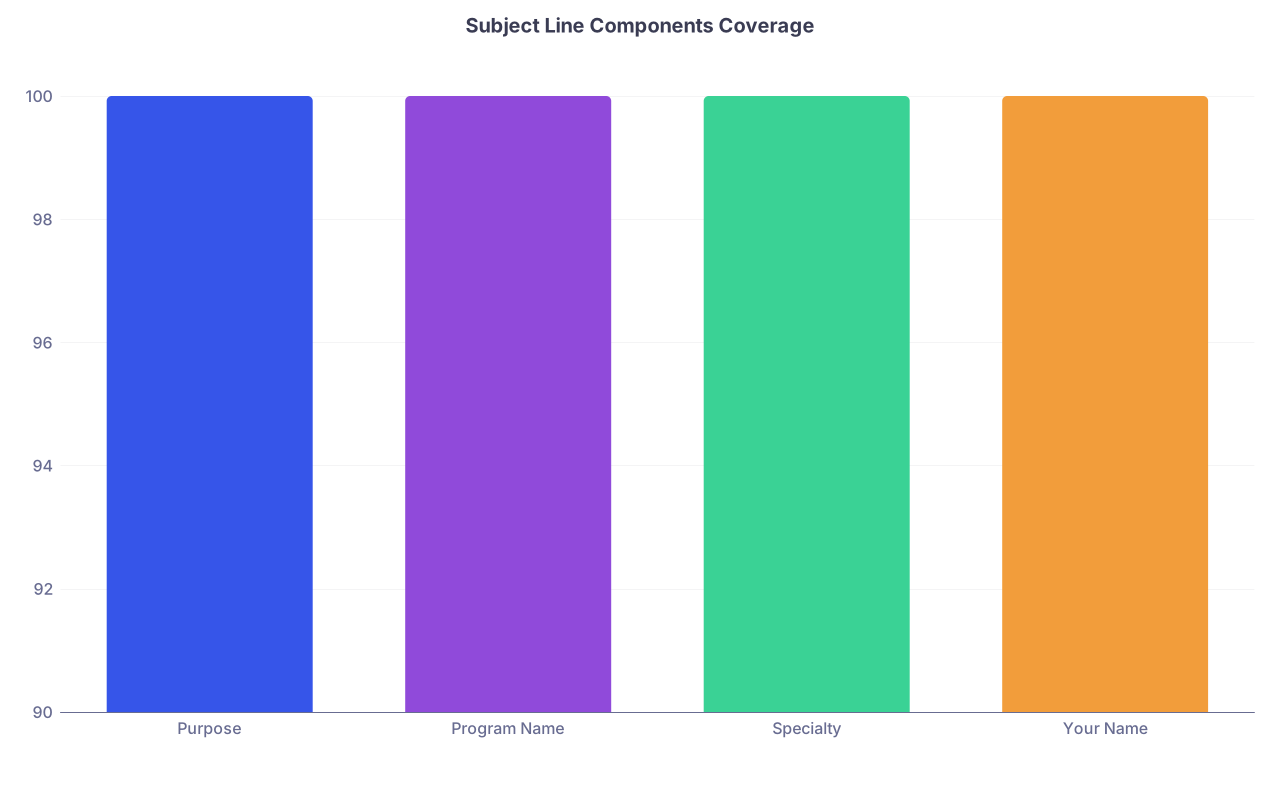
If you want to check your system, you can make a tiny table for yourself:
| Category | Value |
|---|---|
| Purpose | 100 |
| Program Name | 100 |
| Specialty | 100 |
| Your Name | 100 |
Your goal is for every single subject line to hit all four: purpose, program, specialty, identity. If any are missing, fix it before you send.
Final Thoughts: The Short Version for People Who Skim
If you remember nothing else, remember this:
- Do not be cute, desperate, or casual. Use clear, professional, boring-on-purpose subject lines.
- Always include the purpose (thank you), program/specialty, and your full name—spelled correctly and consistently.
- Double-check program names and send times. One sloppy subject line at 2 a.m. can undo a very good interview.
Treat your subject line like part of your interview performance. Because in many programs, it still is.