
Overexplaining in follow-up emails after residency interviews is one of the fastest ways to turn a neutral impression into a concerning one.
Not because program directors are cruel. Because overexplaining screams: anxious, needy, difficult to manage. And PDs are absolutely reading for that.
You’re told to “advocate for yourself,” “show interest,” “follow up.” Fine. But no one warns you about the line between professional communication and “why is this person writing me a novel about their flight delays and feelings?”
Let me walk you through the specific ways overexplaining in follow-ups quietly kills your chances—and what to do instead.
The #1 Thing PDs Are Really Screening For In Your Emails
They are not reading your follow-up to:
- Reassess your research portfolio
- Recalculate your Step scores
- Re-evaluate your class rank
They’re reading emails and thinking:
- “Will this person be high-maintenance?”
- “Are they going to blow up my inbox every time something feels unfair?”
- “Do they understand boundaries and hierarchy?”
- “How will they behave at 2 AM when they’re stressed and exhausted?”
Overexplaining is a red flag for:
- Emotional dysregulation – You process your anxiety in writing… and send it.
- Poor judgment – You don’t filter what’s appropriate for email vs internal monologue.
- Time blindness – You expect busy PDs to wade through paragraphs to find your point.
- Need for reassurance – You want confirmation or validation they simply can’t give.
Those are exactly the traits PDs are trying to avoid in residents. They already have enough chaos.
So when you send:
- A 700-word explanation for why you were late
- A multi-paragraph clarification of a minor point you made on interview day
- A long narrative about how much the program means to you with your life story repeated
…you think you’re being thorough. They see someone who might:
- Argue about every evaluation
- Send multi-page replies to feedback
- Struggle to let small things go
That’s the real risk. Not the spelling mistake in your sign-off.
What Overexplaining Actually Looks Like (And Why It’s So Damaging)
You might think, “I don’t overexplain; I’m just being clear.” Let’s be blunt. If your follow-up fits any of these patterns, you’re overexplaining.
1. The Apology Essay After a Small Misstep
Scenario: You answered one clinical question awkwardly, or you arrived 3 minutes late to the Zoom waiting room.
Bad instinct: Panic later that night and send a massive email.
Example of what raises eyebrows:
Dear Dr. Smith,
I wanted to sincerely apologize again for my late arrival to the interview session this morning. I left my apartment 45 minutes early, but there was unexpected construction, and then the bus was rerouted. I tried to call the program office, but I couldn’t get through, and I was so worried that you would think I was being disrespectful or irresponsible. This is not at all reflective of my usual punctuality. In medical school I have never been late to clinic, rounds, or exams, and I actually tend to show up very early. I hope this does not negatively impact how you view me as an applicant, because this program is truly my top choice, and I would be devastated if such a small thing hurt my chances. I really want to reiterate that I take my responsibilities very seriously and...
You think this sounds earnest. To a PD, it sounds like:
- Catastrophizing
- Poor stress tolerance
- Excessive need for reassurance
What would have been enough?
Dear Dr. Smith,
Thank you again for the opportunity to interview today. I wanted to briefly apologize for my late arrival to the Zoom room. There was an unexpected connection issue on my end, and I appreciate your team’s flexibility.
Best regards,
[Name]
Done. No story. No drama. No emotional overshare.
2. The “Clarification” Email That Turns Into a Defense
You get home and think, “I didn’t explain that patient case perfectly.” So you write:
- Three paragraphs clarifying your thought process
- References to guidelines, trials, etc.
- A worried tone: “I hope you don’t think I lack knowledge in X…”
This is a terrible idea.
Why it lands badly:
- No one is sitting there dissecting your one answer. You remind them to scrutinize it.
- You look insecure and unable to live with a less-than-perfect moment.
- You create more work: they have to re-engage with something they’d already mentally moved on from.
If you truly misrepresented something significant (e.g., misstated a publication, mischaracterized a credential), you can correct concisely. But “I wish I’d said more about my ACS management” is not that.
3. The Life-Story Love Letter to the Program
Programs like to know you’re interested. They do not need your autobiography in a follow-up.
Red-flag version:
I’ve thought about your program every day since the interview. When I was a child, my grandfather was hospitalized at a similar hospital, and ever since then I have felt called to work in a setting like yours. Talking with Dr. Jones made me realize that your program is not just a place to train; it is truly the environment where I see myself growing into the physician I want to be. I know you probably hear this a lot, but I can’t help but emphasize how much your residents’ sense of camaraderie resonated with me…
This kind of email:
- Repeats everything already in your personal statement
- Sounds emotionally intense, sometimes almost clingy
- Risks coming off as disingenuous because every PD knows you said the same thing elsewhere
The PD doesn’t flag “you’re interested.” They flag “you’re emotionally enmeshed with an institution you visited for 6 hours.”
The Specific Concerns Overexplaining Triggers in PDs
Let’s connect the behavior with the thought process on the PD side. Because I’ve heard the real comments in post-interview meetings.
Here’s how they silently categorize these emails:
| Email Behavior | PD Interpretation |
|---|---|
| Long apology for small issue | Poor stress tolerance |
| Defending interview answers in detail | Rigid, argumentative, insecure |
| Emotional outpouring about program | Boundary issues, unrealistic expectations |
| Multiple follow-ups about rank status | Needy, may struggle with hierarchy |
| Over-detailed personal explanations | Time-consuming, high-maintenance |
You probably won’t hear this feedback. They just quietly move you down the list.
And no, this isn’t “unfair.” Their job is to predict future behavior with minimal data. Your email is a data point.
The Hidden Trap: Using Email to Soothe Your Anxiety
Let me be blunt: a lot of these overexplaining emails aren’t really for the PD. They’re for you.
Patterns I see repeatedly:
- You feel unsettled after the interview.
- You replay every awkward phrase on the train ride home.
- You start writing an email “just to clarify” or “just to apologize once more.”
- The real goal? Reduce your own anxiety, not help the program.
That’s the trap.
Residency is full of unresolved feelings, imperfect performances, and moments you’ll wish you could rewrite. If your default move under stress is “I must explain myself in detail to authority figures,” you’re going to have a rough time.
PDs can detect this pattern just from your writing. And they know what it looks like on the wards:
- Long defensive replies to evaluations
- Escalating minor conflicts to leadership
- Needing repeated reassurance about performance
They don’t want that. So they err on the side of not ranking you highly if your emails hint at this tendency.
The Rare Times You Should Follow Up — And How Not to Blow It
Follow-up isn’t the enemy. Overexplaining is. You absolutely can and sometimes should email. But you must keep it tight.
Here’s where a follow-up is appropriate:
- A simple thank-you email
- A clear, short expression of strong interest (when allowed)
- A necessary correction of factual error (publication list, degree, etc.)
- Major update only when meaningful (new publication accepted, significant award)
Now the part where people mess up: they take a simple situation and turn it into a saga.
Let’s put structure on it.
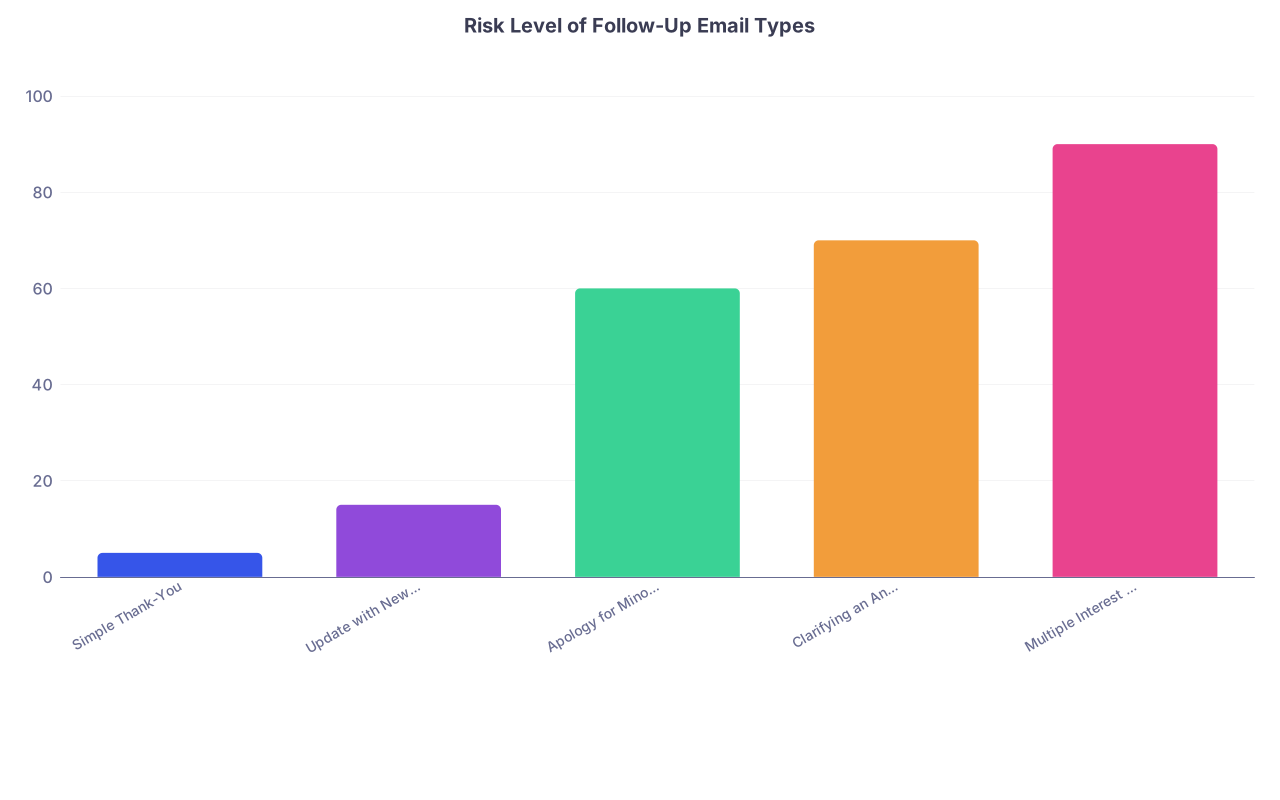
| Category | Value |
|---|---|
| Simple Thank-You | 5 |
| Update with New Pub | 15 |
| Apology for Minor Issue | 60 |
| Clarifying an Answer | 70 |
| Multiple Interest Emails | 90 |
Interpretation:
- 5–15: Low risk, if short and professional
- 60–90: High risk. Very easy to overexplain and look anxious or defensive
Safe vs Dangerous Versions
Thank-you email — SAFE
Dear Dr. Lee,
Thank you for the opportunity to interview with [Program] on [date]. I enjoyed learning more about your curriculum and talking with the residents about their experience. I appreciate your time and consideration.
Best regards,
[Name], AAMC ID [#]
Done. No recap of every conversation. No emotional flooding.
Expression of strong interest — SAFE (if allowed)
Dear Dr. Patel,
I wanted to thank you again for the opportunity to interview at [Program]. After completing my interviews, I remain very interested in [Program] given [1 specific reason: e.g., the strong critical care training and resident autonomy].
Thank you again for your consideration.
[Name]
Not:
- “Your program is my soulmate.”
- “I cannot imagine myself anywhere else.”
- Paragraphs about how you’ve dreamt of this city since childhood.
Concrete Signs Your Draft Email Is Overexplaining
You’re tired. You’re stressed. Your judgment is off. So here’s a practical checklist.
Before hitting send, ask yourself:
Word Count Check
- Thank-you / interest email: usually 75–150 words
- Factual correction/update: 100–200 words max
If you’re at 400+ words, you’re almost certainly overexplaining.
Motivation Check
- Am I writing this to genuinely convey necessary information?
- Or am I trying to make myself feel better about something I can’t control?
If the second, stop. Don’t send.
Emotional Content Check
Look for phrases like:- “I hope this does not make you think…”
- “I would be devastated if…”
- “I just want to make sure you understand…”
- “I can’t stop thinking about…”
These belong in your journal, not your follow-up email.
Narrative Detail Check
Are you including details like:- Full travel story
- Family background
- Step-by-step reconstruction of your thought process on an interview question
Program directors do not have time for this, and it makes you look self-focused, not efficient.
Defensiveness Check
Any version of:- “What I meant to say was…”
- “In case my response wasn’t clear…”
- “I don’t want you to think that I…”
Reads as defensive and insecure. Cut it.
How to Fix an Overexplaining Draft (Without Starting Over)
Let’s say you’ve already written a 600-word monster email. Don’t just send it because you’re tired. Salvage it.
Here’s how, step-by-step.

| Step | Description |
|---|---|
| Step 1 | Write Draft |
| Step 2 | Walk Away 10 Minutes |
| Step 3 | Delete Emotional Sentences |
| Step 4 | Cut Story Details |
| Step 5 | Keep Only Objective Facts & 1-2 Key Lines |
| Step 6 | Word Count < 200? |
| Step 7 | Send or Dont Send |
Practical moves:
- Strike entire paragraphs, not just sentences. Big chunks need to go.
- Convert long explanations into one neutral line.
- “Due to an unexpected connection issue, I joined a few minutes late. Thank you again for your flexibility.”
- Remove all justifications. You’re not presenting a case in court.
If after trimming you’re left with:
- One simple apology + one thank-you
- Or one clear correction + confirmation of interest
…you’re fine. If you’re still trying to “make them see you differently,” you haven’t cut enough.
When Silence Is Safer Than “Clarification”
A harsh truth: sometimes the best follow-up is none.
Scenarios where not emailing is actually the higher-yield move:
- You’re obsessing over a single awkward answer that probably no one remembers.
- You were 2–3 minutes late but the interview proceeded normally and no one commented.
- You feel the urge to “re-explain” a personal story because it was emotional.
- You already sent a thank-you and now want to “just say one more thing.”
Here’s why silence is safer:
- PDs don’t have the bandwidth to catalog every tiny imperfection from every applicant. You remind them of something they hadn’t mentally flagged.
- You protect yourself from revealing something worse: your anxiety pattern.
- You demonstrate emotional maturity by tolerating uncertainty.
If you’re not sure whether to send something, assume you’re biased by your own anxiety. Show the draft to:
- A grounded classmate who is not in the same specialty
- A trusted attending or advisor
- Someone who is chronically underwhelmed, not your most anxious friend
Ask them: “Does this sound anxious or defensive?” If they hesitate at all, it probably does.
One Last Thing You’re Underestimating: Time
You are not the only one emailing. Look at the volume PDs deal with:
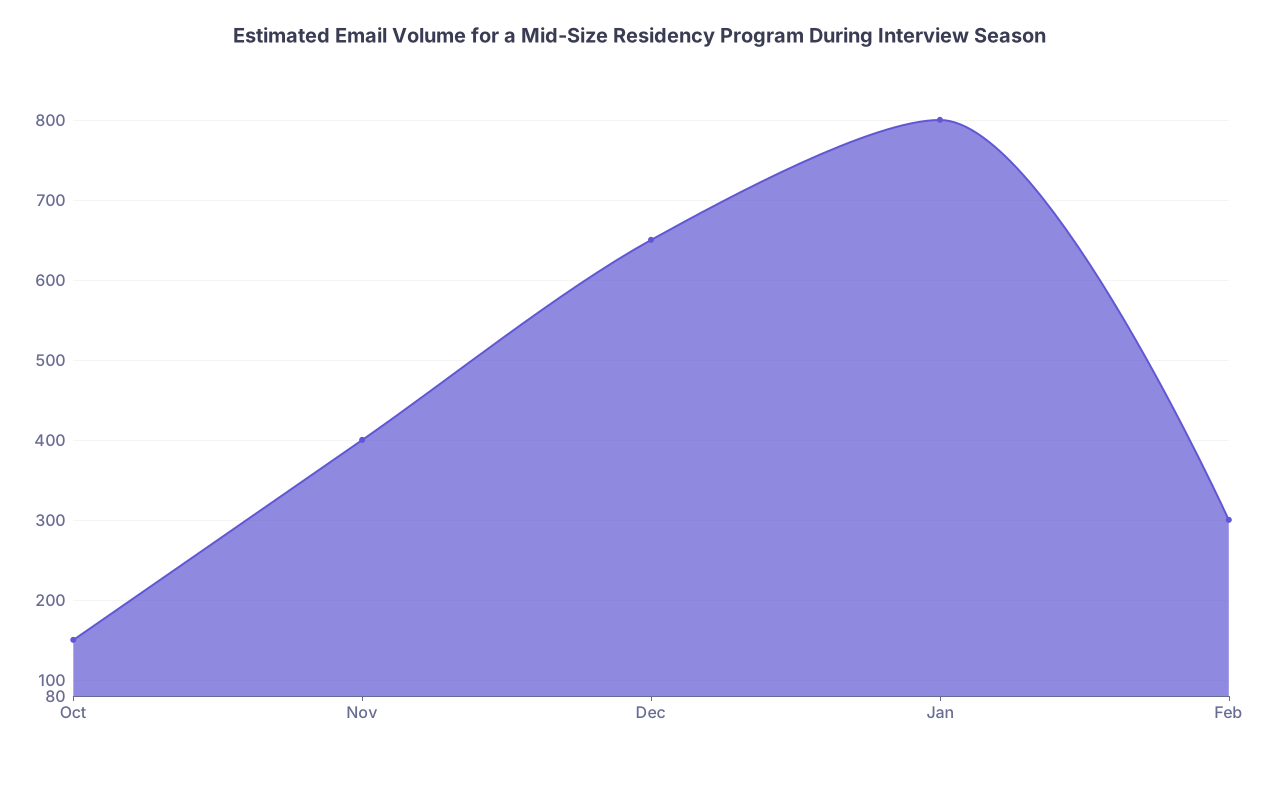
| Category | Value |
|---|---|
| Oct | 150 |
| Nov | 400 |
| Dec | 650 |
| Jan | 800 |
| Feb | 300 |
That’s:
- Thank-yous
- Clarifications
- “Interested” emails
- Logistics questions
- Faculty emails
- Administrative messages
When your message shows you don’t respect their time—by overexplaining, narrating, or dumping your anxiety into their inbox—they don’t think, “how sweet.” They think, “how will this person be at 3 AM on night float when things go wrong?”
They’re not just choosing competent people. They’re choosing people who won’t drain the limited emotional and administrative bandwidth of the team.
The Bottom Line: What To Actually Do Today
You don’t need 20 rules. You need a filter.
Here it is:
- If the email is to say thank you → keep it under 150 words, no drama.
- If the email is to share a factual update → keep it under 200 words, objective tone.
- If the email is to fix your feelings about the interview → don’t send it.
Today’s action step:
Open your last follow-up email draft or sent message. Read it once and highlight any sentence that: explains, justifies, apologizes at length, or shares your emotions. If more than half the email is highlighted, you’re overexplaining. For your next program, cut that highlighted content before you ever hit send.